The number in new Trump polling that’s most worth watching

Even by the standards of Donald Trump’s poorly reviewed second term in office, the poll numbers that have come out over the past week are miserable.

An NBC poll found that two-thirds of Americans think Trump’s doing a bad job handling inflation and the economy and that he’s failing at protecting the middle class. An ABC News-Washington Post poll determined that most Americans think that Trump isn’t committed to free and fair elections, or to a fair criminal justice system, or to free speech or to the freedom of the press. New CNN polling has Trump’s approval rating at a second-term low and disapproval of his presidency at an all-time high. Polling from YouGov conducted for the Economist similarly determined that Trump’s approval is as low now as it has ever been.

Not only that, but YouGov finds him viewed more negatively than positively on a range of issues: crime, immigration, foreign policy, abortion, jobs and the economy and inflation.
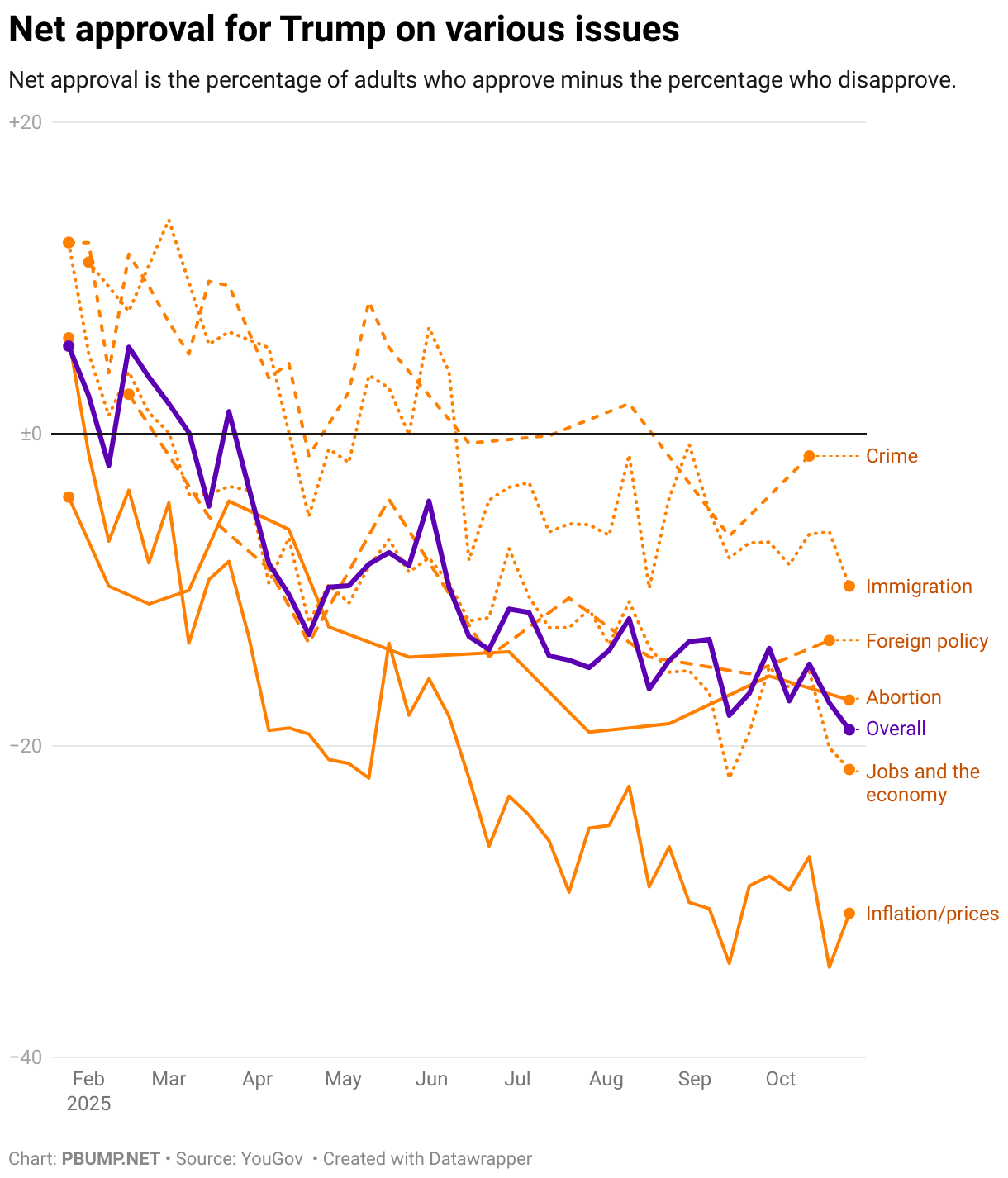
The reviews are just … bad. And yet, even within those bad numbers, there remains that glimmering core of support from Trump’s own party.

In the new ABC-Post poll, for example, nearly 9 in 10 Republicans still view Trump’s presidency with approval. That’s compared to only 40 percent of all Americans — a percentage that’s inflated by all of those still-loyal Republicans.

This is the most important number for Trump. His presidency is dependent on two overlapping factors: that his base will remain loyal to him, regardless of what he does, and that this loyalty will make it impossible for other Republicans to start going sideways. If Republicans stay in lockstep with the president, so will Republican legislators facing primaries in the near-to-medium term. If the base stays loyal, Trump couldn’t care less about being caught in hypocrisies or lies. He’s shed support since the beginning of the year — but mostly not among Republicans, so what does he care?

That said, there is an aspect of Trump’s polling that might legitimately start to cause him and his advisors some concern.

I don’t believe that Trump’s support will ever get too low, almost certainly not under, say, a third of the population. There’s simply too much partisanship baked into our political culture (and our culture culture) for many of the people who’ve been invested in him personally for the past decade to suddenly declare that they were wrong all along.

But that doesn’t mean that there aren’t important fluctuations in his support. For example, consider the difference in approval of Trump’s performance as president from February to October, looking at polls released by The Washington Post.
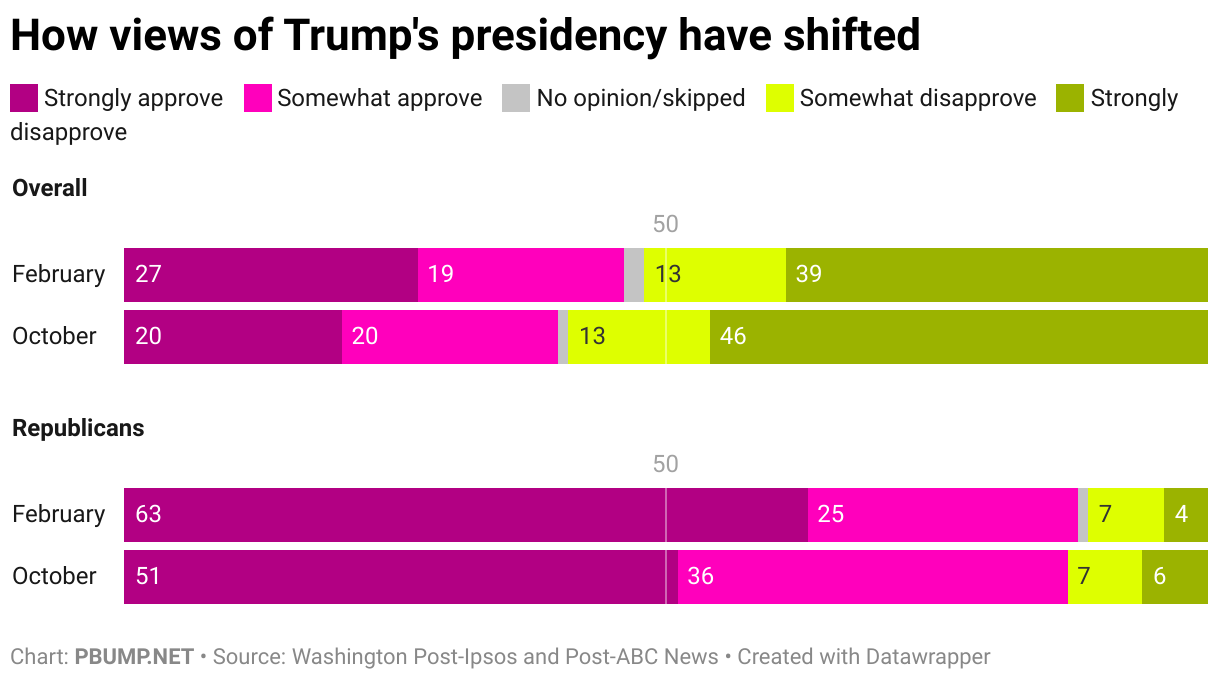
In both months, Trump’s overall approval from Republicans was near 90 percent: 88 percent in February and 86 percent last month. But in February, more than 7 in 10 Republicans who approved of Trump’s presidency did so strongly. Last month, it was less than 6 in 10.

This is how political support works. People don’t simply go from loving a politician to hating him. There’s a waypoint: indifference. Enthusiasm becomes shrugging becomes dislike becomes disgust. And since February, a chunk of Republicans have gone from cheers to shrugs.

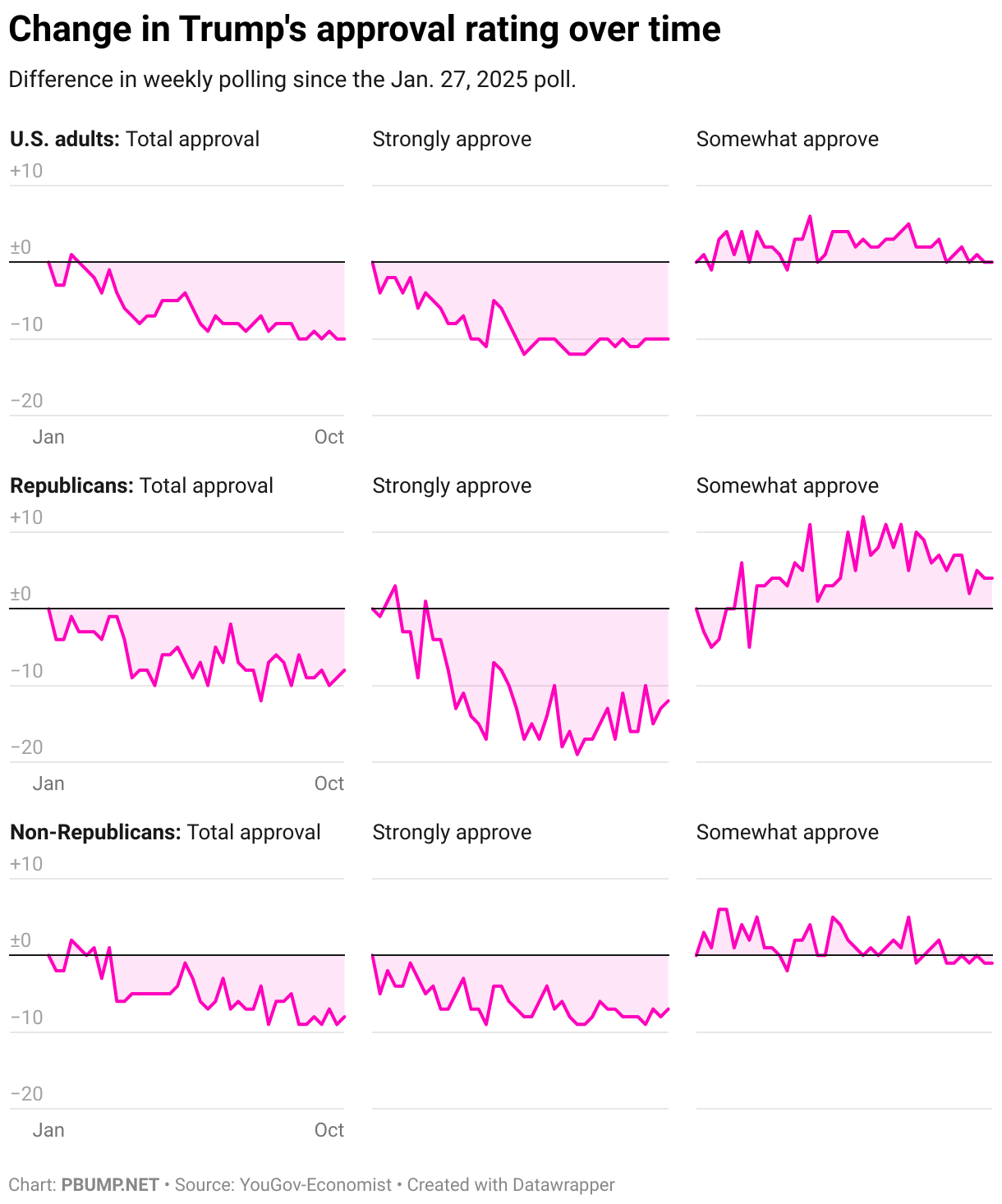
It’s risky to extrapolate too much from a two-point trend, so let’s look at YouGov’s weekly polling over the course of the year. Among all adults, Trump’s approval has slipped, in part because he shed “strongly approve” support from non-Republicans.

But notice what happened to his approval among Republicans. The percent of Republicans who strongly approved of Trump dropped … and the percent who somewhat approve increased. Cheers to shrugs.
To see why this is potentially a problem, let’s cherry-pick a bit. Taking monthly averages of Trump’s approval from Republicans, consider his numbers for February, July and October. They’re highlighted below.
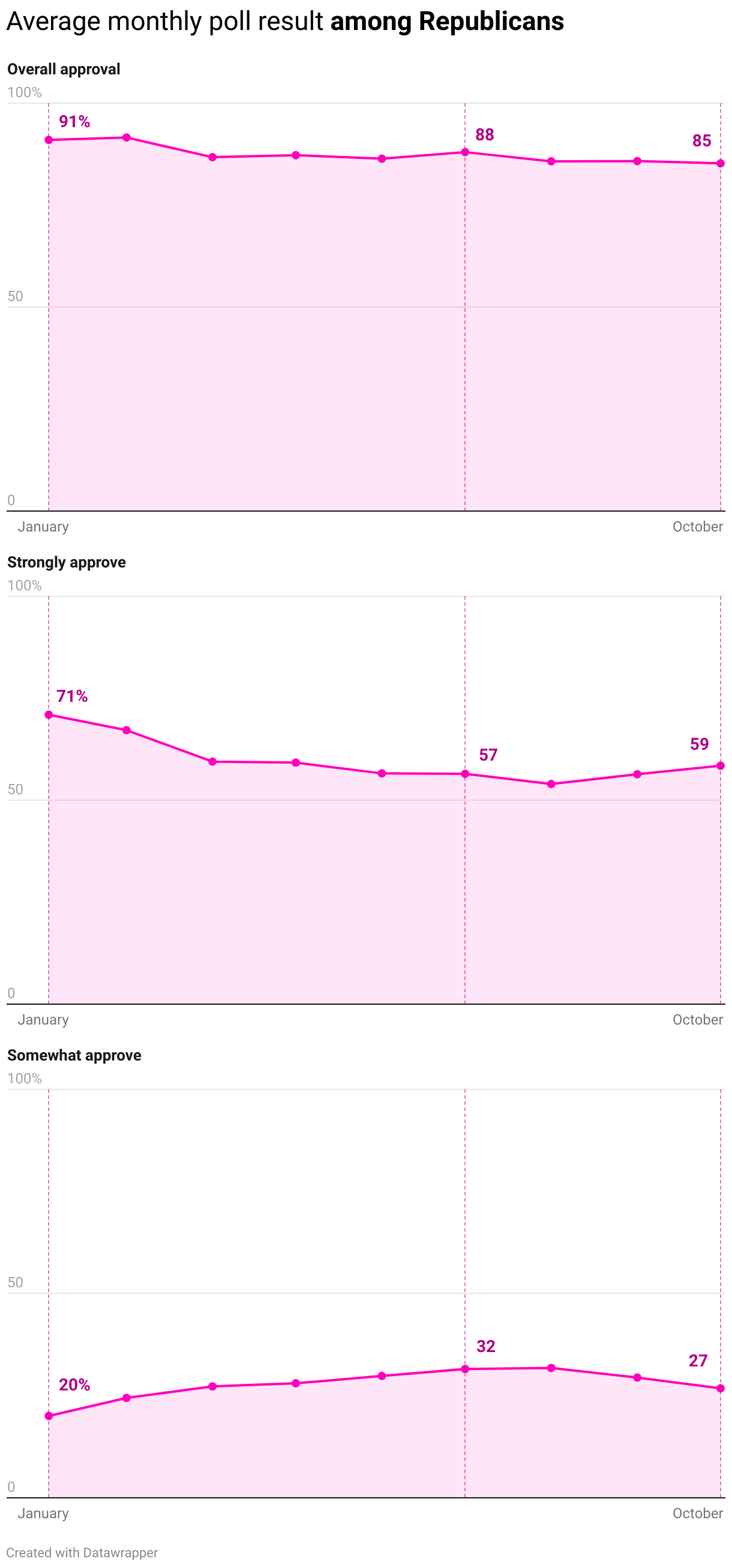
From February to July, his overall approval only dropped 3 points. But the percentage of Republicans who strongly approved of him dropped 14 points as the percent who somewhat approved rose 12 points. By October, he was down another 3 percentage points overall, gaining 2 percentage points among those who strongly approve and losing 5 points among those who somewhat approve.

Does this reflect a small portion of Republicans moving from strong support to soft support to no support? Could be. Are these shifts so small as to be of questionable use? Yes.

As I said, though, these are the numbers I’m tracking. If Trump’s Republican support softens, it may not mean that his party starts to view him negatively. It may just mean they’re not as enthusiastic about what he’s doing — potentially opening up the door for other Republicans to exploit that lack of enthusiasm.

At some point in the near future, Trump’s status as a lame duck will also kick in. There will be less reason for Republicans to insist on his greatness as the 2028 presidential campaign heats up. Republican candidates looking to make their mark will navigate to where the base is, even if that’s not where Trump lands.

For a president who embraces an authoritarian approach to power, fervent opposition is a plus. Those are people to demonize and against whom to use an iron fist. What he really ought to fear is what’s buried in these numbers: his supporters become indifferent.

Photo: A picture of someone taking a picture of Trump. (White House/Flickr)

No, 1 in 11 New Yorkers will not move if Mamdani wins

The headline in the New York Post was characteristically cautious: “Nearly a million New Yorkers ready to flee NYC if Mamdani becomes mayor — possibly igniting mass exodus: poll.” Why the departure of almost a million of the city’s 8.4 million residents isn’t itself a mass exodus isn’t really explained in the article that follows, but, look. If the game is constantly ratcheting up the fear factor, you have to have somewhere to take the panic, right?

As someone within the fallout radius of the New York City mayoral race, it’s striking how much of the late-campaign rhetoric is centered on terrifying voters. My sons, aged 6 and 8, had never seen footage of the World Trade Center attack until this weekend when, during the World Series, an Andrew Cuomo ad used the footage to suggest that a Zohran Mamdani victory would somehow lead to a second such attack. You know, because “Muslim.” (That the actual mayor during that attack was an older Italian guy seems not to have occurred to Cuomo’s rabid ad team.)

The Post’s “nearly a million” story is based on a Daily Mail article that is itself derived from a poll completed for the tabloid by the firm J.L. Partners. Incidentally, the “nearly a million” is actually “at least 765,000 citizens,” according to the Daily Mail, a figure that is equivalent to 9 percent of the city’s population.

That 9 percent is the point, actually. According to the poll, that’s the percentage of all city residents who told the pollsters they would “definitely leave” if Mamdani is elected (as other polls suggest he will be). In other words, about 90 people told J.L. Partners they would absolutely, no-question move if Mamdani wins and that became “nearly a million” in New-York-Postese.

J.L. Partners isn’t a terrible pollster, earning a B/C grade in analysis from The Silver Bulletin earlier this year. It was, however, one of three pollsters that overestimated Republican support in the 2024 election cycle, which is perhaps not a surprise.

The problem here, really, is that you can’t extrapolate in the way that the Post and Daily Mail are extrapolating. Not because a poll of 1,000 people is too small to provide insights; it isn’t. But because it’s much, much easier to say “I will definitely move” than it is to actually move.

Consider, for example, that one-fifth of respondents from Staten Island said they would definitely leave the city. No, they won’t! They already barely live in New York City as it is. One percent of Mamdani voters are definitely going to move if he wins? I have to say that that seems a bit incongruous.

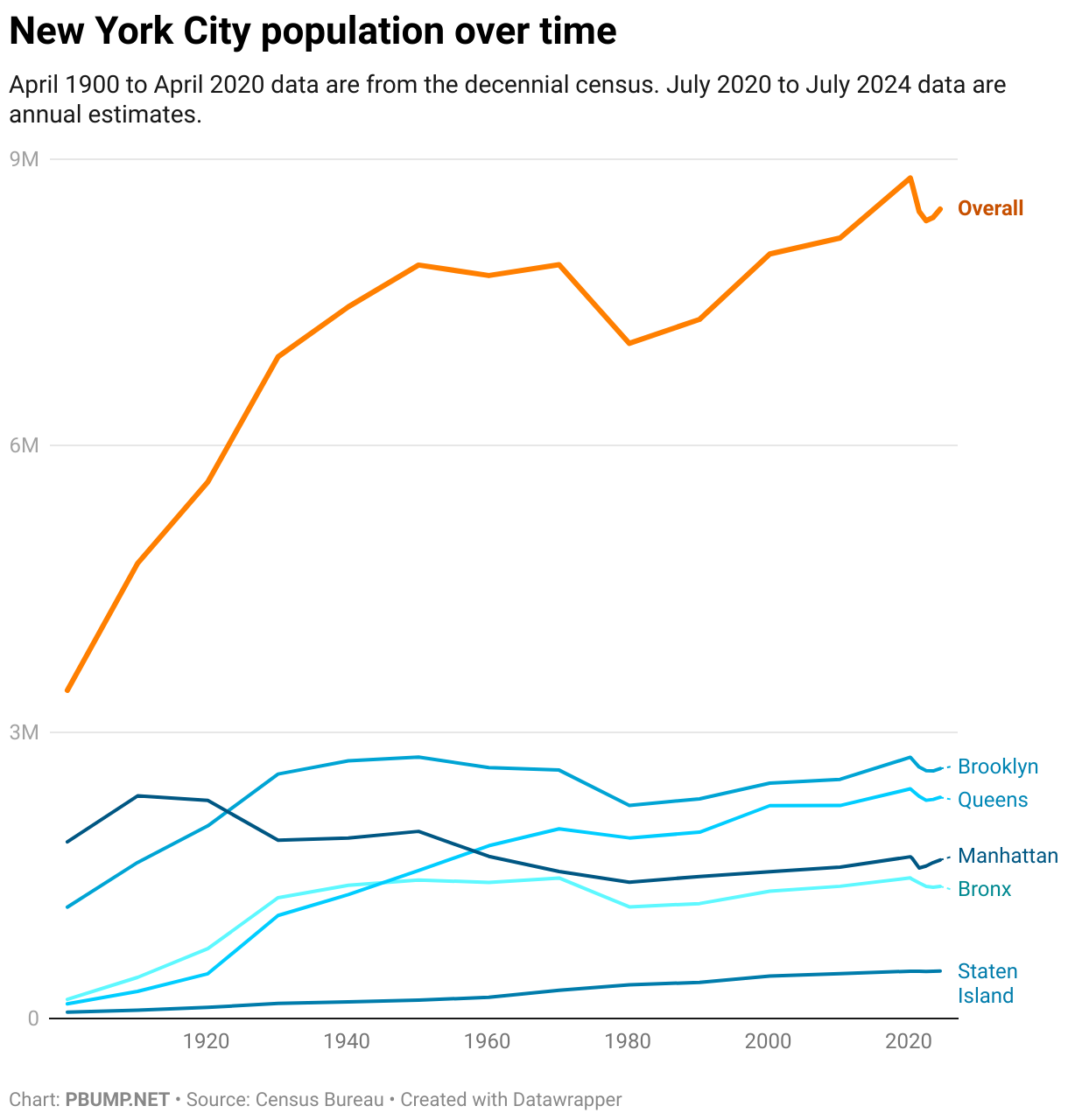
There have certainly been moments in the city’s past when people have actually packed up and left. There was a period of stagnation in the mid-1900s that became an exodus during the tumultuous 1970s. More recently, a big chunk of New Yorkers moved out during the coronavirus pandemic, as people were literally dying in the streets.

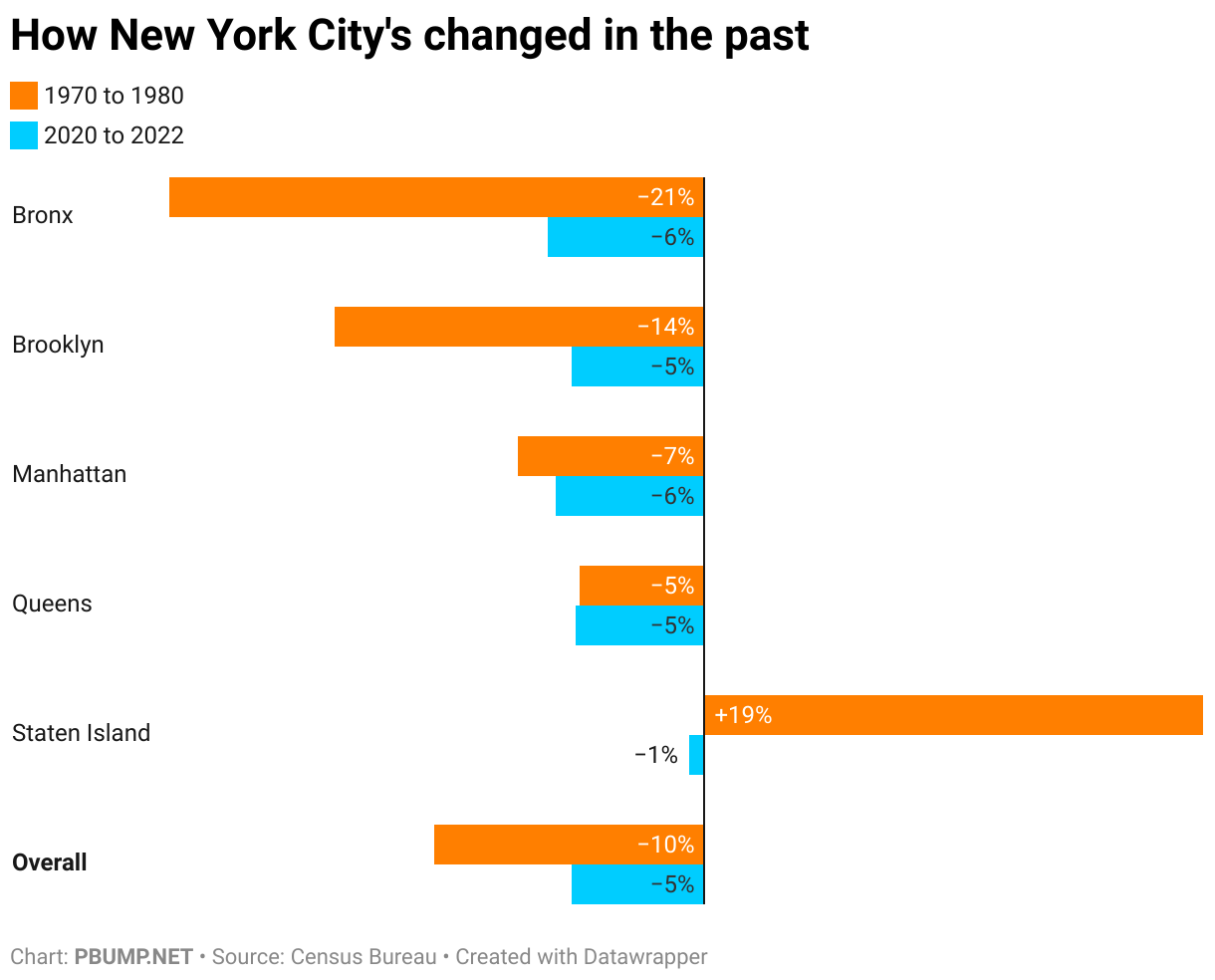
The covid-inspired departures made up only about 5 percent of the city’s population. The departures during the 1970s made up about 10 percent. (Notice that Staten Island didn’t lose a significant number of residents during the pandemic — and gained residents during the 1970s.) The Post/Daily Mail would have us believe that what’s looming is an exodus akin to the Bronx-is-burning era — simply if Mamdani wins.

Perhaps, if he wins, the city will see the sort of collapse that drove people away in the 1970s. Perhaps some chunk of those saying they’ll leave are certain that it will. But it seems far, far more likely that those people are claiming that they will move are simply making a political statement about their opposition to Mamdani and to Mamdani-esque politics than they are actually planning to leave.

If they did leave, it seems extremely safe to assume that the sudden glut of available rental units (and the accompanying price drop) would lead to a rapid repopulation. There are a lot of reasons that New Yorkers live in New York and there are a lot of reasons that non-New Yorkers want to live there. One reason many don’t is that there simply isn’t enough affordable housing for them to do so. If 8 percent of Brooklyn and 6 percent of Manhattan suddenly leaves (as this polls asserts), I’m very confident that there would be a lot of rental applications in short order.

On social media, the New York Post shared an image they apparently made, showing Wall Street executives wearing cowboy hats over a quote from another executive declaring that “you don’t sacrifice anything by being in Dallas versus being in New York.”

If that were true, a lot of those executives would already live in Dallas, a city with one-sixth the population of New York. But they don’t. They live in New York. And I’m pretty sure that the transition most of them are about to make is from sitting at expensive Tribeca restaurants and loudly complaining about the dire policy possibilities that would accompany a Mamdani victory to sitting in those same restaurants a year from now, loudly complaining about the policies themselves.

Photo: A street scene in New York City. (Eden, Janine and Jim on Flickr, shared under Creative Commons license)

In less than five years, Trump has played as much golf as Obama did in eight

Treasury Secretary Scott Bessent appeared on CNN Sunday morning, giving host Jake Tapper a chance to note the incongruity between cuts to food assistance programs during the on-going shutdown and President Trump’s Roaring-20s-themed Halloween party at his exclusive Florida club.

After Tapper played a clip of former president Barack Obama criticizing Donald Trump, Bessent (himself worth hundreds of millions of dollars) shrugged off his billionaire boss’s extravagance with a bit of whataboutism.

“I believe President Obama played a record amount of golf of any president,” Bessent said, “so I’m not sure why he’s out there throwing stones.”

There are lots of ways in which we could parse that response, including that it does little to nothing to address the actual tension that Tapper was noting. But, as someone who’s been tracking Trump’s golf habit since his first term, I’ll point out another issue with Bessent’s response: It’s embarrassingly off-the-mark.

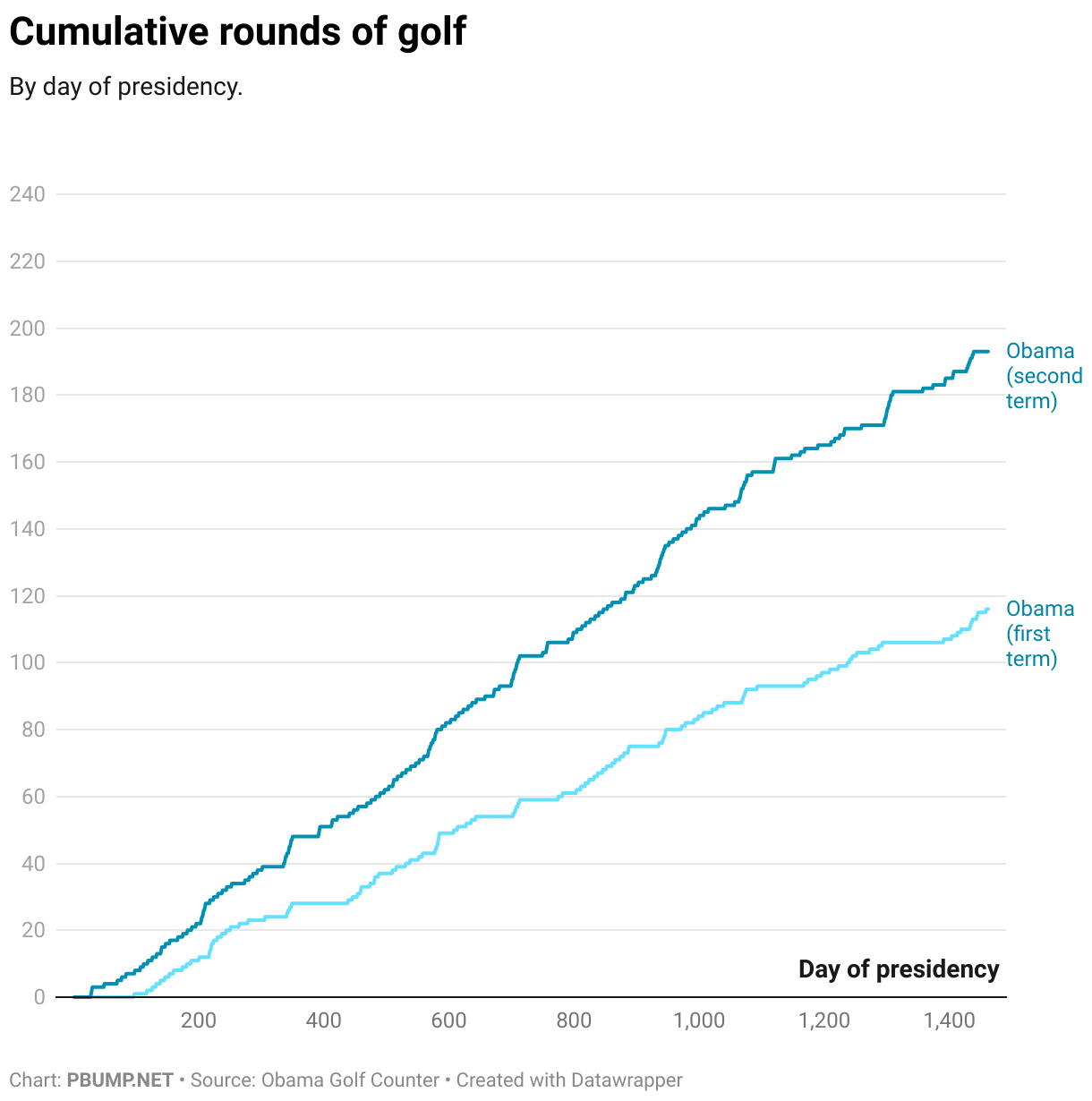
Barack Obama did frequently play golf as president, so much so that it became a point of criticism among Republicans (including Trump) and resulted in the creation of a website focused on tracking his outings. From that site we can see how Obama’s golf outings evolved, slowly in his first term and more energetically after his reelection.

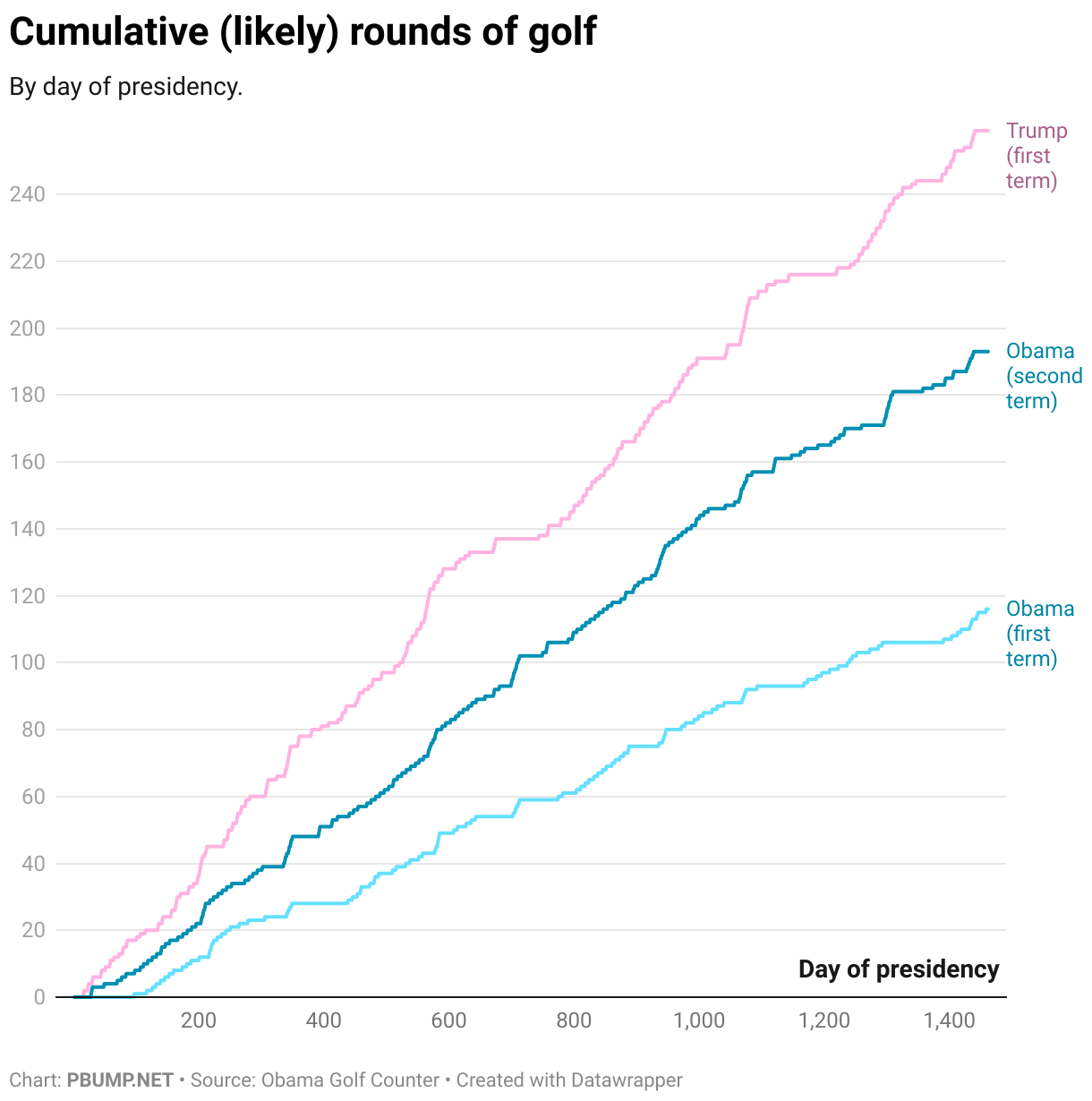
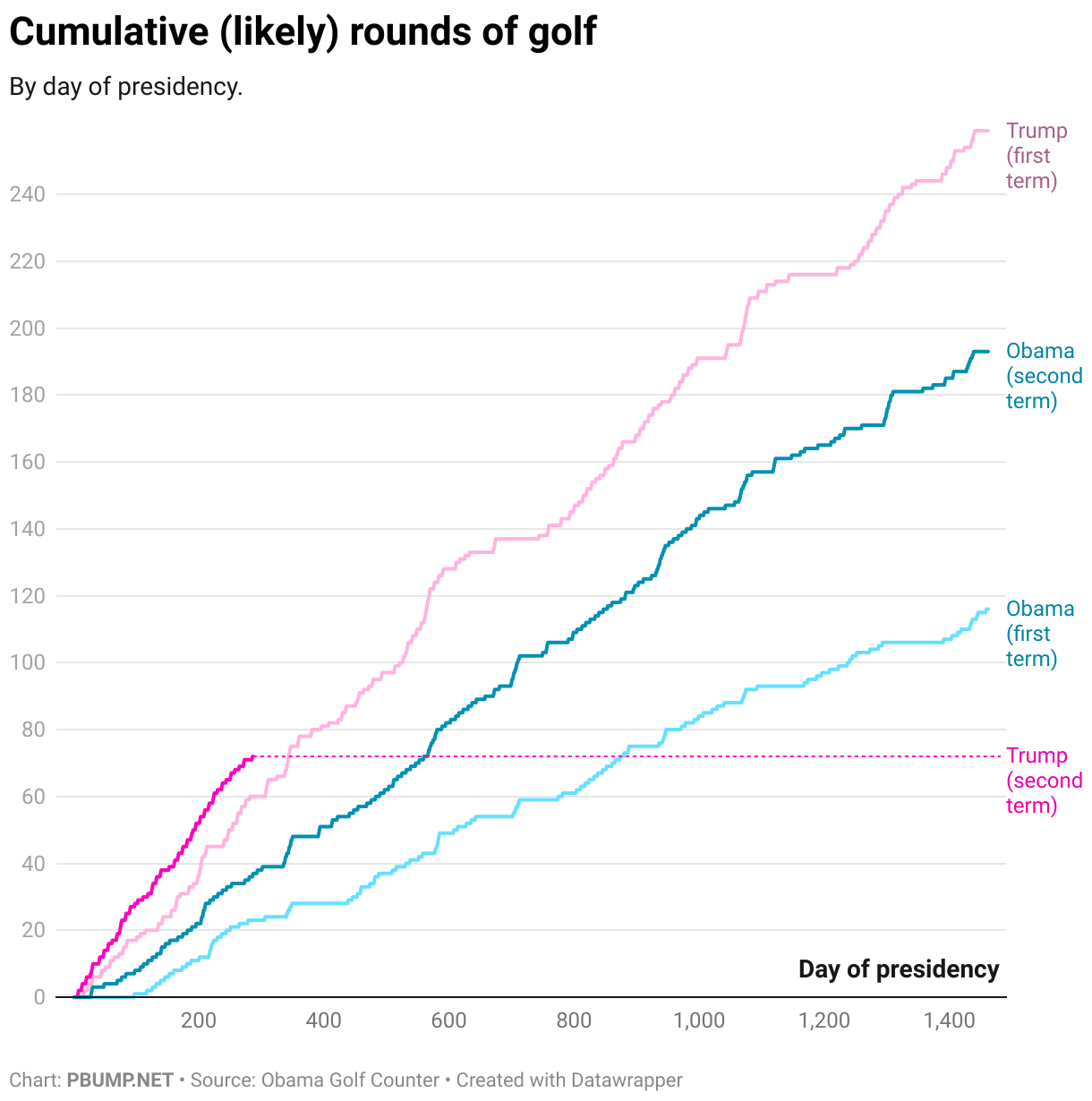
When we overlay Trump’s first-term golf outings, though, you can see that he rapidly outpaced his predecessor.

Then Trump was himself reelected (after a four-year hiatus). Since retaking office in January, he’s played golf at an even more rapid pace than he did eight years ago.

You’ll notice the qualifier “likely” on those charts. That’s because Trump, unlike Obama, doesn’t actually report his outings. Sometimes we learn about rounds played from social media reports or photos taken at the private clubs where he invariably plays. But it is possible that some of the times that he goes to Trump Organization-owned clubs and goes off the radar for a few hours, he’s doing something other than hitting the links. History has shown, though, that the safest assumption is that he’s actually playing golf.

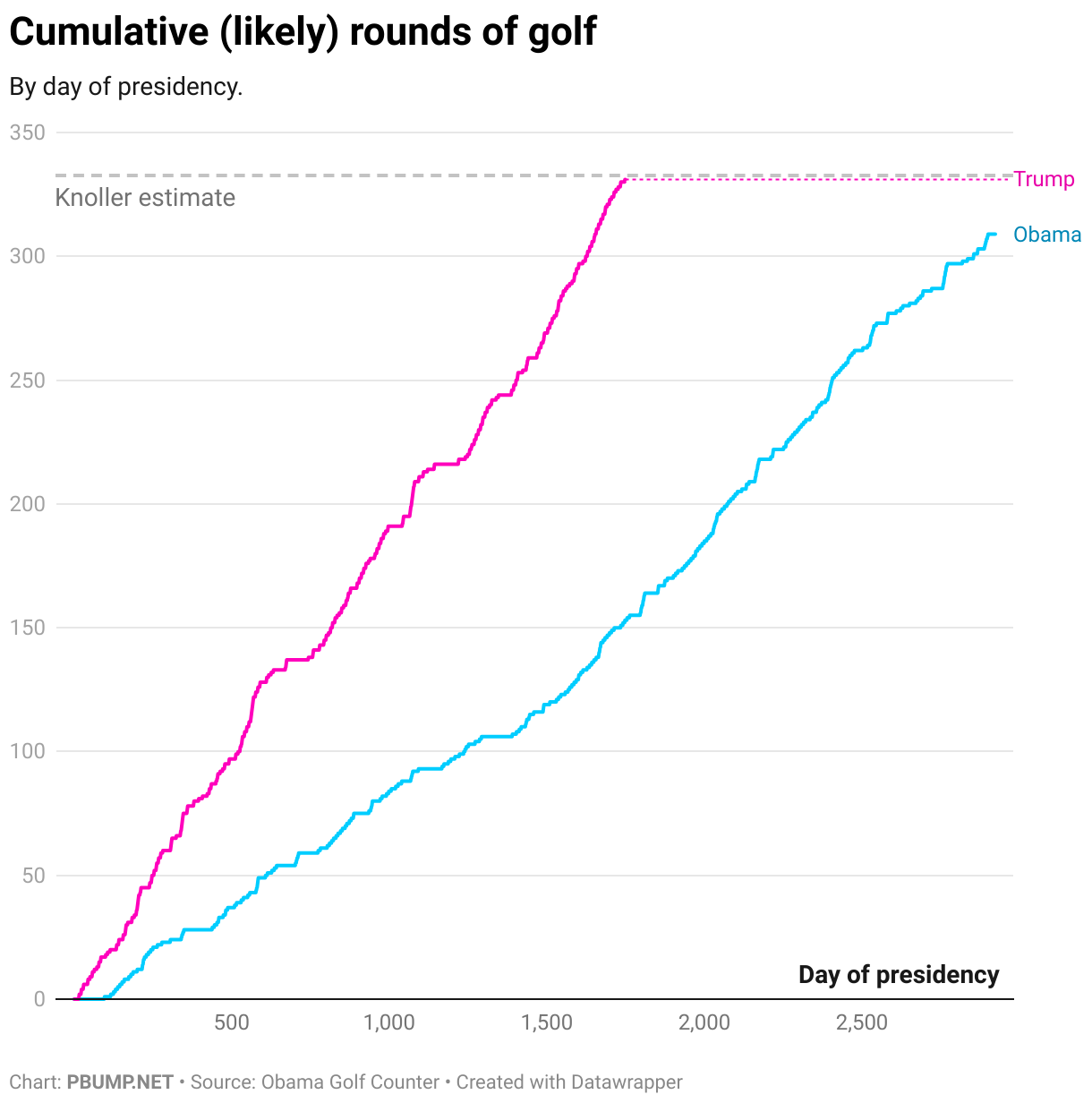
The Obama Golf Counter estimated that Obama played just over 300 rounds of golf as president. That’s probably low; CBS News reporter (and keeper of presidential data) Mark Knoller had the count at 333 over Obama’s two terms. That is in fact more than the 259 outings Trump made in his first term — although spread over eight years. Even if we tack another 30 rounds onto the second-term total above, Trump still outpaced Obama by more than 30 rounds.

There’s another important distinction we need to mention. Obama’s golfing almost always took place at publicly owned courses, with partners who were reported to the press. Trump’s golfing, on the other hand, occurs almost exclusively at courses owned by his private company, meaning that his trips to those clubs are an opportunity for Trump Organization customers to hobnob with or lobby him. (The White House rarely reveals the identities of those who join Trump on the course.) Trump supporters often talk about this difference as though it’s somehow better that Trump played at Trump Organization courses, perhaps assuming that makes it less expensive. It doesn’t.

We’re overlooking an important point, though. Again, Trump has returned to the White House and returned to playing golf. So far this term, by my running tally, he’s already at 72 rounds — about one on every four days of his second term. What that means, then, is that Trump has played an estimated 331 rounds of golf over his two terms, just two shy of Knoller’s total for Obama.

And I’m writing this on Sunday morning, with Trump currently at Mar-a-Lago in southern Florida. That usually means that he’ll head to his nearby golf club for a round before heading back to Washington. If he does, he’ll be only one shy of Knoller’s total for Obama.

Bessent could still be proven correct, I suppose, if Trump plays zero more rounds of golf during the three-plus years remaining in his second term. I am going to go out on a limb and say that this is unlikely to occur.

Photo: Trump, ready for golf at his private club in Scotland. (White House/Flickr)

The racist subtext to the SNAP discussion (that isn’t always subtext)

Clay Higgins, U.S. representative from the state of Louisiana, thinks it’s the poor’s own fault that they might go hungry if and when SNAP benefits aren’t distributed in November.

“Any American who has been receiving $4200 dollars per year of free groceries and does NOT have at least 1 month of groceries stocked,” he wrote on social media, “should never again receive SNAP, because wow, stop smoking crack.”

Let’s set aside the ludicrousness of the idea that $11 a day in groceries is enough to feed a family in the U.S. (or even most adults). Let’s also set aside that those families should also have had the foresight to reserve a portion of that money in order to warehouse groceries in the event that there was for some reason interruption to the support (the reason at the moment being “politics”).

Let’s focus on Higgins’ addendum there: “stop smoking crack.” It’s not clear if he meant that literally, that recipients of SNAP (also often referred to as food stamps) are making bad decisions because they are on drugs. But given how energetically Higgins’s party has tried to tie the receipt of federal benefits to laziness, it’s probably not a mistake.

Of course, there’s also a racial subtext to that addendum. Discussion of government support has for decades carried a racist subtext, at least since Ronald Reagan dishonestly singled out a Black Chicago woman as the face of federal subsidies. Smoking crack has been similarly coded for a long time.

But we don’t need to raise an eyebrow and wonder whether the response to the SNAP shutdown is rooted in part in racism. We can simply quote Rob Schmitt, one of the interchangeable faces on one of the interchangeable right-wing video broadcasting sites.

“People are selling their benefits,” Schmitt claimed. “People are using them to get their nails done, to get their weaves and their hair. I mean, this is a really ugly program.”

Yeah, OK. That’s racist.

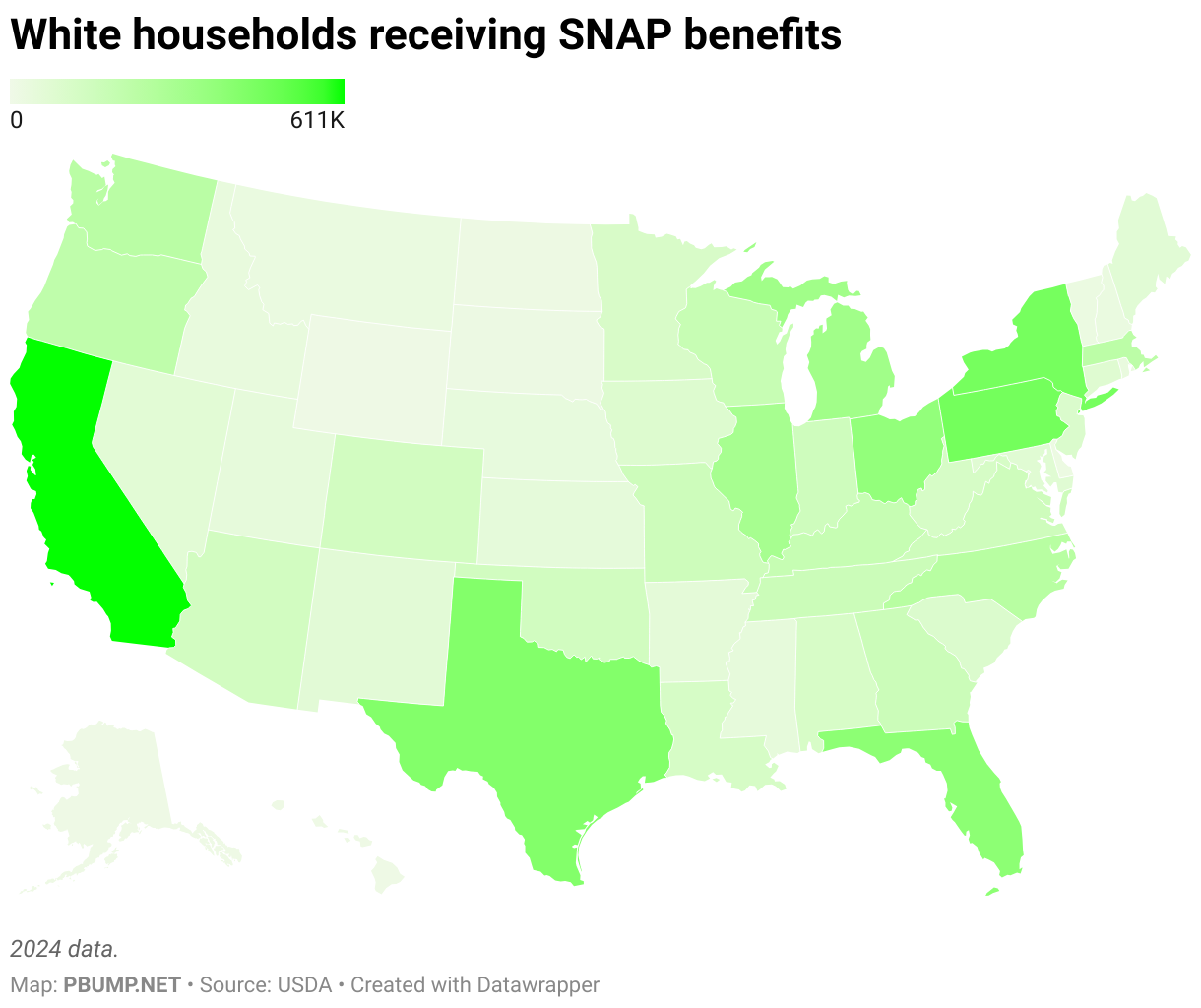
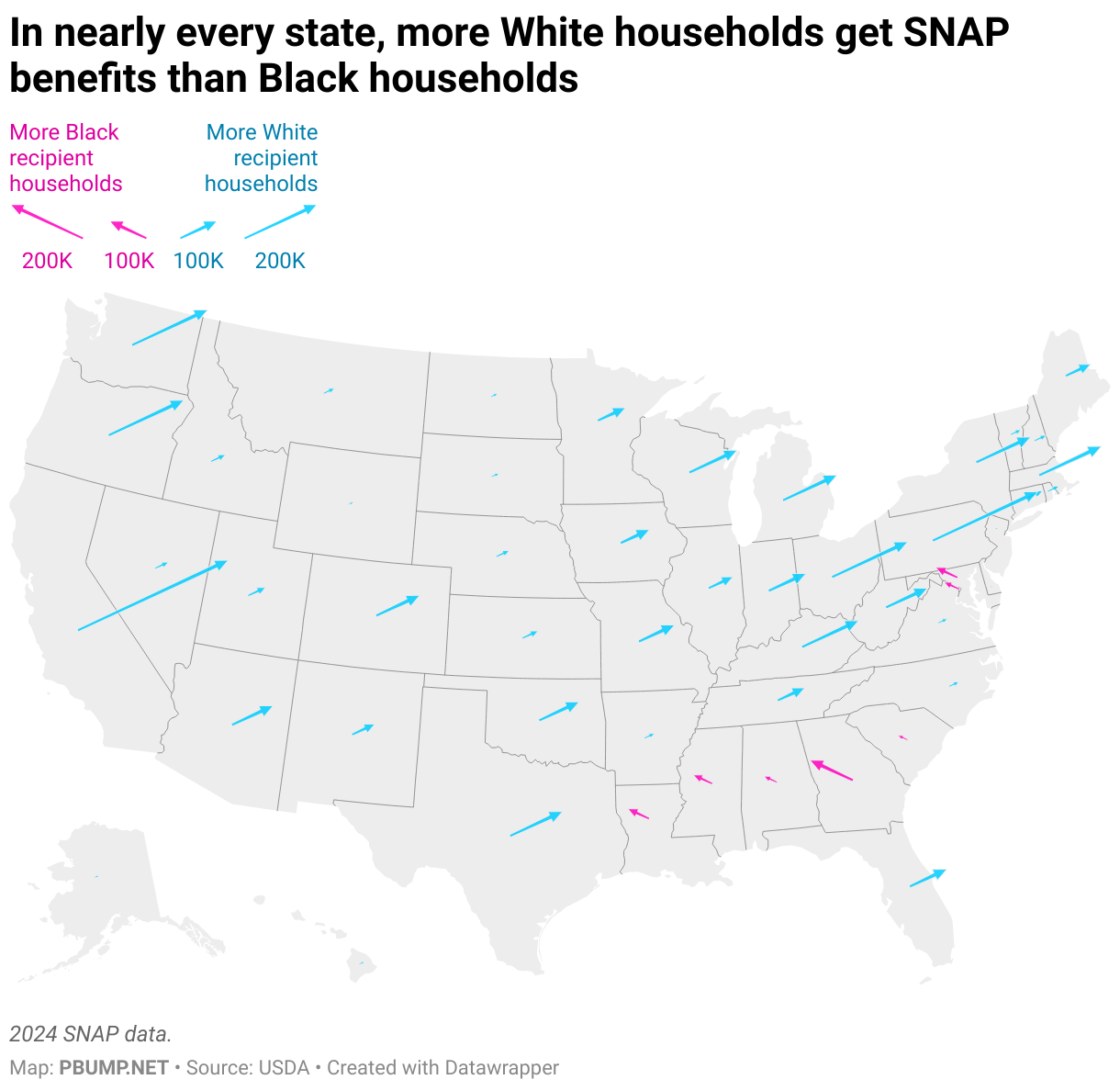
As it turns out, there are a lot more White households receiving SNAP benefits than Black (or Hispanic or Asian) households. Nationally, there are 1.8 White households getting SNAP benefits for every Black one.

In fact, more White households than Black households receive SNAP benefits in 44 states. In six states and D.C., more Black households receive the benefits, in large part because those places have larger Black populations.

It is true that a larger proportion of Black households than White households receive SNAP benefits. But, as I noted earlier this week, that’s in large part because SNAP benefits are (as you’d expect) closely correlated to household income and poverty levels. Since Black households tend to have lower incomes — itself a function of endemic and institutionalized racism! — those households are also more likely to receive SNAP benefits. Benefits, I’ll note, that are almost exclusively used for their intended purpose: food.

Why does Schmitt want to suggest that the aid is going to wasteful Black people? The same reason Higgins wants to suggest it’s going to drug addicts or (at the very least) people inept at taking care of themselves: because it makes it so that their heavily White audiences are inoculated against news reports describing SNAP recipients potentially going hungry.

This is the role such rhetoric has played since the Reagan era. But the people who will be negatively affected by SNAP cuts are a lot more likely to be White than Black.

Photo: Meat for sale in 1936. (National Archives)

These are all the same thing.

1.

When ProPublica emailed questions for a profile of the chief justice of the North Carolina Supreme Court, they received a response from the communications director of the state Republican Party. He suggested that the outlet was engaged in a “jihad” against the party and issued an unsubtle threat.

“I’m sure you’re aware of our connections with the Trump Administration and I’m sure they would be interested in this matter. I would strongly suggest dropping this story.”

ProPublica also noted that many of those who they’d contacted about the story requested anonymity out of fear that the chief justice “or his proxies would retaliate against them through the courts’ oversight system, the state bar association or the influence he wields more broadly.”

2.

During an appearance on Piers Morgan’s television show on Wednesday, Katie Miller, wife of Trump aide Stephen Miller, lost her temper during a debate with left-wing pundit Cenk Uygur. At one point, she suggested that Uygur, a naturalized citizen, might have his citizenship scrutinized.

“You better check your citizenship application and hope everything was [muddled, possibly “legal”] and correct. Because you’ll be just like Ilhan Omar coming next.”

Stephen Miller has been one of the most prominent voices for wide-scale deportations within the administration as well as one of the most fervent advocates for deploying executive power, particularly against perceived opponents. Katie Miller, however, holds no position with the government.

3.

In August, an agent with Immigration and Customs Enforcement was stopped by sheriffs’ deputies in Florida on suspicion that he was driving while intoxicated. One of the deputies who stopped Scott Deiseroth, Markens Dorestant, is Black, prompting Deiseroth to ask if he was Haitian. Later, Deiseroth raised a similar question with Dorestant’s partner, Jonathan Lane.

From The Washington Post:

“Your boy, he’s Haitian, right?” Deiseroth asked.

Lane replied that Dorestant is an American citizen, noting that people must be citizens to work as law enforcement in Florida.

“I’m going to run some checks when I get back,” Deiseroth said. He added that he would have Dorestant deported if “not legit,” according to the footage.

Deiseroth’s attorney, who said that his client is now participating in an alcohol treatment program, assured The Post that Deiseroth knows his comments about Dorestant’s nationality “was just not nice”, and promised that “when this is over he’ll be writing a letter to apologize for that.”

All three of these incidents were reported in the past few days.