So, we’re just moving on from the sedition-execution thing?

It’s quite tidy how the whole thing worked out, in a way.

Democratic members of Congress, recognizing that President Trump would be more than happy to dispatch the military to aid his political objectives, created a video reminding U.S. soldiers, sailors and airmen of the oath that they (including each of those six Democrats, all veterans) had taken to uphold the Constitution and the law. Trump, incensed at the idea that troops were being told to potentially disobey his directives — or, at least, incensed at right-wing covered that leaned on that idea —  furiously condemned the legislators on social media.

“SEDITIOUS BEHAVIOR,” Trump wrote, referring to the Democrats’ actions, “punishable by
DEATH!”

The Democrats didn’t say what illegal orders they feared. Perhaps they anticipated a call for soldiers to be illegally engaged against the public. Maybe they feared an unauthorized international conflict. Maybe the warning was offered in anticipation of Trump trying to use the military to keep himself or his party in power during or after an election. At the very least, we can say that it was presented out of concern that Trump would leverage his position to call for the use of deadly force against his perceived enemies.

Which Trump, posting on “Truth Social,” promptly demonstrated his interest in doing.

It’s been noted before but bears repeating now that members of the armed forces already swear an oath to do precisely what the Democratic legislators had demanded. Upon joining, they swear an oath to defend the Constitution and to obey the orders of the president — but that latter pledge carries an asterisk: they must obey orders “according to regulations and the Uniform Code of Military Justice.” In other words, legal orders.

White House press secretary Karoline Leavitt, a functional extension of the right-wing media conversation into the West Wing, defended Trump’s comments during her press briefing on Thursday by suggesting that some sort of investigation into the legislators was warranted.

“They are literally saying to 1.3 million active duty service members,” she said, “to defy the chain of command, not to follow lawful orders.”

They were literally not saying that, but who’s counting. If the Trump administration depended on accuracy when it announced or called for investigations of its critics, there would be a lot less work for our nation’s grand juries.

What is clear is that Trump’s response was very sincere. This is a man, after all, who less than 48 hours previously had defended the Crown Prince of Saudi Arabia’s role in the murder of American journalist Jamal Khashoggi by indicating that Khashoggi was to blame for his own death.

“You’re mentioning somebody that was extremely controversial,” he said on Tuesday in response to a reporter. “A lot of people didn’t like that gentleman that you’re talking about. Whether you like him or didn’t like him, things happen.”

Trump has in the past shrugged at the deaths of journalists, a group for which he feels little affection. But the idea that someone who was disliked or controversial had somehow earned execution by a state actor? On Thursday morning, he extended that concept to a half-dozen folks at the other end of Pennsylvania Avenue.

We’re more than a decade into Trump’s emergence in national politics, a trajectory that began with a wild, off-the-cuff tirade about the putative threat of state-directed criminal immigrants. Back then, other Republicans, believing Trump to be a crank or gadfly, quickly distanced themselves from his rhetoric. But that furious hyperbole captivated the Republican base, and declining to contradict Trump became a loyalty test. So Trump has pushed lower and lower, dragging a decreasingly trepidatious GOP down with him.

The problem is that we’re so used to this pattern that its effects are muted. This is the president of the United States suggesting that members of the opposition party should be killed because they took a relatively tepid stand against his obvious interest in exceeding his executive power. It is not as bad as actually trying and killing them, but it is a multitude of steps past what would have been considered acceptable rhetoric a decade ago. Or even ten months ago, really.

Given those past ten months, it is more than possible that actual charges might be filed by the Attorney General. So, a reminder: It is not the case that criticizing the president is treason or sedition, as he and his allies have often claimed. Nor is reminding members of the military that they took an oath of service to the country and its laws. Trump, though, sees the state as indistinguishable from himself (l’etat, c’est lui) just as he apparently sees the state’s coffers as indistinguishable from his account at Chase Manhattan.

Of course, there’s not much that can be done in the moment about Trump’s comments. Despite the fact that even a large chunk of Republicans now think Congress has ceded too much power to the president, the initial response from House Speaker Mike Johnson (R-La.) — endorsing the idea that some sort of legal probe of the Democrats was warranted — suggests that no accountability will be forthcoming from that chamber. Perhaps this will be an issue in next year’s primaries or midterm elections, but there will be so many other things jockeying for voters’ attention, so many more recent things by then, that it’s likely this will barely warrant mentions by candidates.

The question is just how much further Trump’s rhetoric and actions will have slipped downhill by then.

Photo: Trump in the Oval Office. (Flickr/The White House)

Americans are more likely to move from Louisiana to New York than the opposite

Jeff Landry, governor of Louisiana, shot his shot.

He took out a full-page ad in the Wall Street Journal, arguing that business leaders worried about the imminent mayoralty of Zohran Mamdani might consider his own state as an alternative. New Yorkers were going to embrace socialism, he wrote, and “we know what that looks like. It’s going to be a mess.” So why not swap the Hudson for the Mississippi?

Look, you miss 100 percent of the shots you don’t take, as Michael Scott once said. But there are at least two problems with Landry’s pitch.

The first is that the idea businesses and business leaders are about to engage in a mass exodus from the city is silly. New York is already enormously expensive, but rich people stick around because of its social and cultural advantages. “I’m going to leave the city” has been a threat so long that The Daily Show compiled annual examples stretching back to Barack Obama’s first year in office. Many of those examples featured clips from Fox News, the channel still based on Sixth Avenue in Midtown Manhattan.

The other problem is that Louisiana is a particularly unappealing destination for New Yorkers.

The Census Bureau compiles annual data on where people are moving within the U.S., the most recent of which covers 2023. From it, we see evidence of New York’s population drain, with 31 states and D.C. receiving more residents from New York than New York gained from those states. In total, about 178,000 more people moved out of New York to other states than moved from other states into New York.

Now that’s New York broadly, not just New York City. It’s safe to assume that many of them were moving from other parts of the state, where more than half of state residents live. Nonetheless, the data are fascinating, showing (for example) that 46,000 more New Yorkers decamped for Florida (for some reason) than moved from Florida back north.

That was the biggest differential between New York and other states, followed by North Carolina, New Jersey and Pennsylvania. Many of the states that sent fewer residents to New York than they received are located in the Sun Belt, comporting with the pattern of Americans moving from (colder) Northern states to (warmer) Southern ones.

That said, eighteen states sent more new residents to New York than they received. Foremost among them was Massachusetts. But there were also a few Sun Belt states — including Louisiana.

In 2023, about 1,600 people moved from Louisiana to New York. Only about 500 moved the other direction. These numbers are roughly the inverse of migration between New York and Alaska — with more than twice as many New Yorkers deciding to decamp for the frozen North than for the Bayou State.

This doesn’t mean that no one will move from New York to Louisiana or that Landry’s pitch won’t convince some people to do exactly that. It simply suggests that there might be some other reasons that there were 43 states to which New Yorkers were more likely to move during 2023.

Photo: New Orleans from the air, 1943. (National Archives)

How different are the North and South on issues of race?

Over the weekend (and bleeding into the week), there was an interesting conversation on Bluesky about the geography of racism in the United States.

The discussion originated with writer Elizabeth Spiers, a native of the South who objected to the tendency of Northerners — particularly liberal Northerners — to wave off the region where she grew up. Yes, it’s conservative … but there are swathes of blue in the deep red. And, yes, there’s racism … but there’s plenty of racism in the North as well.

Spiers suggested that the more important distinction was not North-vs.-South but, instead, urban-vs.-rural. It’s an interesting argument — and one that we can test.

Well, to some extent. It’s a bit hard to measure “racism,” as such, since so few people (although not no people) are willing to tell pollsters that, yes, they think non-White people are somehow inferior. That said, there is a set of questions that is included in the biannual General Social Survey which I think helps us get there.

It presents respondents with four answers to the question of why Black people in the U.S. tend to have worse jobs, lower income and poorer housing than Whites. Americans are asked if it’s mainly due to discrimination, a function of “less in-born ability to learn,” due to less educational opportunity or because of a lack of motivation. As you can probably see, two of those explanations are generally in line with research (discrimination and lack of opportunity), one is at best racism-adjacent (they are lazy) and the fourth is explicitly racist (less ability).

We can break out responses to those questions over time by Census regions, pitting the North and Midwest against the South and everything from the Plains states west. This isn’t exactly the standard definition of “The South,” including Maryland and Delaware along with Texas, Alabama, and so on. But most of the respondents in the GSS/Census Bureau South are residents of the Deep South or former Confederacy.

Here’s the percentage of each region that expressed agreement with the reasons for racial disparity over time. Notice the big surge in attribution to discrimination about a decade ago — a documented function of the BLM movement.

You will notice that the line for the Southern states (pink) is lower than the line for the Northern/Midwestern ones (blue) on the responses that center opportunity and discrimination as causes. In other words, Northerners are more likely to cite those reasons than are Southerners. Southerners used to be more likely to identify the racist or at-least-almost-racist answers, but the gap has vanished in recent years.

We can also break down responses by race and community. If we do, looking at the discrimination and motivation questions, we see that Whites are less likely than respondents overall to point to discrimination and more likely to cite motivation. The same is generally true of rural residents. Urban residents are generally more likely to point to discrimination and less likely to cite motivation.

If we look at South-vs.-North and rural-vs.-urban directly, we see that the two differences have often moved in sync. But, to Spiers’ point, the gap between rural and urban is, at this point, wider (that is, further from the middle point) on all four questions than the gap between North and South.

The gap is particularly wide on the question about discrimination — probably the most politically polarized question, again because of the recent discussion.

Of course, race itself is often a more significant factor in politics. If we look just at the (Census Bureau’s) Southern states, it is the case that more-urban counties supported Kamala Harris by wider margins last year. But counties with the highest percentages of Black residents almost always cast more votes for Harris regardless of population density. The most rural counties only voted more for Harris than Trump when they had lower percentages of Black residents.

If we run the same comparison looking at White populations, the results flip. The least-White counties generally cast more votes for Harris regardless of whether they were urban or rural. The most-White counties cast way more votes for Trump, even when they were very urban.

Spiers’ point, though, is that rural, White racists are not something that exist solely below the Mason-Dixon line. Rural Northerners are only slightly more likely to cite discrimination and slightly less likely to point to motivation as reasons for economic disparities in the U.S.

And if you think there are no racists in Northern cities? Well, perhaps you didn’t pay as close attention to the Black Lives Matter protests as you thought.

Photo: Restroom for White men at Chickamauga Dam, 1941. (National Archives)

The subtext to the surge in young women saying they hope to leave the U.S.

Polling, like anything else that involves human beings, is not strictly analytical. There is an emotional aspect to the results, a natural side effect of asking people how they feel about candidates or issues. That tendency is exaggerated in the current political moment (as the great Ariel Edwards-Levy has written), when partisanship runs high and polling offers Americans a non-Election-Day opportunity to express their enthusiasm or distaste for what’s unfolding in our country.

It is through that lens that we should consider new polling from Gallup indicating that 2 in 5 young women would like to permanently move out of the country. But we should not consider those numbers solely through that lens.

The Gallup finding is striking, if not sudden. The pollster has been asking a version of this question since 2008, finding that young people were consistently-but-only-slightly more likely to express interest in moving out of the U.S. than were older Americans and Americans overall. Since 2016, though — that is, since the year that Donald Trump first won election to the White House — the percentage of young women who’ve expressed that desire has surged.

It’s useful to remember that we’re not talking about one group of people who are changing their minds. A woman aged 18 to 44 in 2025 was not necessarily a woman in that age group in 2016, and vice versa. This shift likely reflects both an expressed decline in enthusiasm for the U.S. among women and an increase in the number of women who never would have expressed enthusiasm in the first place.

Gallup also found that there was a clear connection between interest in moving out of the U.S. and dissatisfaction with the country’s leadership. From 2008 until 2016, there wasn’t really a difference between those who approved and those who disapproved of the country’s leaders when it came to wanting to leave the U.S. Since then, though, a gap has emerged — one that is clearly tied to Trump’s role in government. 

In 2017, there was a 12-point gap in interest in leaving between those who approved and those who disapproved of the country’s leadership. That fell to 7 points in 2021, the first year of Joe Biden’s presidency — presumably in part because there were fewer young people frustrated with the country’s new leadership. This year, though, the gap surged to 25 points, with very few of those who approve of the country’s leadership expressing an interest in leaving while more than a quarter of those who disapprove saying they just might.

Again, they probably won’t; it is much easier to say you will move out of the country (or, uh, out of a city) than it is to actually do so. Put another way, the moving-away question is actually mostly a measure of that disapproval of leadership than of actual intent to move.

But it isn’t only that. It is also clearly a measure of how a large segment of the population feels as though America has failed them and — importantly — that they don’t have an obvious way to reverse that shift.

Gallup also looked at the level of confidence different age/gender groupings had in American institutions like the military and elections. Since 2015, one year pre-Trump, confidence among older men jumped by 15 points. Among young women, though, it fell by 17 points.

There is a theoretical solution built into the system. Americans can vote out politicians who are driving that eroded confidence and replacing them with politicians who can increase it. The solution, in other words, is democracy. And there exists an institution predicated on aggregating power to defeat Republicans like Trump: the Democratic Party.

Data compiled from the American National Election Studies poll shows that views of the Democratic Party among young women have dropped significantly over the past 20 years. In 2024, the most recent point at which the ANES poll was conducted, the average measure of warmth toward the Democratic Party fell below 50 (on a zero-to-100 scale) for the first time on record.

Since 2008, the average rating of the Democratic Party has fallen 13 points among young women (and 15 points among young men). If young women felt as though the Democratic Party was fulfilling its mandate to counterbalance the decline of American institutions, it’s probably safe to assume that those numbers would look quite different.

Again, American democracy is dependent on the idea that losses (and victories) are temporary, that power is shared with your ideological opponents over time and that you are only ever one election away from seeing the nation’s forward progress lurch back onto the path that you prefer. If, however, Americans feel as though that won’t happen, that democracy doesn’t provide any such corrective and that losses are not temporary setbacks, confidence in institutions will collapse alongside confidence in the experiment itself.

It is certainly true that the interest expressed by young women in leaving the country is mostly a reflection of their dissatisfaction with the country’s leadership. But it’s probably also in part a measure of something deeper and more worrisome: concern that America no longer effectively provides the sort of electoral checks and balances that it’s supposed to. That there won’t be any further correction to the country’s course.

Photo: No Kings protesters. (Susan Ruggles/Flickr used under Creative Commons license)

Tuesday and the anti-Trump Republicans

As I mentioned earlier this week, the poll numbers I’m paying the closest attention to at the moment are those showing President Trump’s support softening among Republicans (as opposed to the idea that his support is “collapsing” or “cratering” or whatever other descriptor is most effective at getting people to click links on social media). After all, Trump’s power relies heavily on Republican legislators sticking with him, something they do in large part because they’re afraid of his supporters. But if his supporters start to become indifferent? The dynamics shift.

On Thursday, the New York Times’s Nate Cohn noted a possible manifestation of that softening. In statewide races this week, exit polls showed that a chunk of people who said they voted for Trump last year decided this year to vote for the Democrat.

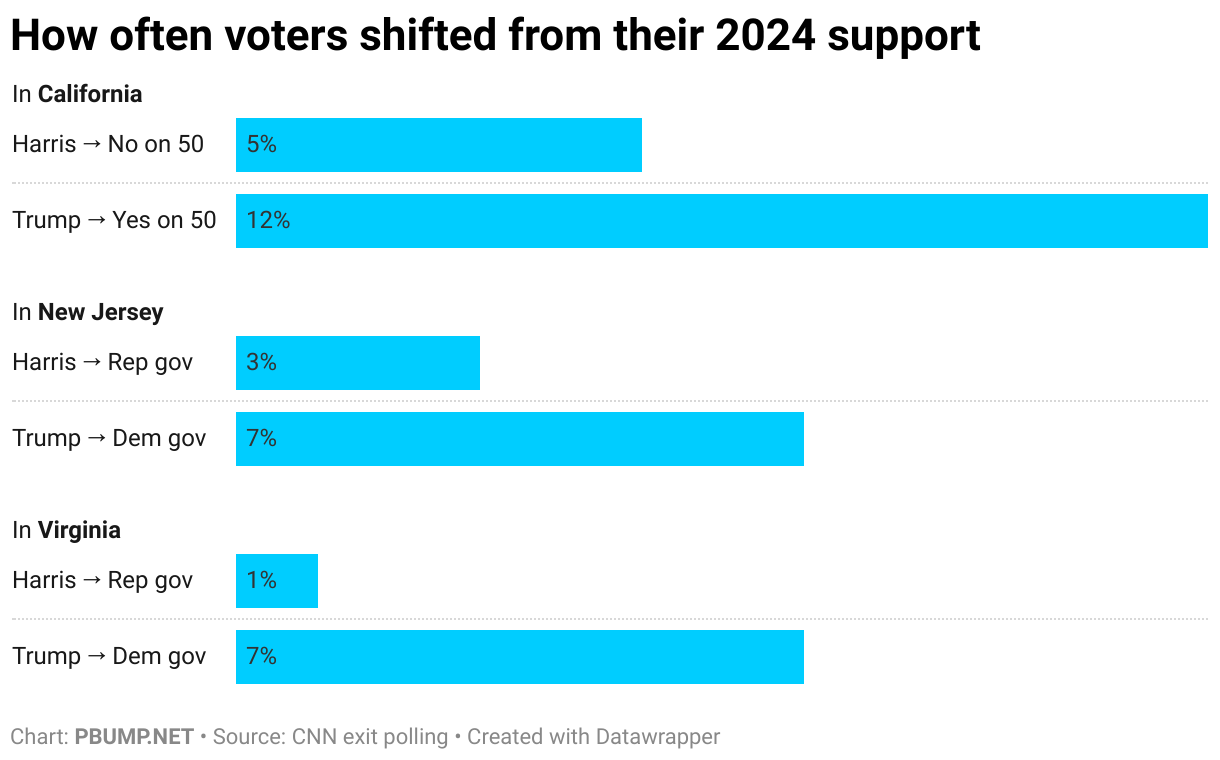
That is true. Exit polls published by CNN from California (where there was a statewide ballot proposition), New Jersey and Virginia (both of which had gubernatorial races) show defections among voters for both major-party candidates last year — but bigger shifts among Trump voters.

In California, 5 percent of Kamala Harris voters opposed Prop 50, a measure centered specifically on countering a Trump-backed Republican power grab. But 12 percent of 2024 Trump voters backed the measure.

In New Jersey and Virginia, a small number of Harris voters cast ballots for the Republican candidates for governor. But in each state, 7 percent of Trump voters supported the Democrat.

These aren’t huge numbers and are subject to margins of error. But that 7 percent jumped out at me because of another number that I spotted in another poll.

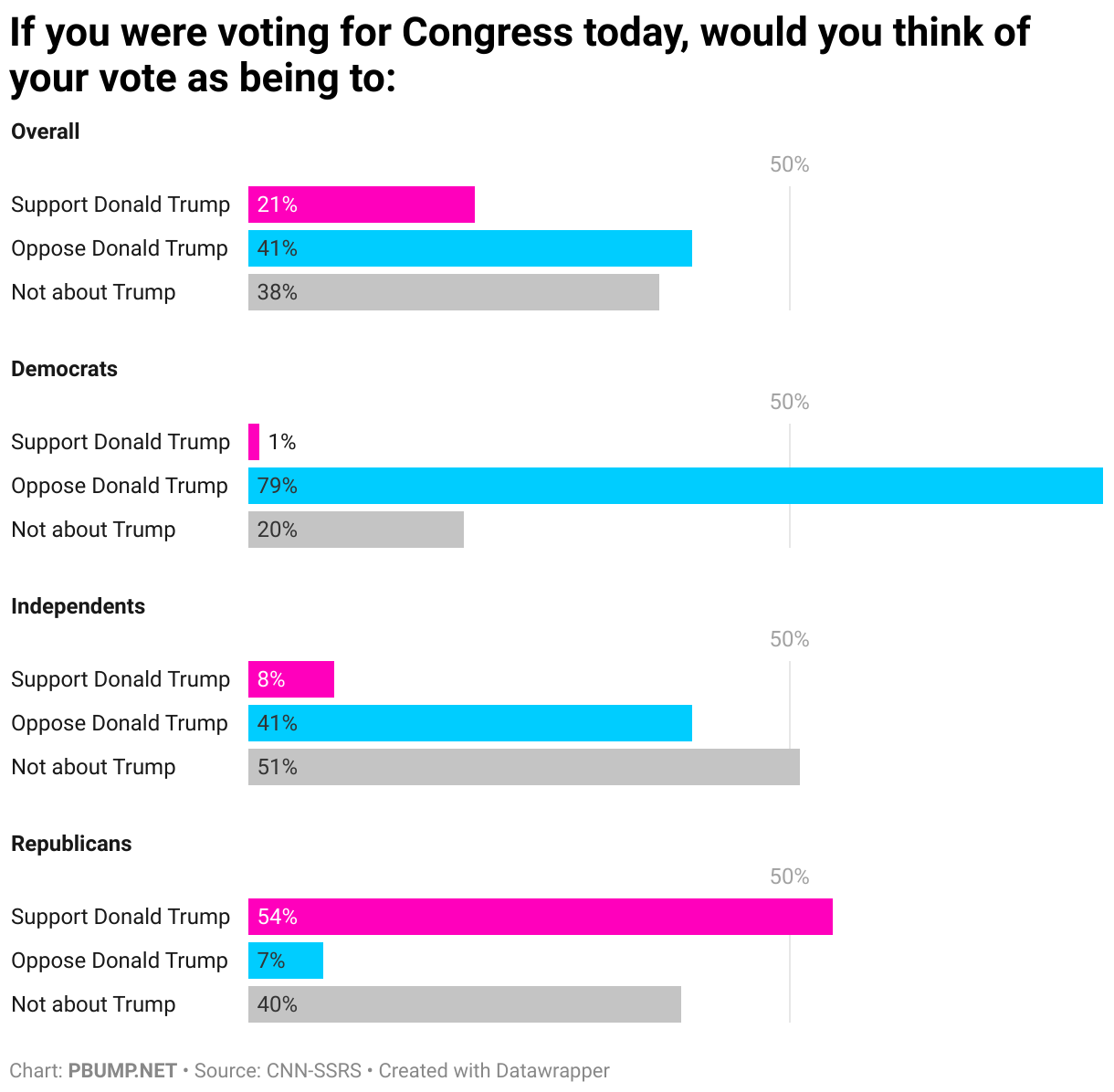
Asked by CNN whether their next congressional vote was intended as a referendum on Trump or not, a plurality of Americans said it was — to express opposition to the president. Among Republicans, you won’t be surprised to hear, most indicated that their vote would be an expression of support for what he’s doing.

A number of Republicans, though, said their congressional vote would be an expression of opposition to Trump. Specifically, 7 percent did.

What’s particularly striking about those results is the ratio between the responses. Most Democrats say their vote will be an expression of their views on Trump; by a 79 to 1 margin, that expression will be negative. Most Republicans also say their vote will express their feelings about the president. But only about 8 times as many Republicans say their vote will express support as say it will express opposition.

Again — as with the exit polls and as with the polling I looked at earlier this week — Trump still has strong support from most Republicans. But this is a country where the Senate and House are about evenly divided. In 2024, 19 House seats were won by Republicans whose margins of victory were 7 points or less.

And that’s not even accounting for the flip. Take 7 percent from Republican House totals last year and give those votes to their Democratic opponents? The House goes from a five-seat Republican majority to a more-than-30-seat Democratic one.

This isn’t how politics works, of course. It is, however, an example of what I’m talking about. If there are 30 Republican members of the House who are suddenly worried that their voters want them to take a harder line on Trump? Trump’s ability to strongarm his way through Washington gets much more difficult.

Photo: Trump descends. (White House/Flickr)