Yes, most Americans oppose the East Wing demolition. But…

It’s one of those sentences one can write about the second Trump administration that would have seemed ludicrously hyperbolic one year ago, but it is nonetheless true: The president of the United States unilaterally obliterated one-third of the structure that constitutes the White House. Two weeks ago, the White House had an East and a West Wing. Now it doesn’t.

In part because the demolition of the East Wing was so sudden, the reaction has been broadly negative. It’s almost certainly true that a slow, deliberate, adjudicated process for replacing the East Wing with a large ballroom would have triggered significant opposition. Such a process, though, might have softened the appearance that Trump was simply reshaping the People’s House as though it was instead a Trump Organization property.

Polling conducted by YouGov found that most Americans disapprove of the destruction of the East Wing. Four in 10 strongly disapprove, including 7 in 10 Democrats and almost half of independents.
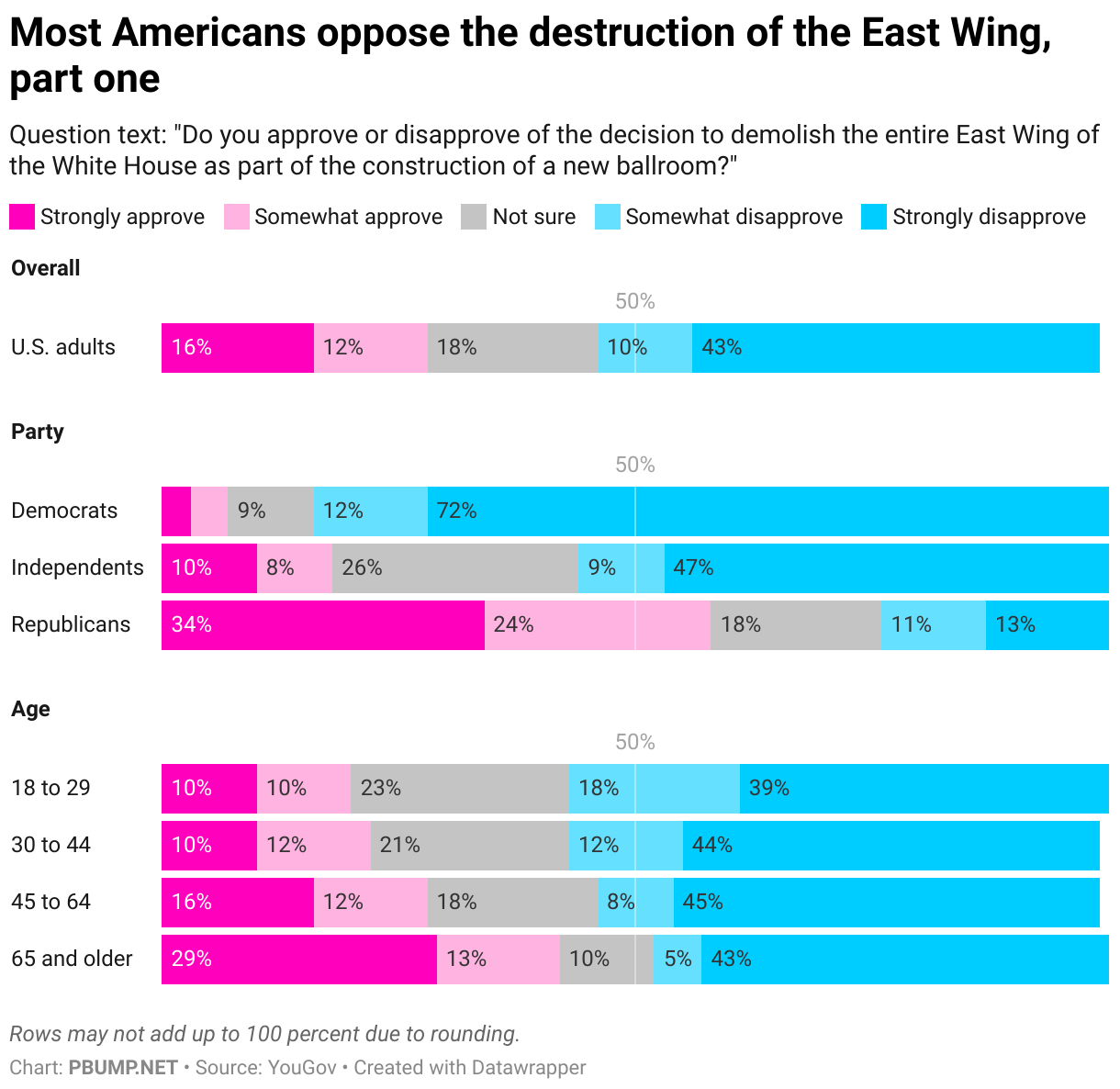
That said, 3 in 10 Americans approve — including a majority of Republicans. There’s an interesting age split in the YouGov data, with older Americans being more likely to express approval of the destruction, almost certainly a function of the fact that older Americans are more likely to be Republican.

We shouldn’t lose sight of the significance of that support, though. A third of Republicans strongly approve of Trump simply smashing the East Wing into rubble, something that it is extremely safe to assume they would have viewed more skeptically had it been undertaken by, say, Barack Obama. Condemnation from Democrats would likely have been more modest under such circumstances, sure … but no Democratic president would have suddenly taken a wrecking ball to the White House without notice. (Harry Truman, a Democrat, did oversee a renovation of the building, but he did so with guidance and input from appointed officials and experts.)

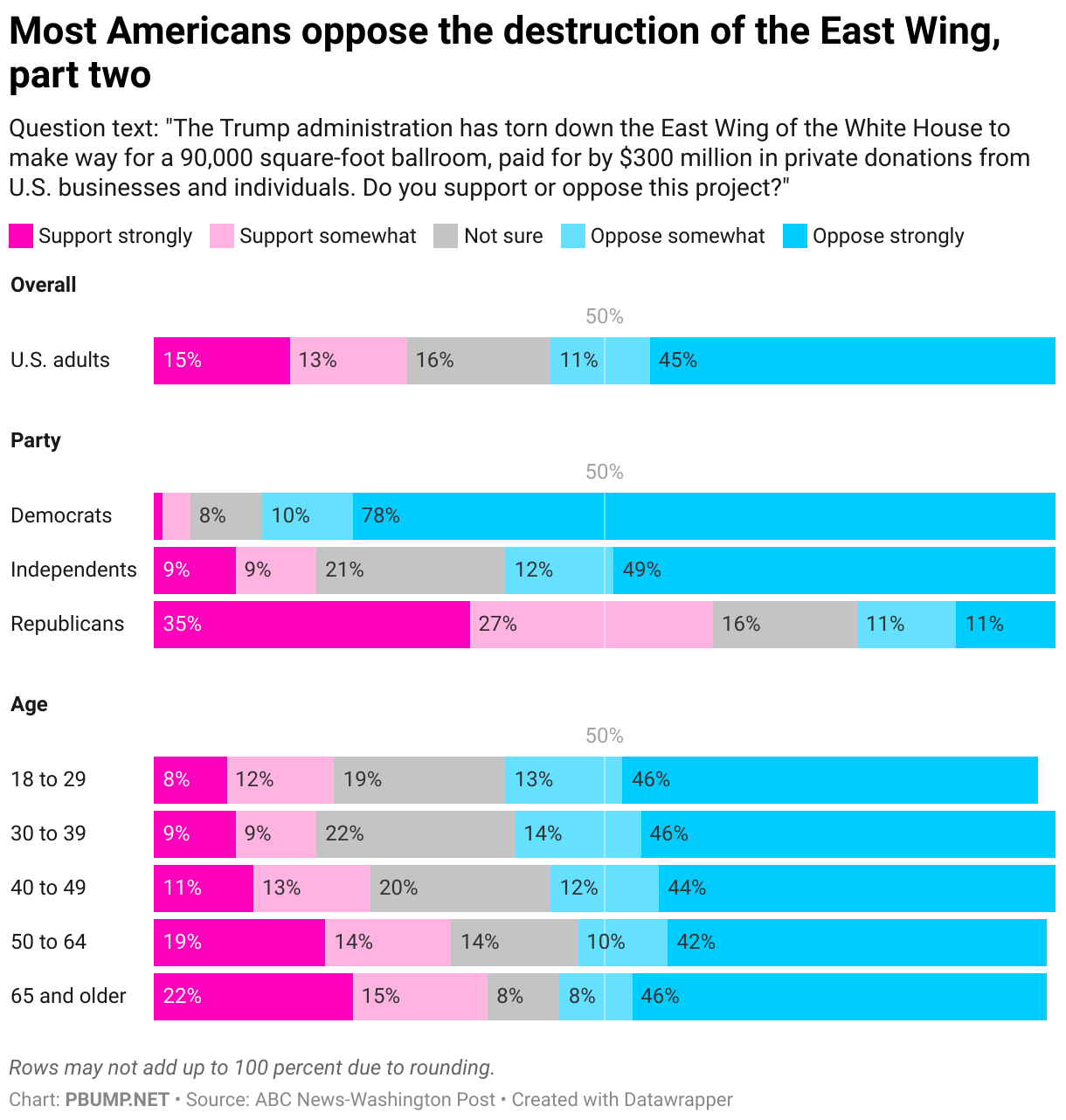
New polling conducted for ABC News and The Washington Post shows similar disapproval of the East Wing’s destruction. Again, most Americans view the move negatively. Again, most Republicans support it, with a third supporting it strongly. And, again, there’s a divide by age.
It is not the case that support for the destruction of the East Wing is a function of people not understanding what happened. YouGov asked Americans whether they’d seen images or video of the building being demolished. Six in 10 Americans said they had, including a majority of Republicans. In other words, at least some (but probably quite a few) Republicans saw the destruction with their own eyes and approved.
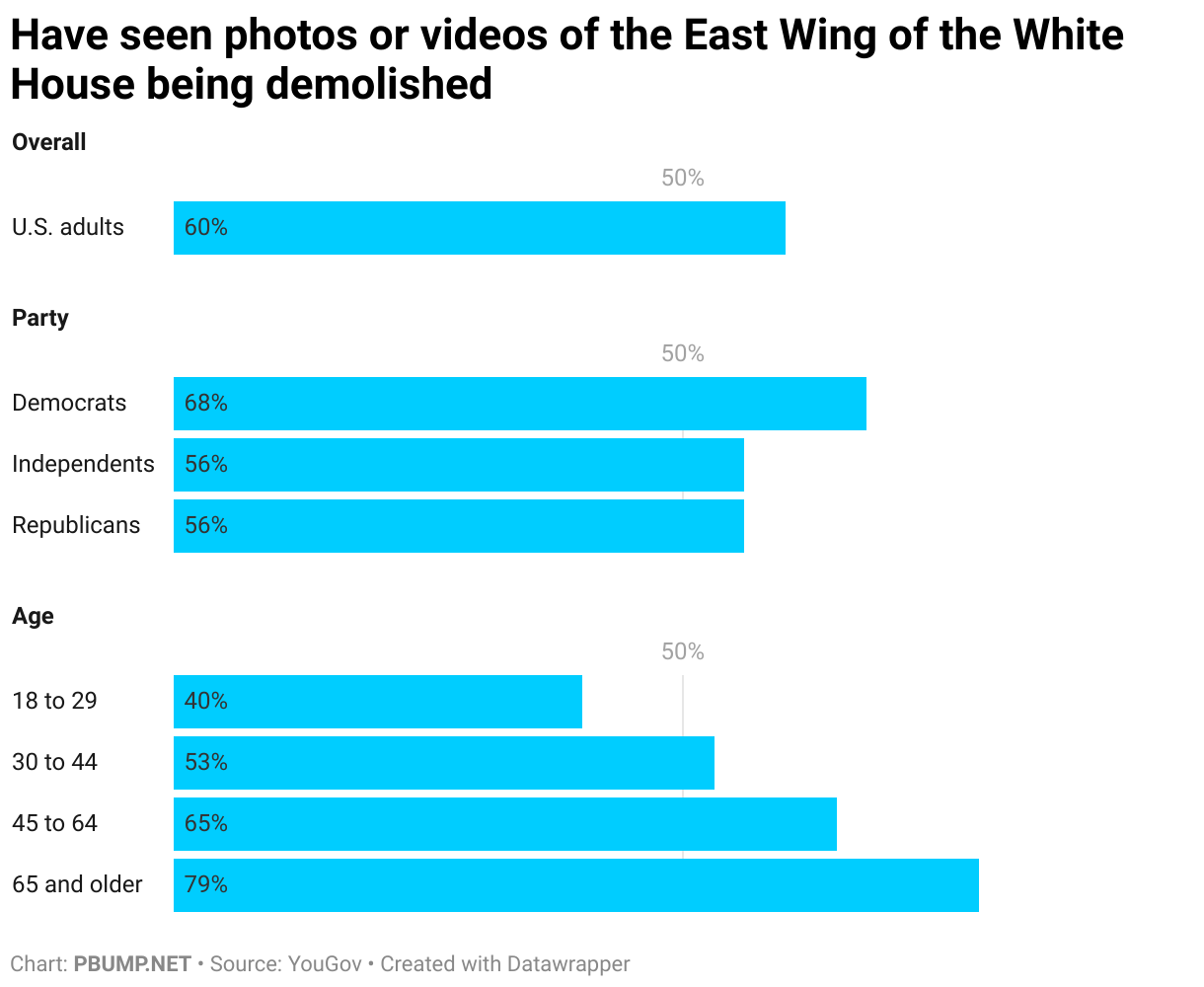
Interestingly, there’s a correlation between having seen photos or videos and approval of the destruction when considering age. In other words, older people are more likely to say they’ve seen photos or videos of the demolition and to say they approve. But this is almost certainly a demonstration of the “correlation does not equal causation” axiom; it’s likely that older Americans are simply more likely to support Trump and more likely to consume traditional news media that covered the destruction.

Update: YouGov generously shared data on views of the demolition relative to whether individuals had seen photos or videos of the destruction. In fact, Republicans who’d seen the destruction were much more likely to say that they approved of it occurring.
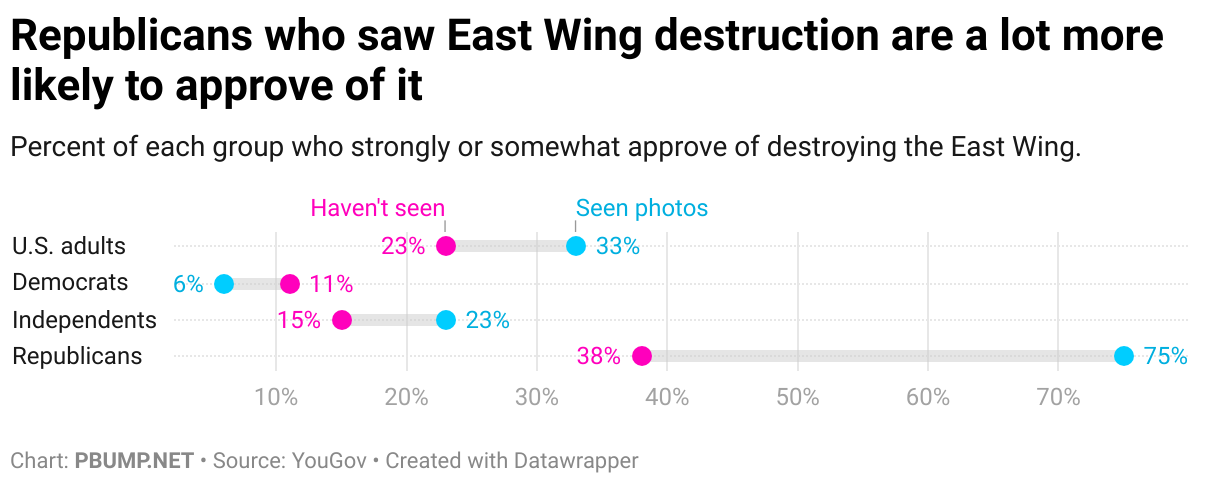
One takeaway here is that the demolition of the East Wing is unpopular. But another is that this, too, has collapsed into a partisan framework. An action that would almost certainly have met with condemnation if suggested to Trump voters in October 2024 is, in October 2025, viewed positively for little more reason than that Trump did it.

If the destruction of a substantial portion of the White House is an on-the-nose metaphor for Trump’s attack on American democracy, consider how we might extrapolate Republican support for his doing so.

Photo: The White House during the 1952 renovation. (National Archives)

The rise of the middle-aged murder victim

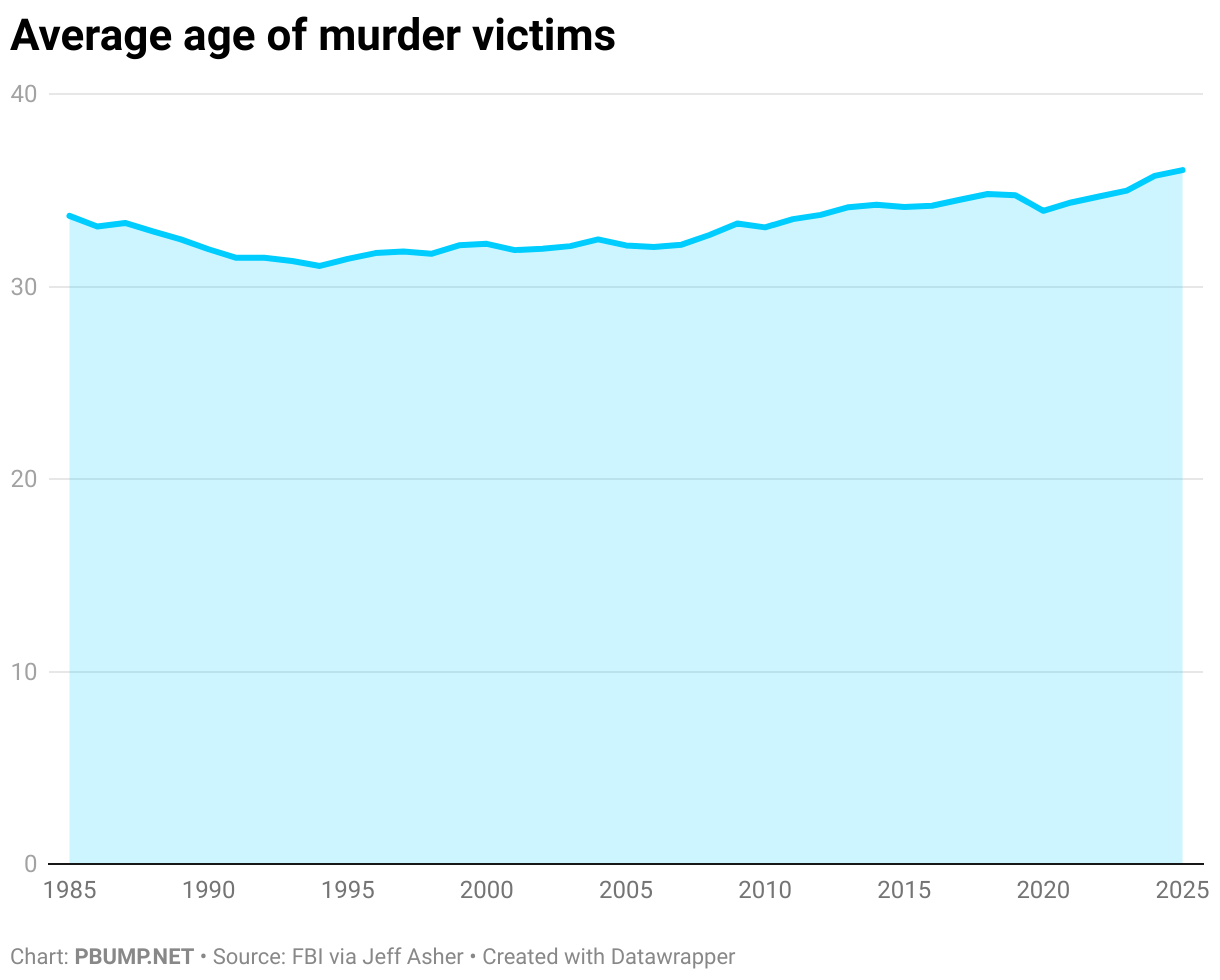
Analyst Jeff Asher, one of the best sources for up-to-date data about crime in the U.S., shared numbers on Tuesday that struck me as interesting: the age of victims of murder has been trending upward for several years.

You can see that increase below. In 2020, the average age of a murder victim was 34, according to FBI data compiled by Asher. So far in 2025, the average age has been 36.

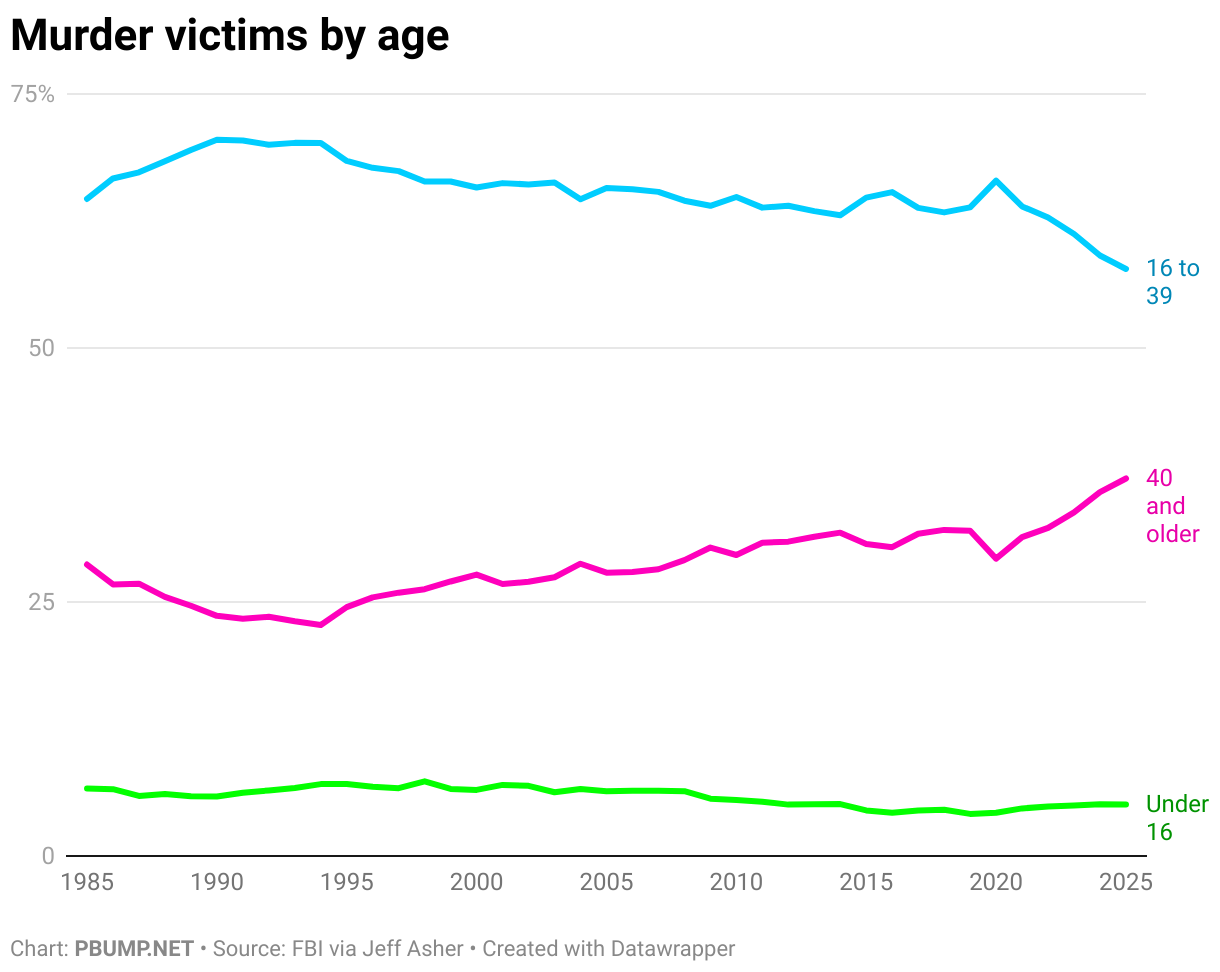
Asher shared a chart that looked a little bit like the one below. Particularly since the pandemic, the percentage of murder victims who are aged 40 and over has increased as the percentage who are aged 16 to 39 has dropped.

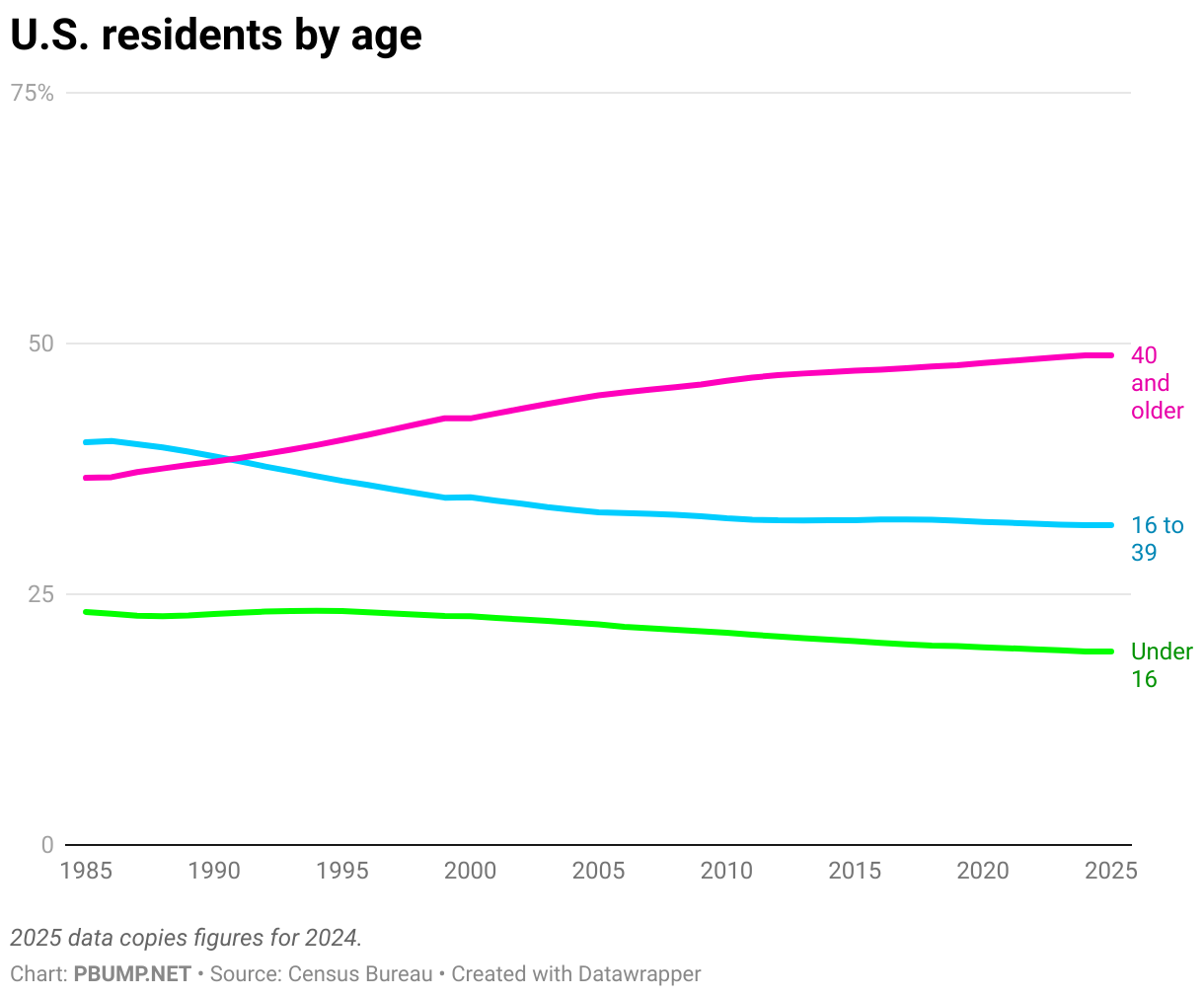
You may not be surprised to hear that I, the author of a book about the baby boom, was immediately curious whether this was simply a function of the increased percentage of over-40 Americans. You can see that below; there are more older Americans than there used to be, so one might assume they would also make up more of the (unfortunate) murdered population.

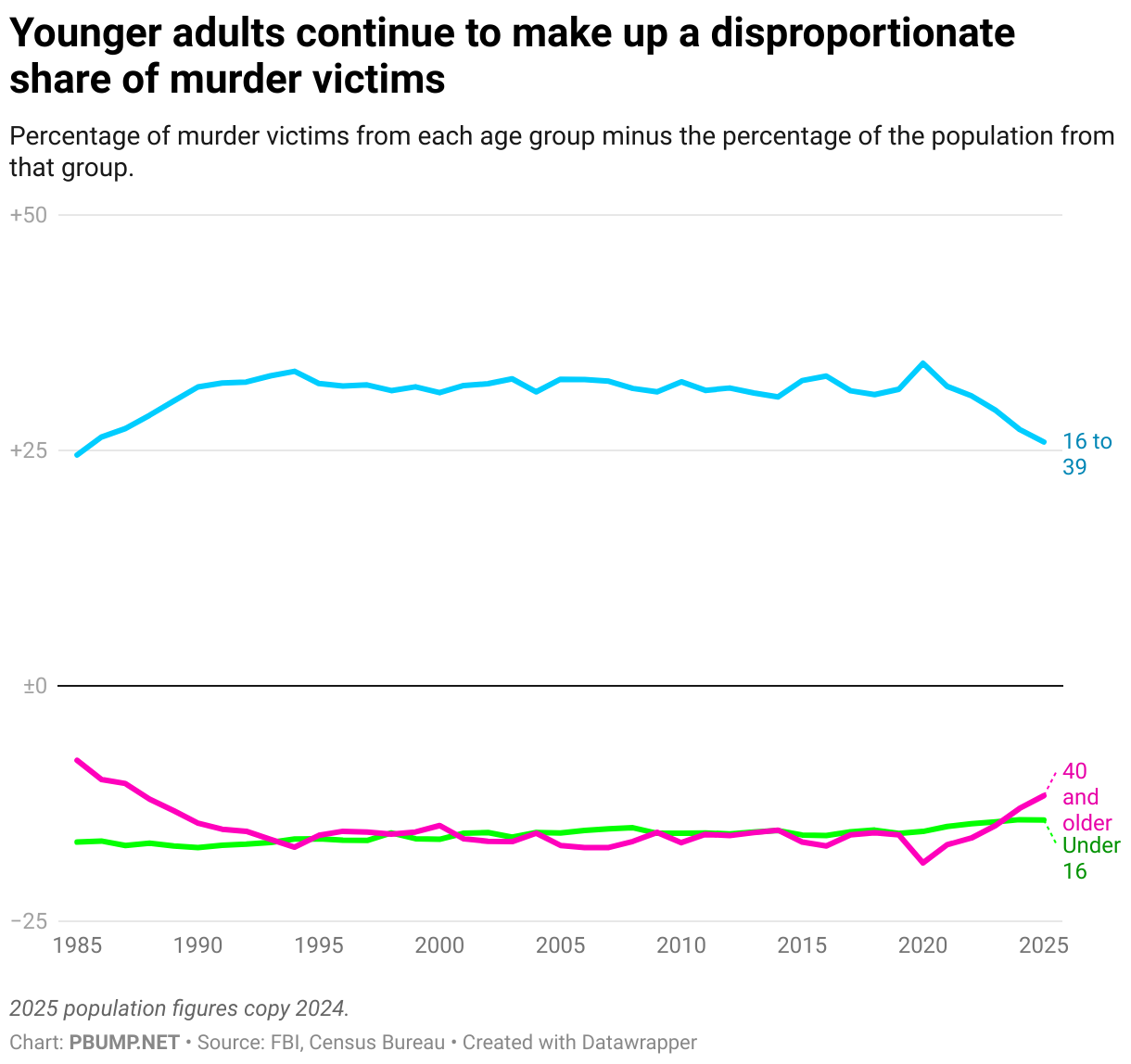
We can compare these two percentages directly. It remains the case that those aged 16 to 39 make up a disproportionate percentage of the population of the murdered, comprising a much higher percentage of the latter group than they do of the population. The gap between the 40-plus victim population and the U.S. population, meanwhile, has narrowed but is still wider than it was 40 years ago.

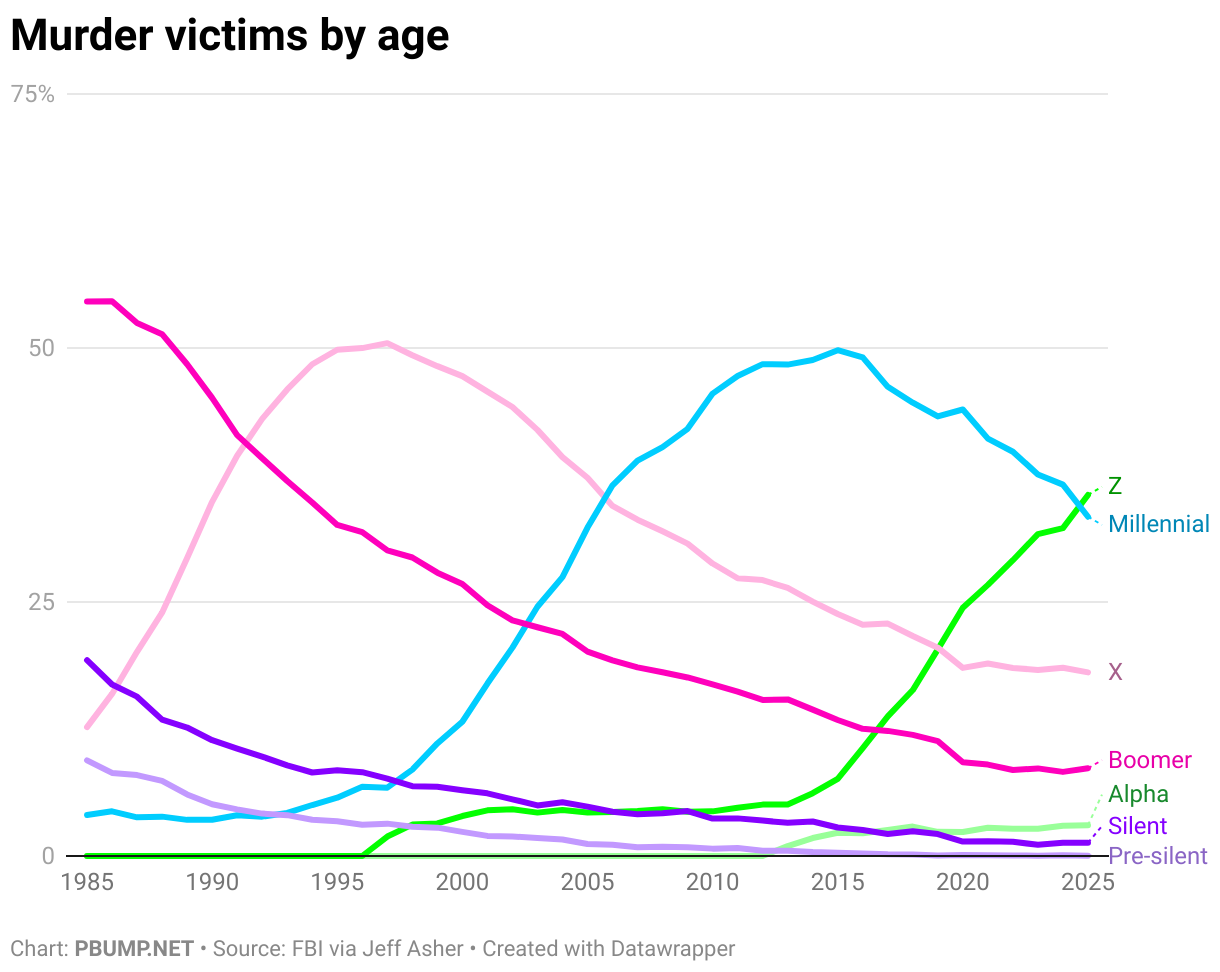
I decided to break the numbers out a bit further. Here’s what they look like by generation.

You can see that this tracks with age; when baby boomers were (relatively) young, they made up a higher percentage of murder victims. Likewise with Gen X, millennials and Gen Z.

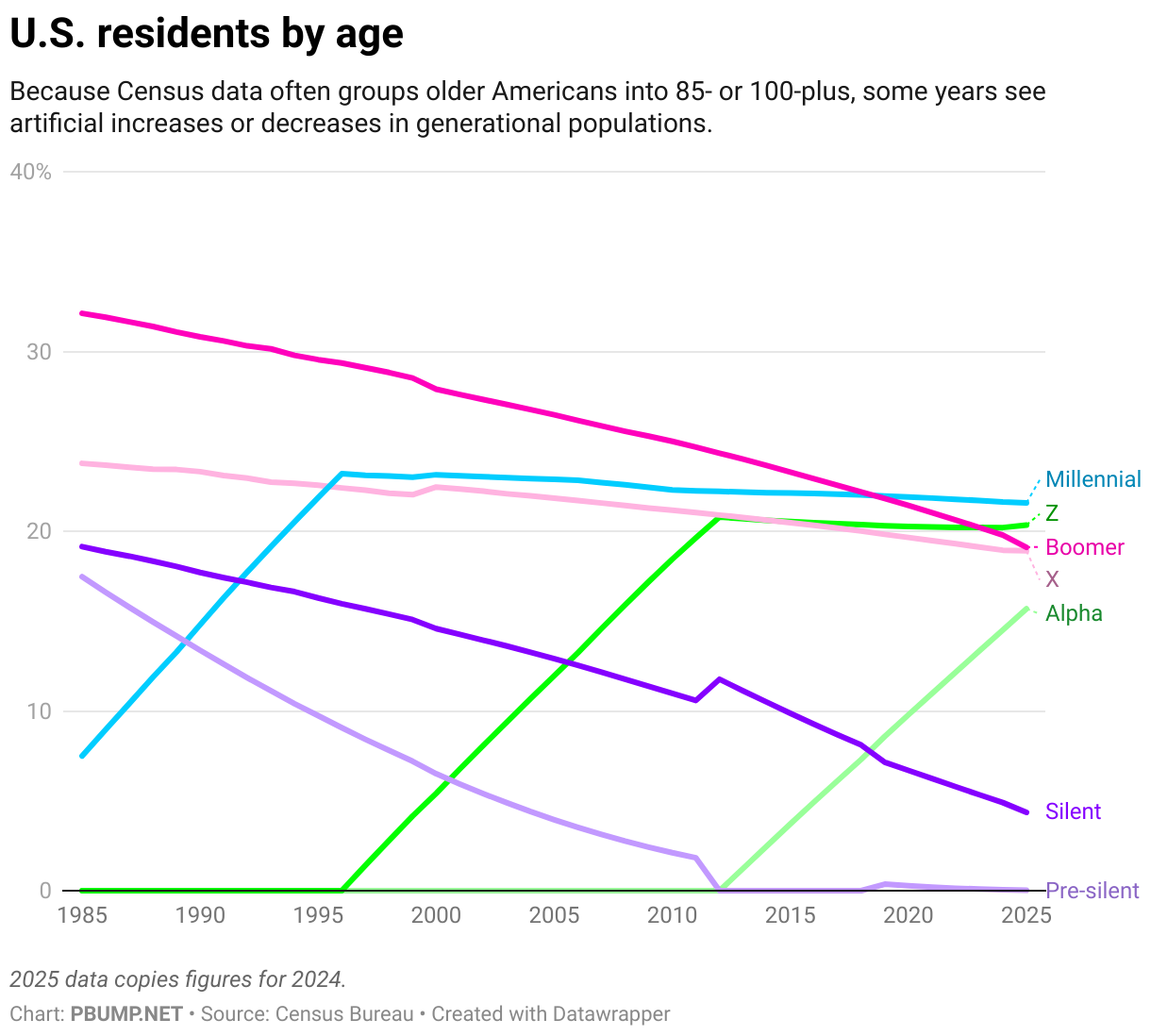
We can also look at those generational groups (as defined by Pew Research Center) as percentages of the population. (Note the little bumps and dips that are a function of the Census Bureau grouping elderly Americans into one bucket at different points.)

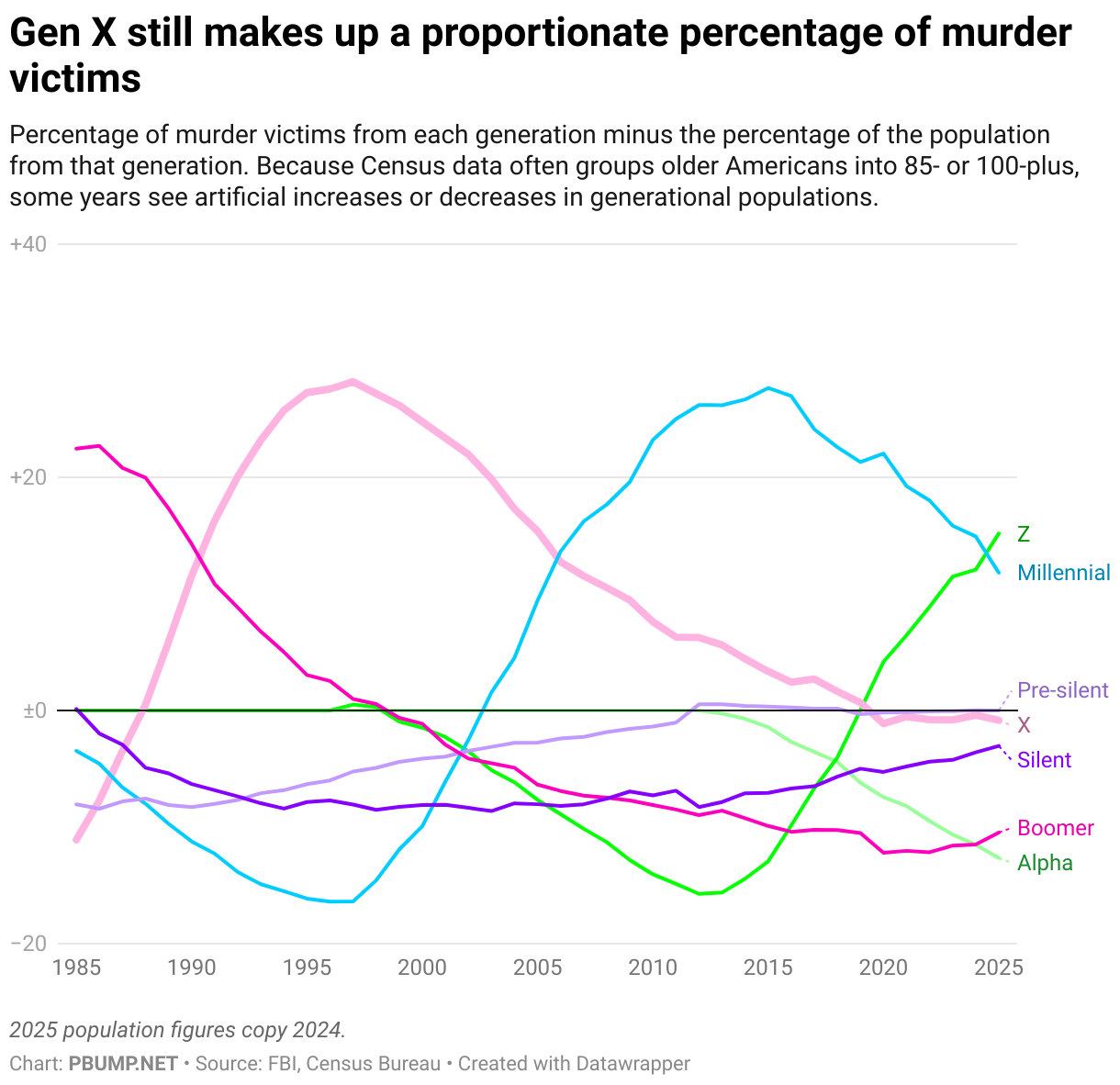
When we directly compare victimhood with population, we see something interesting. While members of the Silent generation (pre-baby boom) made up more of the population than murder victims by the late 1980s and boomers made up more of the population by the late 1990s, Gen X hasn’t made up significantly more of the population than the population of murder victims since its members were little kids. Gen X has, for now, settled in as about the same percentage of murder victims as it is of the population, despite getting older.

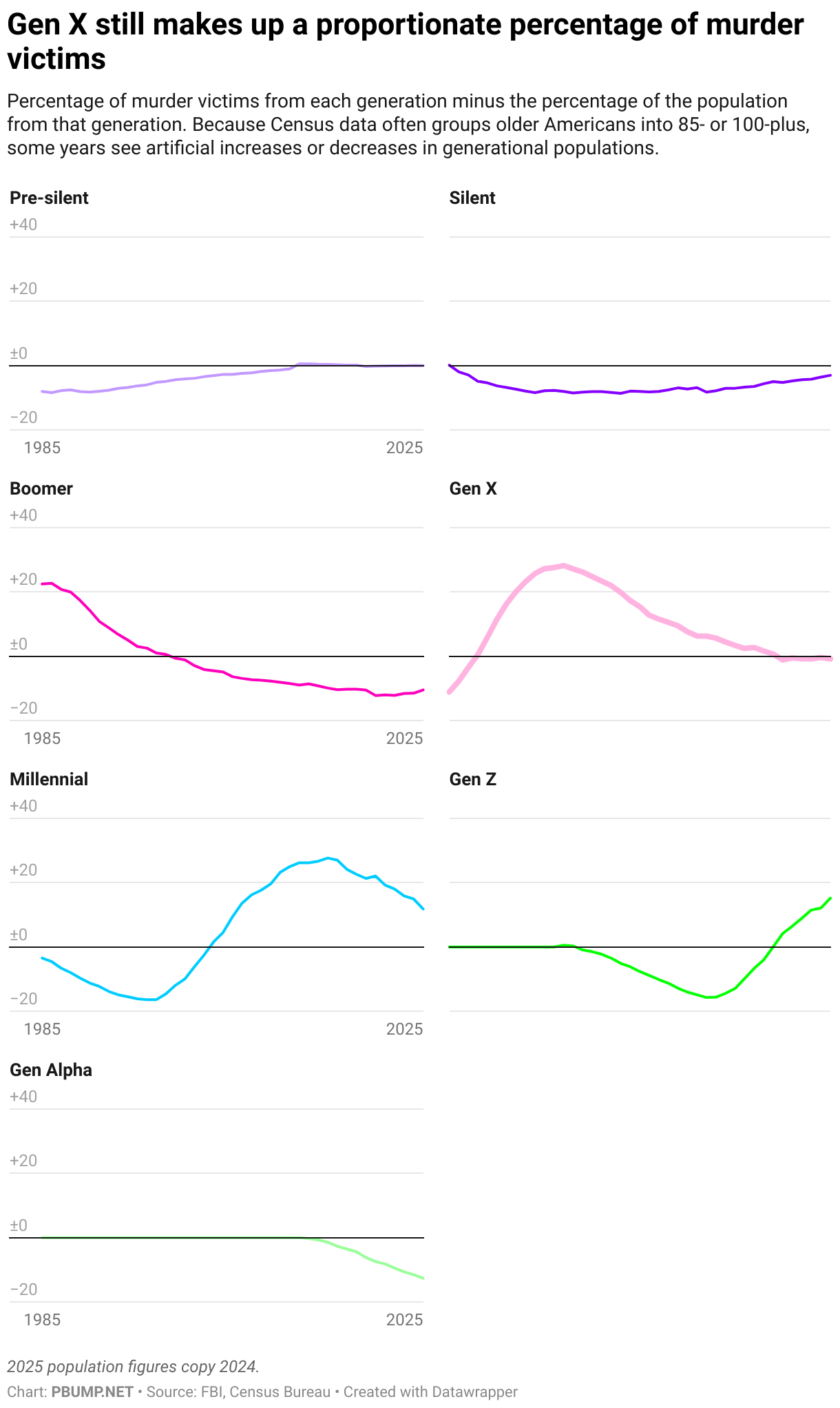
Looking at it another way:

(Note that the ratio among silent generation members is returning to zero. That’s less a function of increased victimhood than decreased populations.)

We shouldn’t overread the numbers here. As Asher noted in an email when he (generously) shared his numbers with me, the murder totals aren’t entirely apples-to-apples and the trend shown above hasn’t existed for that long. But this does comport with the general theory that there’s something unusual about Gen X (my generation, I’ll note) — perhaps, some argue, related to lead poisoning. Murder victims often share their killers’ demographics. If Gen X is disproportionately dying, Gen X may also be disproportionately killing.

Worth tracking these numbers over time, certainly.

Photo: The snub-nosed .38 Lee Harvey Oswald used to kill Officer J.D. Tippit. (National Archives)

Politics is more than temperature-taking

Political campaigns, the axiom has it, are nothing more than a math problem. Get 50 percent of the vote, plus one, and you win. Doesn’t matter the race; that holds. So all a candidate needs to do, however easier said than done, is to ensure that they get that 50 percent-plus.

The problem is that securing that figure isn’t always itself a matter of simple math. It’s hard to know where that 50-plus point sits and it’s harder still to know what chunks of voters you can add into your expected total. You need to hit a particular number, but knowing that number and how to get there requires a more complex toolset than a calculator.

In other words — and despite how much it pains me personally to admit it — there is an element of politics that isn’t quantifiable. There’s an esoteric, abstract element of running for office, an endeavor that, after all, centers heavily on human emotion. And no political consultant yet has figured out an unfailing calculus for anger, fear and enthusiasm.

This risks being trite, so let me get to the point.

The release this week of a lengthy assessment of the Democratic Party’s electoral problems, given the rather leading name of Deciding to Win, offers what it presents as a precise, mathematical case for Democratic electoral success. In short, candidates that moderate their positions to match public opinion are more likely to be successful than ones who don’t. Democrats have moved too far to the left, the report argues, and that cost them power.

To reinforce the point, the report includes a glut of charts, tables and graphs — presenting a seemingly mathematical case to prove their point. As someone who tracks a lot of charts, though, I will say that this data presentation is not particularly compelling, often because the reality suggested by the charts falls short of the conclusions in the accompanying text.

But that’s beside the important point, which is that this sort of slide-rule approximation is central to the party’s actual problems. The report suggests that Democrats track the views of the public and present campaigns that are centered on those views. But that’s an approach that has been central to Democratic campaigns for decades. It’s how you try to figure out how to get to 50 percent-plus-one! In part because this has been the approach for so long — a sort of cold-blooded effort to match the public temperature — Democrats have gotten a reputation as pandering and insincere.

I’ve said before and I repeat here that I think this is related to the extent to which college education and Democratic politics have been increasingly correlated. The party’s balance between pugilistic union reps and McKinsey consultants have shifted toward the latter, increasing the appeal of marketing-campaign-style analyses of voter preferences.

Mind you, Democratic candidates have a challenge that Republicans don’t. They are representatives of a party that includes a diverse membership — White, Black, Hispanic; urban, suburban, rural; young, old; Christian, Muslim, Jewish, atheist — that the GOP doesn’t. This wasn’t a significant problem back in the 1990s, when a candidate in Montana and a candidate in Brooklyn could run their own campaigns on their own issues. But it is a problem in an environment like the current one, in which people’s political lens extends little further than the national conversation.

That shift from local to national is in part due to the consolidation of the media industry and the collapse of local news outlets and newspapers. But it’s largely about the emergence of cable news channels, websites and social media platforms that have captured an audience attuned to and stimulated by national themes. It’s much harder for Democrats from Brooklyn and Montana to run bespoke campaigns when their races are framed similarly and their prospective voters have a similar sense of what their party stands for.

Any effort to offer the Democratic Party electoral guidance that doesn’t grapple with the ways in which the national media environment disadvantages the party is at best incomplete.

The American right has a sophisticated, streamlined system that serves as a sort of rhetorical rock tumbler, bouncing arguments and ideas around until they’re silky smooth. Unlike traditional media, this system is centered not on informing the public but on compelling them, with an almost entirely unrelenting focus on depicting the left as dangerous or ignorant. It relies heavily on what was once called “nut-picking”: elevating bizarre individual acts or claims from purported members of the left in an effort to malign the left broadly. This process, too, has streamlined, from Twitchy publishing stories about random Democrats to accounts like Libs of TikTok amplifying social media posts that are functionally attributed to the entire political left.

This ecosystem infects the traditional media. It happens in part because many traditional journalists fail to understand its scale and intent. The shift that’s occurred wasn’t immediate and isn’t solely a function of Donald Trump (he didn’t invent it; if anything, he’s leveraged it) so, feeling the water warm, many simply don’t appreciate what’s changed. Traditional media is also influenced because this rhetoric and approach has supplanted what was once the Republican Party. Reporters trained to include the considerations of the right in their coverage are now often opening the door for bad-faith allegations and attacks. The traditional media is rightfully constrained by a commitment to accuracy and to nuance, both of which serve as disadvantages in the battle for informing the public.

Politics has become nationalized and that national conversation benefits the right. So if your campaign recommendations center on meeting Americans where they are, you’re often going to be arguing for acquiescence to right-wing policies and rhetorical frames. You’re going to be agreeing to battle the right in the right’s stadium in a game where the right empowers itself to change the rules. And you’re going to reinforce the idea that Democrats don’t have core beliefs of their own.

What if, instead, Democrats ran on what they believe in, in terms that sincerely reflect those beliefs? There’s still the problem of the national environment and its accompanying media universe, but by taking this approach candidates can at least better avoid charges that they’re simply pandering or using poll-tested rhetoric. Sincerity can be an affect, certainly, but it’s a lot easier to come off as sincere if you’re actually sincere.

Advocates for following public opinion polling might counter that this approach means endorsing ideas that aren’t popular. And, yes. It sure does. But public opinion is not static. We’ve seen, even just this year, how views of major issues like immigration have shifted in response to sincere rhetoric about what’s happening. The job of an elected official is to represent their constituents but the job of a candidate isn’t simply to tell those constituents what they want to hear. It’s to make a case as a prospective leader, not a dutiful follower.

Consider how the Deciding to Win report explains Republican success since the second term of Obama’s presidency.

Between 2012 and 2024, Republicans became more extreme on issues like democracy, the rule of law, immigration, and transgender rights. But Republicans also moved toward the center on several issues, including moderating their stances on Medicare and Social Security and dropping pledges to repeal the Affordable Care Act, ban abortion nationwide, and pass a constitutional amendment to prohibit same-sex marriage.

Donald Trump did talk less about reforming social programs, but his party has nonetheless pushed forward on implementing policies that reduce spending on those programs. Saying that the party has moderated on abortion, meanwhile, lands pretty flat three years after the repeal of Roe v. Wade. Giving up on saying you’ll do something extreme when you can’t in favor of doing something slightly less extreme when you can isn’t really moderation, I’d say.

But what’s really missing in that paragraph is the advent of Trump. The GOP’s success since 2012 hasn’t been about being moderate, it’s primarily been a function of finding someone who is compelling to a lot of Americans (with a boost from the unevenness of the Electoral College). Trump overhauled the Republican Party through sheer will and cult of personality. Moderated rhetoric played at best a modest role in his trips to the White House. Lying about his and his party’s plans, like on IVF? Probably more important.

Incidentally, this analysis of the Democratic Party’s failings does seem to give rather short shrift to the 2016 and 2020 presidential elections. 2016 came before the supposed woke-pocalypse — but Trump won against a candidate carefully attuned to public opinion. 2020 came at the apex of the woke era, but Trump lost. 2024 came at the height of the backlash against the fringe positions that Trump allies (and the report authors) ascribe to the left, but it’s pretty clear that inflation played a bigger role in his win than concerns about cancel culture.

The Democratic Party needs to win races beyond the presidency, of course. Perhaps candidates will find recommendations in this report useful as they try to do so. But it seems unlikely that the solution is centrally that candidates should reinforce the idea that Democrats are going to say whatever voters want to hear. Who wants to vote for a party that won’t defend its allies or who will downplay the threat to American democracy? Hell, who wants to run for office as a member of a party deeply committed to raising their voices about nothing other than the price of groceries?

Photo: A Trump rally in New Hampshire, 2019.

The Biden autopen ‘investigation’ is fruit of a poisoned tree

I will admit at the outset that it has been a long time since I approached the legislative branch with anything resembling humbled awe. The problem is that I have known too many legislators.

Still, there was a time — even fairly recently — when Congress functioned well enough that its work product deserved respect. There was a lot of performative wrestling and outrage from individual elected officials, but bipartisan relationships and the legislators’ own interest in backstopping their collective work served to smooth out most wrinkles in the final product. I mean, in 2020 a Republican-led Senate committee produced a report documenting Russian interference in the 2016 election, even drawing a line between Trump’s campaign and Russian intelligence. Marco Rubio was on that committee! Five years ago was a different world.

Of course, that was the Senate, which (as Robert Caro will remind us) was designed to be the more sober, serious side of the Capitol. And that was in an era where Donald Trump, while holding the GOP base tight in his grip, still hadn’t completely locked down party officials.

House Republicans, meanwhile, spent Trump’s years out of the White House first trying to shred the Biden administration and then trying to ensure the former president’s unfettered return to power. Over the course of 2023 (when the GOP regained the majority in the House) and until the day Biden announced he wasn’t seeking reelection, Republicans like House Oversight Committee Chairman James Comer (R-Ky.) did everything in their power to impugn the Democratic president and his party.

It’s hard to overstate just how far this went. As one of the relatively few journalists covering what Comer and his allies were doing, I found it frustrating how little attention the effort got — meaning that it’s likely that many Americans and many reporters don’t fully appreciate the extent of the bad-faith attacks. I won’t rehash them here, but I will point to this overview of all of the attempts to smear Biden over the course of 2023, to the collapse of one of the trashiest insinuations offered by Comer and Sen. Chuck Grassley (with right-wing media’s help) and to the fizzling out of the obviously contrived “impeachment investigation” targeting Biden. It was deeply, deeply dishonest and the only ones paying attention, it seemed, were the Twitter users and Fox News hosts who were cheering it on.

You will forgive me, then, if I don’t take seriously the Oversight Committee’s new report, alleging that key actions taken by the Biden administration were “illegitimate.” And that’s even before reviewing the report itself, flimsy enough to be at risk of disintegration from even a whisper of wind.

To distill the conclusion, Comer and his majority determined that Biden’s mental capacity was diminished during his last year in office, meaning that maaaybeee people on his staff signed stuff without his knowing it and that maaaybeee that included some of his pardons? If this sounds a lot like something Trump himself would say, that’s not an accident. The probe by Comer’s committee developed in concert with Trump’s rhetoric on the issue, functionally handing over to the president the power of congressional oversight activity.

Trump wants someone to say that Biden’s pardons are illegitimate so that he can push his opponents into the Justice Department’s acquiescent crosshairs. Comer and his friends are happy to give him the pretext. As I wrote for The Washington Post in June, there’s no actual question that those pardons were issued on Biden’s instructions. But the game here has always been to whip up a fog of uncertainty — was the 2020 election somehow stolen? can’t a president just destroy a third of the White House? — that lets Trump move forward with what he always intended.

What an Oversight Committee could be doing, of course, is conducting oversight on the executive branch. There’s no shortage of serious questions about the sitting president that would seem to warrant more urgency than unserious questions about a former one. Trump’s own pardons, the enormous sums of money he’s earning from people who are benefitting from the administration’s decisions, his deployment of the military against nebulously defined actors in the Caribbean — the list goes on. Hell, you’d think that the House might be interested in assessing Trump’s willful disregard for Congress’s power of the purse. But that’s only if you think that the intent of Comer and Oversight is to aid Americans instead of simply siding with the president. (Not that this is a surprise; one of the first things Comer did upon taking leadership of Oversight was kill an investigation into Trump’s finances.)

I write all of this centrally because, despite the past three years, Comer and his committee are still granted the baseline assumption that their work product is offered in good faith. The Post’s coverage of its new report, for example, mentions only in passing that Biden has been an ongoing target of Comer’s and doesn’t add the useful context that his targeting has resulted in any number of misfires. This is the same paper that, in 2023, ran the accurate headline, “Comer mischaracterizes Hunter Biden car payment reimbursement to his dad.” Yet we’re led to assume that his current characterizations should be assumed to be legitimate.

No one would credibly argue that questions about Biden’s acuity were baseless. But no one can credibly argue that the output of a Comer-led Oversight Committee is inherently trustworthy. Comer spent years proving that he would embrace any disparagement of Biden as he ignored any criticism of Trump. That should be a focus of assessments of the committee’s output before we consider the output itself.

On Tuesday morning, the next step of the plan swung into action. Speaking to reporters, House Speaker Mike Johnson (R-La.) stated that any Biden administration action that involved the use of an autopen “should be voided,” including pardons. Then come contrived investigations and then come arrests and then come administration lawyers telling district courts that the question isn’t settled and maybe they should just head over and ask Samuel Alito his view of the matter.

The balance of powers has tipped heavily toward the executive branch. Since Jan. 20, Comer and Johnson have been doing most of the tipping.

Photo: Comer at CPAC 2025. (Gage Skidmore/Flickr)

Breaking down SNAP benefits by congressional district

Thanks to the government shutdown, participants in the Supplemental Nutritional Assistance Program (SNAP) are not expected to receive that aid next month. The effects of this could be dire; SNAP, often referred to as food stamps, helps people afford groceries when their incomes are insufficient to do so.

I was curious how the effects of these anticipated cuts would be felt. So I pulled data from the Department of Agriculture (which administers the program) and compared usage to other benchmarks — including electoral data from The Downballot.

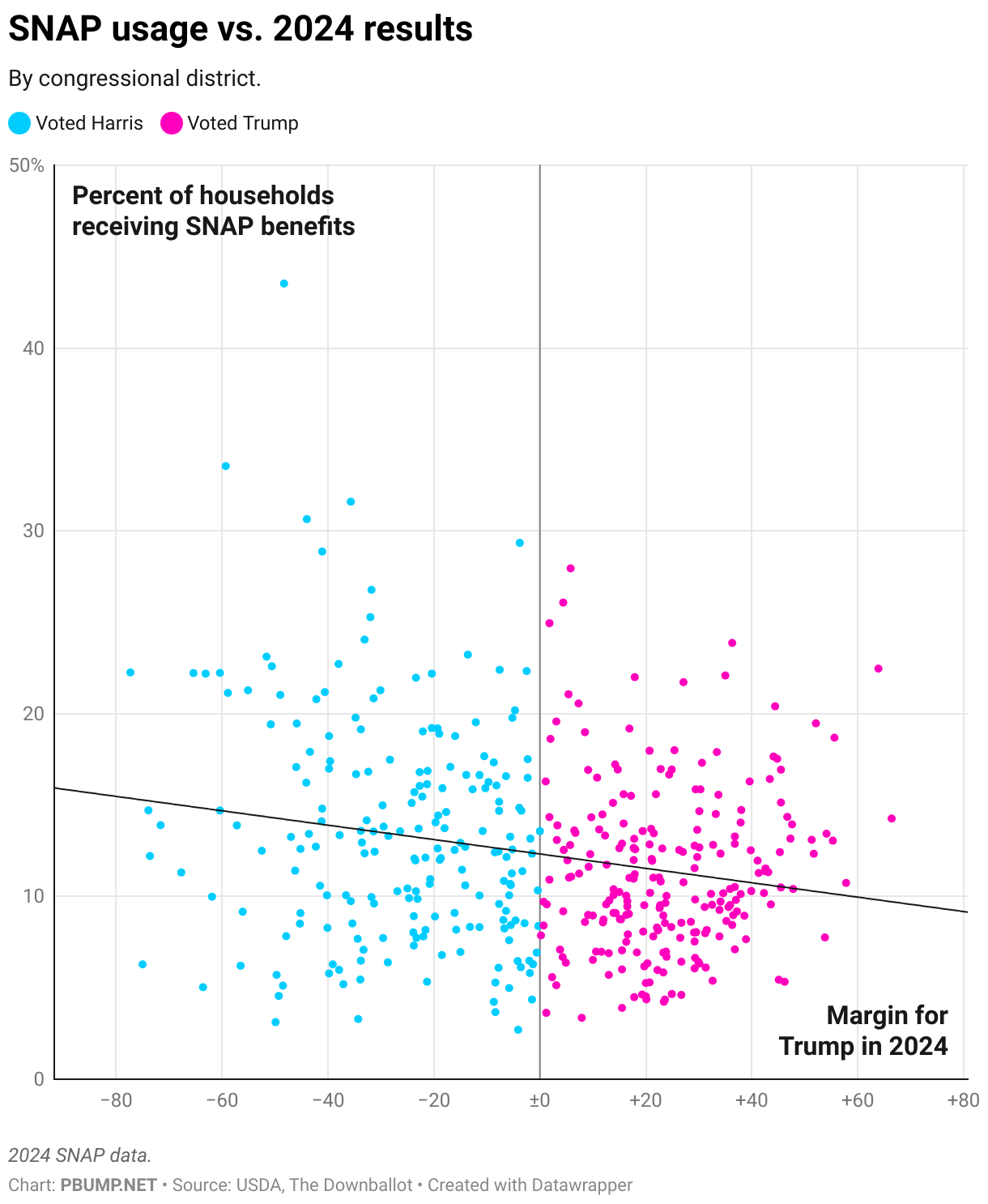
There is a very slight correlation between the extent to which a congressional district voted for Kamala Harris last year and the percentage of households in the district that used SNAP in 2024.

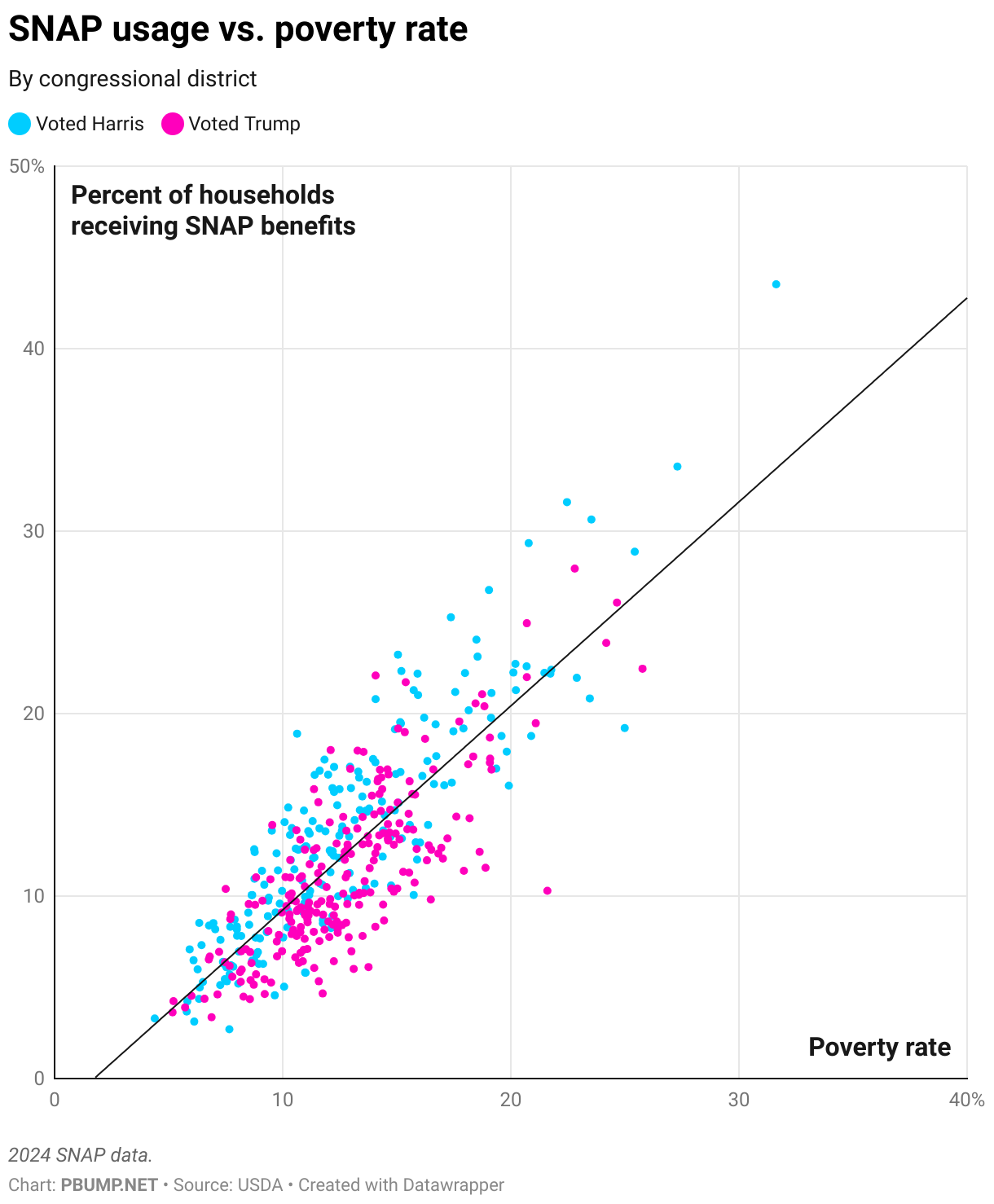
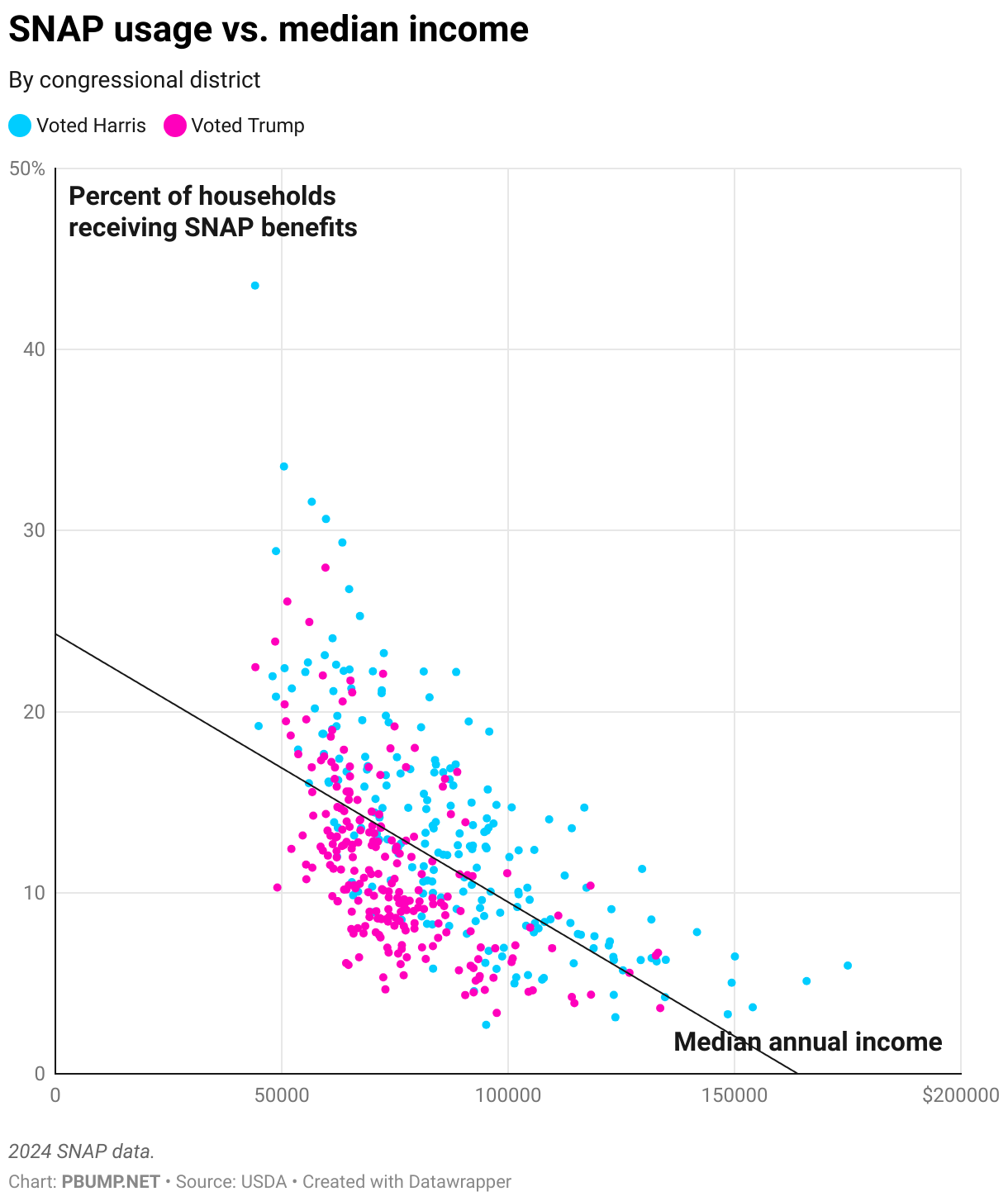
(On these charts, the diagonal line shows the trend in the data.)

The stronger correlation, as you would expect, is with poverty levels.

And, inversely, with median incomes.

Perhaps the most useful correlations from a political context, though, are between SNAP usage among particular groups and 2024 voting patterns.

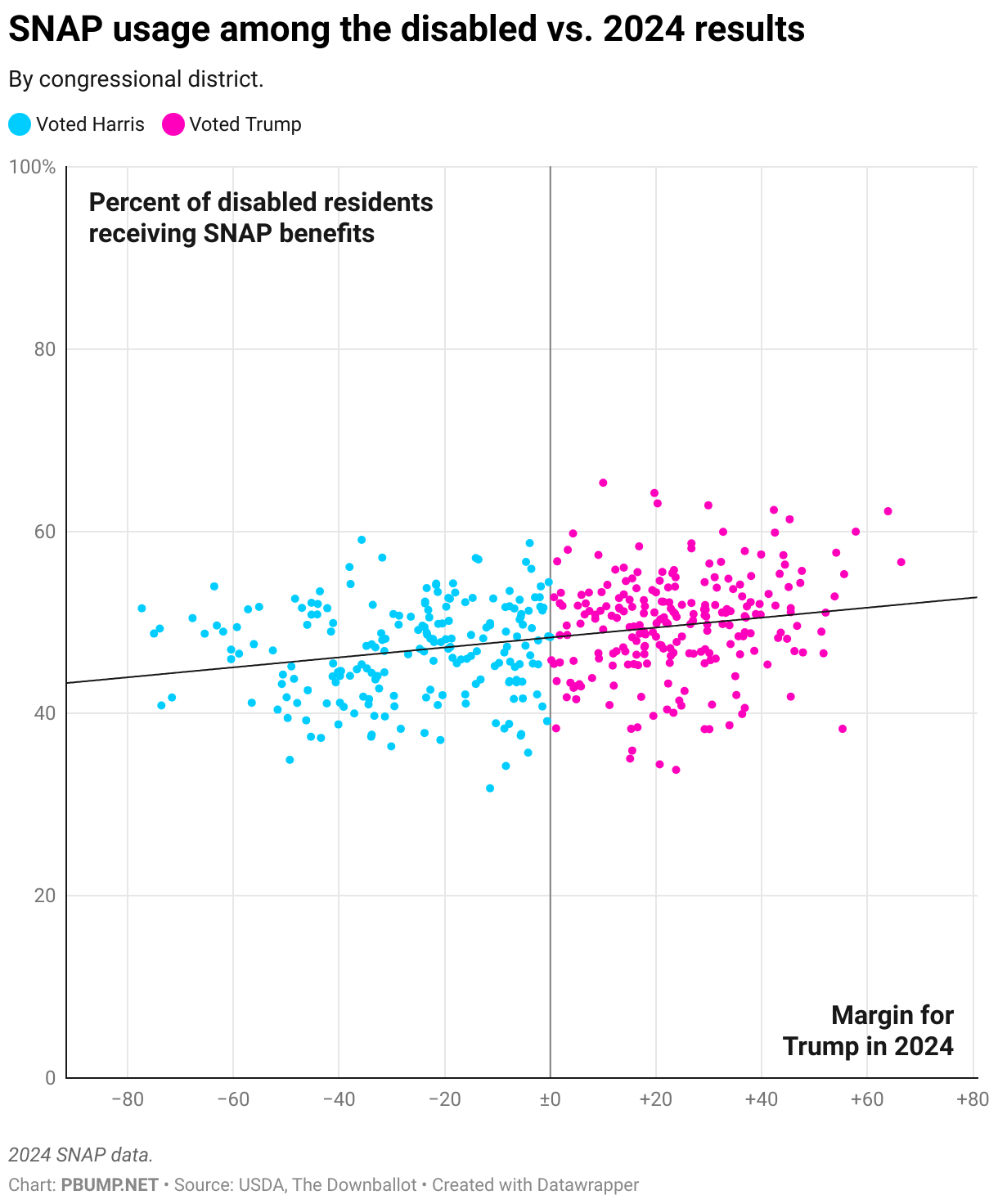
For example, there is a slight correlation between the percentage of disabled residents in a congressional district receiving benefits and the extent to which that district backed Trump. Slight — but stronger than the overall Harris-SNAP correlation.

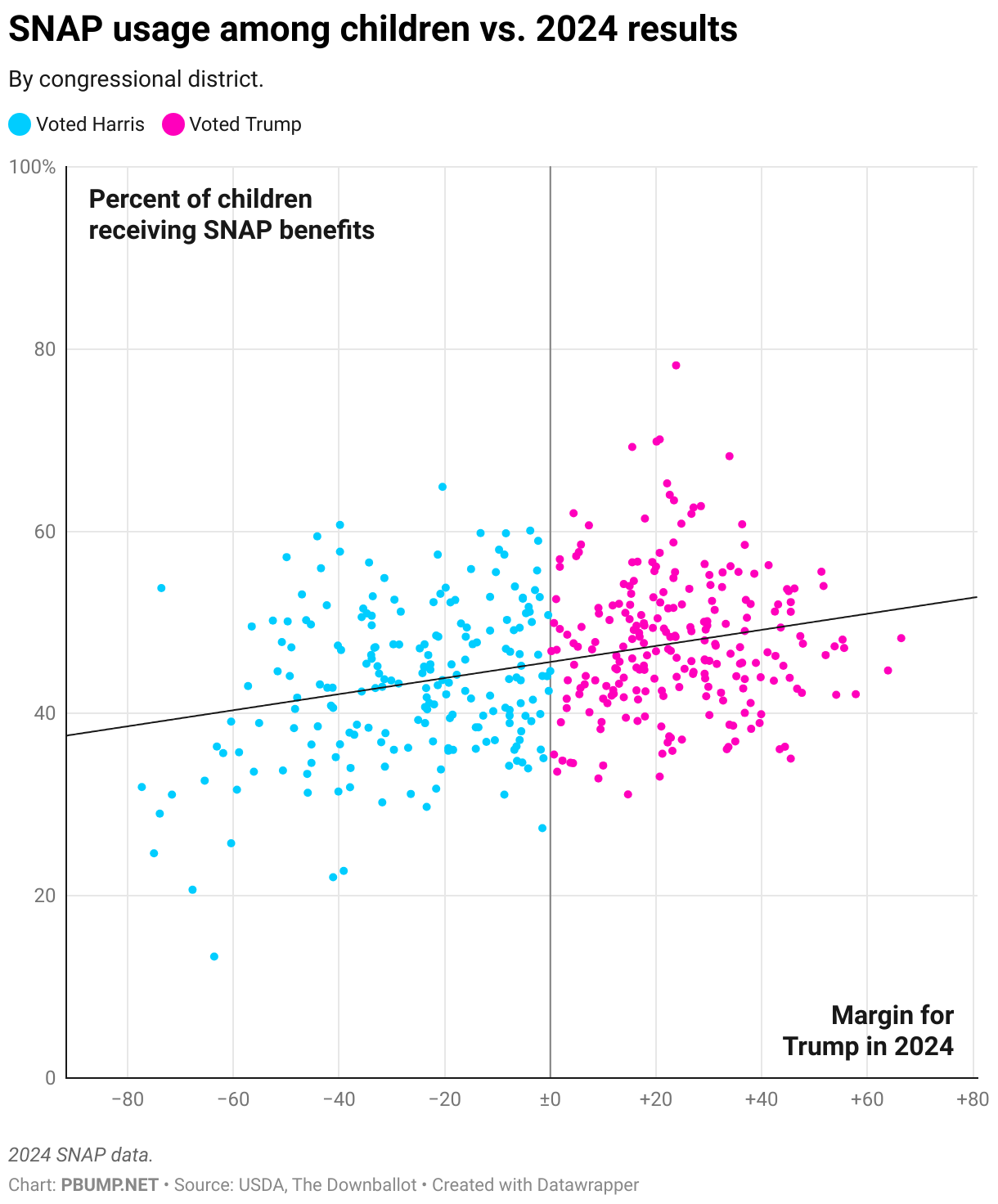
The same holds for the percentage of kids receiving benefits…

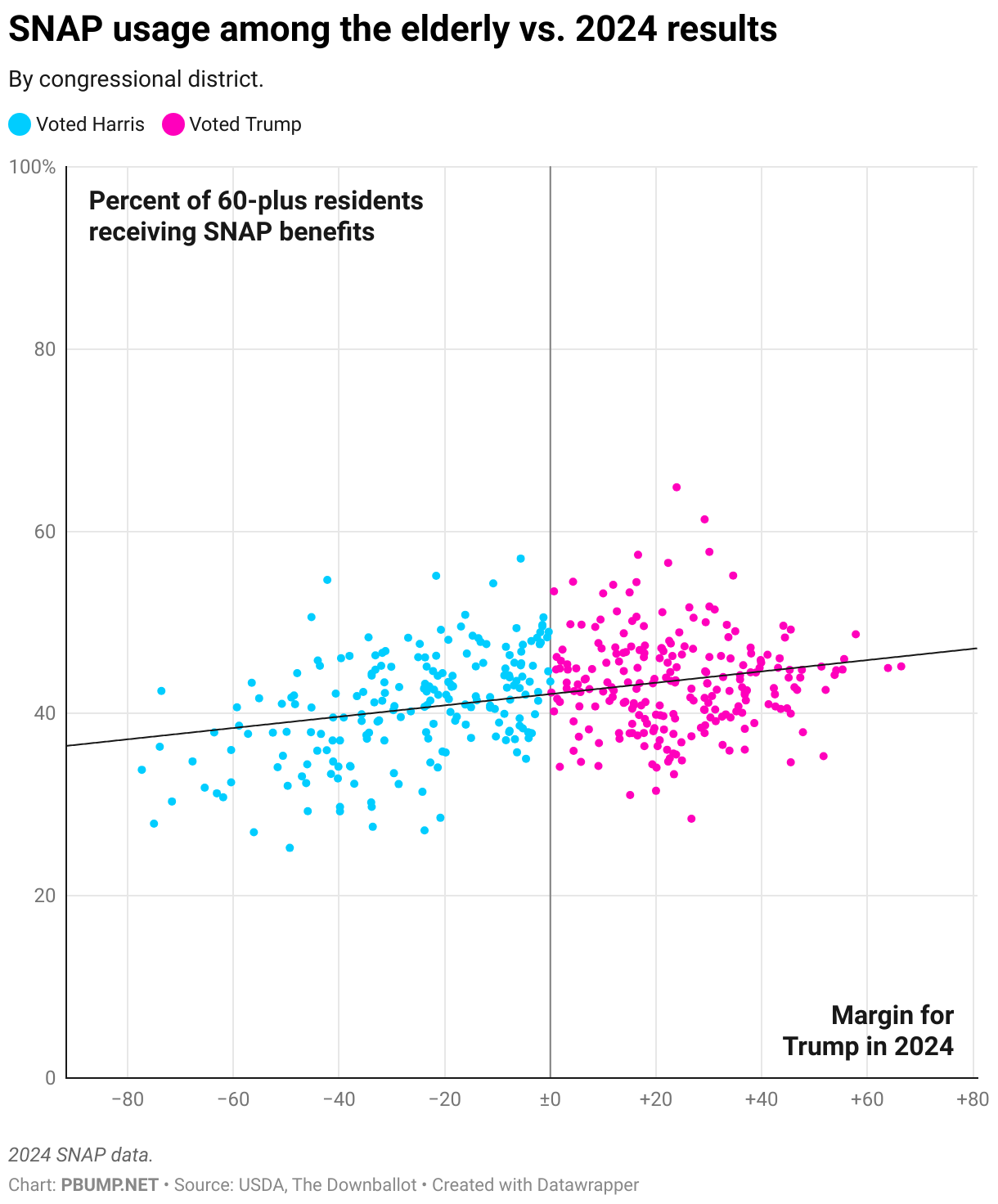
…and the percent of those aged 60 and over who do.

In fact, while the correlation between elderly SNAP recipients and 2024 voting by congressional district is still rather weak, it’s the strongest of those shown above.

In other words, it’s not the case that people in districts that backed Trump will be more affected by SNAP cuts than are those who live in Harris-voting districts. (About 1 percent more households that receive SNAP are in districts that backed the former vice president.) But it is the case that more members of vulnerable populations who receive SNAP benefits (and not just percentages of them) live in districts that also voted for Trump. For example, 8 percent more kids who depend on SNAP live in congressional districts that backed the president.

It is unlikely that this will have much of an effect on the actual political debate.

Photo: A grocery store in Tennessee in 1935. (National Archives)