The shutdown is no longer ignorable

You can see why President Trump might not have been particularly worried about the government shutting down last month. During his first term in office, the government shutdown twice, once setting a new record in duration, but it didn’t really affect him politically. So Oct. 1 this year arrived without a funding bill and the government shutdown and Trump just moved forward with his second-term approach of doing whatever he wanted to anyway.

No prior president had ever seen more shutdown days during his presidency but he won reelection (eventually) anyway. So who cares?
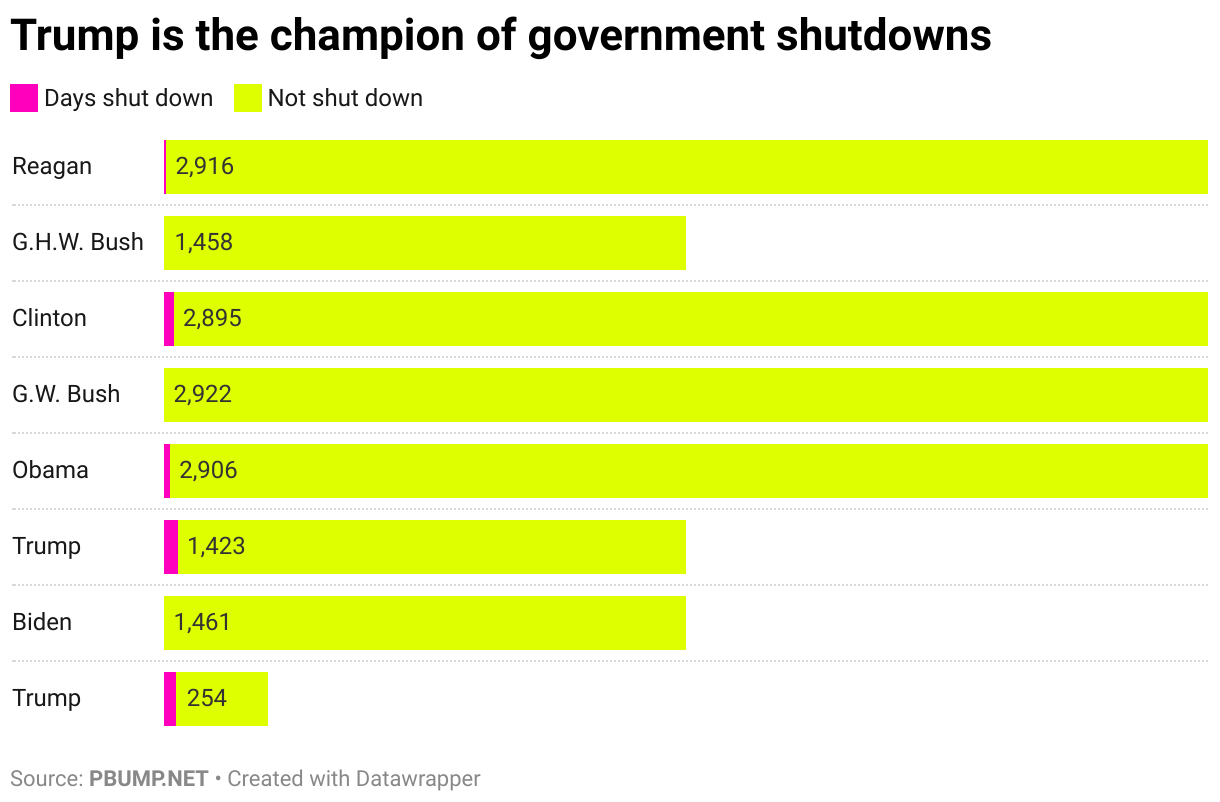
That was all well and good while the government was still able to keep things running without obvious interference or hiccups. It’s probably useful, in fact, that shutdowns are now so common; many parts of the government know how to function without formalized funding, and that experience kicked in. But now, with this shutdown setting daily records for duration, those hiccups are starting to appear.

For example, Trump’s Transportation Secretary and fellow reality-TV veteran Sean Duffy appeared on Fox News this morning to explain how the administration would be forcing flight cancellations in 40 airports given air-traffic-control shortages.

As he spoke, an on-screen box showed the locations where those stoppages would occur: Boston, New York, Atlanta, Denver, Dallas. Basically any major hub might see cancellations that are a function of the shutdown. Luckily, there are no major travel-focused holidays coming up, right?

Trump, at least, believes that the shutdown was one reason his party fared so badly in this week’s elections. He’s probably right, at least in part. But that was also before problems really started to manifest for the public at large.

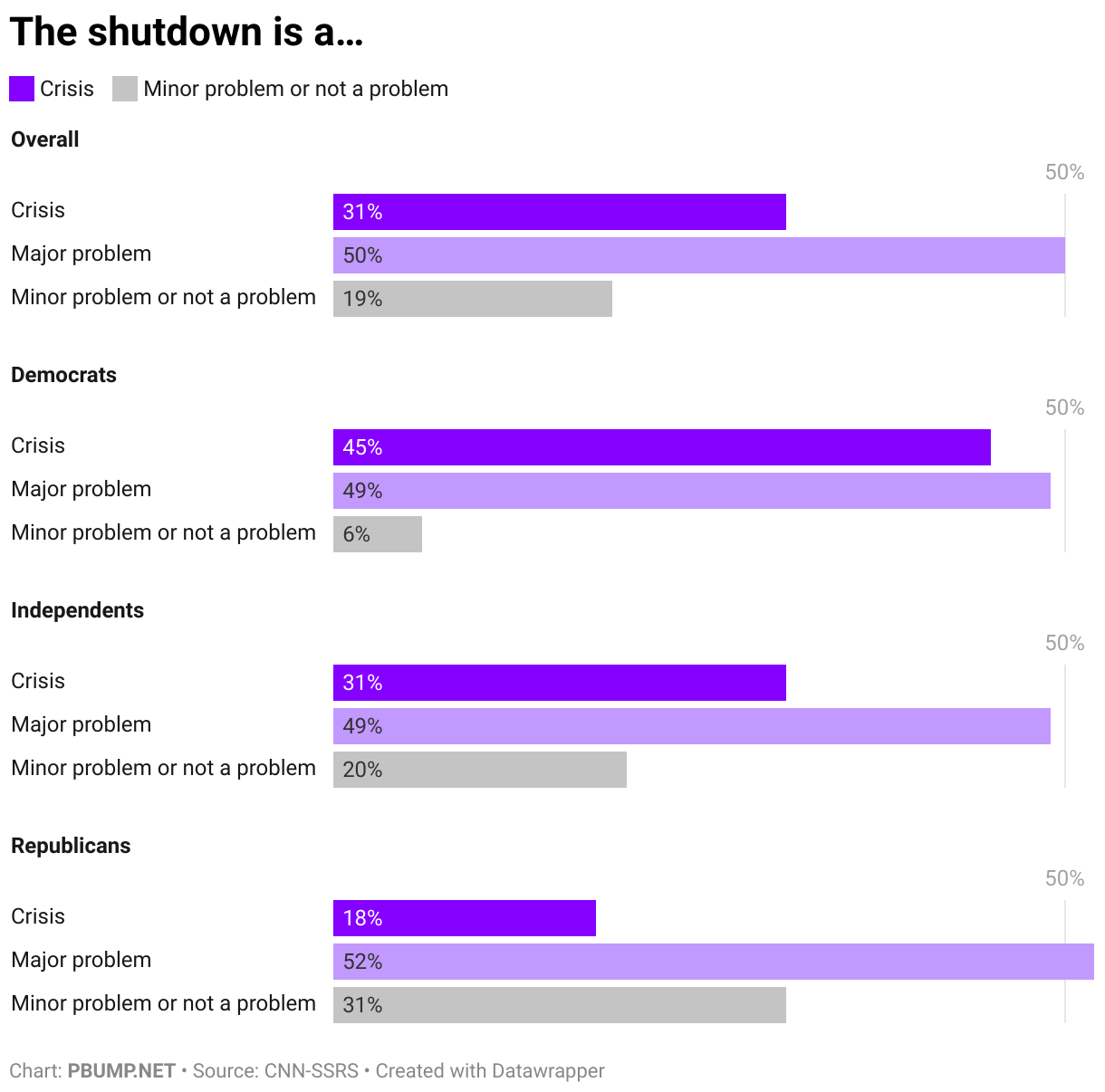
Polling conducted by SSRS for CNN in late October found that most Americans, including most Republicans, view the ongoing shutdown as at least a major problem, with 3 in 10 Americans viewing it as a crisis.
Again, that was before this week. It was also already the case on Election Day that Americans were more likely to blame Trump and Republicans in Congress for the shutdown. Polling from NBC News makes that clear.
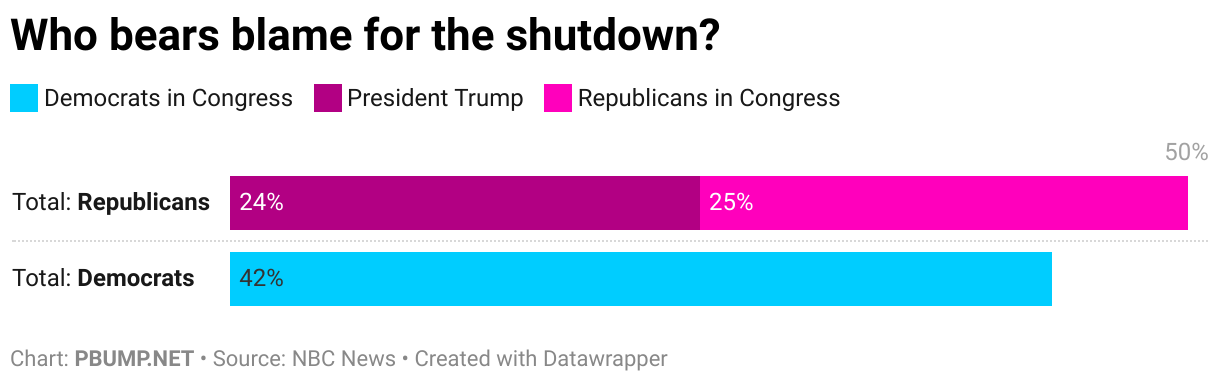
Granted, the difference between the parties was relatively narrow, as it was when CNN asked whether respondents approved of those groups’ handling of the shutdown. A majority of respondents disapproved of Trump, Republicans and Democrats.
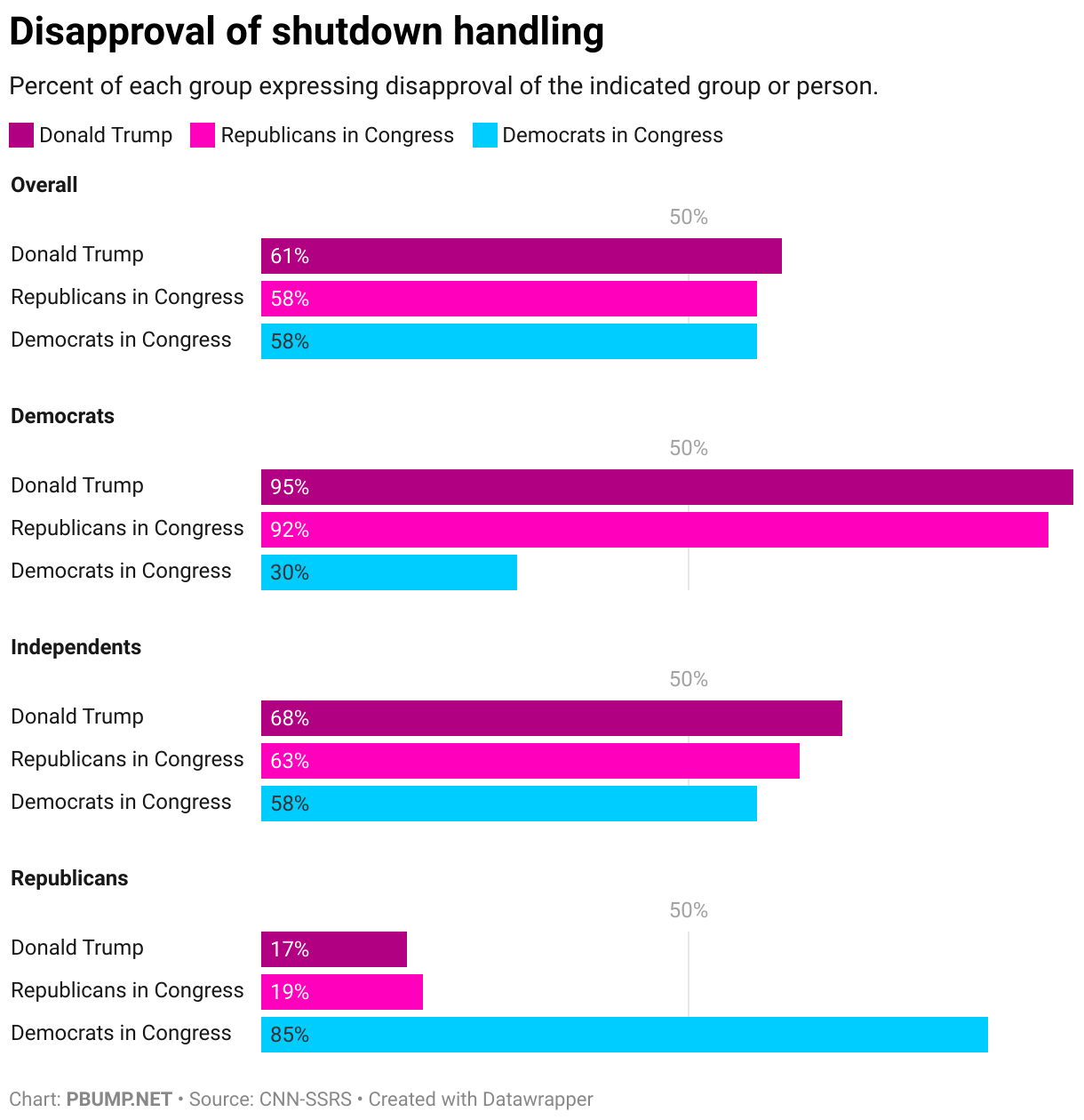
Clearly, Republicans think that they can shunt blame for the negative effects of the shutdown onto the opposition.

“The Transportation Secretary yesterday said 10 percent of flights are going to have to be cut back because we don’t have enough air traffic controllers,” House Majority Leader Steve Scalise (R-La.) said this morning, “because Democrats chose not to pay them.” That was the gist of Duffy’s Fox News appearance, too: Democrats were forcing a “not-great situation” on the public.

Maybe that will work. It will certainly work in the right-wing media bubble that Fox News and the administration so assiduously inflate. If your media allies let you wave off an electoral decapitation as “blue states being blue states,” they’re probably going to be fine with echoing your insistences that it’s the Democrats fault that the Republican-run government isn’t delivering.

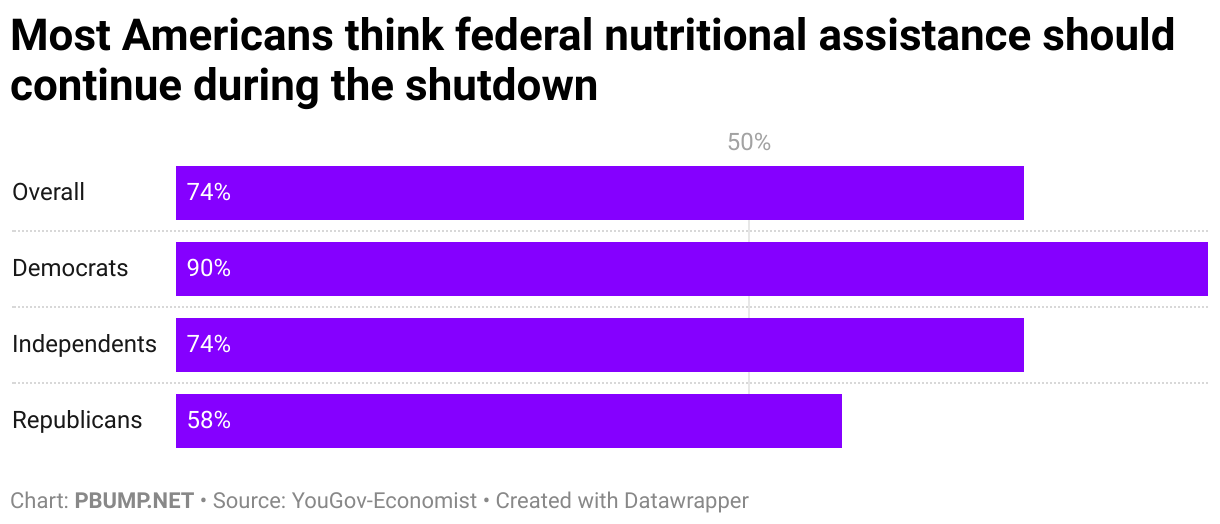
Not sure that will play well in general, though. For example, there are millions of people in red states and districts with Republican legislators who rely on supplemental nutrition assistance programs (SNAP) from the federal government — assistance that Trump has said he doesn’t want to provide during the shutdown. But according to YouGov polling three-quarters of Americans, including 6 in 10 Republicans, think he should.
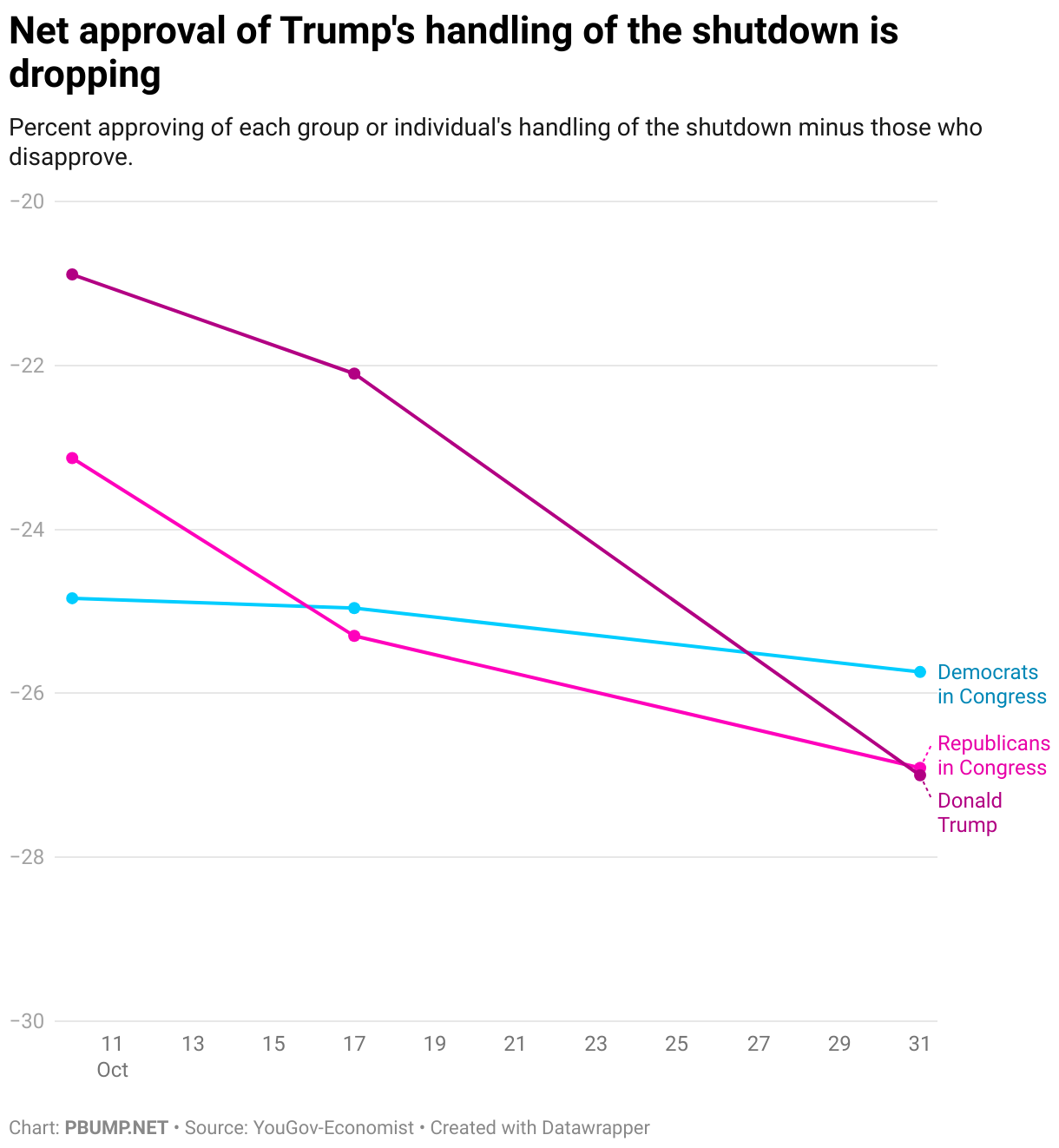
Again, even before SNAP was halted and before the flight cancellations, Americans thought Trump and Republicans were doing a poor job of handling the shutdown. YouGov shows how quickly perceptions of Trump and the GOP’s performance have been slipping.
What’s interesting about this moment is that it marks one of the first points at which Trump’s upending of traditional practice becomes immediately tangible. He imposed (and removed and re-imposed) tariffs that drove up costs for Americans, but that has been slow to effect the broader economy and plucks money out of Americans’ pockets relatively discreetly. He slashed foreign aid and research spending but those, too, had non-immediate repercussions for most people. But the shutdown — which he himself says his party can end — is obvious and instant and increasingly so. There’s no wondering when the other shoe will drop. It’s wondering how many shoes will drop and who they’ll crush.

The pain is expanding. Trump and his party have ownership over it. At some point, the president might want to spend less time thinking about the ballroom or the arch or his extravagant parties or the bathroom renovation or gilding the Oval Office or ducking out to play golf and figure out how to actually run the federal infrastructure that he was elected to run.

Photo: The president shows gold things in a gold room to bored people. (White House/Flickr)

What changed in Virginia

I am by no means the only person to have made this observation, but the point at which I knew Kamala Harris was in trouble last year was when the results in Virginia weren’t immediately obvious. As the hours dragged on, the fact that a state her ticket had won by 6 points four years prior was too close to call suggested that the shift away from the Democrats was larger than what had been expected.

On Tuesday, the state shifted back.

There’s been a lot made (including by yours truly) about the scale of the shift in Virginia. There’s a reason for that: in addition to being one of the few places where there were statewide races on the ballot, Virginia (unlike New Jersey) has a lot of counties and cities that represent different demographics and political tendencies. In other words, you can more easily get more detailed information about what happened in Virginia than you can for a lot of the other races that unfolded on Tuesday.

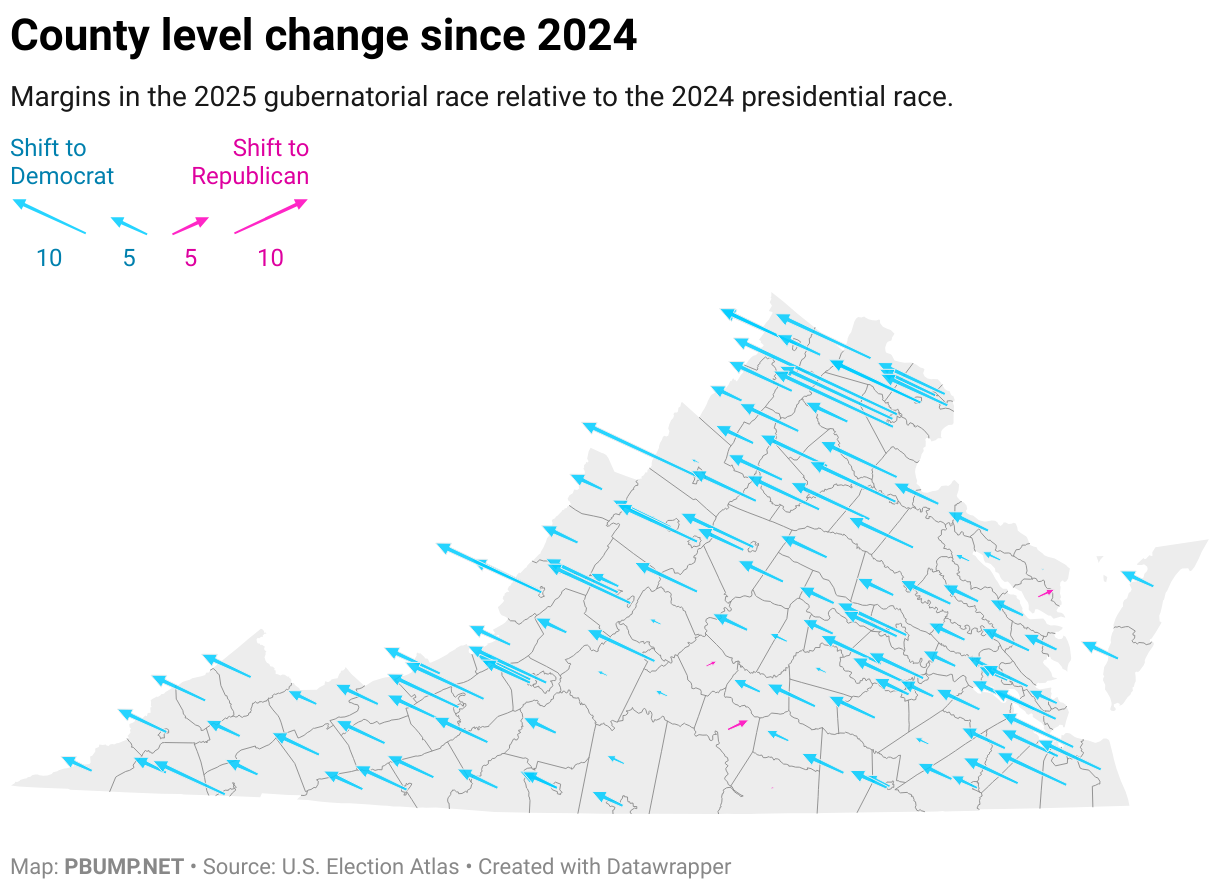
And, again, the shift since a year ago was dramatic. As of writing, there were only four counties or cities in the state that shifted to the right relative to the 2024 presidential election. In all of the 120-plus other places, the shift was to the left.

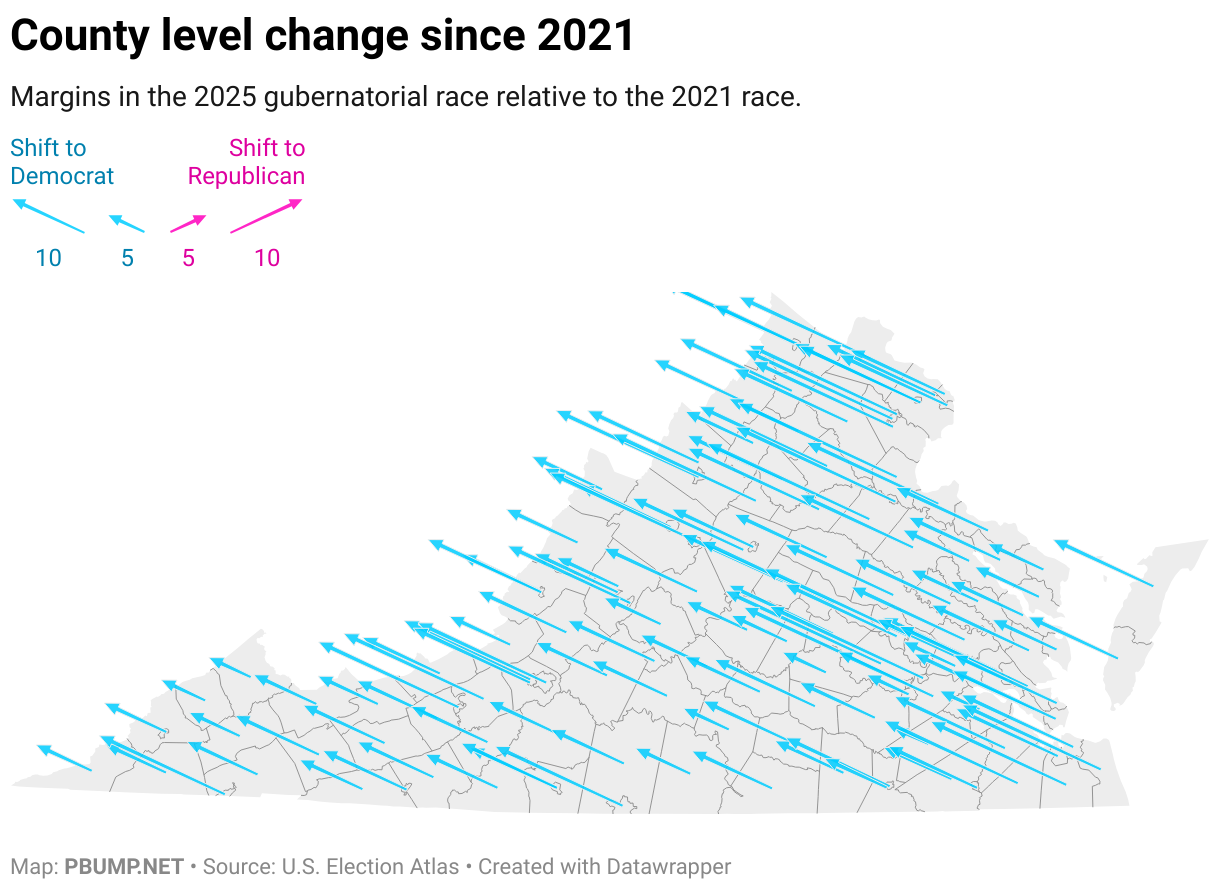
But the shift since the gubernatorial race in 2021 was even sharper. There were no counties or cities (as of writing) that moved right relative to four years ago. On average, they instead moved 13 points to the left.

You can see that on the (laughably huge) chart below. In 103 of the 133 counties and cities, 2021 saw the biggest margin for Republican candidates of any presidential or gubernatorial race since 2012.

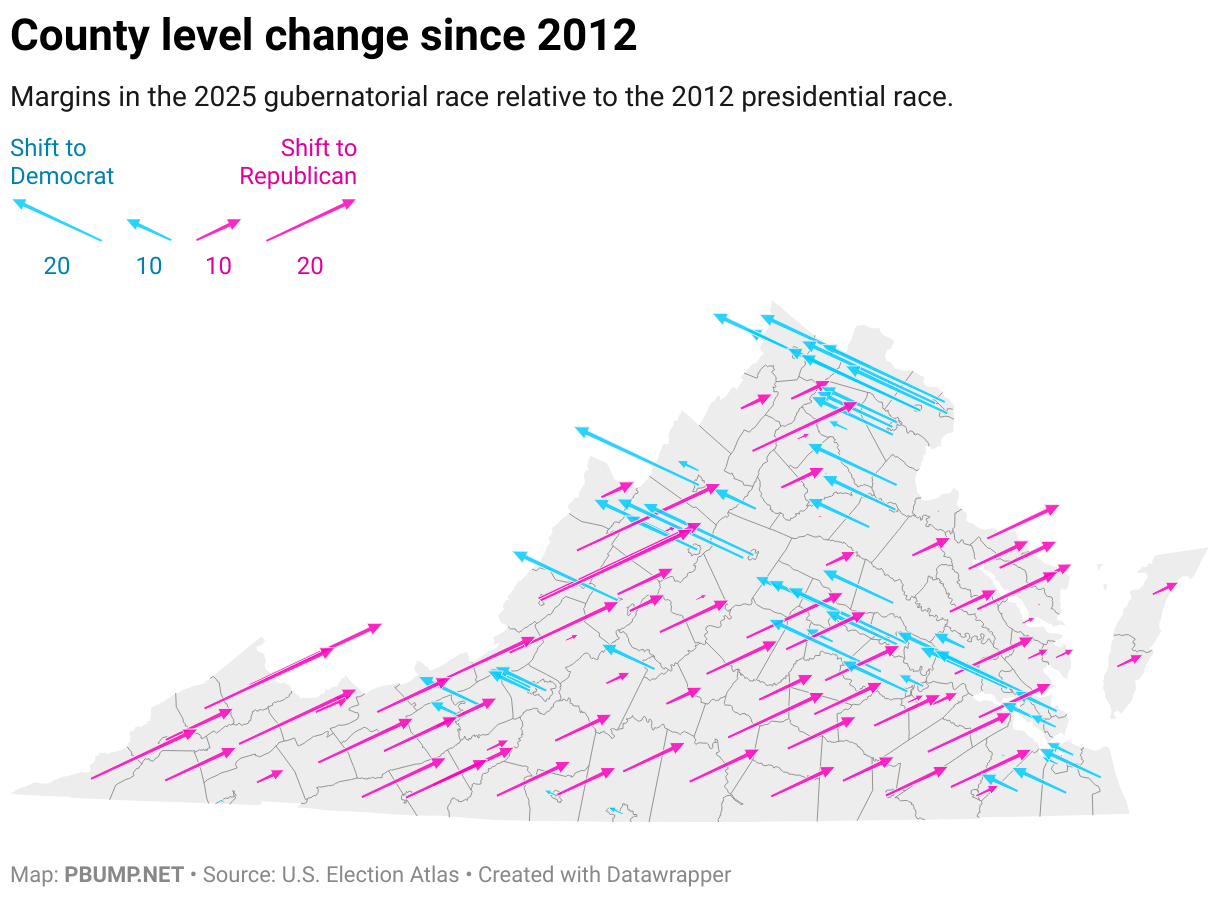
If we compare the 2025 results with the 2012 presidential election, we can see the broader patterns that helped turn Virginia from reddish to bluish 20 years ago. Big shifts to the left particularly in the northern, D.C.-adjacent parts of the state. Big shifts to the right in more rural parts of Virginia, particularly the Appalachian west.

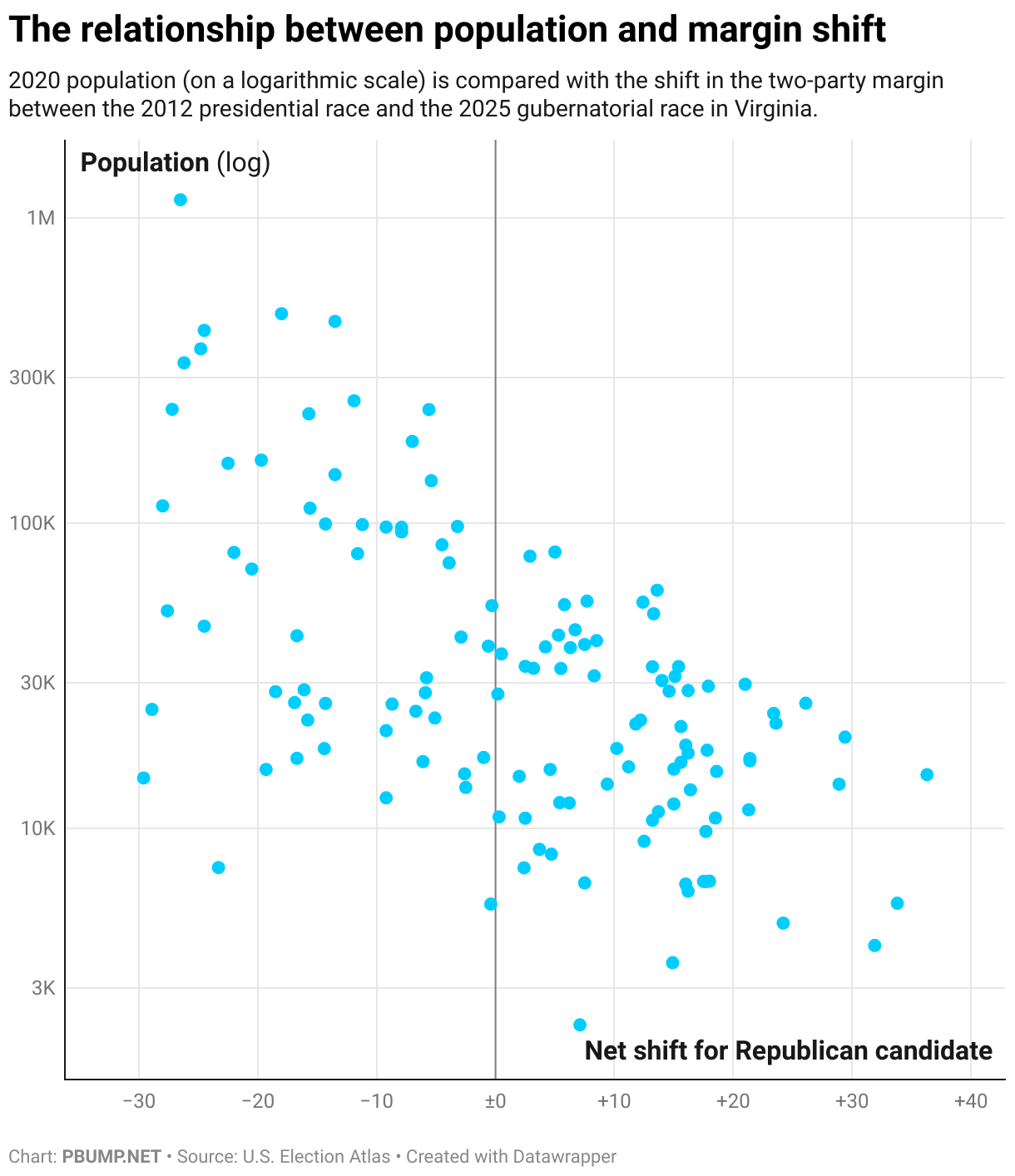
Since 2012, 75 of the 133 counties and cities in the state moved to the right. But the places that moved to the left have a lot more people.

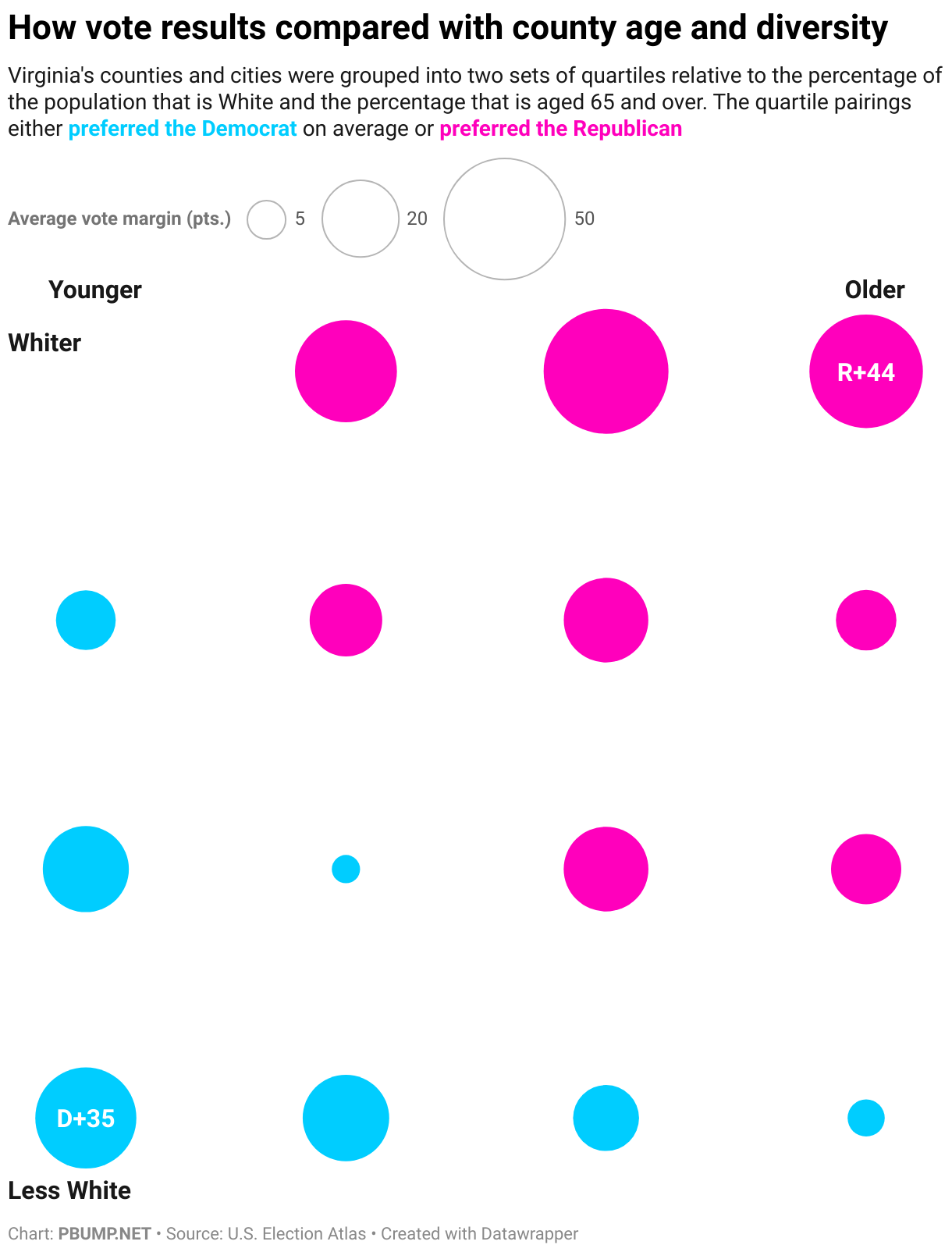
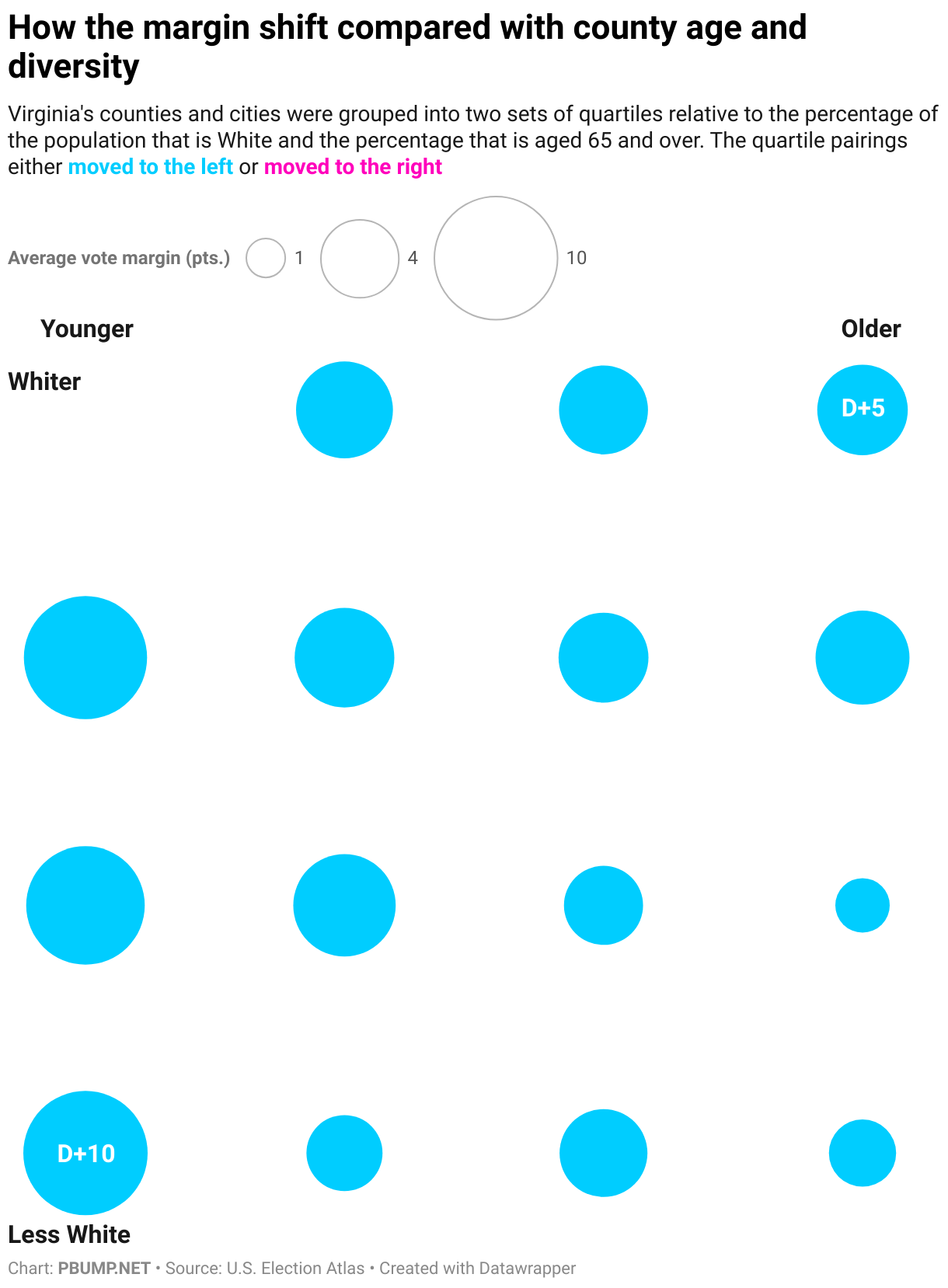
One of the questions about the shift from 2024 to 2025 that Virginia can help answer is whether Trump’s improvement with younger and non-White voters (improvements that overlap) eroded this time around. If we group Virginia’s counties and cities into quartiles by age and diversity — that is, four groups from smallest to largest elderly population and four from lowest to highest White percentage — we can get a sense for what shift might have occurred.

For example, the oldest and Whitest counties voted for the Republican candidate by an average of 44 points on Tuesday. The youngest and least-densely White counties backed the Democrat by an average of 35 points.

(Importantly, there are 12 times as many people in the younger/less-White counties than the older/more-White ones.)

If we look at the average margin shift, the young/less-White counties moved the left twice as much as the older/more-White ones.

As you can see, given that the circles at left are so much larger than the ones at right, this was heavily a function of there being bigger shifts among younger counties. Age and party choice do tend to correlate (which is a subtle way of saying that older people are more likely to be Republican), but we’re talking about shifts in margins here, not vote totals.

The data from Tuesday night are literally incomplete, though it’s unlikely the vote totals will change substantially. It is likely, though, that we’ll learn more about the political shifts that occurred over the past 12 months as weeks and months progress. For now, we can simply say that 2021 was a high-water mark for Republicans in the state since 2012, with data indicating a particular shift back to the left among younger voters since 2024.

Incidentally, while 2021 was the Republican high-water mark, 2025 was the high-water mark for Democrats in about half of Virginia’s cities and counties. (For the other about-half, 2012 was the high-water mark.) From 2021 to 2024, all but four counties and cities in the state had already shifted to the left. Then all but four counties (different ones, if you were wondering) shifted further to the left in 2025.

The question is: What will the shifts look like 12 months from now?

Photo: The University of Virginia, seen from the air, 1934. (National Archives)

Democracy is diversity

It seems likely that, once all the votes are in, somewhere around 10 million Californians went to the polls on Tuesday. That’s well short of last year’s turnout of more than 16 million, but last year there were a lot of things on the ballot, including the election of the next president. This year, in many parts of the state, there was only one thing on the ballot: a ballot initiative that would redraw congressional districts. And two voters showed up for every three Californians who voted for president in 2024.

It’s because of how that 2024 presidential race turned out. Donald Trump won, as you probably heard, and returned to the White House seemingly hell-bent on reshaping the entire country to match his vision of a centrally White, centrally planned extension of the Trump Organization. Realizing that midterm elections often go badly for new presidents’ parties, Republican state legislators began trying to wring a few extra House seats out of Census data where they could in order to help cement that vision.

California’s Prop 50 was an explicit response to the GOP’s effort to game the rules rather than win votes. More broadly, it was an opportunity for Californians to take action in opposition to the Trump administration, and they were very clearly happy to do so.

By the time Prop 50’s passage was announced — immediately upon polls closing in the state on Tuesday night — it was already clear that the night would be a big one for Democrats and a bad one for Donald Trump. In Virginia, Democrats swept statewide elections and added double-digits to their legislative majority. An expected-to-be-close gubernatorial race in New Jersey wasn’t. Democrats held three Supreme Court seats in Pennsylvania easily. It was already going so badly that Trump preemptively popped up on social media to insist that the fault lay everywhere but with him, a sure sign that it was his fault.

While the scale was surprising, the outcome wasn’t. One of the easiest-to-predict eventualities after Trump eked out his victory in 2024 was that the pendulum would swing the other way. It was inevitable that the narrative of Trump reshaping the electorate and blah blah blah would be rendered lame by a big Democratic night. This is how politics works: A thing happens and people draw sweeping assumptions and those assumptions then get swept away.

That said, while the night was a success for myriad Democratic candidates and issues, it’s not clear how much success it augurs for the Democratic Party. It is the party’s job, after all, to collect and retain power for its members and its candidates. As we have seen repeatedly in recent years, repeated moments of backlash against Trump have not necessarily meant increased aggregated power for the party.

This is clearly due in part to the fecklessness of the party’s leadership, which in turn is due (in part) to the way in which the American political terrain has shifted away from the dynamics to which these established figures had grown accustomed. They’ve been doing politics one way but politics has changed. Their values and policies align with young people, particularly young women, but young people are at best apathetic about committing to the party as an institution.

It very much doesn’t help when, for example, the top Democrats in the House and Senate refuse to treat the winner of New York City’s Democratic mayoral primary as legitimate. We get it; Zohran Mamdani is a Democratic Socialist, an outsider to the establishment. But he won an easy victory in the primary and built a campaign in which young New Yorkers in particular were institutionally invested. His victory on Tuesday — winning a majority of votes, with the largest vote total since the 1960s — didn’t see as big a margin as Abigail Spanberger’s gubernatorial win in Virginia, but she wasn’t running against two people, one of them the state’s former governor.

In his victory speech, Mamdani challenged the Democratic Party and its leadership.

“If tonight teaches us anything,” he said, “it is that convention has held us back. We have bowed at the altar of caution, and we have paid a mighty price. Too many working people cannot recognize themselves in our party, and too many among us have turned to the right for answers to why they’ve been left behind.”

His latter point is obviously true. But it’s the highlighted part that’s interesting.

Mamdani is saying that the Democratic Party has been too timid. He’s echoing the argument that the party has tried too hard to triangulate its politics to public opinion, approaching campaigns the way a helicopter parent approaches a playground. He’s siding (as one would expect) with the left in the left-vs.-centrism bickering that’s consumed Democratic political discussions since 2024. Give or take a few decades.

One thing the results on Tuesday can show us, though, is that this is a false choice. Mamdani won while embracing left-wing policies and politics in New York City. Spanberger won while running a more moderate campaign in Virginia. Democrats won in a lot of places while running a lot of different campaigns. This was in part because, like in California, they provided an opportunity for voters to rebuke Trump. But they still won.

It is a reminder that democracy is centered on diversity. Democracy is the idea that people from various backgrounds can unite and decide on common leadership that represents them — meaning them in their town or their county or their state. Maybe the president isn’t someone you agree with or maybe your city councilman isn’t, but democracy provides the opportunity for everyone’s voice to be heard on the subject.

Particularly at the moment, this seems like a valuable idea for the Democratic Party itself to lean into. Trumpism is about homogeneity, about forcing Americans into his views and his systems. His panicky response to the results on Tuesday reinforces how uncomfortable he is with divergent viewpoints and centers of power. The Democratic Party could easily position itself as the home of diverse argument and diverse policy positions reflecting America’s diverse population — a rejection of the uniformity Trump wants to impose. It’s the party of Spanberger and Mamdani, not the party of Donald Trump and various Donald Trumps Jr.

The centrists will say that this is what they’ve been advocating all along: tailoring message to the electorate. But they often argue that point while conceding two inconcedable points.

The first is that this means the party should be willing to backtrack from or downplay support for civil rights if that support is politically fraught. But a party centered on America’s diversity needs to be predicated on bolstering and supporting rights for every American. You can’t be a party that stands for diverse voices and the party that agrees to allow some of those voices to be muffled.

The second unacceptable concession is that national rhetoric should drive candidate campaigns. It is true, as I’ve written, that political rhetoric at all levels of government is largely driven by national issues and debates. It is also true that the right has gotten very good at taking individuals with less-popular views and making them avatars for the left as a whole.

Democrats and the broader left have not yet figured out how to counter this (in part because some of their allies don’t always mind doing the same thing.) But this is precisely why the approach is unsustainable. You cannot pin your politics to a national conversation that your opponents control. Nor can you make political decisions that are eternally popular. Backing the Iraq invasion in 2003 or supporting trans rights in 2016 were positions that had become difficult to defend five years later. The altar of caution is unstable.

If, instead, your approach and your party’s approach is that you are a big tent that is centered on democracy and diversity? You have a built-in response to efforts to nationalize your views: That’s New York, not Richmond. Our community’s priorities and theirs are different. Our party provides the space for Americans to make different choices in different places. I and many other have observed that the Democratic Party, needing to win with diverse populations in diverse places, has to be a big-tent party. So why not center that at the heart of the party’s rhetoric?

You can see how such an approach would work on nights like Tuesday. How it did work, if tacitly. But it has a broader advantage, given that it reflects the promise and values of America itself — or at least of the America that we understood to exist until noon on Jan. 20.

Ten million Californians came out to stand up to Donald Trump. A million New Yorkers voted for Mamdani. Two million backed Democrats in New Jersey and Virginia. Diverse candidates, diverse issues, overlapping but distinct priorities. It was a good night for big-D Democrats and for little-d democracy. Perhaps the party should sew those things together.

Photo: A polling place sign in Virginia. (Mrs. Gemstone/Flickr under Creative Commons license)

Here’s how many people use SNAP in Republicans’ districts

President Trump has announced (on social media, naturally) that his administration will continue to withhold Supplemental Nutrition Assistance Program (SNAP) funds during the government shutdown despite:

  1. a court order mandating that the funds be provided, and
  2. the fact that millions of Americans who depend on the assistance (often known as food stamps) live in districts that voted for him and/or are represented by Republicans in Congress.

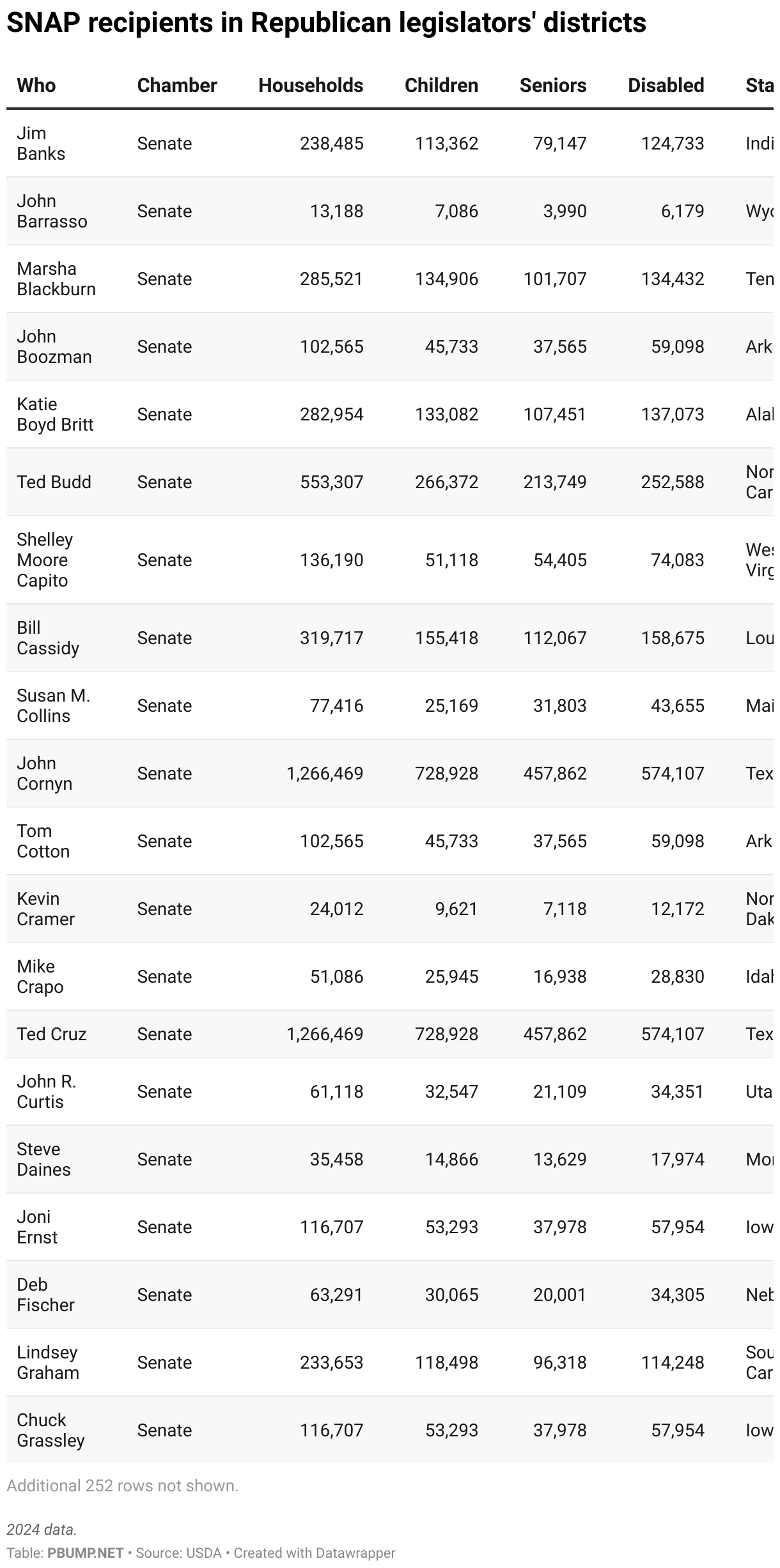
It’s probably safe to assume that those legislators know what a bind Trump’s putting them in. According to my analysis of 2024 SNAP data from the Department of Agriculture, the average Republican in the House has 33,500 households in his district that receive SNAP benefits. That includes an average of 16,000 children, 13,000 seniors and 17,000 people with disabilities who rely at least in part on federal support to pay for food.

For Senate Republicans, the numbers are even larger. On average (which is skewed higher by states like Texas and Florida, admittedly), Senate Republicans have 267,000 SNAP-receiving households in their states, with 127,000 children, 104,000 seniors and 131,000 people with disabilities who will see nutritional assistance vanish.

If you’re curious how many SNAP recipients live in a specific Republican legislator’s district or state: here you go. A sortable, searchable table with those answers. (By default, it shows senators and then representatives in alphabetical order).

Just in Republican-represented House districts, there are 7.3 million households, 3.4 million children, 2.9 million seniors and 3.7 million people with disabilities who used SNAP in 2024. But now — thanks to the Republican president’s interest in using SNAP as a lever to get Democrats to fold on the shutdown — they apparently won’t receive any.

Photo: A grocery store in 1936. (National Archives)

Someone finally asked Americans if they knew who was president when

One of the central questions of American politics at the moment is a complicated one: Who was actually president when bad things happened?

Who, for example, was president when the country instituted restrictions meant to curtail the spread of the coronavirus? Who was president when special counsel Robert Mueller was appointed? These are complicated questions that no one can really answer. (Try your luck at doing so!)

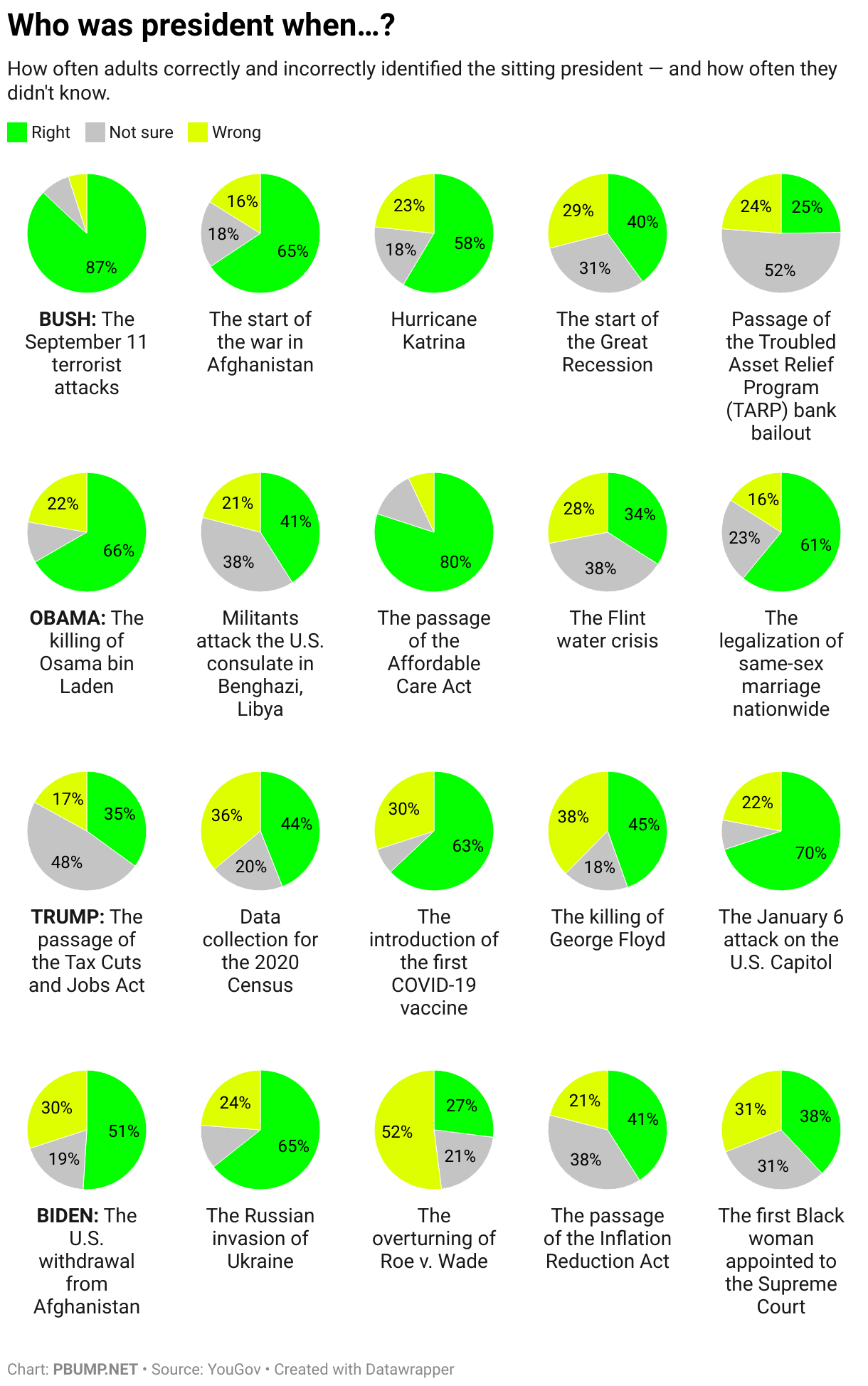
Given how hard it is to know what exactly happened three or four years ago, the team at YouGov decided to put Americans to the test. Presented with 20 major events over the course of the past four presidencies, how often could average people actually identify the sitting president at the time? Could they succeed where so many pundits and sitting presidents have failed?

The answer, I’m pleased to say, is yes. Out of those 20 events, a plurality of Americans identified the correct sitting president 19 times. We’re grading on a bit of a curve here, since there were some events (like the 2008 bank bailout) where most respondents, not just a plurality, weren’t sure when exactly it occurred. Other than that, though, we (Americans) did OK.

What was the one event where Americans were more likely to guess the wrong president than the correct one? The Supreme Court’s 2022 decision to reverse Roe v. Wade. Instead of correctly identifying Joe Biden as the president when that happened, a plurality (and nearly a majority) instead attributed it to the guy who made it happen, Donald Trump.

In fact, it’s interesting to consider not just how often Americans correctly identified the sitting president but also to see who they incorrectly thought was in the White House when these events occurred. Below, you can see the distribution of answers (among those who didn’t say “not sure”).

On some (9/11, Obamacare), there’s little question. On others, like the Flint water crisis, no one seems to be really sure at all.

It is also interesting to compare responses by party. There’s a pattern here: partisans are more likely to say that a negative event occurred under one of the opposing party’s presidents. (See “start of the Great Recession,” for example, or “Ukraine invaded.”) Even so, a plurality of partisans on both sides were still generally able to identify the correct president for each event, except for the repeal of Roe.

There are also divides by age, as you might expect. Younger people, with fewer political events to remember, often did a better job identifying the correct president. (Notice how often the purple circles extend outside the orange ones for incorrect answers below.)

In fact, respondents aged 18 to 29 were the only age group to correctly identify Biden as the president when Roe was overturned — though only by a hair.

Anyway, the important takeaway here is that, for the most part, Americans actually do know who was president when major events happened and, therefore, who deserves credit or blame should such assignments be important. Sure, partisans try to shift things toward or away from their own team, but overall adults in the U.S. got the answer right.

If only pundits and the president were so adept.

Photo: The White House. (Chuck Kennedy/National Archives)