The threat to elections heats up

Over the past few days, President Trump has returned to one of his central animating issues: purported threats to the security of American elections. He has repeatedly claimed that elections at the local, state and federal level are suspect, exclusively reserving those accusations for elections in which his allies have lost and reserving nearly all of his energy for elections that he himself didn’t win.

The most obvious example is the 2020 presidential race. Trump lost that contest, unquestionably. We know this in part because the results were unambiguous and relatively quick to be finalized. But we know it primarily because Donald Trump and everyone into his outer orbit spent an enormous amount of money and time and energy trying to prove that he didn’t lose, without success. There were movies about how the election was stolen, and there were books and there were conferences and there were probably more social media posts than exist atoms in the Washington Monument, but at no point did anything emerge that suggested that even questions about the election were legitimate, much less anything showing that the election wasn’t.

Yet Trump has recently returned to this idea that he was the true victor in the 2020 election, even as he’s outlining steps that would make future elections — including those in 2026 and 2028 — less free and less open.

After an FBI gambling bust that swept up some prominent names in the NBA, Trump suggested on social media that the cheating involved in that case could hardly compare to what he falsely described as “Democrats cheating on Elections.”

“The 2020 Presidential Election, being Rigged and Stolen, is a far bigger SCANDAL,” he wrote, also targeting mail-in voting like that used in California’s elections. The upcoming referendum that would allow the state to redraw congressional lines — thereby adding Democratic seats — was “totally dishonest,” according to the president, with “Millions of Ballots being ‘shipped.’ “

He presumably means that at-home voters are being sent ballots, which is legal, legitimate and has not been demonstrably tainted by significant fraud. But he knows that many of those voters are Democrats and so, as he did in the months before the 2020 contest, he’s arguing that those votes should be considered suspect from the outset.

It was announced last week that the Justice Department would monitor polling places during upcoming elections in California and New Jersey, an announcement that is doubly nonsensical. First, monitoring polling places won’t do much to catch anyone sending in an illegal ballot through the mail (not that any significant number of such people exist). Second, there’s no rampant in-person fraud to detect, meaning that observers will see nothing at all — or, more alarmingly, generate false alarms about legitimate voters that have the effect of scaring people away from casting a ballot.

The GOP has been smacked for similar behavior in the past. After an effort to police voting in the early 1980s (in New Jersey, in fact), the Republican Party was blocked from poll watching activity until 2016. But that restriction lapsed and the party tasked supporters with watching polls when Trump was on the ballot, including when he lost.

The chilling effect that could result from the efforts this year could be particularly robust. After all, this is a moment in which officers from across the government, including the FBI and Justice Department, are snatching up dozens of people every day. They’ve been cleared by the Supreme Court to target people based on ethnic appearance, and they are. They’ve also detained scores of U.S. citizens. Imagine the effect of plunking a few guys in face masks and FBI vests outside a polling place in a heavily non-White part of Newark or Los Angeles.

In another social media post — which begins with the claim that he had won “THREE Elections, BY A LOT” — Trump suggests that he’s seeing “the best Polling Numbers that I have ever received.” Yet, he complains, “Radical Left Losers are taking fake ads, not showing REAL Polls, but rather saying that I’m Polling at low levels. … These ads should not be allowed to run because they are FAKE!”

Conservatives once successfully convinced the Supreme Court that political ads from outside parties were protected speech. This proved a boon to the party and to Trump. But ads critical of Trump are obviously not the sort of thing to which he extends any grace. Maybe the administration won’t be able to block critical ads, but we can assume — given the trajectory of this year — that he’ll be able to intimidate TV stations and networks into pulling them down in order to avoid spurious lawsuits and public attacks.

Perhaps the most important point here is that Trump wants to ban ads that are telling people the truth. It is not the case that he’s seeing “the best Polling Numbers he has ever received.” His current numbers are, in fact, pretty unexceptional.
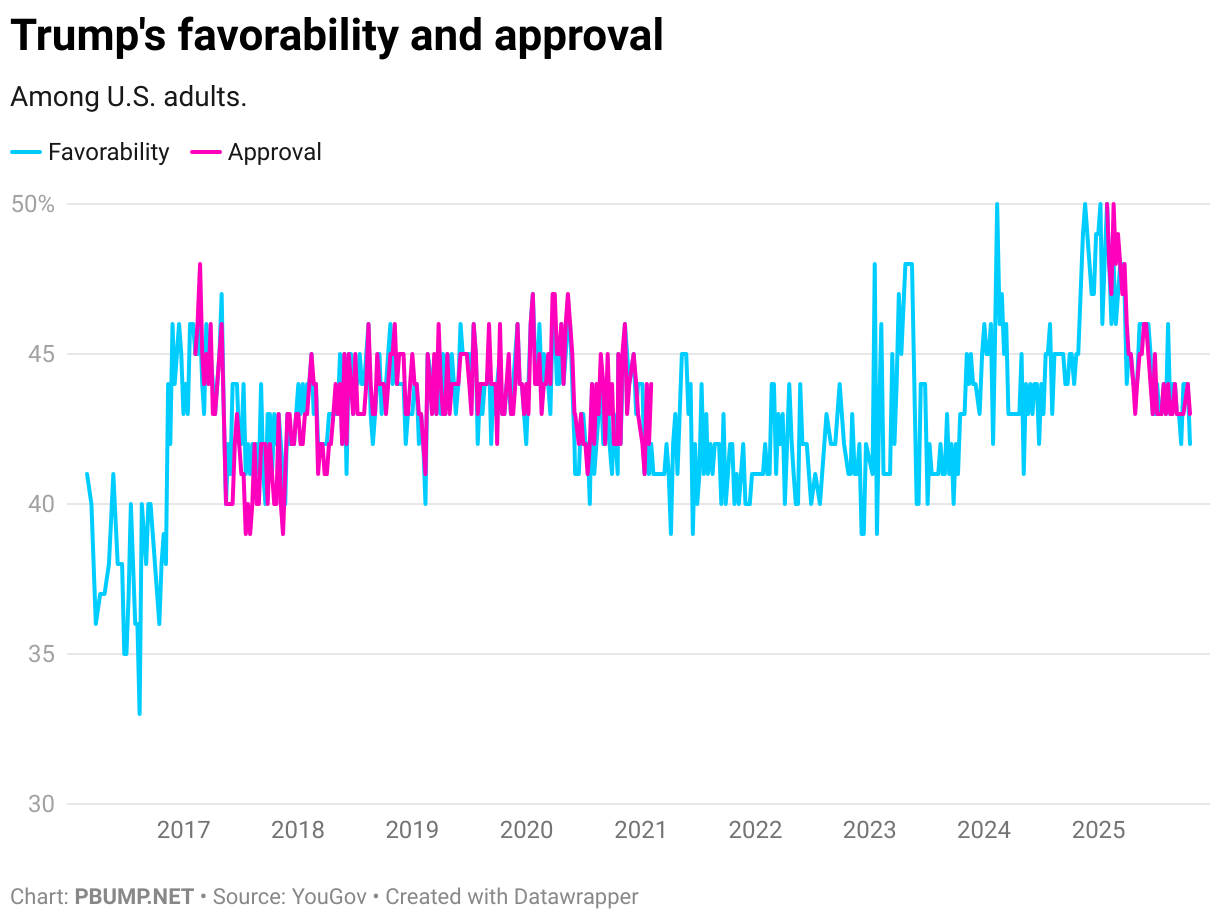
In other words, the predicates for his demands are false. It’s not true that he has great polling numbers that are lied about. It’s not true that there is rampant fraud — or even modest fraud! — that’s negatively affecting his and his party’s chances. These are simply pretexts, reasons offered for the administration potentially attacking advertisers and already intimidating voters. As with the troops on the streets of D.C., the administration action is its own reason; the ex post facto rationale is window-dressing meant to excuse the action. It’s analogous to Trump’s response to 2020, in fact. He already had his conclusion and he and his allies worked awfully hard to find any evidence for it.

Here, the actual point is obviously to put his thumb on the electoral scales. He doesn’t care about winning a free and fair election. He just cares about winning an election. So he invents reasons that he can push the elections in the way he wants them to go.

Everything downstream from a lie is illegitimate. And in the critically important realm of voting and elections, Americans should be clear-eyed about what’s happening.

Image: Section of a propaganda poster released in Asia in the 1950s. (National Archives)

Remember the House?

There is a certain rhythm to the way in which the House of Representatives conducts its business.

The House begins each year with a few weeks of voting before cutting out for an extended Easter break. Then they come back, spend a few more weeks doing things and then taking a lengthy break for August. September is often spent finalizing spending for the next fiscal year, which begins on Oct. 1.

After that’s done, things get patchy. In years with midterm elections, the House tends to take most of October off so that they can head to their districts and convince people to re-hire them for their jobs. It’s a bit like knowing that you have an upcoming performance review with your boss so you skip work for three weeks to figure out how to convince her how good at it you are.

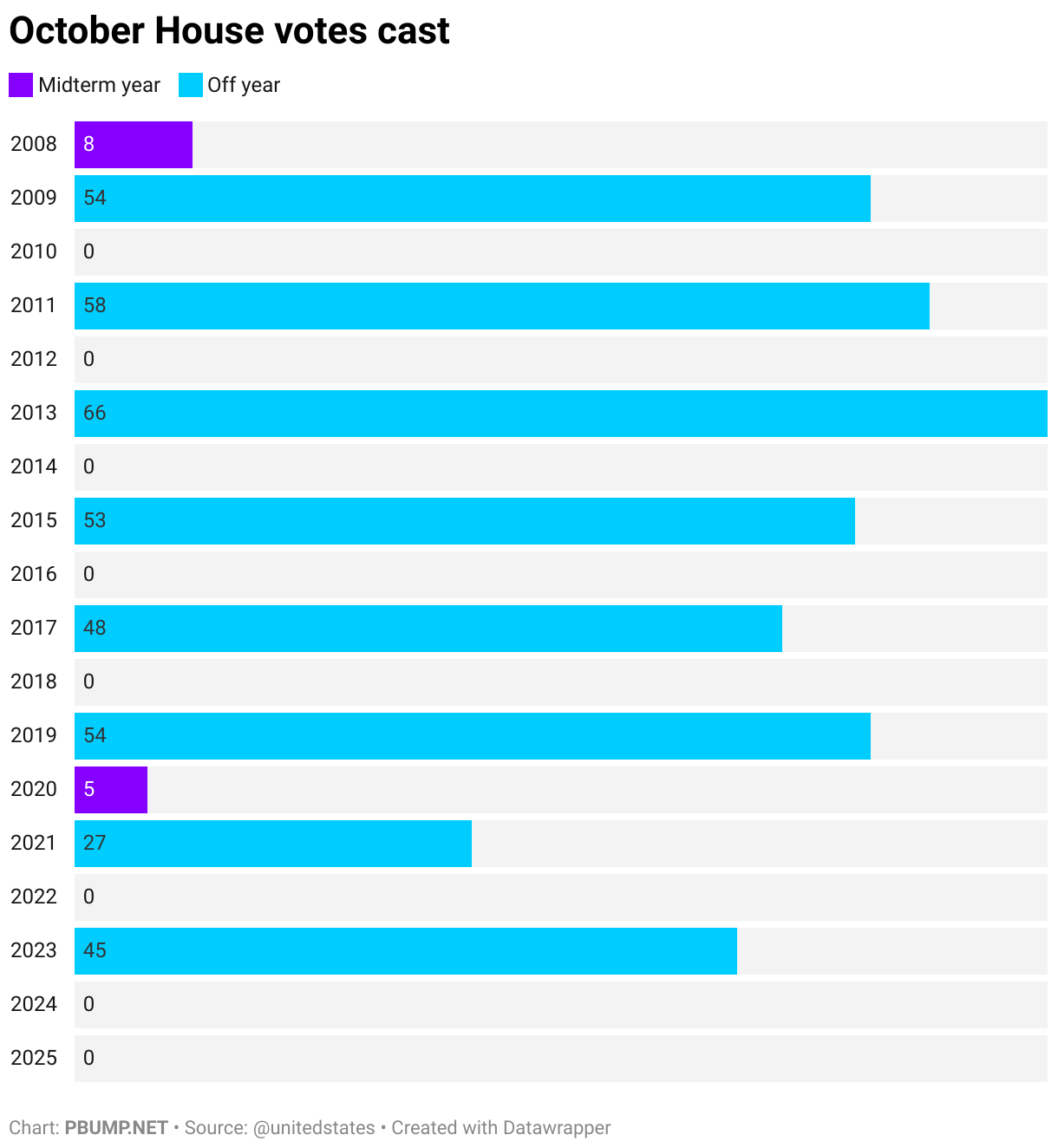
Then, a few more weeks of voting and that’s that. Visualized, the pattern looks like the chart below.

You might notice something odd about that chart. There are years with unusual blank periods, like the stretch in 2020 when there weren’t many votes cast thanks to the advent of the coronavirus pandemic. But there’s also a significant stretch in the far-right column — that is, this year — during which no votes have been taken.

Since 2008, the House has cast an average of 91 votes from Aug. 1 to Oct. 31. This year, the House has cast only 64. What’s more, the House has cast no votes since Sept. 19. Since 2008, the House has cast an average of 55 votes from Sept. 19 through Oct. 27, the only exception being in the midterm election year of 2014.

Again, midterm years are an obvious exception. But this isn’t a midterm year.

It’s not as though they weren’t planning to go into session, to pass legislation and resolutions. House Majority Leader Steve Scalise (R-La.) released a calendar earlier this year that showed the House spending 16 days in session this month. That has not happened.

Perhaps it’s because of the government shutdown, you might be thinking. Well, even when the government was shutdown in October 2013, the House was still casting votes and still showing up to work.

The work stoppage really began a bit before Congress’ failure to finalize a spending bill. Sept. 19 was a Friday. The following Tuesday, Sept. 23, Adelita Grijalva won an election to represent Arizona in the House. Ever since, she’s been waiting to take her seat and, ever since, there have been no votes taken.

Conspiracy theorists will note that Grijalva’s election meant that there are now 218 representatives and representatives-elect who support a petition that would force the release of files related to Jeffrey Epstein. But I’m not a conspiracy theorist, so feel free to run with that if you’d like.

Speaking to the press on Monday, House Speaker Mike Johnson (R-La.) was asked why he wouldn’t bring members back to DC to do the work of governance — even work that isn’t voting-related. Johnson insisted that he was eager to bring people back to “regular legislative session,” but that this couldn’t happen while the government was shutdown, for some reason.

Of course, it may not be entirely up to him.

“I’m the speaker and the president,” President Trump is reported to have said, recognizing that his grip on the House Republican caucus, like his grip on Republicans generally, is much tighter than the speaker’s. And with the House out of session and the government shut down, Trump has an excuse (albeit not a valid one) for sidestepping the appropriations process and refusing to disburse money as he is obligated to do. What incentive is there for Trump (and therefore Johnson) to get back to normal, much less to seat another Democrat?

So here we are, with the members of the federal government specifically tasked with representing the people sitting at home while the president does what he wants.

Photo: Trump and one of his staffers. (White House/Flickr)

The weakest possible rebuttal to the ‘No Kings’ criticism

Meghan McCain would just like someone to explain something to her.

A “nepo baby” (using her own words) born of American political royalty, McCain last week expressed bemusement at the then-looming “No Kings” protests against the Trump administration.

“I don’t understand how Trump is a King,” she wrote, “when he won every single swing state, the electoral college and popular vote in a democratic election.”

On Thursday, historian-turned-Fox-contributor Victor Davis Hanson took the idea one step further.

“So-called King, Donald Trump, ran in two contested Republican primaries,” his essay begins. “He ran three times in a general election. He was elected twice, and his party recently won a Republican Congress.”

From there, Hanson expands outward. Not only is the elected Trump not a king, he insists, but it’s Joe Biden (who, for example, “did not run a typical campaign” in 2020) and Democrats who have been engaged in king-like behavior. Biden’s “DOJ and FBI raided then-former-President Trump’s home”! His White House “helped coordinate 91 indictments” against Trump! That included charges following the Mar-a-Lago raid even though the FBI “found only 102 classified documents among some 14,000 seized”!

“A mere three days after Trump announced his reelection bid on November 15, 2022,” Hanson cries, “Jack Smith was coincidentally appointed special prosecutor of Trump.” Now that’s some king-ing!

But, of course, that appointment was the opposite of a coincidence. It occurred because Trump was running for president and the Justice Department wanted to separate its probe from the influence of the Biden administration. Many of Hanson’s other objections are equally dumb, a mix in which non-presidential actions are attributed to Biden through unmentioned intervening layers or simple presentations of right-wing frustrations as evidence to the point. He looks back over nearly 20 years, including events from the Obama administration, to present his case that “the left” are “the real kings” — a position that has not traditionally been held by collectives of individuals.

To gently explain to Hanson why Trump is being criticized for monarchical behavior, we don’t need to look back over 20 years. We can look back over 20 hours.

He unilaterally obliterated one of the three buildings that constitutes the White House, clearing space for a ballroom paid for by people and corporations looking to curry favor with his administration. He announced that, after talking with some of his friends, he wouldn’t dispatch soldiers to San Francisco in order to usurp that city’s self-governance — but he retained the right to do so in the future. He issued a pardon to a cryptocurrency executive who’d done business with the Trump family, continuing a chain of similar grants of clemency that rewarded his allies and supporters.

If you want a more fleshed out examination of Trump’s king-like actions, writer Julian Sanchez compiled a comparison of Trump’s second-term actions with the complaints against King George III that are articulated in the Declaration of Independence. The reasons the colonists gave for breaking with the British throne have numerous echoes with complaints about the Trump administration.

Of course, the “No Kings” protests aren’t really about monarchy, as such. They were given that name because Trump at one point earlier this year referred to himself as a king, inviting precisely the historical comparison that Sanchez articulates at length.

What’s actually at issue is Trump’s embrace of autocratic power. Monarchy is one flavor of that power, but it’s not really the one that Trump’s targeting. He doesn’t want to be a king; he wants to rule without checks on his power. He wants to do what he wants, to reward his friends and punish his foes, to dip into the government coffers and to make the White House literally his own. And millions of Americans don’t want him to do that.

So, yes, he won the 2024 presidential election, earning more votes than Kamala Harris and returning to the White House. But to imagine, as McCain and Hanson do, that this is the actual critique — that demonstrators are complaining that he is actually a king — is the most lightweight of straw men. It’s not that he gained power as an autocrat, it’s that he’s aggregating and deploying it as one.

It is obviously fraught to invoke events in Europe 90 years ago in conversations about American politics, in part because of the alacrity with which Trump and his allies suggest that any comparison with German fascism is an equation of Trump with Adolf Hitler. But the 1933 election in that country gets to McCain and Hanson’s point directly: The Nazi party gained power through the votes of German citizens. Hitler had already been appointed chancellor and he and his party “used existing laws to destroy German democracy and create a dictatorship,” as one history of the era puts it.

What followed began with voters operating within a democratic system. But that empowered someone hostile to democracy, who worked to coalesce power around himself instead. This is not to say that Trump’s trajectory will mirror Hitler’s. It is, instead, to say that there are examples from the historical record that make obvious why it’s hardly contradictory to suggest that a democratically elected leader might deserve criticism for steering his country away from democracy.

Someone who could attest to that directly is a Silver- and Bronze Star-winning submarine captain who served the U.S. Navy during the war to contain Germany and Japan’s fascist aggression eighty years ago. That would be John S. McCain Jr., Meghan’s grandfather.

Photo: A still from the AI-generated video Trump posted on Truth Social after last weekend’s No Kings rallies.

The president has never understood that the White House (and government) aren’t his

Even if only intuitively, Donald Trump knows that the White House is a storehouse of power. He understands that, like the government itself, it is an institution that our impartial democratic system has spent two centuries nurturing and investing in. And this is why he wants it to be his, as surely as he wants the government to be his and as surely as he wants the government’s money to be his.

There was a moment at which he tipped his hand on this, when he made explicit what had already become obvious. It came during his 2020 acceptance speech for the Republican presidential nomination — a speech that, like his Jan. 6 speech five months later, was delivered from the White House complex itself. It was a blatant violation of the longstanding expectation that the White House wouldn’t be used for political purposes, an expectation that had created far bigger headaches for other politicians who engaged in far smaller violations.

During the 2020 speech, he was reading the standard self-celebratory litany from the teleprompter when he went off script for a moment.

“The fact is, I’m here—” he said, pausing as applause from the prior line interrupted him. But then he seemed to find import in that truncated line itself. He turned to the White House behind him, gesturing at it. “What’s the name of that building?”

The crowd applauded and cheered.

“The fact is, we are here and they’re not,” he said, now speaking off the cuff. Extended applause and cheers. “To me, one of the most beautiful buildings anywhere in the world — and it’s not a building, it’s a home as far as I’m concerned. It’s not even a house, it’s a home,” Trump continued. “It’s a wonderful place with an incredible history, but it’s all because of you.”

As I was watching him say that in real-time, it struck me as important. It’s probably because, the night before, I’d written about the incredibly cynical incorporation of an immigrant naturalization ceremony — also taped at the White House — into the Republican convention programming time. It was obviously a violation of the Hatch Act, which prohibits government officials (excluding the president) from using federally funded resources for campaigning. But Trump and his team did it anyway, just as they’d repeatedly violated the Act’s prohibitions over the preceding three years.

He and they were treating the White House and the presidency as though it was theirs — and here was Trump saying that he was there, not them, in this building that he called a home. He adopted the habit of giving esteemed visitors a ceremonial “key to the White House,” as though this was something that was his to bestow — a practice he continued even after he left office.

But as egregious and unusual as those manifestations of Trump’s sense that the White House was his to do with as he pleased, it was child’s play, a microcosm of the way in which Trump has behaved since January.

First, there was the gilding, the slow and gaudy accretion of gold-tinged objects and appliqués around the Oval Office. Then there was the Rose Garden, paved over to make a patio that felt more like the places where he and his customers would congregate at Mar-a-Lago. There was the “Presidential Walk of Fame,” images representing past presidents that were added along the west colonnade seemingly meant primarily to troll Joe Biden.

Now, as you know, he has authorized the destruction of the East Wing of the White House, the visual counterweight to the West Wing.

The West Wing is home to the Oval Office and the president’s staff; the East Wing was where the First Lady has traditionally had her offices and where visitors would begin their tours. But in July, the page with information about visiting the White House was updated to inform Americans that an “upcoming expansion,” the addition of a “White House State Ballroom,” would go “where the small, heavily changed, and reconstructed East Wing currently sits.” In recent days, construction crews have begun ripping the East Wing apart, bypassing input from historians or other branches of government.

Because Trump views the White House as his. For decades, Americans embraced the idea that electing non-politicians to office would improve governance, operating under the assumption that bringing an outsider’s view to calcified systems might spur fixes. This isn’t really how it worked out. We got a president who has no appreciation for the balance of federal power and no concept of the presidency as an entity that sits above the person who holds the title. We got someone with decades of experience in putting his name on things and vacuuming up money from all available sources and he’s putting that experience to work.

The metaphor of Trump crushing a portion of the White House as he aims bulldozers at democracy itself is almost too obvious to note. But it’s not just a symbolic parallel: both are rooted in the same indifference to what these American institutions mean to Americans and to America. Both are rooted in Trump wanting to treat those things as his own and now feeling empowered to do precisely that.

As of writing, by the way, the visitors page at the White House website still encourages people to reserve tours through the offices of their members of Congress. Those tours, the site advertises, will “include the public rooms in the East Wing”; whether hard hats will be provided is not indicated.

And at the top of the page is a ticker noting that the government is shut down — an act, it says, that is the fault of Democrats. That, too, is an inappropriate-if-not-illegal use of federal resources for partisan politics. Set beside the leveling a portion of what we once naively called “the people’s house,” though, that little piece of commentary is positively quaint.

Photo: Edited 1952 photo of the East Wing. (National Archives)

Half of Republicans aren’t sure how violent the No Kings protests were

I’ve been traveling this week, so the amount of attention I’ve been able to pay to the world around me is diminished, no doubt to my benefit.

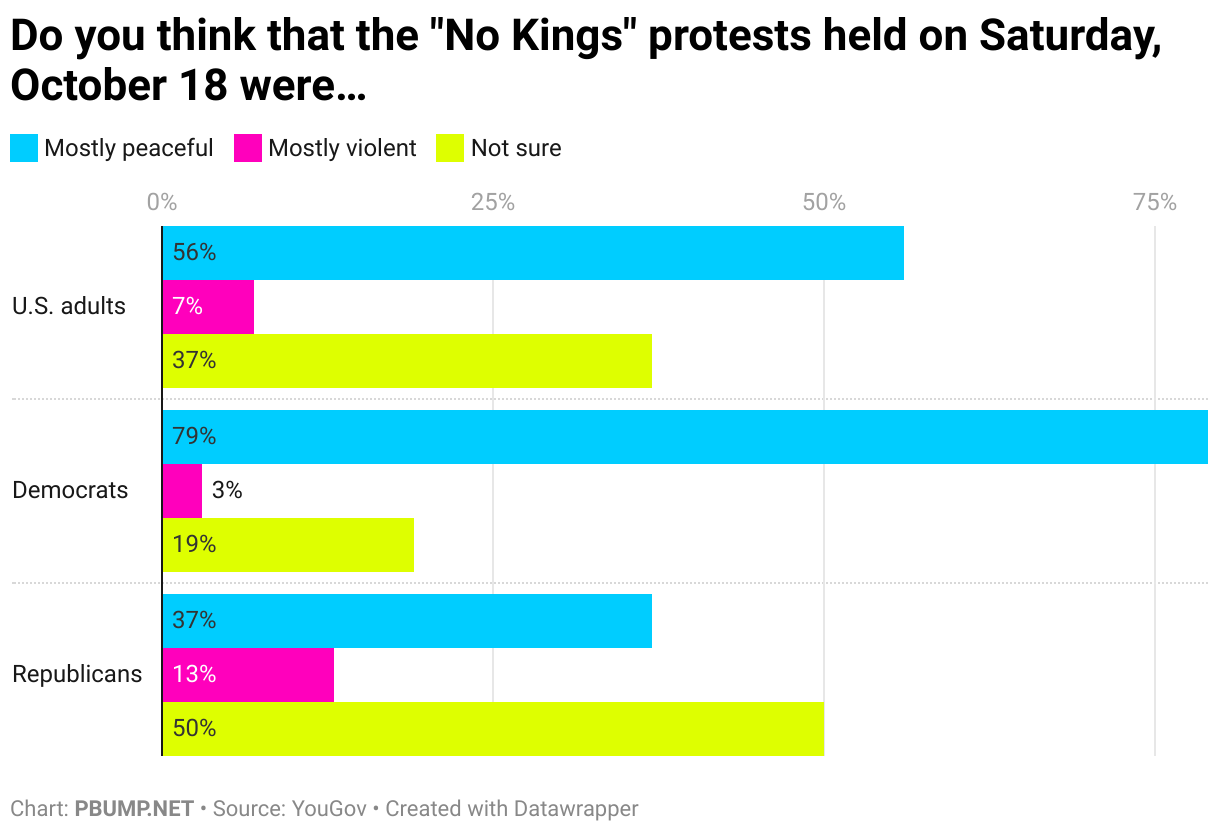
That said, the poll result below did come to my attention, and I thought it was worth elevating. In short, YouGov asked Americans whether last weekend’s almost-entirely-peaceful protests were mostly peaceful or mostly violent. And most Americans correctly said that they were mostly peaceful, because they were.

But the results among Republicans do stand out. Twice as many said they were mostly peaceful as said they were mostly violent — but, again, there’s no evidence of significant violence at all, much less nationally. Still, 1 in 8 Republicans think the protests were mostly violent, a claim that you might be forgiven for allowing to color their complaints about the rampant violence during the Black Lives Matter protests in the summer of 2020. Those, too, were mostly peaceful, but incidents of violence have been amplified for years — including in recent Fox News coverage — in an effort to cast all of those events as dangerous and illegitimate. Now that sentiment has bled over into last week’s events, which are perhaps described by Republicans as violent simply because (like the 2020 protests) they understood to be hostile.

Of course, we must also note that 50 percent of Republicans say they aren’t sure how violent the protests were. This may be a function of limited coverage among media outlets most consumed by Republicans. Or it may be a function of the pattern — present among both parties — of feigning ignorance instead of conceding an inconvenient point. If you are a Republican who opposes the protests and knows they weren’t violent, you might simply say “man, who’s to say” when prompted to evaluate what unfolded.

The real tell here will be how the protests are viewed in the future. It took time for the 2020 protests to become summarized as uniformly violence-soaked and wantonly destructive, just as it took time for other false narratives about American politics to take root. When your perceptions of the world are uniformly filtered through a partisan lens, what you see necessarily diverges from reality.

Photo: A No Kings march in New Jersey. (Jeffrey Hayes/Flickr)