The critical role Christianity plays in Trumpism

I remember being in Des Moines in August 2015 when Donald Trump made one of the first major appearances of his 2016 presidential bid: A stop at the Iowa State Fair. He emerged from a Trump-branded helicopter in a nearby parking lot, talking to reporters and meeting fans. One woman gave him a copy of “The Art of the Deal,” asking him to sign it. He did so, telling her it was “the second-best book ever.” The best, of course, was the Bible.

At the time, this just seemed like an obvious bit of pandering. But it was pandering that became a central element of his politics. Despite his … let’s say, sinful background, he positioned himself as the candidate of the religious right and, in short order, they welcomed him as their champion.

When Charlie Kirk was killed earlier this month, it was inevitable that the moment would become a rallying point for the political right. What’s been striking about that energy, though, is that it has flowed both to Donald Trump and to Christianity itself — a reflection of Kirk’s own embrace of the religion. There’s no reason to think that Kirk’s religiosity was insincere or calculating in the way that Trump seems to have been. But it’s probably the case that Kirk could not have become the force in right-wing politics that he was without it.

A few weeks ago, I wrote about recent Gallup polling showing that Americans had shifted to the right on a number of moral issues over the past few years. That article included a version of the chart below, showing the relatively rapid erosion of self-identified Christians in the U.S. over the past few decades — an erosion that seems to have stalled since the pandemic.

The decline has served as a political catalyst much as rumblings about the decline in the density of Whites in the U.S. population have. The result has been a bunker mentality. In June, YouGov asked Americans how much discrimination different groups faced. Republicans said White Americans face more discrimination than Black or Hispanic Americans — and that Christians face far more discrimination than either of those groups as well.

Yet it remains the case that most Americans are Christian — as were most voters in the 2024 election. Not all of them are Trump’s preferred flavor of Christian (White evangelical) but there are far more evangelical Christians than members of non-Christian faiths.

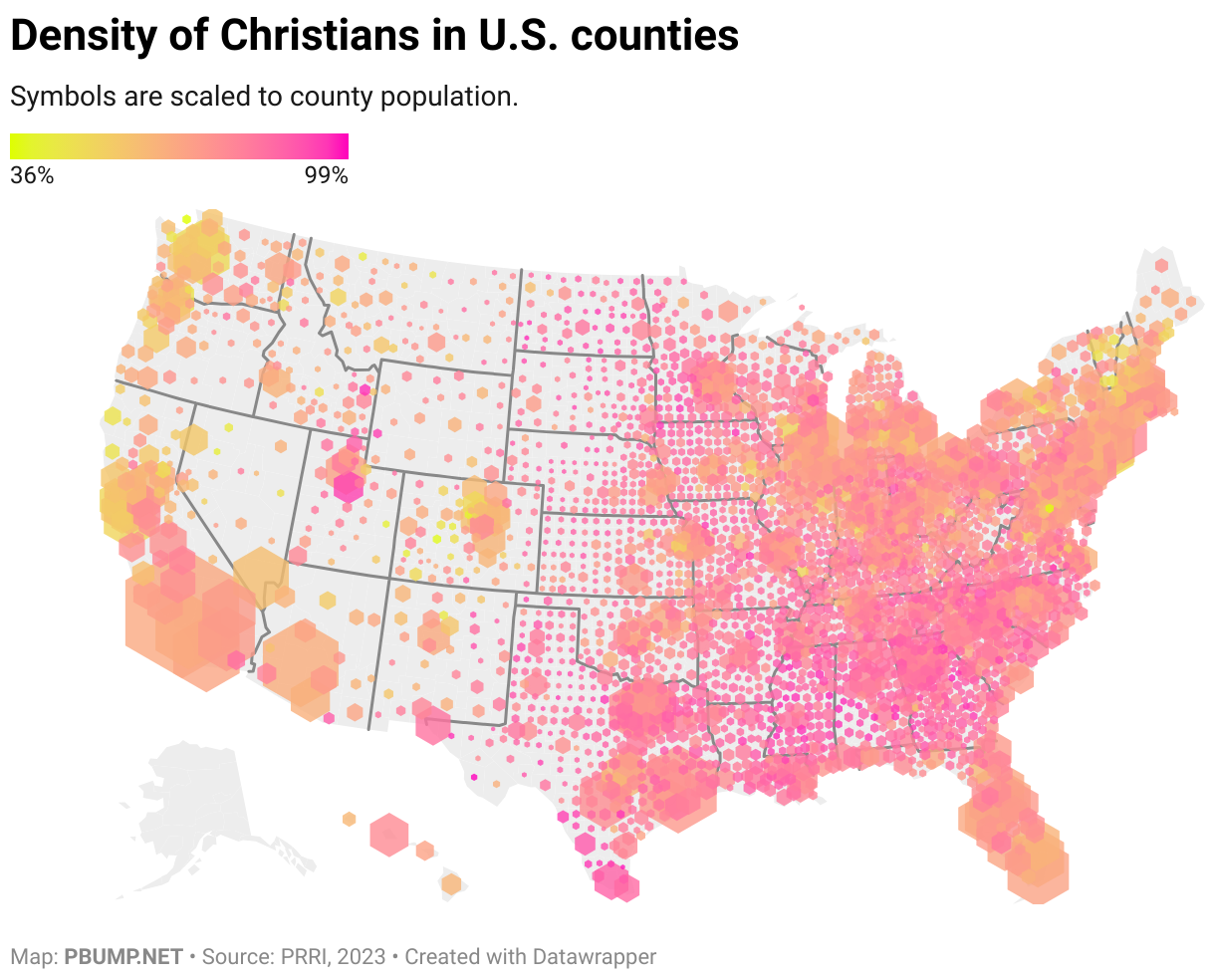
As you would expect, this varies by region. The Midwest and Deep South are heavily Christian; the West Coast and Northeast, less so. (The county-level data below are from PRRI and only show counties for which I also had reliable 2024 election data.)

Displaying the map like that, of course, distorts what that means in terms of population. Scaling county symbols to population shows that many urban areas are much less densely Christian.
If we compare the density of each county’s Christian population to the results of the 2024 presidential election, you can see a loose correlation: more Christians generally means more support for Trump.

Obviously, the inverse holds true: a smaller percentage of Christians generally meant less net support for Trump.

In both cases, many of the outliers are places with large Black, heavily Christian populations, including a number of counties in the Deep South. In 2020, PRRI estimated the percentage of White Christians in each county. If we compare that figure to the 2024 results, the correlation is much sharper.

There is a subset of Trump’s support that explicitly combines race and religion, the Christian nationalist movement. Other PRRI analysis shows a close correlation between support for Christian nationalism — that is, support for American being an explicitly Christian nation. The percentage of people in each state who support or are sympathetic to that idea correlates to Trump support in 2024. The percentage of Whites who fall into that category correlates even more robustly.

Pew Research Center’s analysis of the 2024 electorate shows just how important Christians were to Trump’s victory: more than three-quarters of his voters were Christian. Only about half of Kamala Harris’s were; about 4 in 10 of her voters were unaffiliated with a religious tradition, including atheists and agnostics.

Those voters who wanted to see Trump advocate an explicit Christian identity for the United States are starting to see their investment bear returns. The assassination attempt on Trump’s life last year accelerated his and his movement‘s embrace of the idea that Trump was chosen by God to serve as president. (More than half of Republicans viewed Trump’s win as part of God’s plan or as a reflection of God’s support for his policies according to recent Pew polling.) Trump’s second term in office deviates from his first in many ways; his and its embrace of explicit religious language since January is a notable one.

You would have been forgiven for assuming, back in Des Moines in 2015, that thrice-married playboy Donald J. Trump would not become the avatar for a White Christian resurgence of right-wing politics in the U.S. But Trump gave it a shot, and it worked.

Photo: North Christian Church, Columbus, Ind., 1973. (National Archives)

Republicans see Trump as unusually resistant to bribery

Between 2012 and 2016, Americans got a lot more cynical about the government.

To be specific — and to indicate that your likely immediate reaction to that bit of data was accurate — this increase was measured at the time of each year’s presidential election. In 2012, an already-high 6 in 10 Americans thought that at least half of those working in government were corrupt. By 2016, 7 in 10 did.

The biggest jump in this sentiment, measured in the American National Election Studies poll conducted around the election, was among Republicans. Overall, the assumption of corruption rose 9 percentage points. Among Republicans, it jumped 13 points.

(As used here, “leaners” are independents who say they generally vote with the indicated party.)

It is impossible to assume that this shift is unrelated to the emergence of Donald Trump in national politics. Trump’s first bid for the presidency, after all, was heavily centered on elevating cynicism about the system, excoriating legislators as corrupted by money — something that he insisted he’d seen firsthand. That he ended up running against someone deeply enmeshed in the political system worked to his advantage: he was the outsider who’d clean things up, which Hillary Clinton (in his presentation) was part of the problem.

In the years since, the assumption that government officials are corrupt has held relatively steady. It is higher among political independents (as you might assume) and among those who don’t have a college degree.

Notice, though, how partisan views shifted in 2020. Below, you can see the percentage of each group (by party and education) that thinks most or all members of government are corrupt. The year 2020 is indicated with a vertical line; notice where the percentage jumps or sinks that year.

Relative to 2016, Republicans (and leaners) and independents were less likely to see members of government as corrupt; among Democrats (and leaners), the percentage increased another 6 percentage points. In 2020, Democrats (and leaners) were as likely to view half of the government as corrupt as were Republicans.

What changed? The person in charge of the government.

Last month, YouGov dug into the question of corruption more specifically. If offered a bribe, they asked U.S. adults, how likely would various political actors be to accept? Mayors and members of Congress were most likely to be viewed as likely to take a bribe. Supreme Court justices and the president were least likely to.

There was a wide partisan divide on those last two, however, as you can see above. And the relative skepticism about a president taking a bribe diverged slightly when YouGov asked about a specific president: Trump.

When asking a similar question in January (just before inauguration), YouGov found that about 45 percent of Americans thought it was very or somewhat likely that Joe Biden would take a bribe, about equal to the percentage who said Donald Trump would. Partisans rejected the idea that their own party’s president would take a bribe while independents were more likely to think that Trump would.

In August, the percentage of Americans who thought Trump was at least somewhat likely to take a bribe jumped over the 50 percent mark. While the percentage of Democrats and independents who thought he would jumped, the percentage of Republicans did held steady.

The effect is not only that Republicans view Trump as less likely than any other group or listed individual as likely to accept a bribe, it’s that they purport to view him as less likely than any theoretical president to do so. Seven in 10 Republicans say it is not at all likely that Trump would take a bribe, compared to only a quarter who say the same of presidents in general. They see Trump as more resistant than other presidents to the temptations of bribery.

Some of this is simply partisanship, obviously. When a prominent conservative podcaster declares “we DO NOT CARE” about a credible report of a prominent administration official taking a bag of cash, it’s a reflection, in part, of rejecting attacks on members of one’s own team.

But there is evidence in the numbers above that there’s space for Democrats to run as anti-corruption candidates, as political scientist Adam Bonica argued over the weekend. There are a lot of people who see rampant corruption in government, including a lot of people who aren’t already Democrats. Whether it’s possible for the Democratic Party to reinvent itself as that — given the inherent skepticism independents have about the parties — is another question entirely.

Photo: Apple CEO Tim Cook sets up an engraved glass Apple disc on the Resolute Desk in the Oval Office, Aug. 6, 2025. (White House/Flickr)

Power from the people, once again

The story of this era is that institutions with power aren’t using it or are only using it in their own (often misguided) defense. That leaves the fight for democracy to regular people, to aggregated individual power that is joined on a largely ad hoc basis rather than on an institutional one. 

It’s fair to ask why. Why are media outlets and elected officials and businesses so unwilling to use what they’ve accrued or inherited for the country’s collective defense? Is it a failure to recognize that defense is needed? Is it some sort of perceived or actual mismatch between the power they’ve built and the power that’s demanded? Is it just weakness or self-interest or greed?

It may be that anti-democratic actors understand how to muffle that kind of institutional power. Doing so has been a decades-long project, after all, one that has seen a lot of success. My last column at The Post centered on the long-term erosion of institutional power and the opportunity that provided Donald Trump.

But that idea wobbles when considering where institutional pushback has been effective. Power is power, and it matters more that it is expended than how. 

Luckily, aggregated individual power — and even just individual power — is also effective. The utility of ad hoc, internet-enabled groups has been obvious for at least 15 years. When I was writing my book, which looks at trends in power over time, I noted that these efforts are hindered in the long term by being ad hoc and not building the sort of organization that can let power accrue, to build metaphorical interest. 

To some extent, though, they did. The No Kings protests were organized, in part, by Indivisible, which grew out of ad hoc organization. But the long term doesn’t matter in the immediate term. Building power over the long term doesn’t matter if the long term itself is under threat. 

So we see people self-organizing in effective ways, in and for novel institutions. It is true that existing, expansive institutional power applied aggressively could shift the political terrain in the U.S. more rapidly; congressional Republicans could effect constraints on the president tomorrow, if they chose to. 

In lieu of that, though, there isn’t nothing. There are a lot of regular people doing relatively small things, making the implementation of an autocratic state that much more difficult. Past generations of Americans collectively built big, weighty institutions that have proved to often be honeypots for abuse. Without many of those tools at their disposal, Americans today are building new arsenals from scratch. 

When the monarchists are on the march, sometimes it falls to a random group of farmers to stand in their way. 

Photo: A picture I took as I realized I needed a picture.

Elon Musk should buy a introductory data course

I am not revealing any trade secrets by telling you that Elon Musk’s public persona is unserious. He obviously has some business acumen; he remains in control of a number of corporations that are not at risk of imminent collapse. But politics? Woof. The lack of sophistication that was obvious during his brief stint in Donald Trump’s administration remains readily apparent — as does his willingness to amplify any fringe-right claim that pops up in his social media feed.

Yesterday, that meant sharing an idiotic graph from one of his ideological allies, appending only his trademark “Wow”. (He has also presumably trademarked 😂, but that’s beside the immediate point.)

The chart from podcaster (and former recipient of income from the Russian government) Tim Pool purports to show “what violence rates look like depending on political party.” It is offered, he explains, as a counterpoint to various analyses showing that violence is far more common on the political right than the left. Aha!, exclaims Pool: but the “combined violence rates” for “Democrat” are 21,765 compared to 858 for “Republican”!

Perhaps you find yourself slightly befuddled, unclear on what exactly Pool is talking about. Allow me to reassure you: This is not because you are stupid. It’s because the chart is stupid.

What Pool appears to be doing (but, honestly, who the hell knows) is taking violent crime rates from different cities and adding them together depending on whether the city is run by a Democrat or a Republican.

Even so, the numbers don’t make sense. What cities is he picking? How many? What is his source for the crime rates? When I took the list of the 100 largest cities, extracted the party of their mayors (now, mind you, and not in 2023) and overlapped that with Wikipedia’s violent-crime-rate data, I got very different numbers. (I would not normally use Wikipedia’s aggregated data, but I am very confident that Pool’s analysis, such as it is, did not rely on more sophisticated assessments of crime patterns.) Excluding two GOP-run cities for which data wasn’t immediately available, my totals are about 276,000 versus 54,000 (with another 32,000 for cities run by non-partisan mayors).

The specific figures don’t matter, though, because this is a very, very stupid metric.

Allow me to use a baseball analogy. What Pool is doing, in essence, is not looking at which team has more hits but, instead, comparing the cumulative batting averages of players on the New York Mets with players on the Chicago White Sox. That’s … not how batting averages work!

Even worse, though, is that he’s comparing different numbers of players. It’s as though he’s adding together the batting averages on each team, but only including players who live in or around New York City. There’s a lot more of them on one team!

In the case of the 100 most populous cities, there are about three Democratic mayors for every Republican. Even if those cities had violent crime rates that were half the value of Republican-led cities, the cumulative total would still be higher.

Again, though, that’s granting Pool the grace of assuming that his chart is based on anything at all. That grace is not deserved. The Republican-led city with the lowest violent crime rate in the Wikipedia data is Gilbert, Ariz., where there were more than 1,100 violent crimes per 100,000 residents in 2023. In other words, even if Pool only included one Republican-led city and that city was Gilbert, the “cumulative violent crime rate” would still be higher than his “858.”

Setting aside the ridiculousness of the data, it’s worth pointing out that, even if the figures were real and useful, there’s no actual connection to the debate at hand. Democrat-run cities among the 100 most-populous do have higher average violent-crime rates, but there are plenty of smaller cities run by Republicans where violent crime rates are higher still. But a city being run by a Democrat does not mean that the crime in that city is being done by Democrats, any more than having a Republican president means that crimes committed today are necessarily committed by Republicans. In fact, there’s research to show that mayoral partisanship isn’t correlated to crime rates.

Pool’s chart is just winking, leveraging the right’s core belief in the violent, criminal nature of ✨ People From Urban Areas ✨ to backstop the false claim that the left is more likely to engage in acts of political violence. It’s sort of useful, honestly, because it reinforces the extent to which all of the “it’s the left that’s violent” rhetoric is often simply about perceptions of who constitutes “the left.”

Allow me to now summarize my assessment of Pool’s chart and Musk’s response: 😂.

Thanks to Kevin Korb for elevating the research about mayors and crime.

Photo: People doing data stuff in 1990. (National Archives)

Television (audience) is not real life

The debate over the shelving of Jimmy Kimmel’s show isn’t really a debate, as such.

Kimmel has been a target of Donald Trump’s for years, with the president predicting in July that the ABC host’s show would be next to be shut down after CBS cancelled Stephen Colbert. Last week, Kimmel made a joke about Republican eagerness to pin the Charlie Kirk assassination on the left, a joke that suggested obliquely that the shooter was a Trump supporter. The head of the FCC suggested that ABC should face sanction for the comments. A conglomerate that owns a number of local ABC stations — and is seeking a merger that requires FCC approval — announced that it would not air Kimmel’s show. ABC itself quickly followed suit.

In other words, Trump got his desired outcome. And Trump desired that outcome because he pays far more attention to television personalities and ratings than nearly anyone else in America.

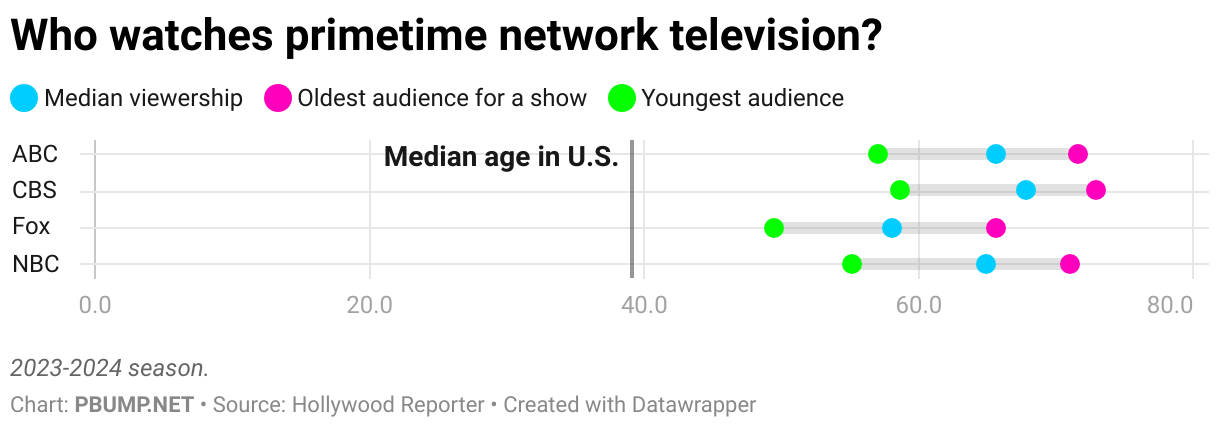
Analysis from the Hollywood Reporter published last year found that ABC had a median primetime viewership age a bit lower than CBS in 2024 — 65.6 years versus 67.8. The youngest audience that tuned into ABC’s primetime lineup was for “NBA Primetime,” which enjoyed a youthful median age of 57.1 years.

If you’re curious, as I was, three-quarters of the U.S. population were younger than 57.1 years old in 2024.

After poking around a bit, I couldn’t find current estimates of the median age of Kimmel’s viewership. But that’s OK, since I mostly wanted to talk about the news.

Last month, Pew Research Center published its most recent analysis of the audiences of different news organizations. It included estimates of the median ages of people who cite specific sources as regular sources of news.

You’ll notice that two of the news sources with the youngest audiences are Spanish-language and targeting a Hispanic audience. That is almost certainly not unrelated to the fact that Hispanics are generally younger than Americans overall — and substantially younger than White Americans.

You may also have noticed on the original chart that the two oldest audiences were for right-wing outlets: Breitbart and Newsmax. This, too, is related to the racial demographics above.

But let’s consider those numbers in the context I offered for “NBA Primetime.” Univision has the youngest median audience, landing right at the median age of Americans overall. Every other news source skews older, with a larger percentage of the population younger than its median age than older. (According to Pew’s calculations, that is.)

It’s also true that most of these news sources have audiences that skew older than the voter pool in the U.S. That pool of people is older than the population overall, since you have to be 18 in order to vote. Using Census Bureau estimates of the voting-age population, we see that most of the news sources still skew older than the universe we’re looking at.

The point here is simple: These audiences are not particularly representative of the population. And that’s even before we consider actual viewership, which is a small subset of any particular age group. Kimmel averaged 1.7 million viewers last year, one-half of one percent of the U.S. population.

Targeting Kimmel shouldn’t really be viewed about sending him a message to constrain his dangerous, popular commentary. It is instead about sending a message to the rest of us.

Photo: Something that is unidentifiable to anyone under the age of 40. (National Archives)