What ‘They’ have done

In 2020, They stole the presidential election.

How They did this has never been explained clearly. At first, it was alleged that They did so through fraud, by stuffing ballot boxes or submitting fake absentee ballots. Robust efforts to prove this claim unearthed no such scheme, so the explanation shifted: Actually, what They did, was rig the election by painting Donald Trump as unpopular in the mass media and shielding Americans from the truth. Here, too, the rhetoric was not supported by the evidence — but the nebulousness of the assertion made that inconsequential. Unseen, unidentifiable influences can’t be proven to exist, which just reinforces how nefarious they truly are. Ergo, we can assume that They stole the election.

This idea found particular traction with adherents to the QAnon conspiracy theory, an idea that emerged during Trump’s first term in office and which framed his administration as a direct, secret battle against Their evil forces. Trump leaned into this idea, naturally, and the riot at the Capitol on Jan. 6, 2021 was heavily populated by QAnon adherents joining Trump’s fight for power against Them.

Republicans more broadly were primed to accept Trump’s explanation for 2020 because they’d heard for years — for decades! — about how They are trying to indoctrinate our young. College professors, Hollywood communists, all of Them were dripping poison in the teens’ ears, turning them from red-blooded conservatives into climate-change and income-inequality obsessed liberals.

One thing that shifted in 2020 was that the president of the United States seized upon Their culpability for his defeat. Trump had targeted Them from his first days as a presidential candidate, siding with disaffected right-wing voters against their vaguely described oppressors. But in 2020, he could point to something specific that They had done to alter political power: They stole the election.

Four years later, they did something far worse. While Trump was speaking at a rally in Butler, Pa., They tried to kill him. In the immediate aftermath of that shooting, Trump’s allies insisted that Trump was being targeted by Them for his politics. When the shooter was identified as a local teenager of unclear political allegiances and no obvious ties to Them … it didn’t matter. They were still the culprit, with Republicans insisting that They had fired the bullet that narrowly missed killing the then-former president.

Last week, They killed Charlie Kirk in Utah. Again, an alleged shooter has been arrested and again his politics and intent are unclear. But, again, the real culprit has been known since the shot rang out: Them.

“They killed Charlie Kirk,” Sen. Jim Banks (R-Indiana) told Politico — so “the least that we can do is go through a legal process and redistrict Indiana into a nine-to-zero [House] map.”

“Five years earlier, I was told he was a Trump supporter,” former Arizona gubernatorial candidate Kari Lake said of the alleged shooter over the weekend. “And we sent our kids off to college, and [T]hey brainwashed him.”

“We’re dealing with a radical left group of lunatics,” Trump told NBC News in an interview about the shooting, “and [T]hey don’t play fair and [T]hey never did.”

And so on. There are myriad examples, often from prominent voices on the right, all making the same claim: They did this, and They will do it again.

“Fascists need a demonized enemy against which to mobilize followers,” Robert Paxton wrote in his 2004 book “The Anatomy of Fascism,” “but of course the enemy does not have to be Jewish. Each culture specifies the national enemy.” The original enemy identified by Trump was immigrants, a group that retains that status on the right to this day as evidenced by the lusty cheers for the administration’s targeting of people born outside the U.S. But particularly since Trump lost in 2020 and leaned so heavily into the purported evils of his opponents — stealing elections, trying to hold him accountable in criminal court, shooting at him — the primary They he seeks to uproot is his political opposition.

Many of his allies and supporters are hard at work identifying Them. Anyone with the temerity to question Kirk’s legacy or the administration’s response to his death is one of Them and, it seems, deserves to be publicly shamed and fired.

This has been organized and stoked on social media, which makes sense. “Tech giants and media benefit from the dramatic clash of friend and enemy,” Jason Stanley wrote in his 2018 book, “How Fascism Works: The Politics of Us and Them.” “Fear and anger get people to the polls, but they also keep people online and glued to the media.”

Fascism does not always look like Nazi Germany and fascists do not always look like Hitler. Fascism does not always lead to death camps. But fascism does depend on a vague sense of oppression and victimization that flows from a powerful, shadowy opponent.

An opponent that can rig elections and corrupt children and place assassins on rooftops. An opponent who acts because They are evil and They are un-American — because They hate America. An opponent so hazily powerful that a president constrained by the old rules can’t combat it. So, the argument seems to go, we must give Trump whatever power he demands in order to keep us safe.

Photo: World War II poster from the VFW, edited to remove a racist caricature. (National Archives)

Another view of the U.S. population

On Thursday, I looked at the way in which Sept. 11 was fading from public memory — not because Americans are forgetting it happened but because a larger percentage of Americans weren’t yet born when it happened. Fully a third of the country’s residents were too young to remember the attacks that day, a reflection of the inexorable progress of time, yes, but also of the shifting demography of the country itself.

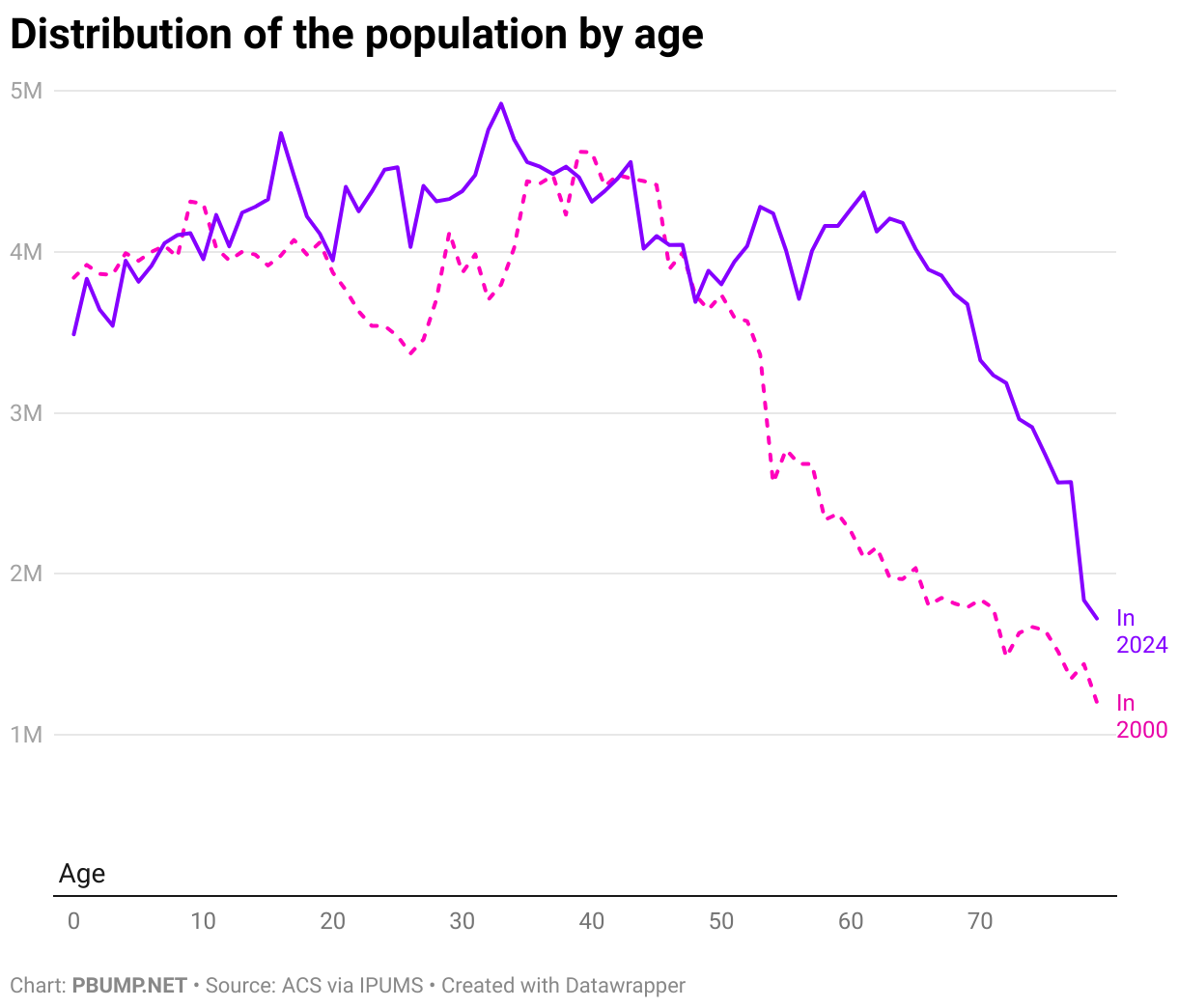
That article included the chart below, comparing the population of the U.S. last year with the population the year of the Sept. 11 attacks. From 2001 to 2024, I noted, the population under the age of 50 grew about 5 percent. The population aged 50 and up grew by more than 50 percent.

I posted that chart on social media, prompting an observation from Bloomberg’s Steven Dennis.

Same chart without immigrants would be much starker

— Steven T. Dennis (@steventdennis.bsky.social) 2025-09-12T16:21:41.696Z

After looking at the data: he is right.

Getting population-by-age data from the Census Bureau is a little tricky, so I used the online tools offered by the (essential) IPUMS Center for Data Integration. It compiles data from the Census Bureau’s American Community Survey, allowing users to split up population numbers as they wish.

Below, for example, we see a recreation of the original chart with two differences. First, it uses the IPUMS data, so the values aren’t precisely the same. (That’s why there’s a spike around age 15 below that doesn’t exist in the original chart.) Second, I compared 2024 to 2020.

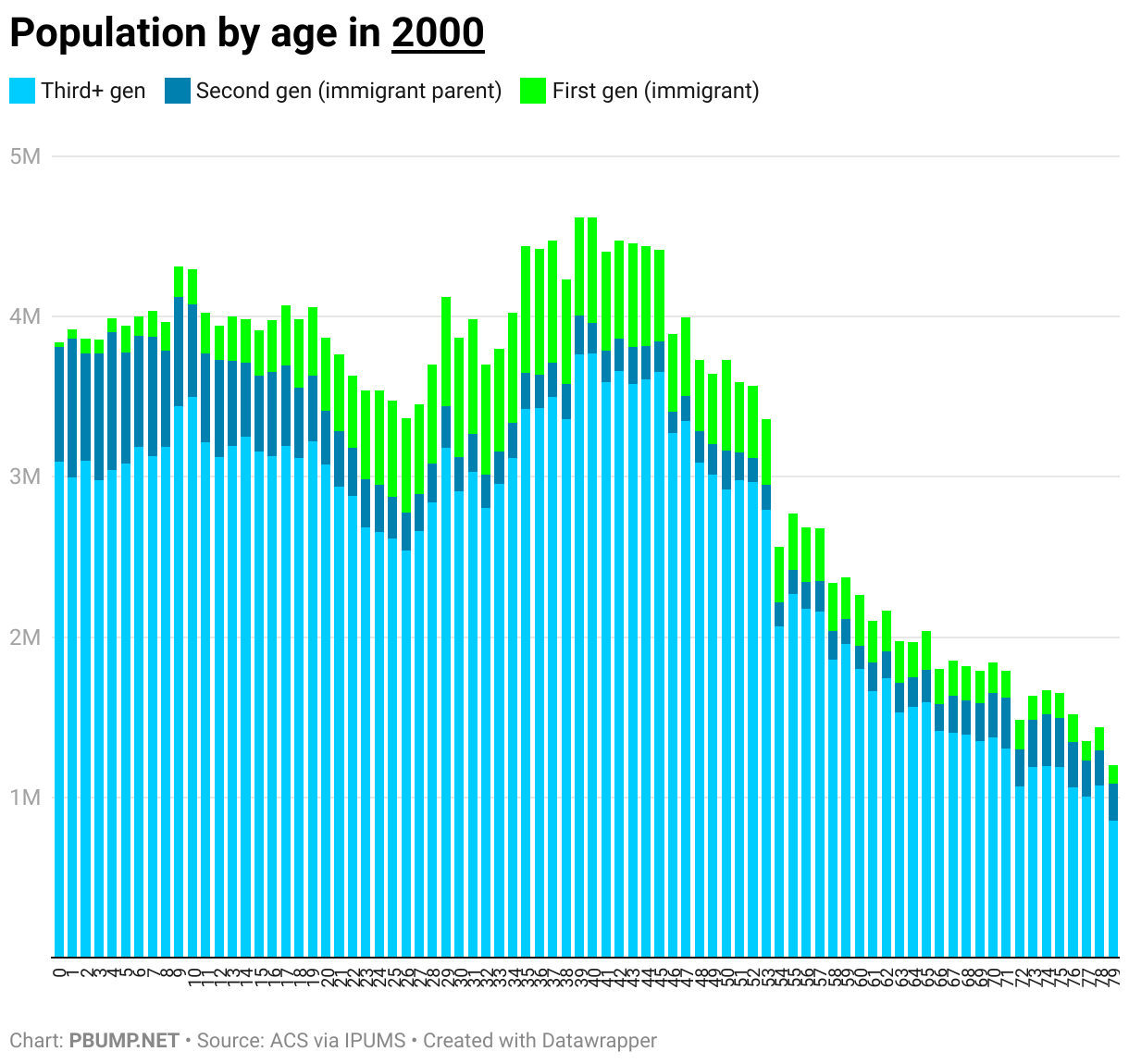
Using IPUMS, we can parcel out the population in each year relative to Americans’ proximity to immigrants. First generation Americans are themselves immigrants. Second generation Americans were born in the U.S. but have at least one immigrant parent. Third-plus generation Americans had immigrant grandparents or great-grandparents or great-great… etc.

Here’s the distribution by age in 2000.

And here is the dramatically different distribution in 2024. Notice not only that there are more immigrants in the population, but that there are more second-generation Americans in the younger population.

By combining the second- and third-plus generation populations, we can see how different the original chart looks. Now, population growth from ages 0 to 49 between 2000 and 2024 was not even 1 percent while population growth from 50 to 79 was more than 50 percent.

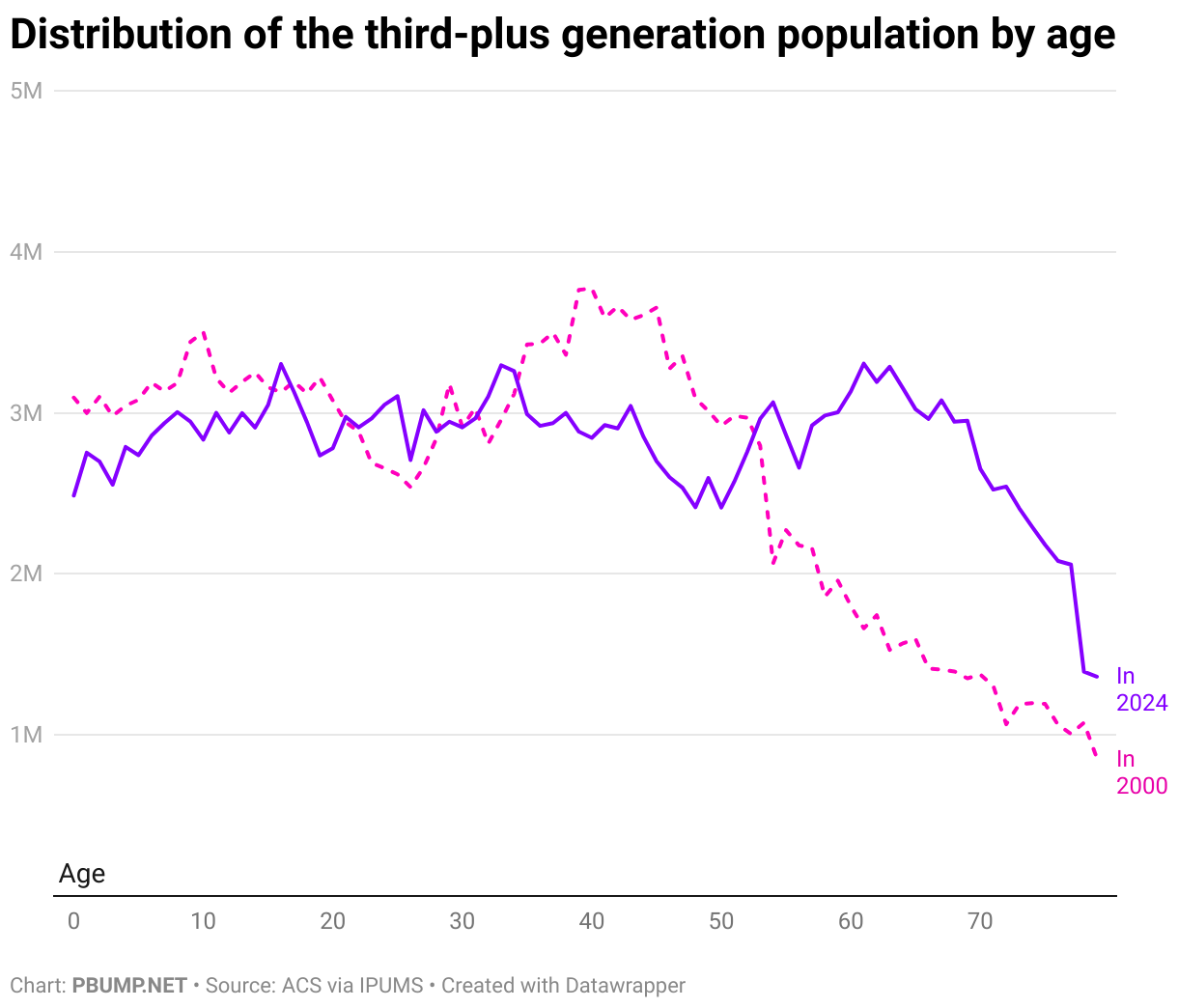
If we take out second generation Americans, the children of immigrants, the shift is even more striking.

Change in the 50-plus population over that time? Plus 58 percent. Change in the under-50 population? Down 9 percent.

What’s particularly striking about that final chart is how flat it is. Population distributions are often shaped like a roller coaster, with a big hump at the beginning that tapers off as people die. But the U.S. had about as many third-plus generation Americans aged 50 last year as it did newborns.

Population growth — and therefore economic growth — is heavily a function of immigration. The increase in America’s aging population (a function of the baby boom) will increase demand for service-sector jobs aiding the increased population of seniors, jobs that will need to be done by younger Americans. Curtail immigration and you curtail the working-age population both immediately and over the longer term, since those immigrants won’t be there to have native-born American kids.

And that could be a very big problem indeed.

Photo: Immigrants on Ellis Island. (National Archives)

Reassessing the ‘fine people hoax’ hoax

Donald Trump appeared on Fox News’ “Fox & Friends” Friday morning, returning to the program where he was a weekly contributor until he announced his bid for the 2016 Republican presidential nomination. Back then, he used to offer right-wing assessments of the news, unbound by any the constraints of politics or accuracy. Now that Trump is president … not much has changed.

The central news from the appearance was Trump’s casual revelation that an arrest had been made in the killing of right-wing activist Charlie Kirk. But a related interaction, prompted by one of the hosts of the show, deserves exploration as well.

“We have radicals on the right as well,” Ainsley Earhardt said to the president. “We have radicals on the left. People have got  — are watching all of these videos and cheering — some people are cheering that Charlie was killed. How do we fix this country? How do we come back together?”

“Well,” Trump replied, “I’ll tell you something that’s gonna get me in trouble, but I couldn’t care less.”

“The radicals on the right,” he continued, “oftentimes are radical ‘cause they don’t want to see crime. They don’t want to see crime.”

“Worried about the border,” co-host Brian Kilmeade jumped in.

“They’re saying, ‘We don’t want these people coming in. We don’t want you burning our shopping centers. We don’t want you shooting our people in the middle of the street,’ ” Trump continued. “The radicals on the left are the problem, and they’re vicious, and they’re horrible, and they’re politically savvy.” (He went on to add that the “worst thing that happened to this country” was “when we let 25 million people in” — echoing his long-standing, false claim about immigration during the Biden administration.)

First of all, Trump’s assertion about the motivations of right-wing extremists is obviously untrue. In October 2020, during Trump’s first term in office, the Department of Homeland Security released a report in which the acting director expressed that he was “particularly concerned about white supremacist violent extremists who have been exceptionally lethal in their abhorrent, targeted attacks in recent years.” That comported with Anti-Defamation League analysis showing that the vast majority of extremist killings from 2013 to 2022 were committed by right-wing actors.

A January 2024 report published by the National Institute of Justice reinforced the point.

“Militant, nationalistic, white supremacist violent extremism has increased in the United States,” it stated. “In fact, the number of far-right attacks continues to outpace all other types of terrorism and domestic violent extremism.”

None of this is to say that there is no political violence perpetrated by the left. There obviously is. Instead, it is to note that right-wing violence has been more common and not motivated by, as Trump speculated, opposition to crime. He was closer to the mark when he suggested that right-wing extremists were motivated by not “want[ing] these people coming in” — which is just another way of describing xenophobia and anti-immigrant sentiment. (His claims about crime, of course, are not distinct from rhetoric about race, as Charlottesville attendees were aware and as recent Trumpworld rhetoric has demonstrated.)

Trump has always had a soft spot for violent actors who side with him politically. The most obvious example is the riot at the Capitol, of course, an incident in which crime-fighters were beaten by Trump supporters in an effort to subvert the 2020 election. But there are other examples, too, like Trump’s glossing over the fringe beliefs of QAnon adherents while he was president because “they like me very much.”

His “Fox & Friends” framing Friday morning, though, made me think specifically about the eight-year-old debate over Trump’s comments in August 2017, after a young woman was killed in Charlottesville, Va. He faced enormous criticism at the time for first suggesting that violence and culpability existed on both sides of the protests in that city — the side aligned with white nationalists and the side opposed to the white nationalists — and later declaring that there had been “very fine people” on both sides of the debate.

Those comments came to encapsulate a sense among many Americans that Trump is indifferent to racist violence. So, he and his allies applied a familiar and successful tactic to defuse the criticism: claim that the whole thing was a hoax.

In this case, Trumpworld decided to focus specifically on the phrase “very fine people,” which they insisted was not a reference to the racists who’d organized and dominated the original event in Charlottesville. They pointed to Trump’s after-the-fact assurances that he was “not talking about the neo-Nazis and the white nationalists, because they should be condemned totally” as proof that he was praising only those attendees of the fringe-right rally by white nationalists who weren’t nazis and white nationalists. This was not only an exoneration of Trump, they insisted, but more evidence that the left was unmoored in its attacks on Trump.

That was back in 2017, though, when Trump was new to the gig and still allowing himself to be constrained by public expectations and some norms of behavior. That’s why his first comments, about bad actors on both sides, spurred a straight-from-the-teleprompter denunciation of the worst extremist elements.

But now it is 2025. There are no similar guardrails. Trump perceives little need to distance himself from extremists who share his ideology; instead, he excuses them. There’s no fine people on both sides, equating attendees of a extremist rally with those opposing that extremism. Instead, he pats the right-wing extremists on the head as he excoriates some vaguely defined group of extremists on the left.

This is the dichotomy that was always at play in his “fine people” comments. What’s changed is that now he isn’t concerned about revealing it.

Photo: President Donald Trump rides in his motorcade on Sept. 9, 2025. (White House photo by Daniel Torok/Flickr)

The fading immediacy of Sept. 11

I remember the explosion of the Challenger only vaguely. I was still in elementary school, and remember — I think; it’s hazy — being told during lunch that the shuttle launch had failed. This was the watch-every-launch-on-TVs-rolled-into-classrooms era, so the school was attuned to the moment. That said, I don’t remember anyone’s reaction, including my own.

I remember Sept. 11, 2001 with much more clarity. This isn’t surprising; I was older and the disaster more recent. It was also much more damaging, both in human and geopolitical terms.

There are lots of ways to reflect on 9/11, but this is the way I tend to do so: as a marker on our paths through history. I remember the day it happened, but many people don’t. An ever increasing number of people don’t. This signal moment in America’s and my own life is, for many Americans, now an abstraction.

We can measure this. If we assume that one can form permanent memories at about the age of four, fully a third of Americans alive last year were too young to remember the attacks on the World Trade Center and the Pentagon.

You’ll notice that I’ve added some other historic moments there: the Challenger explosion, the assassination of John F. Kennedy and the end of World War II. There are, at the moment, far more people who are too young to remember Sept. 11 than there are people old enough to remember Kennedy’s assassination or V-E Day.

In 2001, 4 in 10 Americans were old enough to remember those events, twice the percentage that can at this point. Only a small portion of the population was aged three or under and therefore too young to remember the attacks.

It’s interesting to compare the two populations directly. You can see how the group of people too young to remember Sept. 11 growing, as you would expect — but can also see the winnowing of those older groups as segments of the population.

What’s remarkable about the shift since 2001 is that the U.S. population has grown — but that the population under the age of 50 has grown by only 5 percent while the population aged 50 and over has grown by 56 percent.

In other words, the percentage of Americans who remember Sept. 11 is relatively small given how disproportionately old the American population has grown.

And yet a third of Americans don’t remember that day. Didn’t spend the day glued to the TV, didn’t watch the towers fall in real time. A third of Americans didn’t experience the day and a huge portion of them also didn’t experience what happened next: the overhaul of American politics and the surge to war.

Never forget, they say, but every year fewer Americans are able to remember even if they wanted to. Every year, fewer of us remember the lessons learned from the attack’s aftermath, too.

Photo: The World Trade Center towers. (National Archives)


Update: YouGov asked American adults if they remember where they were on Sept. 11, 2001. Here are the responses by age.

Why do only 7 percent say they weren’t yet born? Because this is only people aged 18 and up.

The climate of fear is self-imposed

I am not generally in the habit of criticizing the editorial decisions of The Washington Post, my employer for 11 years and an institution that continues to do good, important work in covering the unwinding of American democracy. But I think the paper’s assessment of the putative debate over Donald Trump’s signature on the note provided for Jeffrey Epstein’s 50th birthday demands some context.

The article’s original headline was “No clear answers on whether Trump signed the Epstein birthday book,” a declaration that was eventually softened to “Is the signature Trump’s? Epstein birthday book feeds speculation.” The article first presents the denials of Trump’s staff and allies that he couldn’t have signed the bizarre, creepy, suggestive document. It then quotes handwriting experts, some of whom who indicated uncertainty about the signature’s provenance. A number of full signatures of Trump’s are shown in an apparent effort to demonstrate variation.

The use of full signatures doesn’t make sense because the signature in the book — created in 2003, before Epstein was on law enforcement’s radar — includes only Trump’s first name. The New York Times compared that signature to other examples of Trump signing only his first name, showing that they are nearly identical. In fact, the Wall Street Journal, which originally reported on the note, also published an article demonstrating why the note was almost certainly from Trump, including similar first-name-only signatures from the now-president.

The Journal did so, it’s safe to assume, because its initial report on the letter was rejected as invented or “fake news” by Trump et al. (Trump even sued, claiming, in part, that no such letter existed.) In other words, it probably assumed that publication of the note would trigger precisely the response that it did, an effort to move the goalposts of claimed fraudulence.

There is absolutely no reason to think that the note was not, in fact, from Trump and no reason to think that the signature is not his own. Even setting aside the obvious-to-any-layperson similarity to other signatures, the idea that someone would create a phony Trump letter as a private gift to someone Trump had praised publicly the year prior doesn’t make any sense.

So why treat the idea that the signature isn’t his seriously? Why treat the assertions of people with demonstrated track records of lying on Trump’s behalf — including Trump, his communications team and right-wing influencers — as offering sincere complaints on this particular issue? Why grant them the benefit of the doubt that they actually think the signature isn’t his?

There’s a marketplace for treating those bad-faith claims as valid, clearly, but there’s also friction for those who call them out as nonsense. One of the developments that’s helped Trump immeasurably since his decision to enter national politics is the right’s streamlining a system for directing public pressure on chosen targets. Evolving from sites like Twitchy to social media pile-ons to simply mainstreaming abusive behavior, it’s now trivial to pollute the media space in which journalists operate with unpleasantness (and worse).

But I don’t think that this system of pressure is what The Post’s reporting is responding to. I think, instead, it is offering grace to bad-faith actors because institutions have internalized the idea that bad-faith actors must, particularly in this moment, be granted that grace. The mainstream media has long been criticized for bolstering both sides of even lopsided debates, but that tendency faded during Trump’s first term in office. After all, both sides used to operate much more obviously in good faith than did Trump and his allies. With Trump’s return to the White House, though, and his imposition of proto-authoritarianism as the new D.C. normal, institutions seem to be willing to treat it as normal, on pain of ostracism.

There is overlap here with the embarrassing and disconcerting situation at Texas A&M. A student in a class recorded herself challenging a professor who was reviewing a discussion of gender and sexuality. In short order, the video made its way to a Republican Texas legislator.

“I’m not entirely sure this is legal to be teaching. Because, according to our president, there’s only two genders and he said that he would be freezing agencies’ funding programs that promote gender ideology,” the student tells the instructor. “…I am not going to participate in this because it’s not legal and I don’t want to promote something that is against our president’s laws as well as against my religious beliefs.”

Facing a firestorm of pressure generated by the aforementioned right-wing outrage system, the university quickly fired the instructor, demoted two officials and announced an audit aimed at ensuring that no similarly transgressive instruction was occurring within its system.

I don’t want to harp too much on the student’s verbiage, since nitpicking the complaints of college students is one of the lowest forms of commentary. But I do think she said something revealing. Not her invocation of “our president’s laws,” which is obviously a wild distortion of the American system, but her insistence that “according to our president, there’s only two genders.”

We don’t need to dig into the science here to understand what’s wrong with that phrasing. We don’t even need to disagree with the assertion. We can simply focus on the idea that she’s pitting the veiws of the president against the views of a faculty member at a college … and the college chose to side with the president. In the eternal human struggle to understand the world, Texas A&M is demonstrating — quite eagerly — that it will defer to politicians on the nature of truth rather than the people it has hired to explore and examine that nature.

You can see the overlap with The Post’s signature assessment. Assertions about reality that are bolstered by evidence and/or examination run afoul of the president and his allies. So the president and his allies are granted the space to object or even simply granted primacy in the debate they invented. Institutions that should be centered primarily on elevating truth instead risk becoming institutions that elevate propaganda.

What could The Post have done? What it has done so many times before: Parse the issue and fully demonstrate the flimsiness of Trump’s claims, even if a just-asking-questions style headline would generate more traffic. What could Texas A&M have done? Stand behind its instructor and defend its role as a truth-seeking institution in court, if it came to that.

It has been observed that individual Americans are putting up more fight than many institutions. Those individuals are also smaller targets for the authoritarian president and his allies. They are less powerful. But that’s obviously why it’s more important for the institutions to engage and not to succumb to the climate of fear.

That climate, after all, only exists if it goes unchallenged. There is no climate of fear without capitulation.

Photo: Sen. Joseph McCarthy. (National Archives)