Let’s get you to In-N-Out

My eight year-old and I were waiting for the school bus this morning when I commented on his t-shirt, which was from the West Coast fast-food chain In-N-Out burger. It is a particularly popular chain, appreciated by its fans for its fresh ingredients — burgers so good that customers overlook the weird, soggy fries.

I told him that, when I was in Houston last week, I’d gotten In-N-Out. His response was to briefly express jealousy before asking a valid question: There’s In-N-Out in Texas?

I’ll admit that I hadn’t known that either until I was there. In-N-Out’s restaurants are usually clustered, anecdotally because it assures access to those fresh ingredients. Maybe that’s not why; that’s not the point. The point is that I suddenly realized that I didn’t know exactly where In-N-Out could be found. And then I had an interesting thought, given Houston’s location in Texas: Had I eaten at the furthest-east In-N-Out Burger? More intriguingly, had I eaten at the In-N-Out closest to my house?

This was a job for a guy who is good with data. Happily, I know one.

First thing was to find a list of restaurant locations (which the chain publishes online) and then to geolocate them (easy enough with Geocod.io). And, just like that, I could produce a map.
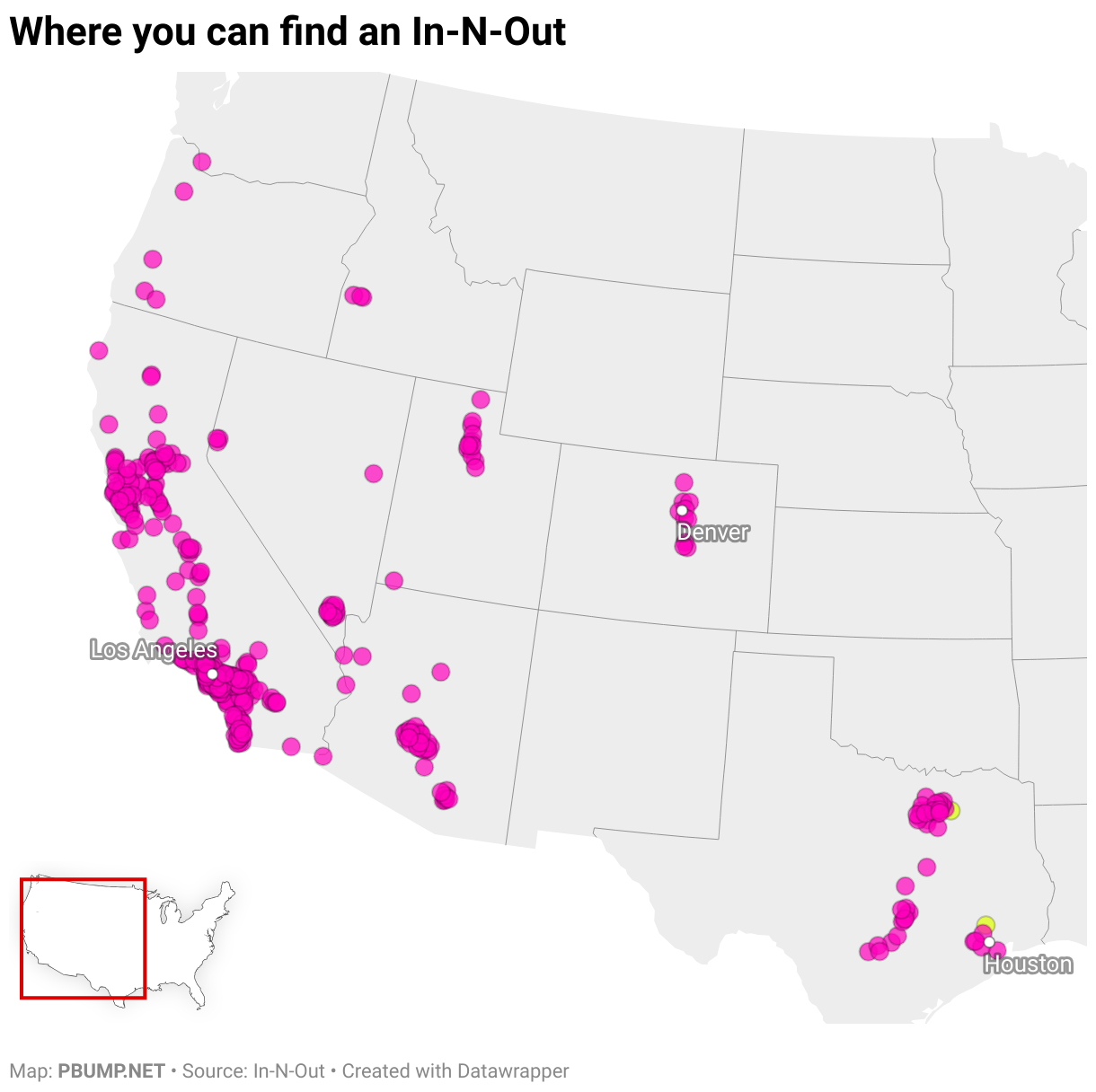
As it turns out, I had not eaten at the easternmost In-N-Out. The restaurant at The Woodlands (in yellow on the map above) is only the second easternmost franchise. The easternmost is in Webster, Texas. The most western, meanwhile, is in Eureka, Calif., in the upper left corner of the state.

(For the sake of completion, the furthest north and south are in Ridgefield, Wash. and San Antonio, respectively.)

The In-N-Out I’d gone to was also not the closest to my house in New York. That honor — and it is an honor — goes to the restaurant in Rockwall, Texas. (It’s also in yellow above.) This is as-the-crow-flies, mind you, not if I wanted to drive or fly to get a burger in an airplane. It is simply the closest I am to an In-N-Out grilled cheese on any given day, the place where its food has the strongest gravitational pull on me.

Perhaps you’d like to know where your closest In-N-Out is? Well, sure; who wouldn’t. Since I had the data in hand, I made a little tool that will allow you to locate it.

First, let’s find you.
To find your closest In-N-Out:

  1. Click the button below.
  2. Click “Allow” when your browser asks for location permission.
  3. If it’s blocked, click the location icon in your address bar and enable location sharing.
  4. Refresh the page if needed.
  5. Or just do your own Google search, I guess.

Is this useful? Yes. You’re welcome.

Anyway, that’s what I was talking to my son about as he was getting on the bus.

This article was updated upon learning that a location just opened in Washington.

Photo: A picture I took at an In-N-Out in 2010. I assume the prices have gone up.

Climate change and LGBTQ rights are among Democrats’ strongest issues

The New York Times’ Reid Epstein reports on the emergence of a new center-left think tank dubbed the Searchlight Institute. Its aim, he explains, is to help Democrats find “their way out of the political wilderness” by fixing where the party has gone wrong. To wit, having placed “too much emphasis on issues like climate change and L.G.B.T.Q. rights.”

This idea has been rumbling around in Democratic circles for a while, centered on the idea that advocacy groups (“the groups”) had pressured Democratic legislators to espouse unpopular opinions that hurt them with the electorate. Searchlight, Epstein reports, will “conduct its own polling and serve as an ideas generator in the service of winning with margins big enough to advance meaningful policy in Congress.”

Fine. Except that climate change and the party’s approach to LGBTQ issues are already two of its biggest strengths.

May polling from CNN presented Americans with 13 different policy areas. Climate and LGBTQ issues were two of the three where Democrats had the biggest advantage.

Climate change in particular offered Democrats the biggest advantage among independents as well. It was the second biggest advantage among younger voters — a core constituency for the party — behind abortion. This isn’t a new development, mind you; the challenge for Democrats has largely centered on the fact that voters prioritize other issues over climate change when casting ballots.

The question of how the party emerges from this metaphorical wilderness has in recent months centered on a related question: Should the Democratic Party try to show centrist and independent voters that its priorities are the ones those voters already have, or should it instead try to shift voters’ views of issues where Democrats have more existing strength?

The Searchlight idea, it seems, is to abandon a focus on two strengths, presumably in large part because they are polarizing. But it’s also because those issues are often more nuanced or complicated than the party’s position on abortion, leading to internal debates that Democratic politicians might find grating. The groups advocating for a particular position on abortion won, so they don’t offer the same sort of agitation that climate or LGBTQ groups do.

I will not be so presumptuous as to assume that I know what would or wouldn’t work for the party. But I am not sure that walking away from or downplaying existing strengths will fix the party’s problems with its disaffected and shrinking membership.

The vast, left-wing conspiracy

Sen. Ted Cruz (R-Texas) appeared on CNN Tuesday night, unwittingly offering a useful distillation of the right’s consideration of political violence.

“You need to get your facts right,” Cruz told host Kaitlan Collins after she brought up the killing of Minnesota legislator Melissa Hortman. “The assassin there was not a right-wing assassin, acting on a political motive. The assassin there was someone who had been an appointee of Tim Walz, and he was a deranged lunatic.”

“Yes,” he continued, “there are deranged lunatics who attack people, both right and left. But if you look at murders carried out for political agendas, they are overwhelmingly on the left.” In addition to the killing of Charlie Kirk (the incident that prompted Cruz’s appearance), the senator cited the attempts on Donald Trump’s life in 2024 and the “assassination attempt on Brett Kavanaugh,” in which a plotter turned himself in before committing any act of violence.

Cruz’s description of Vance Boelter — the man accused of killing Hortman, her husband and shot another Democratic legislator — is false. He attempts to tie Boelter to Minnesota Gov. Tim Walz by describing him as an “appointee,” but Walz merely extended Boelter’s term on a state board as he did scores of other prior appointees. Boelter is a Trump supporter who engaged in “targeted political assassinations” according to a Justice Department official.

But this is the play. In order to rebut the abundant evidence that extremist murders are more likely to be driven by members of the political right (including two deaths that occurred on the same day as Kirk’s), those murders are downplayed in significance or dismissed as the work of isolated, mentally ill actors. Murders committed by people driven by left-wing ideologies (as appears to be the case with the Kirk killing) are presented as part of a concentrated political project.

This is why accusations against the left so often focus on the word “they.” If these acts of violence are downstream from left-wing politics, there’s an implied chain of influence that often proves impossible to define clearly. So instead it’s left as nebulous: They did this, through whatever means the right seeks to cast as unacceptable.

It is true that public attention can drive targeted violence as we’ve seen repeatedly in recent years. But that’s different than arguing that violence is the desired outcome of that attention, much less that this is primarily an issue on the left.

The emergence (re-emergence, really) of this idea that the left is engaged in a coordinated project to destroy the right by whatever means it can reminded me of research I wrote about in my 2023 book, “The Aftermath.” (You should probably buy the book. The bit below is in chapter four.)

Here’s what I wrote:

America’s non-White population is now mostly not Black. This makes it facially odd to assume that a theoretical erosion of White power will benefit a conglomerated group of non-Whites, as though the zero-sum calculus of politics will reward “non-Whites” as a group. Finding this idea puzzling, a group of researchers including New York University’s Eric Knowles examined precisely that assumption — and found clear evidence that it was one being made particularly by White Republicans.

“When you think about it, what does it mean for White Americans to become a minority? Well, it doesn’t mean that they’re going to not be the largest single group anymore — unless you sort of lump everybody else together,” he said when we spoke by phone. (Indeed, even in the Census Bureau’s projection for the population in 2060, Whites still outnumber Black and Hispanic U.S. residents combined.) “So there’s ‘us’, and then there’s ‘everyone else’, and that ‘everyone else’ forms some sort of coherent whole. That would be, it seems to us, kind of a prerequisite to feeling that sense of threat. If you think that you’re still the largest player in the game, and it’s just that there are a lot of other, smaller players, it’s not logical to feel all that threatened by it.”

Knowles and his colleagues conceived of a way to measure what they dubbed the sense of “minority collusion,” the idea that non-White Americans have a shared dislike and jealousy of Whites and that they work together to peel away power and resources to which Whites are entitled. They surveyed a nationally representative pool of White people multiple times from 2015 to 2018, asking them to respond to statements like “minorities may disagree about some things, but one thing they agree on is that they don’t like White people” or “different minority groups are willing to cooperate with each other in order to take power away from White people.” The research team also offered statements explicitly endorsing White identity politics like “Blacks, Latinos, and Asians often vote for politicians from their same racial group because that’s who has their best interests in mind; Whites should not be criticized for doing the same thing.” 

“What we ended up finding,” Knowles said, “was that there was a marked increase in agreement with the idea that minority collusion is happening over the course of the survey.” But, importantly, that increase “was driven only by an increase in this minority collusion belief among White Republicans.”

Knowles’ research looked at a specific us-versus-them framing. But you can see the parallel: If they are not us, they must be part of a them that is out to get us. Even when it doesn’t make sense to assume that disparate elements of the opposition are working together, because they are perceived as the opposition they are assumed to be acting in concert.

Earlier in his conversation with Collins, Cruz alleged that moneyed interests were behind the left-wing violence they were committing.

“The Black Lives Matter and antifa riots all over the country, there was real money behind that,” he said. “The anti-Israel, antisemitic riots on college campuses, there was real money behind that. The open border riots we saw in L.A., and across the country, there’s real money behind that. I’m not the only person who noticed that at the antisemitic protests, on college campuses, many of the tents all matched. And so, what I’m urging the Department of Justice to do is look at who’s funding it.”

The “antifa riots”? OK.

It’s helpful that he mentioned the tents thing because it was nonsense that was seized upon by the right in its effort to imply a coordination that simply didn’t exist. The “real money” he describes almost invariably gets traced back to contributions from donors to organizations that supported often completely non-violent protests. But he and his allies work backward to construct a conspiracy where none otherwise exists because it allows them to impugn their political opponents. Drawing attention that, in the past, has led to right-wing political violence.

Except that political violence isn’t something done by us. It’s just something they foment and celebrate as part of their left-wing collusion and conspiracy. Right, senator?

Photo: The most powerful person in America, holding court with allies and aides. (White House/Flickr)

Tracking how young people view Trump

One of the things I’m curious about in the wake of the killing of Charlie Kirk is whether the political views of young people will shift. This was Kirk’s wheelhouse, we are told: engaging young people in politics to Republicans’ and Trump’s benefit.

I am personally skeptical about claims that Kirk and his organization, Turning Point USA, had a major influence on the rightward shift of young people in recent years and I am very skeptical of the (now frequent) claims that he and his organization had a significant effect on the 2024 election outcome. But if he was an outsized force among young people, we might expect to see some movement in views of Trump, on whose behalf Kirk’s efforts were primarily deployed.

So I figured I’d measure the current baseline. In YouGov’s regular polling on Trump’s approval rating, there was a jump in the views of Americans under the age of 30 this week. But that number is often volatile, given that it is a measurement of a relatively small subset of the population.

While Americans aged 18 to 29 were about as likely to approve of Trump’s performance as president back in March, that approval has since collapsed. The recent uptick still has Trump’s approval among young people below where it was in early August.

When Trump won in November, his favorability rating surged among Americans under the age of 45. But here, too, that positive sentiment collapsed. Now, only about a third of young people view Trump favorably (looking at a three-week average, mostly to smooth out some of the aforementioned volatility).

On both approval and favorability, Trump’s seen the biggest declines among young Americans since mid-February.

So that’s where we are, in polling conducted in the aftermath of Kirk’s death. We will see where we stand in a month or two.

Photo: The president dances, in his way. (White House/Flickr)

The MAGA subset of American culture

One of the things I appreciate about the polling firm YouGov is that they are able to poll a lot of things over a short timeframe. One effect of that is that they can ask unusual questions and get statistically significant responses. And unusual poll questions can lead to unexpected revelations.

Last week, for example, YouGov presented a panel of Americans with 40 “cultural entities,” an umbrella term for celebrities, TV shows, concepts and tchotchkes. Respondents to the poll were asked how they felt about those items — did they love them? Hate them? — and then whether they thought those items were associated with MAGA-supportive Republicans. YouGov has also been tracking self-identification as “MAGA Republicans,” meaning that we can use these numbers to approximate what MAGAworld views as MAGA culture.

There are some caveats here, but let’s ignore those for the moment. Instead, let’s see if you can estimate how MAGA supporters view these cultural items.

Loading…
What percentage of MAGA Republicans would you estimate like or love this cultural item?
0%
What percentage of MAGA Republicans do you think see this as part of MAGA culture?
0%
Who like/love this item:
Overall:
0%
Democrats:
0%
Independents:
0%
Republicans:
0%
MAGA Republicans:
0%
Your guess:
0%
Who sees this as part of MAGA culture:
Overall:
0%
Democrats:
0%
Independents:
0%
Republicans:
0%
MAGA Republicans:
0%
Your guess:
0%

How’d you do? Do you have your finger on the pulse of MAGA culture? Did the results comport with how you yourself view those things?

One caveat, of course, is that YouGov selected the 40 items. The options were, by construction, a subset of the available possibilities. So there may be some element of MAGA culture that dominates over everything YouGov presented but is missing from the dataset. Another caveat is that the framing about “MAGA culture” is mine, not YouGov’s, so don’t blame them if you disagree with it.

That said, YouGov did a good job selecting the 40 items. In almost every case, more self-identified MAGA Republicans said they “liked” or “loved” the item than did Americans overall. You can see that below; every dot sits above the dashed diagonal line. The further from the line the dot sits, the bigger the gap between the percentage of MAGA Republicans who liked/loved the item and the percentage of Americans overall who did.

The biggest gap? Well, we’ll get to that.

If we compare the net response by item — subtracting the percentage that “hate” it from those who “love” it — we see that the dots appear to sit more tightly along the diagonal trend line. But there are still some outliers. American flags, for example, have a much bigger love-hate gap among MAGA Republicans.

So do Confederate flags.

So what is MAGA culture? According to MAGA Republicans, it includes American flags, Kid Rock, Clint Eastwood and steak. According to Americans overall, it’s American flags, Kid Rock, Confederate flags and “The Apprentice.”

We might justifiably assume that MAGA Republicans are better judges of what constitutes MAGA culture than people who don’t identify that way. Sometimes, though, our understanding of ourselves is incomplete or willfully blind. So I decided to compare MAGA Republicans’ views of the cultural items with the difference between their views and Americans overall. The theory? That MAGA Republicans might be disproportionately likely to say they like or love something even if they don’t necessarily see that thing as associated with the MAGA universe.

Here are those results.

Podcaster Joe Rogan stands out here. Rogan ranks eighth in the percentage of MAGA Republicans who associate him with MAGA culture but also sees the biggest gap between how liked he is by MAGA Republicans relative to Americans overall. Mel Gibson sees the second-biggest gap, but is only 12th on the MAGA-culture-as-seen-by-MAGA-Republicans list.

Among the items least likely to be seen as MAGA-related by MAGA Republicans are lip fillers, breast implants, hair extensions, high heels and spray tans. That’s no doubt in part because of the overlap between MAGA Republicanism and perceived (or performative) masculinity and in part because men are more likely to identify as MAGA Republicans.

But while those are the least MAGA-linked items as identified by MAGA Republicans, they are not necessarily dismissed by everyone else. Spray tans, for example, are seen as identified with MAGA culture by a fifth of independents, a quarter of all Americans and 4 in 10 Democrats — compared to only 6 percent of MAGA Republicans.

Beauty is in the eye of the partisan beholder, it seems.

Photo: Trump go vroom. (White House photo/Flickr)