The hat generator returns

Back in, oh, 2015 or 2016, I made a tool that let Washington Post readers create their own versions of Donald Trump’s signature baseball hats. After a while and after a change in The Post’s content-management system, it stopped working. I sort of forgot about it.

I have since remembered it. And, tonight, I got an email from someone asking if it was still around. So I figured I’d fix it. Here it is.

When you generate the image, you can just right-click / press-and-hold to save it and do whatever you want with it. I wash my hands of the whole thing.

Photo: Trump in Daytona. (White House/Flickr)

Taking Tylenol

“DON’T GIVE TYLENOL TO YOUR YOUNG CHILD FOR VIRTUALLY ANY REASON”

I don’t remember why we brought our two-year-old son all the way into Brooklyn to see the doctor. We were living way out near Connecticut at the time and traveling to downtown Brooklyn had to have taken at least an hour, if we were lucky. But his first pediatrician was there, the doctor who, when we showed up a few days after our son’s premature birth in an utter, tear-streaked shambles, had told us exactly what we needed to hear: You guys need to relax. He was always calm and never riled and, given that our son was running a high fever and that this was still new to us, calm and unriled was no doubt worth an hour in the car.

When we got there, another doctor was on duty. His bedside manner was not as reassuring, but he was a doctor and our son was seen and given ibuprofen to reduce his fever and that was about what we could hope for. So we scooped up our son and headed for the elevator, to the parking garage under the building so we could head home.

As we walked into the garage, my son started to seize. His little body twitched and his eyes rolled back and the panic that had spurred us to drive to Brooklyn suddenly soared into outer space. Our son had lost control, was doing something I did not know could happen and something that I did not know what could happen next.

Writing this now, six years later, I feel that panic. I tear up. That day, it was far worse, sheer terror — for us and no doubt for the people who were in the elevator we commandeered in our rush back up to the doctor. I remember their stunned faces watching me holding my tiny, convulsing son. They probably thought what I thought, that he was on the brink of death. But they, at least, weren’t his father.

We got back to the doctor’s office and pushed through the waiting room, interrupting the doctor as he was talking with other parents. (Parents who probably also still remember this moment vividly! I can’t imagine how I would have reacted if, after the pediatrician in that first visit told us to relax, some other father had burst in with a baby having a seizure.) The doctor noticed my son’s lips turning blue, put him on oxygen and summoned an ambulance.

That, thank God, was as bad as it got. My son stirred and regained control of himself. We got to the hospital where they simply kept an eye on him for a bit and, in a few hours, we went home.

What we learned (and wished we’d learned sooner) was that small children can sometimes have what are called febrile seizures, seizures that stem from fevers. In essence, the fever that results from a body’s fight against illness can, in small kids, short-circuit the connection between the brain and everything else. If the temperature rises too quickly, it can trigger a seizure. You do have to watch for the sorts of dangers that accompany any seizure, but, over the long run, the risk from such events is low. So are the chances it happens; my son hasn’t had another seizure since, nor has his brother. (Febrile seizures are believed to have a genetic component.)

Of course, the absence of further events may also be because we aggressively treat fevers as they emerge. Switching between ibuprofen and acetaminophen (the active ingredient in Tylenol) every few hours helps control fevers and reduce the possibility of spikes.

Or so it has been explained to me by doctors, to whom I defer on such issues. I will opt for the opinion of people who went to medical school and have spent decades helping children get well on questions about the wellness of my children.

That day, April 20, 2019, was the most terrifying day of my life. Perhaps using Tylenol to combat the fever wouldn’t have prevented the seizure; maybe using it in the future didn’t prevent other ones. But since we began treating high fevers by alternating Advil and Tylenol, I have not since held my child’s limp body in my arms as I wonder if he is going to die. I choose to follow the guidance offered by that experience over the insistences of a guy posting his opinions on social media.

Photo: The view from the doctor’s office on the day it happened. The quote, of course, is from the president.

All the president’s bogeymen

Immigration and Customs Enforcement regularly publishes data on the people being held at its detention facilities. Considered over time, those numbers are revealing. It is now the case, for example, that there are more ICE detainees being held in ICE custody who have not been charged with a crime than there are convicted criminals or people with pending charges — almost certainly the first time in the organization that’s been the case.

That’s because, until Jan. 20, 2025, ICE mostly did what President Donald Trump insists it is now doing: targeting criminal immigrants within the country’s borders. A far larger proportion of ICE detainees who’d been stopped by Customs and Border Protection — meaning primarily people stopped directly at the border as they sought entry into the U.S. — were people with no criminal convictions or charges.

Since Trump took office, though, that’s changed. First, the number of people being stopped at the border has dropped as fewer immigrants are seeking entry into the U.S. But, more importantly, ICE is spending a lot more money and energy scooping up non-criminal immigrants. A year ago, only about 3 percent of the people in ICE detention who didn’t have pending criminal charges or a conviction had been arrested by ICE. Now, more than half have.

The year-over-year change since last September is stark. The percentage of immigrants with criminal convictions who’ve been arrested by ICE is up about 80 percent. The percentage of immigrants with no convictions or pending charges who’ve been targeted by ICE is up nearly 2,000 percent.

Again, this is not generally what the president and his allies promised during the 2024 campaign. While the president did at times say that a second Trump administration would identify and deport every immigrant living in the country illegally — a group that is itself determined by vague and disputed boundaries — far more often he promised America that he would target the really bad guys, the criminals who he insisted were running rampant in the U.S., wantonly committing horrible acts of violence. But it turns out that people who are seeking permanent residency by following the rules are a lot easier to arrest and it turns out that the administration is more interested in the number of arrests than the target of them, so here we are. Trump told his base that immigrants were criminals and tasked his subordinates with arresting as many of them as possible, even if they turned out not to be criminals at all.

You likely noticed, though, that the image at the beginning of this article featured not an immigrant or an ICE officer but former FBI director James Comey, pictured in happier times and with a different president. Perhaps you see the throughline, but I’ll put a fine point on it anyway.

Comey, too, is the center of a narrative about his supposedly criminality that has been stoked and tended for years within the pro-Trump media bubble. He is not as sympathetic a victim as an immigrant parent seized outside his kid’s school, certainly, but the pattern is the same. Comey was presented as a nefarious force within the U.S. and a lawbreaker and, Trump’s base having accepted that, he is now being targeted for prosecution by the federal government.

I’ll take a moment here to note that, just as many of the non-criminal immigrant detentions are waved away as justified because those immigrants didn’t arrive on valid visas, Trump allies will and do insist that Comey’s prosecution is warranted given his actions. According to the federal indictment, Comey made false claims during congressional testimony. But legal observers from Lawfare to Fox News contributor Andrew McCarthy view the charges as weak if not entirely contrived.

The way in which the indictment was obtained does little to counteract that perception. With the statute of limitations on Comey charges winding down, Trump publicly demanded that his attorney general move forward on targeting his opponents. A new acting U.S. attorney — someone who’d served as his personal counsel — was put in place and the indictment pushed forward. The official she replaced had declined to seek charges, almost certainly because of the weakness of the case.

What’s striking about the Comey indictment is that, even on its own terms, it is contrived. Trumpworld loathes Comey because it holds him responsible for the investigation into Russian interference in the 2016 presidential election, one of the central irritations of Trump’s political career. But this indictment doesn’t allege that Comey invented the Russia probe or anything even close to that. It is, at best, a multi-bumper bank shot, one that satisfies the right’s desire to see Comey in the crosshairs rather than its desire to prove Trump’s view of the Russia probe correct. (Trump and his allies have tried this before, with other targets. It didn’t work out.)

Instead, we have a pattern in which someone or some group of people is offered up by Trump as an enemy of the American people. This is credulously accepted by his base, in part because the pro-Trump media universe scrambles to dig up sketchy support for his claims in its eternal race for the right’s most valuable currency, attention. Trump’s presentations about the world rely on widespread incuriosity and accepting bad-faith actors at face value, but because those values have been so effectively inculcated on the right there’s little value for right-wing politicians or media personalities to contradict his claims.

The president said these were bad guys and so a third of Americans accept and celebrate that they are bad guys. The president says these people should be in jail so his administration works to put them in jail, to cheers from the base that he’s deceiving and the political allies who aren’t interested in disagreeing. And when it turns out that the presentation was wrong or that things weren’t quite as clear-cut as had been suggested, blame always falls somewhere outside of the Oval Office.

Trump’s us-vs.-them worldview will never run out of thems because what makes someone a them isn’t anything they’ve done — it’s simply that Trump has decided they are not an us.

Photo: FBI Director Robert Mueller acknowledges applause during President Barack Obama’s remarks in the Rose Garden of the White House, June 21, 2013. (White House Photo by Pete Souza/Flickr)

The doomerism spiral

Democracy depends on optimism.

This isn’t simply a pithy slogan; it’s an encapsulation of what it means to agree that power should be allocated by consensus. If you cast a vote for a candidate who loses, you need to be optimistic both that you will not be punished for your vote and that a candidate of your choosing can win in the future. While elections are generally zero-sum contests between two sides, democracy isn’t. It and the government it undergirds are fluid things, shifted subtly by changes in how power is allocated.

Or, at least, that’s usually been the case. The second presidency of Donald Trump is not approaching his accession as a temporary granting of power by the people. Instead, it’s treating Trump as the central executor of all federal decision-making, a treatment that is prompting very little pushback from Congress or the Supreme Court, the entities specifically designed to keep his power in check.

Americans don’t like what Trump is doing. His approval rating is underwater, with more than a 10-point gap between those who approve of his presidency and those who disapprove.

For those who disapprove, though, there’s no immediate consolation, no possibility that he will suddenly face condemnation from the Republican-controlled House and Senate. Even the idea that Democrats will retake control of the House in next year’s midterms isn’t a salve for the most concerned critics of the president. Democrats won the House in 2018, but it didn’t change the trajectory of Trump’s first presidency much. Not to mention that the president and his allies appear to be doing everything in their power to cement his control over the government, from creating new House maps that disadvantage Democrats to threatening to assume federal control over local elections.

In February, YouGov asked Americans to evaluate how important certain things were to American democracy and whether those things were actually present in our system. At that point — early in Trump’s effort to remake the country during his second term — about 9 in 10 respondents said that having open and fair elections was very or somewhat important to democracy. Only about three-quarters, though, said they strongly or somewhat agree that our national elections are open and fair.

Less than half of Americans strongly agree that national elections are fair. Among American adults under the age of 30, only about a third did. That’s a striking amount of pessimism about the system.

A few years ago, I spoke with Princeton University political scientist Corrine McConnaughy. She reinforced that the central aim of a democratically elected government is to “solve problems in ways that people feel represented enough, they feel their voice heard enough.” Participants in the system need to “understand that losing today is not losing tomorrow” — an optimism that depends on the idea that there’s a possibility of future victory.

It seems likely that one reason younger Americans are relatively pessimistic about national elections is that many of them have internalized pessimism about American systems. The candidate who was most effectively mobilizing young voters in the past decade was Sen. Bernie Sanders (I-Vt.), someone whose argument — as Marquette University political scientist Julia Azari once put it to me — is that “the system does not work for you.”

“And,” Azari added, “younger people were saying, ‘Yeah, that’s right. It doesn’t.’ “

There are lots of manifestations of this frustration among younger voters, including the backlash Joe Biden saw during his own presidency. Some of that centered on America’s role in Israel’s invasion of Gaza; much of it was a function of younger Americans being less engaged in party politics. A lot of it centered on rising prices, still the most obvious driver of Donald Trump’s reelection overall.

Younger Americans also have a pessimism about the country that extends beyond politics. Yes, past presentations of the economic status of millennial Americans in particular overstated how disadvantaged they have been relative to older generations. (With all due modesty, this is a point I made in my 2023 book.) But recent measures of economic confidence have seen sharp declines among young people. A poll conducted by NORC for the Wall Street Journal determined that 7 in 10 Americans think the American dream no longer holds true or never did.

That sentiment is encapsulated for many young people in the difficulty of purchasing a home — a milestone that is hampered by student loan debt, high interest rates and a graying U.S. population that bought homes decades ago in which they still live. Data from the American Community Survey conducted by the Census Bureau shows that millennials are less likely to own a home at this stage in their lives than were members of the baby boom generation or Gen X.

Why wouldn’t Americans who grew up experiencing the Great Recession and/or covid — and who saw politics dominated by older Americans and little responsiveness within the democratic system even before this second Trump administration — be pessimistic about the nation’s future? Why wouldn’t some fragile subset of that group collapse into cynicism and irony and toxic online communities where they can feel some sense of power?

I would argue that this is the reason that it’s important for Trump’s political opponents to demonstrate that they are challenging him if they hope to gain power. The president is not simply a political opponent, he is the manifestation of the system and someone who is actively trying to reshape the system so that it excludes those with whom he disagrees. Compromise is valuable in a democracy, but in the moment any talk of compromising with Trump shows a willingness from Democratic leaders to maintain the system that’s triggering so much pessimism. Two of the people that have energized the left the most in the past few years are Rep. Alexandria Ocasio-Cortez (D-N.Y.) and Zohran Mamdani — politicians who are not part of the traditional Democratic Party and who present their politics through an optimistic lens. They are young; they argue that change is possible, if not inevitable.

Over the short term, presenting a credible, optimistic vision of the future will help disarm doomers who foresee nothing but collapse. Over the long term, reinforcing optimism — where- and however possible — is essential for maintaining democracy itself.

How that’s done, of course, is the challenge.

Photo: B-17s flying over Germany in World War II. (National Archives)

A quick diversion about Wordle

SPOILERS FOLLOW

Since I left The Post, I’ve had more time to ensure that I am attending to other important parts of my life, like not missing days doing the Wordle.

One thing I like about the game is that it includes data, measures of one’s own performance and comparisons against both other players and the Wordle Bot — a sniffy, perfect implementation of a Wordle player who is always happy to attribute one’s best performances to luck rather than skill.

I am happy to report that I have beaten Wordle Bot to the answer three times in the past two weeks. (Wordle Bot, true to form, puts scare quotes around the word “beaten” when reporting this fact.) I have tied with the robotic manifestation of Wordle perfection seven times.

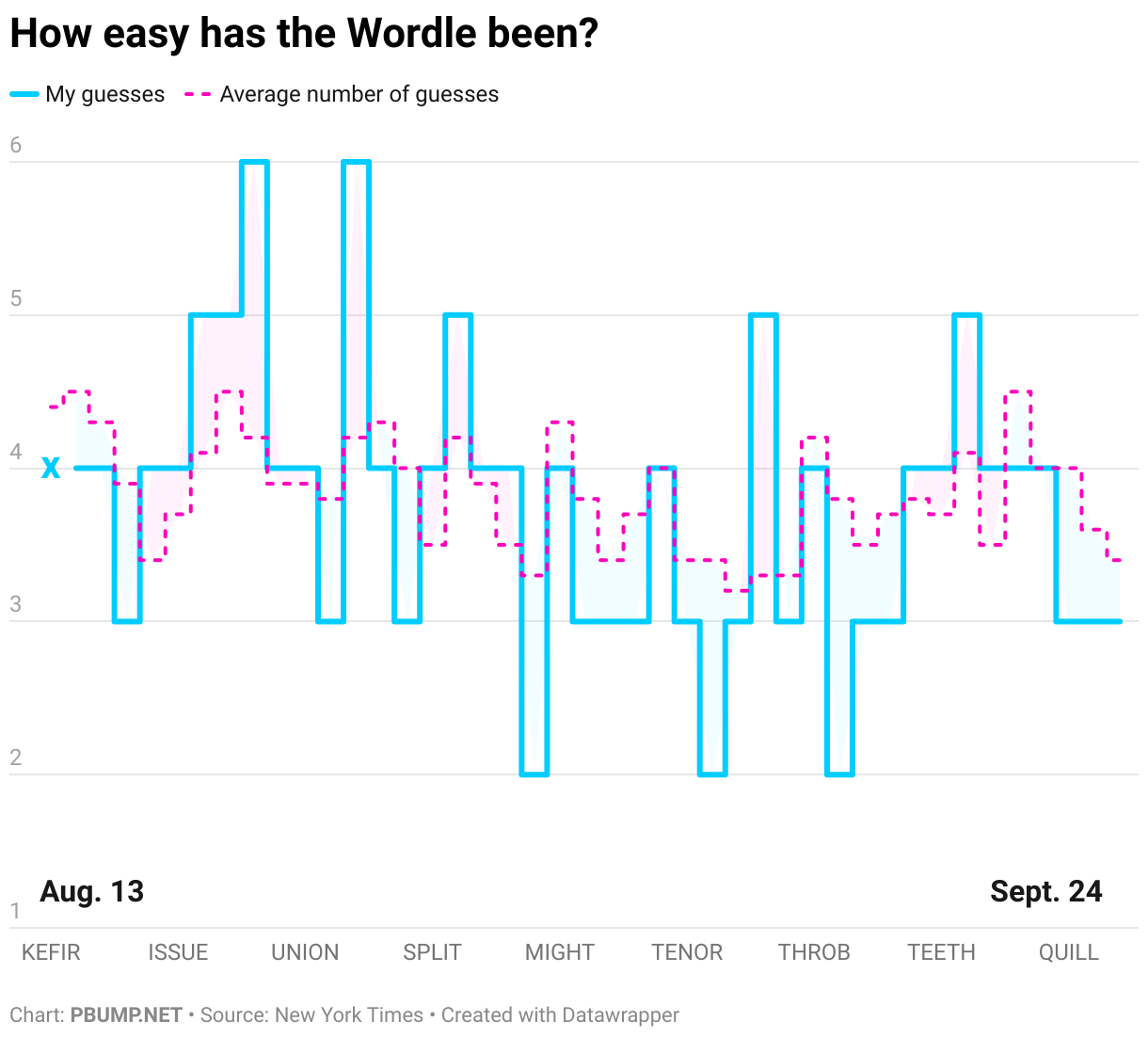
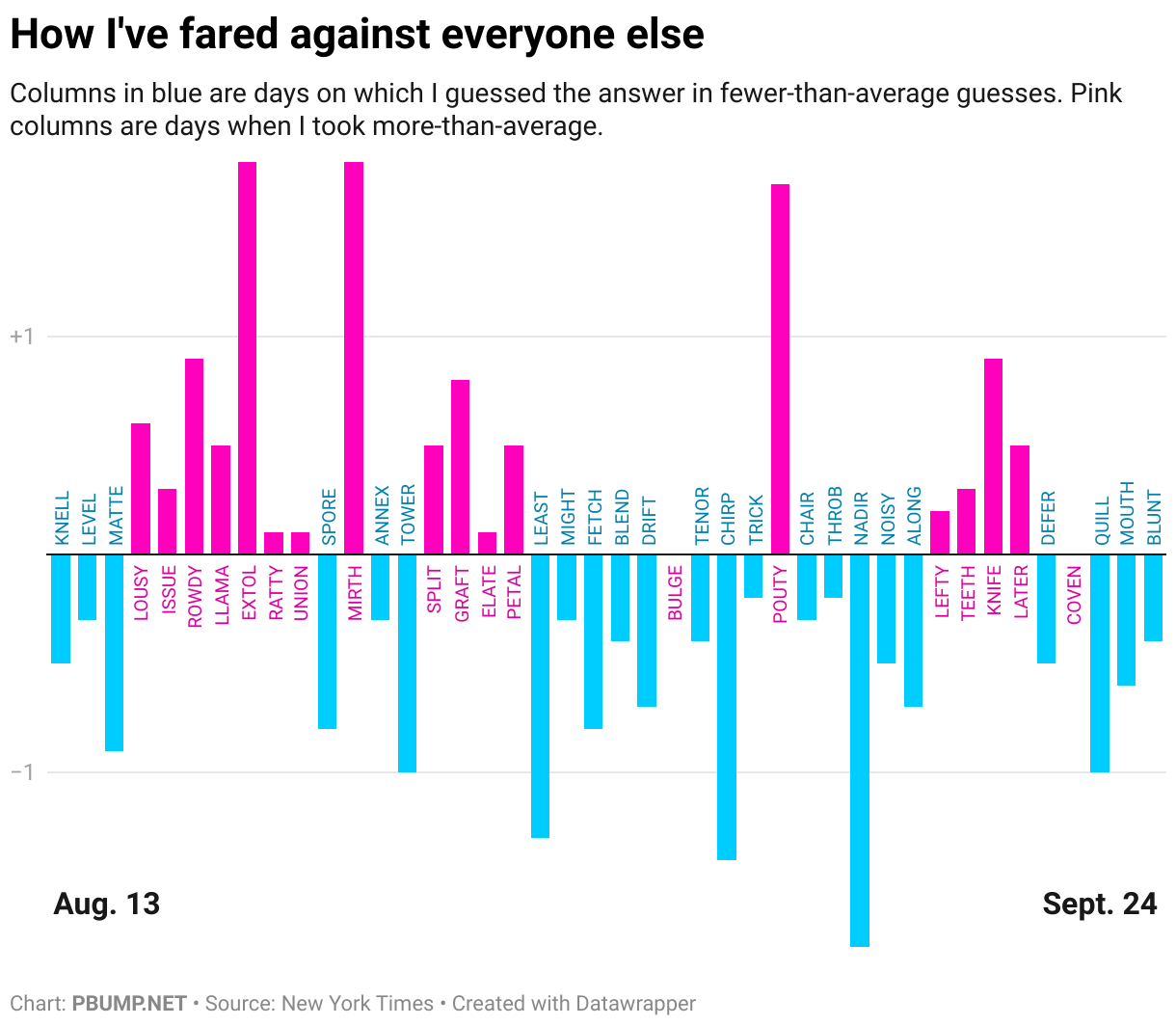
I am also outpacing the actual humans who play. Ever since Aug. 13, when the word was the execrable KEFIR, I’ve found the answer in two guesses three times and in six guesses only twice. For the uninitiated, this is pretty good. In fact, I’ve beaten the average score of human players 23 times and taken more guesses than the humans on only 17.

Naturally, I charted this. On the graph below, a lower number is better, indicating fewer guesses.

All the times the blue line is under the pink one, that’s when I outperformed the average player. Or, to show that difference another way, see the chart below. (If you haven’t done today’s Wordle and plan to, note that the answer is revealed.)

On average, I’ve beaten the average player by about 0.1 guesses since Aug. 13. My average number of guesses over that period is 3.74; theirs is 3.83.

It is true, of course, that luck does play a role in determining how successful you are. There’s a metaphysical point to be made about all of this, about how a perfectly constructed computer player will still lose to someone who’s taking an ill-advised chance. But I’ll leave the philosophy to others. I’ll just stick to making charts.