Even 2 in 5 Republicans understand Trump is impeding free speech

It’s not often the case that you will be working on a quick article about something only to have the president of the United States directly validate your thesis. But it happens occasionally, particularly since Jan. 20. And it happened today.

At a White House event this afternoon, President Trump declared that his administration had “[taken] freedom of speech away” — the sort of thing that past presidents didn’t say, in part because they had far less reason to do so.

Trump: "We took the freedom of speech away because that's been through the courts and the courts said you have freedom of speech, but what has happened is when they burn a flag it agitates and irritates crowds."

— Aaron Rupar (@atrupar.com) 2025-10-08T19:42:11.679Z

The event was focused on the purported threat posed by antifa, a loose-knit, microscopic collective of left-wing agitators that the administration has framed as an existential threat to the nation. During the discussion, the attorney general and the head of the Department of Homeland Security both presented antifa as a robust, insidious organization that demanded federal intervention, which is true only in that there is more grassroots interest in battling fascism than there was nine months ago.

Then Trump declared that one of his tools in combatting The Antifa Menace™ was instituting criminal punishments on people who burned American flags, something that he’s threatened on social media in the past but which continues to run afoul of First Amendment protections on speech. (See Texas v. Johnson.) Trump didn’t and can’t “take it away.”

As I said, I was already writing on the subject because of remarkable new data published by Pew Research Center this afternoon. Pew’s researchers asked Americans whether they viewed Trump’s use of presidential power positively or negatively, finding that most Americans considered his actions improper — and most disagreed that the changes he’s instituted have been positive.

The issue on which Americans were most critical? That Trump has improperly used his office to punish those who say things he doesn’t like. Which isn’t Congress making a law abridging speech (as the First Amendment prohibits) but is a reflection of Trump’s efforts to stamp out criticism and wrongthink.

So two-thirds of Americans think Trump is improperly using his power to punish those who make statements he opposes. Even more remarkably, that figure includes more than 40 percent of Republicans and independents who usually vote Republican. So even within his own party, a party that’s been fervently supportive of Trump, about 2 in 5 think that the president has improperly constrained speech.

I was originally going to end this post by noting that there was good reason for them to feel this way, articulating examples of Trump and his administration imposing costs on the free exercise of speech. But then the president just up and said it: we took the freedom of speech away.

Quod erat demonstrandum, I guess.

Photo: Trump in the Gold Office. (White House/Flickr)

Thawing out ‘Arctic Frost’ and the new Biden-was-worse argument

A recent American presidency, you may be alarmed to hear, engaged in an action that was “arguably worse than Watergate” — an event still positioned in some circles as the gold-standard of presidential malfeasance. What might surprise you about this claim is that the presidential administration during which this horrendous act occurred was Joe Biden’s, not Donald Trump’s. What might further surprise you is that Biden had nothing to do with it.

So let us now talk about Arctic Frost, the FBI investigation into Donald Trump’s efforts to overturn the results of the 2020 presidential election that was turned over to special counsel Jack Smith once he was appointed in November 2022. It is Arctic Frost that Sen. Chuck Grassley (R-Iowa) described as Watergate-esque, making it the latest in Grassley’s fumbling effort to cast the Biden administration as the most nefarious since Richard Nixon’s.

What’s the new development?

As part of that effort, Grassley asked the FBI to sift through a set of restricted-access files to see what might turn up. FBI Director Kash Patel — also eager to portray the pre-him FBI as hopelessly biased against Trump and the right — turned over a September 2023 document indicating that the Bureau had received “limited toll records” linked to nine U.S. senators.

The document doesn’t say much more than that, except that a special agent conducted “preliminary toll analysis” on the data that had been received.

On X, Patel crowed about having “discovered and exposed the weaponization of law enforcement” as he shared a clip from Sen. Josh Hawley (R-Mo.) complaining about the revelation. On Tuesday, Hawley demanded that Attorney General Pam Bondi explain who “ordered the tapping of phones” of senators including himself.

So what’s a ‘toll record’ and how is it obtained?

Well, it isn’t phone-tapping. Such records don’t include information about the content of calls, especially in real-time.

Instead, toll records include data about calls, allowing for potential analysis of the “source or destination of a call; the times of calls; and the dates, frequency, sequence, patterns, and duration of calls to/from one or many telephones” (as a fairly old Justice Department handbook explains). It’s not clear what information about calls to or from the senators’ phones were obtained by the FBI, given the qualifier “limited” in the published document’s description.

Importantly, the authorization for obtaining the records followed the approval of a subpoena by a grand jury, according to CBS News. In other words, this wasn’t the FBI simply digging into phone records. It was the government presenting a case to grand jurors that the records would be useful in their investigation and the jurors agreeing.

Why would investigators want those records?

“The only thing we all had in common was we were all Republicans,” Sen. Bill Hagerty (R-Tenn.) fumed after the story broke. But that commonality is important.

Remember, Arctic Frost was an investigation into the effort to overturn the 2020 election, an effort that culminated in the attack at the Capitol on Jan. 6, 2021. And phone calls made to senators that day played an important role in the investigation.

Here, for example, is the federal indictment accusing Trump of (among other things) conspiracy to defraud the U.S.:

Notice that it contains multiple mentions of calls to senators on Jan. 6 that were allegedly part of Trump’s effort to block the finalization of Electoral College votes.

In Smith’s overview of his investigation, presented to the Justice Department in the waning days of the Biden administration, he offers a pithier summary:

Same deal, though: Trump and his team were calling senators to pressure them to reject valid slates of electors. And since Trump was at the White House and his team was (mostly) at the nearby Willard Hotel, this cajoling occurred over the phone.

If you want to know who called which senators to apply pressure, there’s a straightforward way to do so: obtaining records of calls to those senators’ phones.

Is there any reason to think that the senators broke the law?

In fairness, we don’t know what data was sought and obtained. But there’s no reason to think, based on this document, that the senators were themselves targets of the investigation.

That said, there is reason to think that at least some of these senators were engaged with Trump’s effort to retain power. In the days prior to the finalization of the electoral votes, multiple senators publicly announced their intentions to vote against certification of the results. Hawley went out on his own, releasing a statement indicating that he would oppose the slate of electors offered by Pennsylvania (for contrived reasons). Sen. Ted Cruz (R-Tex.) cobbled together a group of senators (and senators-elect) who announced their intention to oppose the final electoral tally, including Hagerty, Tommy Tuberville (R-Ala.), Cynthia Lummis (R-Wyo.) and Marsha Blackburn (R-Tenn.).

Sen. Lindsey Graham (R-S.C.) appeared on Fox News Tuesday night to complain about being on the Arctic Frost list and to assert that he “made phone calls to a lot of people to find out what I should do as a senator regarding certifying the election and whether or not we should have hearings.” That’s true. But this downplays what happened pretty dramatically.

Remember, there was no reason to believe that there should be hearings into voter fraud by Jan. 6, 2021 — or even by Dec. 14, 2020, the day electors met to vote. Hell, there wasn’t reason to think there was anything suspect about the results by mid-November. But Trump was stoking the idea that the outcome was dubious (for obvious, self-serving reasons), building demand within his base for Republican politicians to agree. Graham did — to the extent that a grand jury in Georgia recommended that he be indicted in that state as part of the conspiracy to throw out its election results. Prosecutors declined to do so.

Why are Republicans making such a big deal out of it?

A few reasons.

One becomes clear when you consider the timing of the new information: just before Bondi was on Capitol Hill to face questions about her handling of the Justice Department. New claims rippling through the right-wing media universe centered on alleged abuse by the Biden administration gave Republicans and Trump allies a way to dismiss the obvious and explicit intervention by Trump in federal prosecutions at the moment. It was a useful way to say “Biden was worse,” which is in fact what a lot of the Republicans questioning Bondi ended up saying.

More fundamentally, though, Republicans simply don’t think Jan. 6 and the effort to overturn the 2020 election is worth investigating. Many of them see the probe into Trump’s post-election efforts not as an attempt to enforce accountability in the wake of a subversion of American democracy but, instead, as Democrats and Democrat-sympathetic investigators attempting to block their rightful power. This is much easier to believe if you are soaked in the right-wing media conversation, where the riot at the Capitol is seen as harmless or ancillary or both. To this day, most Republicans believe there was something hinky about the results of that election, a belief that’s largely a function of the concerted, unrelenting push by Trump and his supporters to insist, despite the evidence, that there was.

In addition to excusing Trump’s behavior, this idea also plays into the sense of victimization that Trump has stoked in his base. They and he aren’t doing anything bad; it’s the bad guys who are out to get them!

But, wait: Did Biden have anything to do with this?

No. Except that Biden was president in the wake of Trump’s first presidency and his effort to overturn the results of the 2020 election, and that Biden nominated (and 20 Republican senators voted to confirm) an attorney general, Merrick Garland, who believed in adherence the rule of law and independence from the White House. Jack Smith’s appointment, you will recall, was meant to separate the probe from the Biden administration, given that Trump had just announced his bid to be the Republican nominee challenging Biden’s reelection effort.

That’s really the original sin here: Someone tried to hold Trump to account. And Donald Trump doesn’t like to be held to account, so his allies gin up elaborate explanations for why doing so was invalid. Was somehow, bafflingly, “arguably worse than Watergate.”

Photo: FBI headquarters in September 1974. (National Archives)

The red-state invasion that worsened Chicago gun violence

President Trump’s eager deployment of federal and federalized troops is ostensibly rooted in fighting crime. Maybe he actually believes that; he did apparently see some footage from 2020 on the TV and argue that it actually represents the current environment in Portland. But it’s almost certainly mostly a pretext. He’s wanted to have troops marching through the streets of D.C. for years and was reportedly just looking for a reason to send them out. There’s also not much evidence that the deployment in D.C. is having much effect on crime.

What’s happening in Chicago isn’t being driven by soldiers. It’s immigration officers — mostly Immigration and Customs Enforcement, augmented by other deployed federal officials — who are turning over apartment buildings and tackling residents. But the administration’s messaging has long dishonestly conflated “immigration” and “crime,” and its current rhetoric about Chicago often mirrors what the president is saying about threats everywhere else.

During an interview on CNN Tuesday morning, Rep. Jonathan Jackson (D-Ill.) was asked about the argument that Chicago has an urgent need to address violent crime. He offered a useful counterpoint.

If the president’s concern about gun violence were sincere, Jackson argued, Trump “would be more interested in saying, ‘How do we effectively deal with gun violence? How do we deal with gun manufacturers?’ The city of Chicago does not have one gun shop, does not have one gun range.”

“How are these guns flooding our streets?” he continued.

It’s a very good question.

It is not the case that there are no gun dealers in Chicago. The Bureau of Alcohol, Tobacco, Firearms and Explosives (ATF) maintains a list of licensed firearm dealers in the U.S. Cross-referencing that list with Chicago-area ZIP codes shows only six licensed dealers in the city — a city of 2.7 million people.

Mapping dealers by ZIP code, you can see how few dealers there are in Chicago. Zoom in on the city below.

You might also notice that there are a lot of ZIP codes with a number of gun dealers not that far from Chicago. In fact, there are 14 licensed dealers in the 46350 ZIP code, an hour east in La Porte, Ind., home to about 22,000 people.

The ATF also tracks where firearms recovered from crime scenes were originally purchased. Just over half of the firearms recovered in Illinois in 2023 were purchased in Illinois. Another 16 percent came over the border from Indiana.

If that balance sounds about right — most from in-state, some from a neighbor — consider the numbers for Indiana itself. More than 80 percent of firearms recovered in Indiana in 2023 came from Indiana, while less than 2 percent came from Illinois.

This is Jackson’s point. It is much easier to buy a gun in Indiana than in Illinois, so a large percentage of guns used in Illinois come from Indiana. In fact, the number of firearms seized in Illinois that originated in that state is remarkably low compared to other states.

You may notice that many of the states with the most seized firearms that originated in-state are red states and that most of those with the fewest are blue. Those two things do correlate: the more a state voted for Trump in 2024, the higher the percentage of seized guns that originated in that state.

In the vast majority of states, most of the seized firearms that originated out-of-state came from red states — states where gun laws are often looser.

None of this excuses gun violence or is meant to suggest that such violence is entirely a function of lax gun laws in red states. But it is the case that a lot of the gun violence that occurs in Illinois and in Chicago uses weapons purchased outside of the city.

It is easier — and more palatable to Trump’s base — to send squads of enforcers into the heavily blue city to crack skulls. Combatting gun violence, though, might also benefit from efforts to reduce access to guns, reconciling Illinois’ efforts to limit gun ownership with its neighbor’s interest in putting firearms in shopping bags.

Photo: Biplanes over Chicago in 1931. (National Archives)

You can’t get anti-institutionalists to trust an institution

I will stipulate at the outset that I do not know how to reverse the long trend toward distrust in traditional American news sources. There’s probably a solution out there, likely something involving increased engagement in communications formats where people spend more time and less money. I’m pretty confident, though, that the answer is not taking established media institutions and attempting to realign them to meet the tastes of Americans who are actively hostile to media institutions.

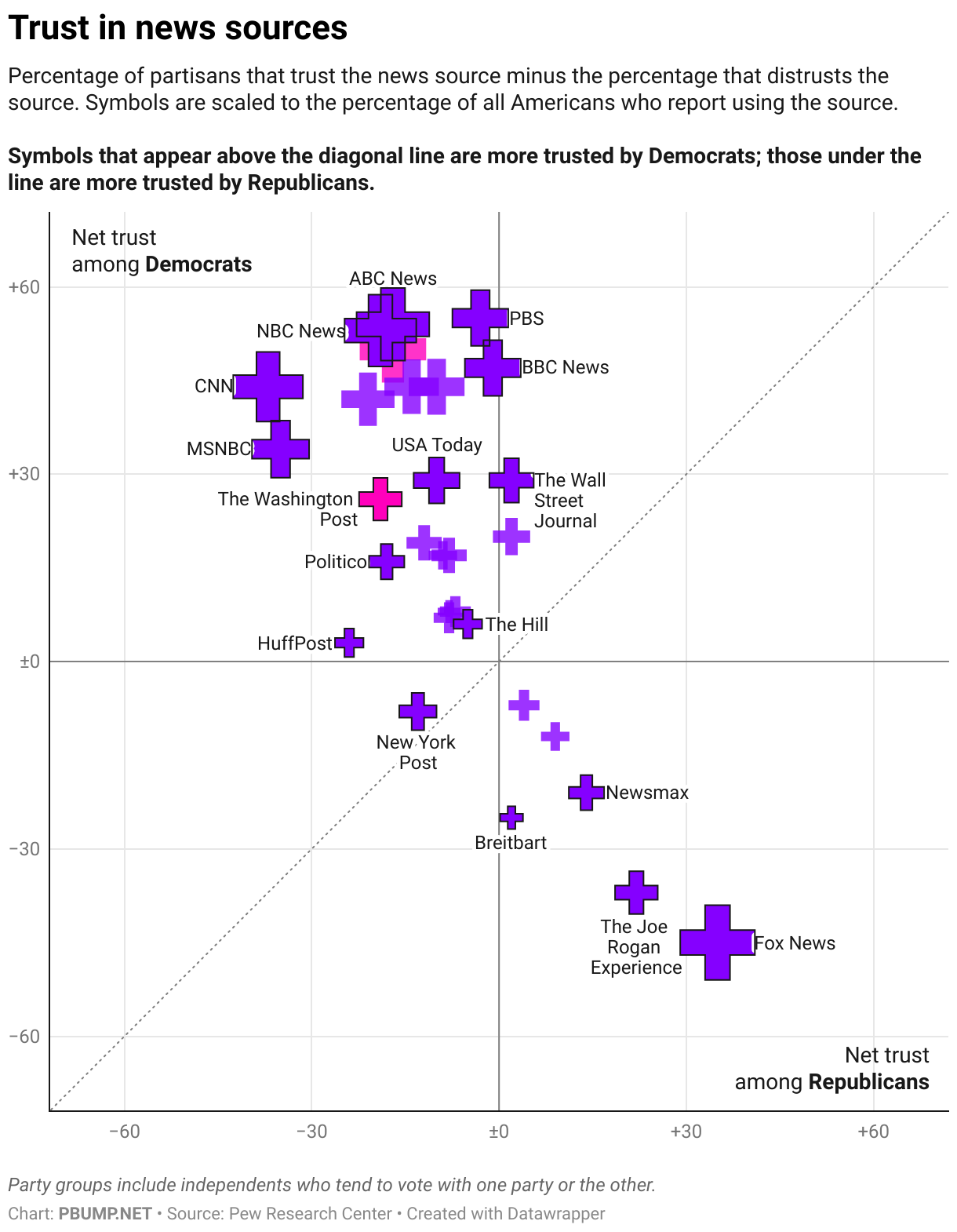
When we talk about distrust in the media, we are usually (though not always) talking centrally about distrust among Republicans. In Pew Research Center’s June analysis of trust in news sources, Democrats expressed more trust than distrust in 23 of the 30 sources identified. Republicans expressed more trust than distrust in only eight. Among Democrats, there were 10 sources of news that were trusted by 30 percentage-point more respondents than distrusted them. Among Republicans, only one source hit that mark: Fox News.

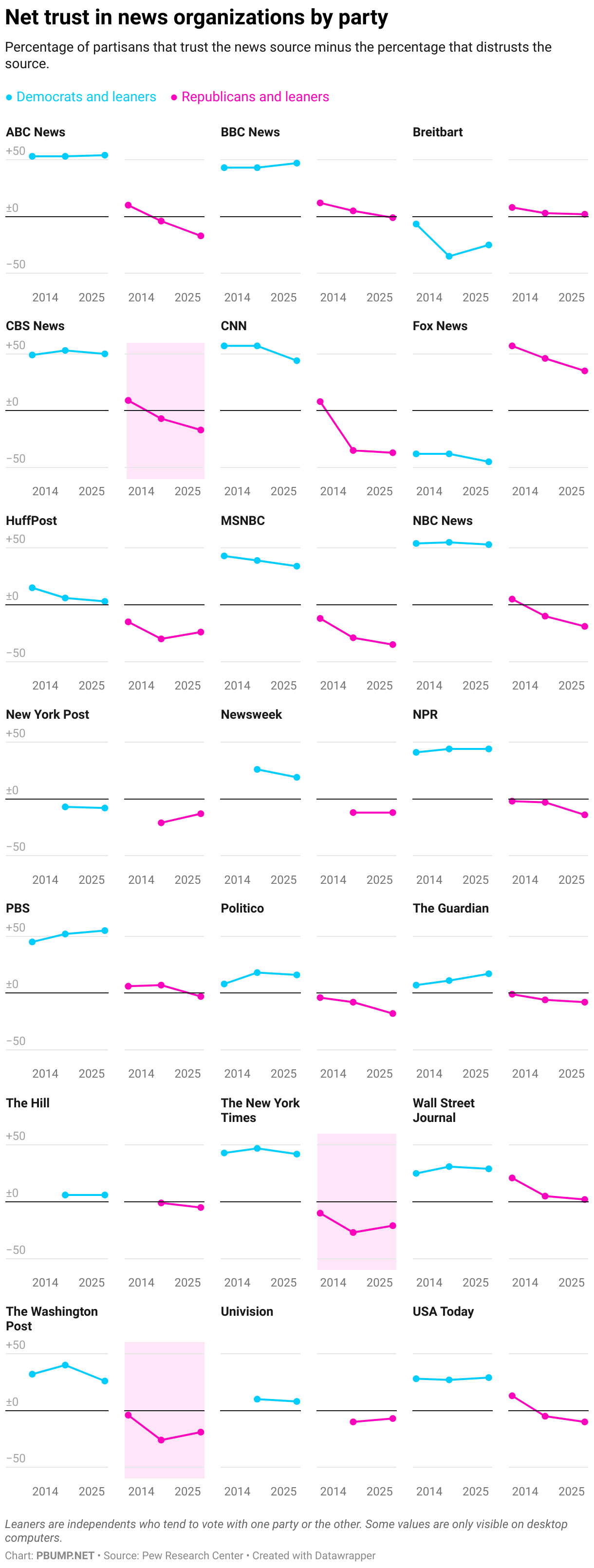
You’ll notice that I’ve highlighted CBS News and The Washington Post on that chart. These are both news sources that fall into the traditional/institutional media bucket and both sources that have attempted or are attempting to remedy the decline in trust by appealing more explicitly to “all Americans” — meaning, obviously, more Republicans.

CBS’s shift is driven by its new owner, David Ellison — the son of megabillionaire and Donald Trump ally Larry Ellison. The Post’s, to which I can attest firsthand, is driven by the shifting approach of its owner, megabillionaire Jeff Bezos. In each case, net trust among Republicans dipped from net-positive or neutral in 2014 to negative by 2025 (as measured at both points by Pew).

The Post has seen an uptick in net trust among Republicans since 2019, a change that one might be inclined to attribute to Bezos’s accommodation of Trump and his base. But Pew notes that Republican trust in news sources surged upward since last year, a change “which has coincided with President Donald Trump’s return to the White House.” More importantly, Republican trust in the New York Times has also shifted upward since 2019, to about the same extent that trust in The Post increased. In other words, there’s no reason to think that The Post’s improvement is a function of Bezos’s public moves to appease Trump, like spiking the paper’s endorsement of Kamala Harris. And, in fact, Republicans are still more likely to distrust the paper than to trust it, by a wide margin.

Ellison has argued that the changes he’s advocating at CBS News, including the installation of Bari Weiss as editor-in-chief of the network’s news side, is an effort to “appeal to the 70 percent of Americans who define themselves as center-left or center-right,” as the Times reports. This is familiar framing for those who want to frame distrust in the media as being a function of its unfair coverage, arguing that the media is out of touch with mainstream America. For what it’s worth, analysis from the General Social Survey shows that only about a third of Americans are both mostly moderate and mostly independent. The remaining two-thirds are more partisan, more ideological, or both.

“We want to be in the truth business, we want to be in the fact business,” Ellison said earlier this year. But, of course, CBS and The Post have long been in the fact business and the truth business. The problem is that the fact and truth businesses are both suffering economic headwinds driven by the bullshit and rhetoric businesses. The current administration is hostile to facts that conflict with the president’s claims and is both leveraging and driving his base’s distrust in any outlet that’s actually in the business of generating facts.

What we can assume Ellison is really saying, of course, is that he wants to be in the business of generating the sorts of facts that won’t stir the ire of the president and his supporters. Maybe this will be good for the outlet’s bottom line — though that seems unlikely. Trump’s politics are rooted in the idea that his and his base’s worldview is rejected and mocked by traditional institutions including outlets like CBS and The Post. Each will be on a very short leash as it tries to appeal to those Americans, with coverage scrutinized endlessly for any perception of hostility to the president. It is an impossible standard to meet if one wants to be in the “fact business.”

Cynics will note that the Ellisons and Bezos are in other, non-fact businesses, too — ones that depend on the largesse of the federal government and therefore, in this moment, the approval of the president. Perhaps, then, the effort to publicly rescope the work of these institutions built to hold power to account is aimed less at some theoretical 70 percent of Americans than at one American in particular.

Photo: Harry Reasoner, CBS-TV, interviews Secretary of Defense Robert S. McNamara in 1964. (National Archives)

The corrosive rigidity of fascism

Is America something fixed or something fluid? Is it a country founded on a perfect set of ideas or a country that has struggled to become perfect? Is it a system that works or one that sputters, one that’s being damaged or one that’s being fixed?

This debate undergirds an enormous part of the political conversation. It manifests in disputes about the Constitution, in the fight over immigration, in attacks on government spending and research. At the risk over being overly concise — particularly since this is mostly meant to be a rumination on Paul Thomas Anderson’s film “One Battle After Another” — it seems likely that some part of this is rooted in the idea that America achieved and now risks losing a position as the most dominant nation on Earth. The America that was, won. Can the America that is?

The position of the administration is that America is deviating from its path, led astray by deviants. Rhetoric from the vice president and Trump allies centers on the idea that the United States is a nation built centrally by 18th century writers and 19th century frontiersmen (the “White” descriptor not always left as subtext). That trajectory of greatness led the country to where it is, a path forward as unswerving and inevitable to their eyes as the Democratic Party’s historic embrace of Southern racism.

To protect the nation, they argue, we must protect that path. We must more tightly control how Americans think and who enters the country. We must return rigor and rigidity to the American system.

To a significant extent, this narrative is often used as post hoc rationalization for the centralization of power. But the rigidity is always there. The inflexible understanding of what constitutes America sits at the root of the effort. Make America great again, as it was.

The opposing theory is that the union isn’t perfect. That it doesn’t follow clean lines and never has. And, in fact, that this is what makes America great. America is a social experiment that shifts ingredients and approaches and achieved success through experimentation and flexibility. It is not and has never been a perfect machine, as any even cursory assessment of history will attest. But it can be made more perfect, by continuing to explore and test and adjust.

”One Battle After Another” is a terrific film, and an astonishingly timely one. I won’t get into the plot since if you’ve seen it there’s no need and if you haven’t I wouldn’t want to spoil it. But I will say that this tension between rigid and flexible is at its core: from the explicit tension between the fascist regime and opposing revolutionaries, to the search for racial purity in our national melting pot, to the question of what constitutes a family. The overarching national battle between rigid and flexible isn’t resolved in the movie, but the others are — with the forces of rigidity losing. Even, at one point, they lose to more rigid versions of themselves.

As a work of fiction, we shouldn’t see the outcome as particularly reassuring. (It’s telling, though, that some on the real-world right view the story as threatening.) What we might take from the movie instead is its reminder that fluidity is natural, if not unavoidable; uncertainty seeping out of and into order. Love strengthens a family more than DNA does. Inclusion strengthens America more than exclusion does.

American ideals and American success require defense. Improvement means eternal adjustment and improvisation. Creating a more perfect union means fighting one battle after another, indefinitely.

Photo via Warner Bros. Pictures.