The more things change

During a tour at my son’s new school this summer, another father struck up a conversation. He asked about my son’s reading and described his efforts to get his child to pick up books more frequently. A key problem, he insisted, was that kids weren’t instructed as they had been when he and I were young: no more recitations and writing drills, among other things. He had hired an outside tutor in order to make sure that his child was learning the way he thought they should learn.

Perhaps it’s because I have friends who are teachers or perhaps it’s because I spent some time working in an elementary school, but his approach struck me as ridiculous. Teachers in public schools have spent years learning about teaching methodologies before they even get into a classroom and then hone their techniques as they teach. They necessarily have a much better sense of effective teaching methodologies than does some guy who hasn’t been in elementary school since he was a student during the Reagan administration.

This exchange has popped into my mind sporadically over the past few months, and I’ve come to believe that my response to his insistence wasn’t really a function of who I knew or my experience. It was, instead, a recognition that the world evolves and changes and that how things were is never necessarily better than how things are.

It takes a long time for people to recognize that the world isn’t static. Some probably never do. We are born into a world and learn how the world works as we age and then feel as though we have a handle on things. But the world, frustratingly, has kept on changing and evolving, until the world that we understood has new tweaks and gaps and systems that we don’t recognize or immediately understand.

That’s not what we don’t recognize, really; everyone knows that things change. What we don’t recognize for a long time, if ever, is that even the static world into which we were born was itself a product of change. The static reality that we had a firm grasp on by the age of 10 or 15 was someone else’s bizarre new way of existence that made no sense and was probably not all that sensible. We plunked into a constantly shifting timeline but only really recognize the shifts that diverge from the world we first learned about.

I suspect — and I’ll admit to probably being somewhat parochial here — that this understanding of having been plunked down into a roiling, churning reality probably comes more quickly to people who live in environments where such change is a constant. My wife and I took our kids down to Soho this morning, a Manhattan neighborhood near where she and I used to live. Walking around was a constant stream of “this used to be X” comments about buildings and storefronts. The places that hadn’t changed were the exception.

This is the nature of New York City. I imagine that it is much less the nature of, say, a small town in an agricultural region. I imagine that in such places, with fewer things to change and change happening at a less rapid pace, it’s harder to see change as the constant and easier to see it as anomalous.

I could spin this out into some observation about politics and American culture, but it’s Dec. 31 — about seven hours, as I write, from the new year. I’m writing this in part because the trip to Manhattan reminded me that things change but that the ship of Theseus is still the ship of Theseus. This year has been one of personal change extending far beyond my son’s new school. It is reassuring to remember, to recognize that the universe is chaos, not order. Change is eternal. And it is not necessarily change for the worse.

So trust yourself. And, for God’s sake, trust your kid’s teachers.

Photo: Goldberger’s Pharmacy on 1st Avenue, as it looked in 2016 (and photographed by me). Below, via Apple Maps, what it looks like today.

Did Trump voters vote for deporting every undocumented immigrant?

I’ll cut to the chase: No.

We as Americans do have the habit of being selective about how we describe the motivations and priorities of voters. Most people cast their ballots in support of candidates from the party with which they agree, rather than engaging in a complicated analysis and ranking of policy positions. (This, in fact, is a central reason that political parties exist!) When a candidate loses or wins, however, they — and their supporters — and their detractors! — often ascribe the victory or loss to specific things that they advocated or opposed. If they ran on putting billboards on the Washington Monument and were elected because their opponent was caught on video abusing a puppy, the now-inaugurated candidate will happily inform the public that they must put a Pepsi logo on the National Mall because it’s What The Voters Wanted.™

Over at Bluesky today, there was a little flurry of a debate over the extent to which supporters of Donald Trump’s 2024 candidacy were explicitly supportive of the sweeping deportation effort that’s now underway. One side of the debate argued that Trump (and his surrogates) spoke frequently about deporting millions of people; there had even been signs at the convention reading “Mass Deportation Now.” The other side noted that conventions are only rarely considered by the voting public, and that many people voted for Trump for reasons that had nothing to do with any promises about deportation. (Like, for example, inflation.)

Again, the latter argument is correct. And we know that because Trump voters themselves indicate that they oppose the sort of deportations that are underway.

Even before Trump took office in January, polling showed a wide gap between support for deporting any immigrant who was living in the country without proper authorization and deporting those who’d committed crimes. The specific numbers depended on the wording of the poll (see results from AP-NORC and the Wall Street Journal below), but the gap was consistent: Far more people endorsed narrower deportation efforts than broader ones.

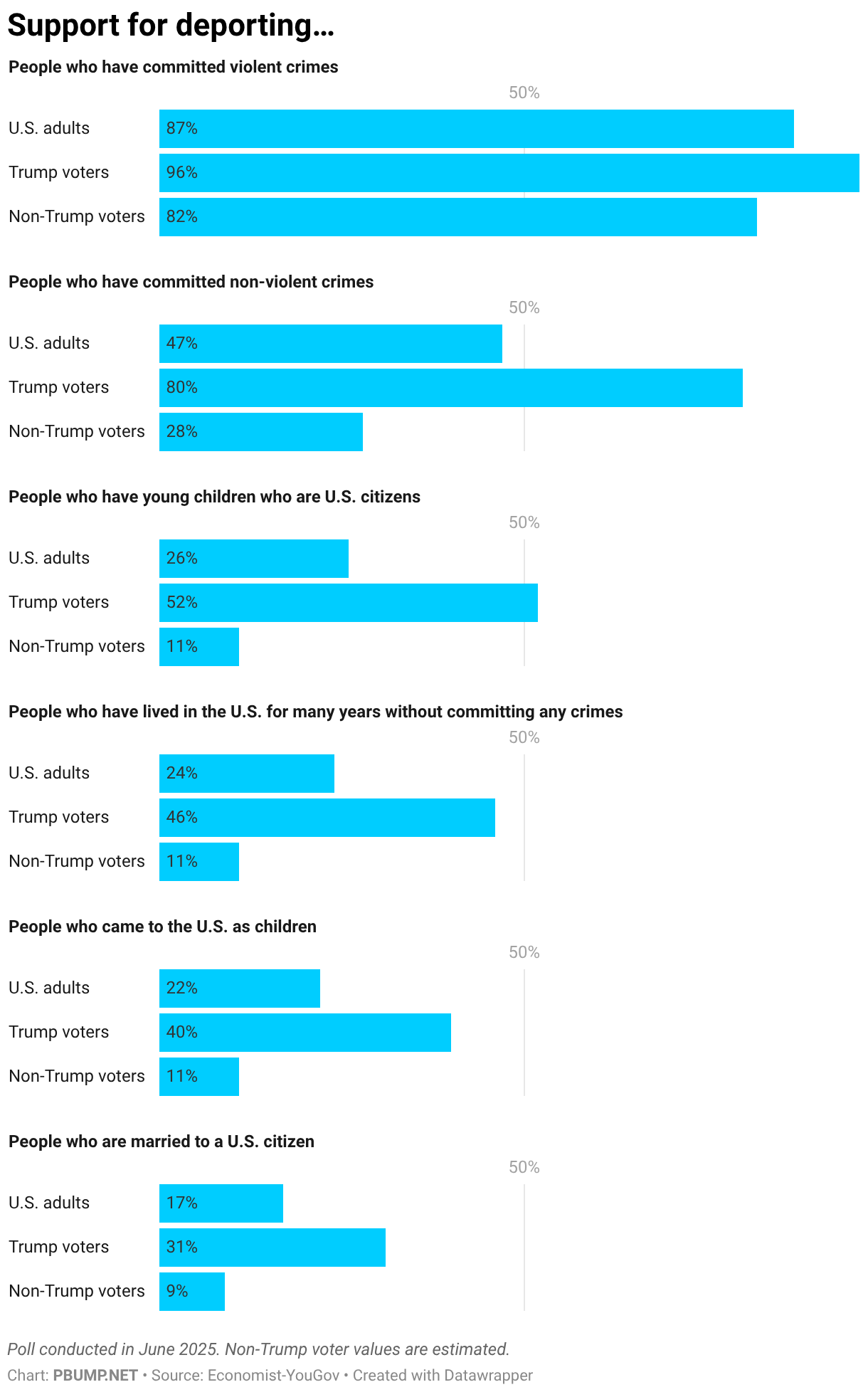
Those numbers weren’t broken out by party, however. So let’s look at June polling from YouGov, which presented various deportation scenarios to respondents.

Again, we see that deportations of immigrants convicted of crimes enjoys wide support. But support declines under different circumstances. Only a quarter of Americans — and only half of people who say they voted for Trump last year! — support deporting immigrants who have kids that are citizens. Less than half of Trump voters support deporting people who’ve lived in the country for years without committing crimes.

I’ll note that this doesn’t mean that half of Trump voters oppose deporting people who’ve lived in the U.S. for years without committing crimes. In fact, only a third do; the other 20 percent say they aren’t sure if such people should be deported.

But it is clearly not the case that Trump voters supported sweeping deportation of immigrants regardless of circumstance back in June. From that, it follows that it is unlikely that most of them supported such a sweeping deportation strategy last November, when they were casting their ballots. Some did, yes. But it’s very unlikely that most did.

I’ll add one last thing. While I was still at The Washington Post, I occasionally wrote about Trump’s deportation policies and looked for images from the convention of people holding those “Mass Deportations Now” signs. As it turns out, this was not easy to do. They were not ubiquitous or constant; I believe (and am happy to be corrected) that they were trotted out for only one part of one night.

Meaning that while they came to represent Trump’s position in the eyes of his opponents, it’s probably not the case that they represented the views or understanding of most of his supporters.

Photo: Trump at Mar-a-Lago on Nov. 26, 2025. (White House/Flickr)

Finding a tradition inside of a tradition

Every so often, I Google the names of my grandparents. The internet keeps expanding backward as more pre-internet information is digitized so it’s interesting to see if anything else has surfaced.

I wasn’t lucky enough to spend much of my adult life with them or wise enough to spend more of time with them when I could. Swimming through the internet allows me occasional glimpses of slices of their lives, from Census records documenting their existences to tiny vignettes that emerge solely through the twin coincidences of having at one point been documented and that documentation being digitized.

A few months ago, for example, I did a search for my grandfather, Elwood Glass. In the past, I’ve uncovered his name in advertisements related to his work recruiting employees at Sohio or as a member of the American Chemical Society. Did you know that local newspapers used to document people coming to town for visits? Well, they did.

My most recent search, though, uncovered something different: a mention from a 1979 Cornell University alumi magazine. Both he and my grandmother attended Cornell, graduating in 1938. And 41 years later, their classmates were treated to an unusual update on their lives.

A lovely family tradition is that of Flora (Daniel) and Elwood Glass ’38, described in a recent issue of Woman’s Day magazine. Each year, for more than 30 years, they have saved their Christmas tree, cut the trunk in small pieces, and written the year in pencil on the cut ends. On Christmas Eve, the family (five grown children and—at last report—six grandchildren) gathers in front of the fire and throws into it a piece from each year’s tree.
Each child puts on a piece from his birth year and those from special years such as college graduation, marriage, etc, and now the grandchildren put on a piece from their birth years as well. The children who celebrate Christmas in their own homes have also started this beautiful custom.

What struck me about this update wasn’t that it offered some new information about an interesting part of their lives. What struck me, instead, was that this is a tradition in which I still participate.


In my garage, I have ten chunks of wood, each a segment of a Christmas tree from each year of the past decade. When I’m taking our tree down after Christmas, I cut about eight inches off of the trunk, adding it to the collection. By the following Christmas Eve, it is seasoned and dry, so I write the year on the base with a marker — and then cut a slice off of it and each of its predecessors.

The night before Christmas is one of the few days each year on which we use our fireplace. I start a fire and my wife and (admittedly reluctant) kids sit around it. I have a file on my laptop that records the events of the years that correspond to each piece of wood — itself a modern update to the heavily scrawled upon piece of paper my grandfather used to use — and I read out what happened in that year. Or, at least, what we thought was important to include; the ceremony (such as it is) ends with our figuring out what events of the current year should be included on the list.

The stash of old trunks, as it looked last year.

As the Cornell alumni magazine suggests, someone is picked to toss the piece of wood from each year into the fire. New jobs, the kids’ birth years, etc., are reserved for the person for whom the year was the most meaningful.

When we would do this at my grandparents’ house as a kid, there were decades worth of logs (or, in some cases, small slivers of wood) and often more than a dozen people vying for the title of most significant year. At our house these days, the lucky person is generally whichever of my kids wants to throw it in, since a lot of what’s documented occurred before they were born. But that’s the point: It’s a way of documenting and sharing family history that they otherwise don’t know.

Which brings me to the other interesting part of that 1979 update about my parents: That at some point in that time period, this family tradition had earned a write up in a national magazine.


My quiet hope was that this mention would turn out to have been some multipage spread, one in which a photographer from Woman’s Day came to my grandparents’ house in Cleveland Heights and took pictures of the process. I remember certain parts of that house distinctly: the green, high-pile carpet and yellow chairs in the living room; the pervasive, slightly acrid smell; the low-ceilinged attic stairs with the bookshelf of kids books on the landing. To be able to see a photo of that space, much less of my grandfather’s list (where did that end up?) would be remarkable.

But this meant tracking the article down. It meant, most likely, another attempt to see how much of the past the internet has already absorbed.

I was hampered by the vagueness of the reference. The alumni magazine was dated February 1979, suggesting that the Woman’s Day issue was probably during the preceding holiday season. At that point, the magazine came out monthly, and I tracked down the November 1978 and January 1979 relatively easily. The latter cost me $5 to access a downloadable PDF — a gamble, since it was unlikely that the magazine would be presenting Christmas tips in January (much less that the alumni magazine worked on such a relatively quick turnaround schedule). And, sure enough, the mention of my grandparents was in neither.

The most likely issue, of course, was the December issue, but I was having trouble locating a digital version of it. There was one accessible through Proquest, a clearinghouse of old periodicals that I could access from the New York City Public Library, but that meant carving out time to head into the city to do so. I set the project aside for a few weeks.

As it turns out, though, no such trip was necessary. Picking the idea back up earlier this month, I remembered that the NYPL allows people outside of the city to get library cards. I did so, allowing me to log into Proquest remotely.

The story about the fireplace logs wasn’t in the December 1978 issue. It was in the December 1977 one, featured in a section of household tips called “Neighbors” just across from a cigarette ad.

MEMORY TREES
Each year for over thirty years we have saved our Christmas tree, and after winter-mulching perennial plants and small shrubs with the lopped-off branches, my husband has cut the trunk into small pieces, each with the year written in pencil on the cut end. Then every Christmas Eve we gather in front of the fire and throw into it a piece from each year’s tree for all those thirty-odd successive years, remembering as we do so the major events of the year. Each child—now grown, of course—puts on the piece from his birth year (as the grandchildren are beginning to do too) as well as from years that held special events for him-college graduation, marriage and such. Thus each Christmas Eve becomes a time filled with happy memories of all the years we have lived in this house. Now the children who have Christmas in their own homes are starting the same custom for their children, and last year when for the first time we spent Christmas with a child’s family, they gave us part of their tree to take home and add to our collection so we could have an unbroken sequence.
Flora D. Glass, Cleveland Heights, Ohio

No photo of the family or of my grandparents’ house, but still a wonderful window into their lives. It’s very fitting that my grandmother would go into unnecessary detail about the handling of the old tree; she was an avid and careful gardener. Just reading the brief description allows me to visualize crowding around their fireplace on that green carpet, my mother, sister and me debating my cousins and their families about who deserved to throw in a particular sliver of log.

I would love to know how this came about. Not only the tradition, the origins of which are murky to me. (Was it something my grandparents themselves had inherited? Or was it something they invented, like saying “Asciugamani!” when toasting — Italian for “hand towel”?) But why did my grandmother send this in? Was she reading Woman’s Day when she spotted a call for family traditions? Perhaps she sat down to type it up at a typewriter in the small office at the top of the stairs — a room that I remember as being off-limits to the grandkids but that we lingered around anyway to review the framed family tree that hung on the wall just outside of it. I remember her and my grandfather as being fairly reserved, but this was obviously a notable enough achievement that it warranted sharing with the other alumni of Cornell University.

Holding the magazine in my hands, I had another thought, one that I’ve had often before: What would my grandparents think of me? What would they have said to me? What might they have told their friends? This is an under-appreciated part of what happens when we lose loved ones: We not only lose them but we lose the bond between them and us. We’re left imagining what present-day interactions might have been like — a longing that’s being exploited by those AI-grandparent apps.

This is a large part of why I was Googling my grandparents in the first place. It’s an effort to add onto the piecemeal memories I have of them with whatever other information exists out there. It’s an attempt to build as complete a picture as I can of people I didn’t really know well, besides what I picked up during visits … or as we were throwing logs into a fire.

Then, as I was holding the magazine, I realized that it was itself the endpoint of a connection between my grandmother and me. I, like her, find enough value in the tradition to share it with others, as I have on social media each year since the pandemic. Without knowing that she’d once done so, I sat at my own keyboard in my own office and sent out a message to the world about a thing that our family did that was important to me. Across a half century and halfway across the country, the same impulse from grandmother and grandson.

And now this essay about it, which will have to substitute for the alumni magazine.

Header photo: The segments of tree trunk that we used for our 2024 tradition.

Twin shooting incidents highlight American mass-shooting exceptionalism

Americans went to bed on Saturday night with news that a shooter had killed two people at Brown University and woke up on Sunday morning to news that gunmen had massacred 16 people on a beach in Australia. The terror and disgrace of gun violence, hours apart on the opposite sides of the world.

The 16 deaths on Bondi Beach, where two men targeted Jewish people celebrating the start of Hanukkah, were the worst such incident in that country this century. There have been 10 mass-killing incidents using firearms since 2001; more people were killed and wounded on Sunday than in the other nine mass-killing incidents combined.

Here, I’m using a definition of “mass killing” that includes incidents in which at least three people were shot to death, excluding the shooter. This definition is certainly debatable, but it’s what I’m using because it’s also what’s used for Mother Jones’s database of shooting incidents in the U.S.

If we add mass-killing incidents in the U.S. since 2001, you can see that the Australian incidents are quickly dwarfed. (You can mouseover or click the colors to see each country’s incidents.) Nine of the 120-plus incidents in the U.S. since 2001 had larger death tolls than Bondi Beach. Three resulted in more injuries.

You might have noticed that the chart above doesn’t include the deadliest mass shooting in U.S. history: the attack on a concert in Las Vegas during Donald Trump’s first term in office. That’s because it obliterates the scale of the chart on both axes.

What happened at Bondi Beach was horrible. It would also have been only the tenth deadliest mass shooting in the U.S. this century.

It’s worth noting that the U.S. also has a significantly larger population than Australia. But U.S. mass killing incidents have been deadlier even relative to population. The incidents in Australia killed 1.86 people for every million current residents. The incidents in the U.S. killed 2.12.

In fact, the shooting at Brown University was relatively unremarkable in the context of American gun violence. According to the Gun Violence Archive, there have been 22 incidents in which more people were killed in a mass shooting (defined as an incident in which at least four people are shot) and 24 incidents in which more people were wounded this year alone.

The incident at Bondi Beach was only the second-worst mass killing in Australian history. The first was a shooting rampage in 1996 that left 35 people dead. In the wake of that incident, the Australian government implemented a number of strict limits on firearms possession, helping to tamp down incidents like the one this weekend.

Following its more numerous massacres, the U.S. has not done the same.

Photo: An AR-15 at a range in Connecticut. (National Archives)

Even Republicans don’t think attire is a central problem with flying

It remains the case that a good way to learn how people feel about things is to ask them. So you don’t have to simply assume, say, that people are hankering to work up a sweat before hopping onto a six-hour flight or that they think the central failure of the airline industry can be summarized as “sweatpants.” You can just contact a bunch of people over the phone and online and ask them to tell you what it is that they are concerned about.

Which is what YouGov did. And what they found is probably not surprising: The things that people find most annoying about flying are prices, delays and discomfort.

In fact, more than 6 in 10 Americans pointed to ticket prices as a major problem with flying. Half said the same of cramped seats, delays, hidden fees, and staffing shortages (which, of course, lead to delays). And waaaaaaaaaaay at the bottom of the list came “passengers dressing too casually,” which only 8 percent of respondents described as a major problem.

I’ve highlighted it above because it’s useful to contrast that issue (such as it is) with other highlighted ones, like delays and fees. Delays and hidden fees are very much issues over which the administration and the Transportation Department have some influence — yet Transportation Secretary Sean Duffy has instead repeatedly cajoled people into spiffing up before jumping in their C-group Southwest seat to Bozeman.

On most of these issues, by the way, there isn’t much difference between Democrats and Republicans. When looking only at those with an opinion, we see that the biggest gap in opinion between Democrats and Republicans is on the availability of ground transportation at airports, which is perhaps related to the fact that residents of big cities (where traffic is often more of a problem) are more likely to be Democrats.

The next two biggest partisan gaps are on a lack of aircraft safety — where Democrats, critical of Duffy, see a bigger problem — and on this issue of attire, where Republicans are more likely to offer complaint. (Just after that comes a probably correlated partisan divide, with Democrats being more likely to complain that dress codes are already too strict.)

The takeaway here, though, is that less than half of Republicans see attire as even a minor problem. More than half say that prices are a major problem, including a majority who identify hidden fees as a major problem with flying.

I’m afraid I have some bad news for them on each of those fronts.

Photo: What flying looked like in the 1950s — at least in a British Overseas Airways ad.