America’s moral inflection point

Last week, Gallup released the latest in its series of polling evaluating America’s moral worldview. Respondents were presented with a number of scenarios — wearing fur for fashion, cheating on a spouse, etc. — and asked whether those actions were generally morally acceptable or morally wrong.

There was a wide variation in responses, as you’d expect given the wide range of scenarios presented. Here are 19 of the options presented to respondents, listed from most to least likely to be considered morally acceptable.

What I noticed in looking at this data is that, for a number of these measures, there has been a sudden reversal of the long-term trend in recent years, with issues that were becoming more likely to be viewed as morally acceptable or consistently likely to be viewed that way suddenly being viewed more negatively. Those shifts appear to have often begun after the data from 2022.

If we re-order the results to show the largest declines since 2022, that trend is more apparent (albeit sometimes inconsistent).
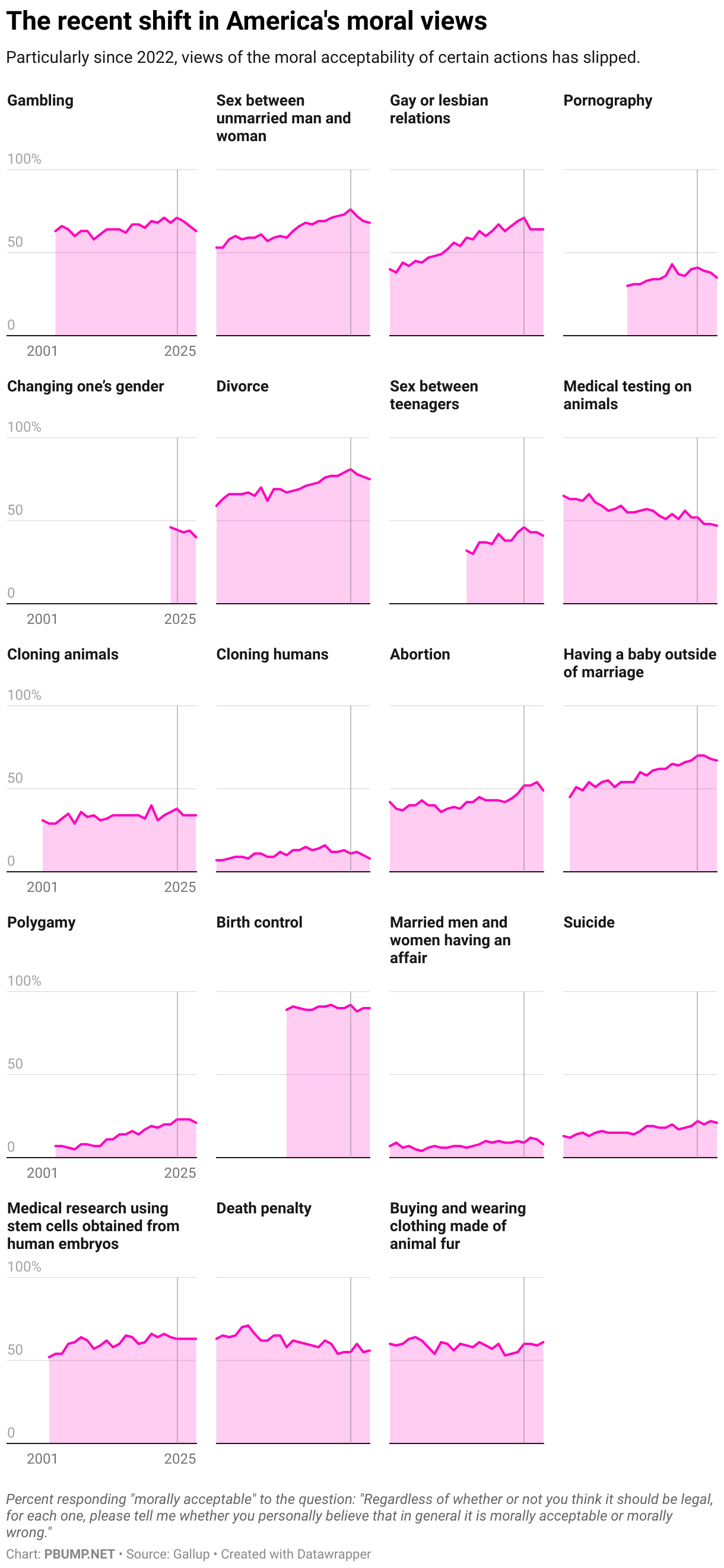
This mirrors another shift that is easy to believe to be related: Pew Research Center data from earlier this year showing that self-identification as Christian has stabilized in recent years — and even increased a bit since a low in … 2022.

The timing here is striking. It is by now well established that there were shifts in behavior that accompanied the emergence of the coronavirus in the U.S. in 2020. But this isn’t that. This suggests that something else shifted in the 2022-2023 period — a period when, for example, the covid-era spike in crime was beginning to recede.

Gallup’s analysis, summarized by Frank Newport, notes that the shifts over the past few years haven’t been uniform. Younger Americans, for example, have become disproportionately more likely to view porn, sex between teenagers and extramarital affairs as not morally acceptable.

His analysis ends with a cautious note.

“More research and more time are necessary to understand this recent shift,” Newport writes. “It may be a temporary, short-term change. Or it could be evidence of a more substantial shift in Americans’ moral and values positioning.”

That’s data-speak for “it looks like something happened here, but it’s not clear what — or if it even anything significant happened at all.” But if it did, as it seems to have, the question is: Why?

Photo: LGBT Solidarity Rally in front of the Stonewall Inn, New York on Feb. 4, 2017. (Mathias Wasik/Flickr under Creative Commons license)

Why Trump 2.0 aims to destroy green energy

Fifteen years ago, American advocates for increasing the use of renewable sources of energy for electricity production offered two central arguments for doing so. The first, obviously, was climate change. The second was strategic: If the U.S. didn’t seize the initiative in building out companies and investing in innovations to drive the green economy, some other country would. And if they did, those other countries would have a significant advantage moving forward.

The U.S. was well positioned to lead, even though it was quickly becoming apparent that other countries, including China, were making the same play. But the evolution of energy production was centrally a technological race, the kind at which the American system excelled. Innovation in fossil fuel energy existed but was largely about improving extraction, as the fracking boom demonstrated. Innovation in renewables — wind and particularly solar — was multi-faceted: smaller, cheaper, easier production, more output.

For a while, the surge in awareness about climate change driven by Al Gore’s 2006 movie on the subject seemed as if it would drive an ozone-layer-like moment of bipartisan agreement. It even seemed as if oil companies that made and maintained huge fortunes selling fossil fuels might spend resources to lead in the green energy space, too. But many Republicans were already skeptical of climate change and used to siding with the oil companies (remember who was president in 2006?) — and therefore inclined against taking action.

This was also a period in which partisan hostility surged. The emergence of the Tea Party was centered heavily on the election of Barack Obama, (who, like his opponent in 2008, promised to take action to combat global warming). The new president ran broadly on a platform of change, but that idea, twisted from its original presentation, freaked a lot of conservative Americans out. They saw in him not just change from the George W. Bush era but a change toward something exotic, foreign and un-American, with all of the subtext that suggests.

This, not the stuff about protecting oil companies, is where Donald Trump got folded in. As was the case with the Iraq War, Trump’s view of climate change (to the extent that he expressed one) mirrored the conventional assessment. In 2009, in the period before backlash to Obama and climate activism reached full steam, he was a signatory to a letter calling for action on carbon emissions that was published in the New York Times.

A few months later, Trump had already begun harrumphing along with the rest of the right about efforts to increase renewable energy and cut down on emissions from cars. But what really polarized the future president was that someone planned to build wind turbines off the coast of Scotland, within sight of a golf course he was working on. This was his own fight, engaged in in his own way, with social-media rants, attacks on opponents and baffling misinformation. When he opted to run for president, he applied those same tactics against his opponents.

The broader fight against climate change was also introducing tactics that would be deployed more broadly in the Trump era. Hacked emails selectively leaked to undermine the opponents. Attacking scientists as elitists and suggesting that agreed-upon facts were actually still in contention. Leaning on partisan alignment to combat unhelpful arguments.

(Such consistency has not been uniform. One of the attacks on Obama’s green-energy efforts centered on a federal loan guarantee given to a solar company, Solyndra, that eventually went under. That the program that provided that guarantee ended up making money for the government was generally ignored. The GOP’s voluminous objections to a president “picking winners and losers” in the economy, meanwhile, have necessarily vanished completely.)

Trump and the GOP were destined to land in the same place on climate change because Trump is a product of the right’s information ecosystem as much as its leader. He wasn’t motivated by ensuring that ExxonMobil made money but he was very motivated by the undercurrents that Exxon and its allies leveraged: young vs. old, change vs. the same, elites va. normal people. No one really cares about LED lightbulbs. They care that some kid with a placard or some bureaucrat in a tie is telling them they have to change what they are doing. This, Trump gets.

By the time Trump launched his 2016 bid, climate change was one of the most polarized issues in politics. Republicans rejected its existence and opposed taking action to address it while Democrats (and particularly younger Democrats more likely to see its eventual effects) demanded action. This polarization was so robust that it was essentially a litmus test, weeding out Republicans who might have been sympathetic to action. There are now functionally no defenders of addressing climate change on the American right.

(This happens elsewhere, too. “Wokeness,” for example, is a caricature of diversity issues that’s loathed on the right as a perceived demand that older Americans do something other than what they’ve always done. What was the fight over the “woke” Cracker Barrel logo other than a fight centered around unexpected change? By now, there is essentially no powerful Republican willing to stand in defense of pluralism.)

On Jan. 20, Trump returned to office, determined to use his regained power to settle all of his longstanding grudges like a long-tied Michael Corleone. That meant not only cutting government support for renewable energy projects but actively opposing them. It has meant treating wind and solar projects like they’re DEI initiatives, with whole-of-government efforts to uproot them in favor of coal.

This isn’t picking winners and losers; it’s just picking losers. Despite the U.S.’ general failure to move fast on renewable energy 15 years ago, we’ve seen a dramatic shift away from coal and to wind and solar.

In 2003, nearly every state generated more electricity from coal than from renewable sources.

By 2023, most were generating more from wind, solar and hydroelectric than from coal — despite the first Trump presidency.

Part of this was the replacement of coal-burning power plants with ones that used natural gas, a shift driven in part by the boom in extraction that accompanied fracking.

But every state also saw increases in the percentage of electricity generated by wind and solar over that same period. On average, 17 percent more of state electricity production in 2023 came from wind and solar than did in those states in 2003.

Trump and officials in his administration seem intent on reversing that trend. They claim that wind and solar are somehow only viable when it is windy and sunny, as though mankind has developed no way of storing generated power. Trump insists that fossil fuels are the only way to meet rising electricity demand not because they are but because he has internalized that renewables (and wind in particular) are bad. His base has learned this lesson along with him.

There has been one particular irony to Trump’s rejection of renewable energy over the past five years. One of the reasons he insists that wind and solar not be implemented and that electric vehicles not be encouraged is that so many of the constituent elements of those shifts — the car batteries and solar panels — can only be sourced from Chinese companies. Because China, recognizing the approaching economic battle that renewable energy presented 15 years ago, went all in on winning it.

Our failure to compete then is used as an argument against competing now.

Photo: An illustration from 1985. (National Archives)

Who is(n’t) benefitting from the Trump economy

I will leave it to the economists to say that the economy isn’t doing well, which they are saying, because it isn’t. What I will do, instead, is explain what that looks like in practical terms.

As you have probably heard, the Bureau of Labor Statistics reported on Friday morning that the economy added only 22,000 jobs last month. That number is subject to revision, a process in which the bureau continues to add data over time in order to ensure that its measures are as accurate as possible. There is some (fully warranted!) concern that future revisions might include a bit of thumb-on-scale adjustment to benefit President Trump politically, but that isn’t obvious from the new numbers. In fact, a revision to the June estimate now indicates that the country lost jobs that month for the first time since the pandemic emerged. It was just such a revision that prompted Trump to oust the non-partisan head of BLS after last month’s report.

What is clear is that the rate of hiring has slowed substantially and, since April, basically flat-lined. Compare this year’s change in employment since January with the steady rates of change in 2023 and 2024, for example.

Perhaps something that occurred in April had an effect on the economy? Who’s to say.

The shifts in employment have not been evenly distributed. For example, fewer Black and White Americans are working now than were working in January, while more Asian and Hispanic Americans are.

It’s important to note that the uncertainty in the employment numbers is even larger for subsets of the population. You can see that below in the data for Black men; the whipsaw drop and surge is probably not because of big swings in employment as much as statistical randomness. That said, there are some clear patterns, with Black women and White men in particular seeing employment loss since January.

In case you missed the joke earlier, some hard-to-measure-but-probably-significant portion of the economic softness we’re seeing is a function of Trump’s off-again-on-again tariff declarations. At the time he introduced them, they were presented (sometimes) as an effort to boost domestic manufacturing. (At other times they were presented as an effort to level the playing field on trade. The inconsistency is simply part of the slapdash nature of the policy.)

You can see below, though, that manufacturing employment has declined this year. So too has employment in the government, largely because 100,000 federal employees were put out of work.

There are lots of other numbers we could look at that suggest the economy is much weaker than any of us might desire. But these are more than enough for now. Since April, the country has added only 107,000 jobs, the smallest number over any four-month period since 2000. During 2023 and 2024, the country added an average of 192,000 jobs per month. This year, under Trump, we’ve added an average of 75,000.

The economy is slowing down. Uh, as an economist might say.

Photo: Unemployed men queued outside a depression soup kitchen opened in Chicago in 1931 by Al Capone. (National Archives)

Hardly anyone has a lot of trust in RFK Jr.’s medical advice

Not that they should.

Note that, even among Republicans, only 1 in 5 have a lot of confidence in what he has to say. It’s really only in comparison with the CDC that he fares decently with members of President Trump’s party.

That is, as always, the play: maybe you don’t love me, but at least I’m not a Big Government, Know-Ot-All Elite. And here we are.

America 201: We are a nation of immigrants from places besides Europe, too

It is likely that you have by now heard about Sen. Eric Schmitt’s (R-Mo.) speech at a right-wing conference on Tuesday. In it, he rejected the idea that America was “an abstract and vaguely-defined proposition” but, instead, a “nation and a people” in possession of “its own distinct history and heritage and interests.”

This is an explicit rejection of a long-standing tenet of American patriotism; Lincoln, you will recall, described America as a “new nation, conceived in Liberty, and dedicated to the proposition that all men are created equal” in his address at Gettysburg. But it’s more than that. The speech was also an explicit rejection of American pluralism and the United States’ role as (and beneficiary from being) a global melting pot.

“We Americans are the sons and daughters of the Christian pilgrims that poured out from Europe’s shores to baptize a new world in their ancient faith,” Schmitt said, defining his boundaries quite clearly. These were the people he described as lamenting the “memory of a country that once belonged to them.”

The speech included a lot of the now-familiar, Manifest-Destiny-colored narrative about the virile men who once tromped their way out to the Pacific coast. Schmitt’s America is one whose history had been almost entirely written by the turn of the 20th century. He cherry-picked a few developments after that point; that, for example, Missourian Charles Lindbergh (actually a Michigander) had flown across the Atlantic. (Lindbergh, incidentally, would likely have approved of Schmitt’s speech.) But mostly it was a familiar pastiche of Founding Fathers and Intrepid Explorers and so on.

This is a recently popular view of American history, given the primacy it offers to Christian White men. It is also almost hilariously naive, failing to recognize that the America that existed in 1900 was a pale shadow of the one that exists today — thanks in no small part to the contributions of immigrants. Schmitt’s speech was a bit like a Nokia executive insisting that the company get back to its roots of making boots.

Last month, Pew Research Center published an important analysis of the immigrant population in the U.S. and the recent shifts that have been driven by President Trump and allies including Schmitt. Many on the right like to frame the recent increase in immigrants to the U.S. as an aberration (including by wildly exaggerating the scale and threat of that increase). Pew’s data shows that the density of immigrants in the population returned to about 15 percent — the levels seen in the late 1800s — after a period in the mid-20th century during which immigration was limited by law. Since Trump took office this year, though, that percentage has already dropped noticeably.

It is true that the most recent wave of immigration to the U.S. (beginning with the lifting of those anti-immigration restrictions in the mid-1960s) is larger than the waves that came before it (as explained by Pew). It is also true that the more-recent immigrants come from regions that the pre-restriction immigrants didn’t, including Latin America.

But that scale is deceptive. The U.S. is far more populous now than it was at the end of the first big wave of immigration, the one that included nearly 12 million arrivals from Northern and Western Europe. The number of immigrants from that region was equivalent to about 18 percent of the country’s population at the end of that first wave. The number of immigrants from Latin America who’ve come since 1965, by contrast, is about 11 percent of the current U.S. population.

Of course, there was actually a fourth wave of immigration to the U.S. that largely preceded the influx from Northern and Western Europe. That was the wave that originated in Africa, involving unwilling migrants. It was those immigrants and their enslaved offspring who did most of the literal work of building the early United States. In 1890, Black people made up about 12 percent of the U.S. population.

The definition of “American” that Schmitt uses excludes Black Americans as well as immigrants from Latin America, Asia and anywhere besides Europe. That means that, per his definition, nearly half of all U.S. residents aren’t “Americans,” including an average of about 4 in 10 residents of each state.

Note the relatively small percentages in the southern states, a function of the unnamed first wave of “immigration” from Africa and immigration from Latin America in the most recent wave.

It’s important to note that a central reason that there were restrictions placed on immigration 100 years ago was the shift in the nations of origin between the mid-1800s and late-1800s waves of immigrants. Immigrants from southern and eastern Europe were often viewed as dirty and unwelcome; their embrace of Catholicism was seen as a threat to the Protestantism that was prevalent in the U.S. at the time. (Schmitt, I’ll note, is a Catholic.) The largest mass lynching in U.S. history occurred in New Orleans in 1891 and targeted Italian immigrants.

If we assume that Schmitt’s embrace of America’s European heritage excludes any of those second-wave arrivals (he reserved specific praise for the “Scots-Irish” in his speech), then his definition narrows the pool of “Americans” significantly. Only 4 in 10 U.S. residents have ancestry that originated in Western or Northern Europe.

Schmitt’s hostility to immigrants is toxic in its own right, of course, but the Trump administration’s institution of hostility to immigration as federal policy has a specific problem: It threatens the American labor force.

Immigration to the U.S. has been the primary reason that the population has grown in recent years — growth that is now at risk. But the aberration of contraction is less important than its effects. As I wrote both in my 2023 book and for The Washington Post in April, the aging of America’s population is disrupting the balance between those who build the economy and those who depend on it. A higher percentage of elderly Americans — a group far larger than the population of immigrants — means more need for services from a population that has a lower density of working-age people.

One path out of the problem has been immigrants continuing to move to the U.S., building families and filling jobs. As immigration increased in the wake of the covid-19 pandemic, so did foreign-born workers as a percentage of the labor force. As the population of immigrants has fallen during Trump’s second term in office, so has the density of foreign-born workers in the workforce.

So far, the loss in foreign-born members of the labor force has been offset by an increase in the number of native-born workers. Trump’s value proposition is that this trend will continue.

But from 2020 to 2024, the number of U.S. residents who are aged 65 and up increased by 12.3 percent. The percentage of residents aged 18 to 64 — prime working age — increased only 1.5 percent.

Trump and allies like Schmitt have chosen not to frame immigrants to the U.S. as potential workers, instead often describing them as “military-aged males” — implying they came to the U.S. to fight rather than to work. That gives Trump and his party cover to uproot immigrants in the guise of protecting America — and “Americans” who’d been wringing their hands about the “country that once belonged to them.”

I will note, by the way, that I have every right to impugn Schmitt as an unwelcome Johnny-come-lately, as someone who doesn’t understand American heritage. My ancestor, Edward Bompasse, came to the not-yet-United-States from England in 1621 on the Fortune. Luckily for the senator, I understand that this actually doesn’t give me more right to define Americanism than anyone else or empower me to look at anyone whose ancestors arrived more recently with disdain.

Photo: Undated photo of American immigrants. (National Archives)