Trump wants you to think invoking the Insurrection Act is more common than it is

It’s clear that Donald Trump spent a big chunk of the period between his presidencies thinking about what he would do differently if he returned to the White House. One thing he settled on was that he wouldn’t be constrained by staffers and experts who were cautioning him about precedent and the law. Another was that he would use the power of the presidency as a cudgel against his opponents, real and perceived.

This was obvious well in advance of his actual election. During his first term — and particularly after the BLM protests that emerged in mid-2020 — he’d made repeated comments about deploying the military against protesters and immigrants. His interest in invoking the Insurrection Act to deploy the military on the streets of American cities became part of Kamala Harris’ argument against his election. When that didn’t work, questions about such deployments became part of the confirmation hearings for Trump’s Cabinet.

Those concerns were well-founded. Trump hasn’t invoked the Insurrection Act, but he has federalized state National Guards to use as law enforcement. And over the weekend, he repeatedly suggested that the Insurrection Act was the next step.

“I haven’t used it but, don’t forget, I can use the Insurrection Act,” he said in an interview with his friend Maria Bartiromo. “Fifty percent of the presidents, almost, have used that. And that’s unquestioned power.”

Flying back to D.C. from (another) weekend at Mar-a-Lago, he repeated the claim when talking to reporters.

“I’m allowed as you know as president, like, 50 percent of the presidents have used the Insurrection Act,” he said. “Everybody agrees you’re allowed to use that and there is no more court cases, there is no more anything.”

He’s making two claims here, both of them false.

The second claim is that the Insurrection Act allows him to have “unquestioned power” and avoid “court cases.” It does not. The Brennan Center explained what it actually does a few years ago, articulating that it, in essence, allows the president to use the military to “execute the Laws of the Union, suppress Insurrections and repel Invasions.” In other words, to stamp out rebellions or to supplement law enforcement.

But I’d like to focus on Trump’s first claim, that about half of presidents have invoked the Insurrection Act. That’s not true.

The Brennan Center has a list of times at which the Act has been invoked in U.S. history. Over the course of 47 presidencies, it has been invoked in 19 — meaning about 2 in 5 presidencies, not 5 in 10.
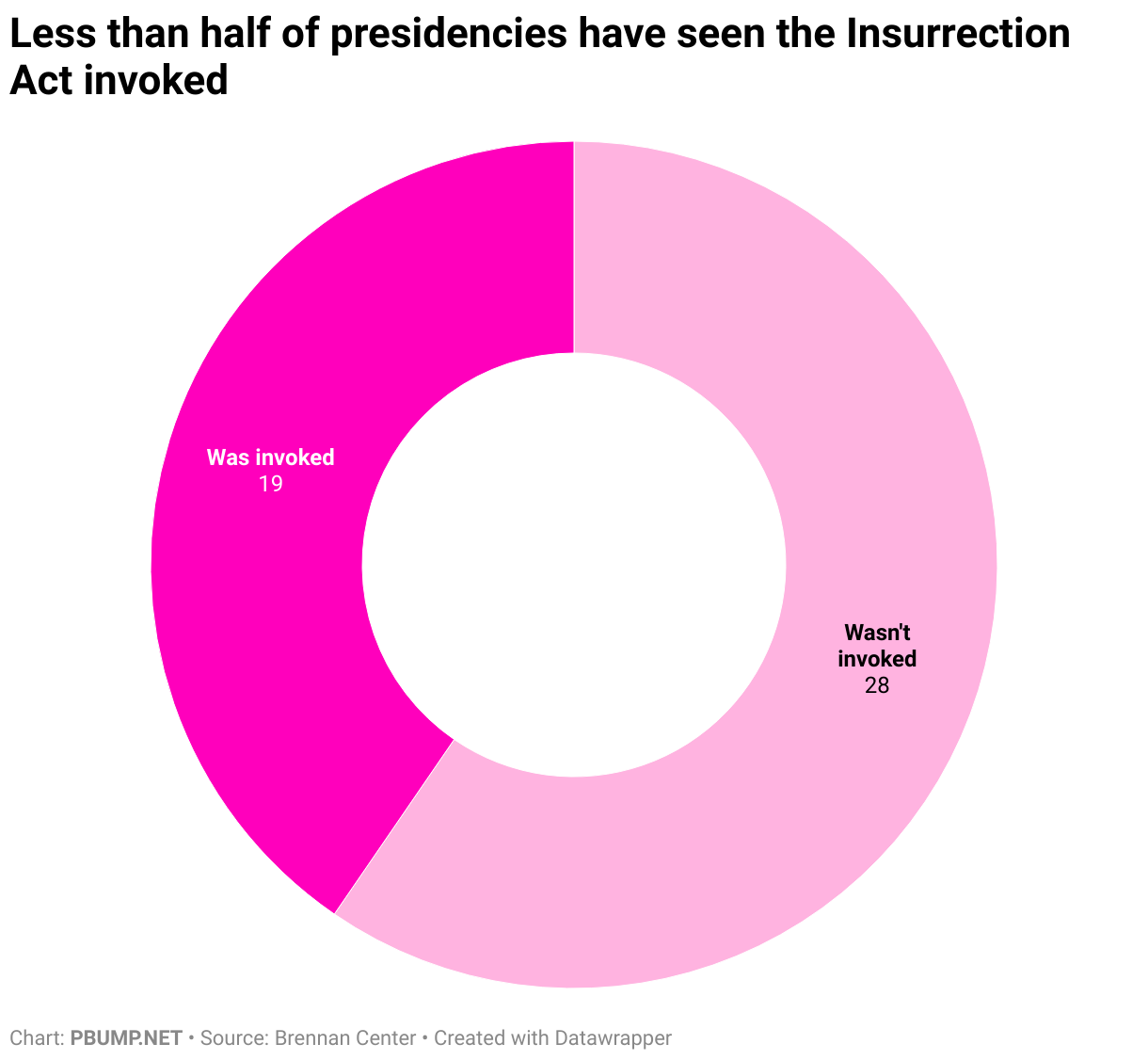
The reasons for those invocations vary. Early in the country’s history, they were to put down actual rebellions — including at the outset of the Civil War. At a lot of other times, the Act has been invoked to allow a federal response to racist incidents: anti-Chinese riots, efforts by Southern states to retain segregation. In that latter case, the federal government stepped in to enforce laws that state authorities were hoping to ignore.

The most recent invocations — during the presidencies of Ronald Reagan and George H.W. Bush — were to provide additional support to states combatting unrest. Not rebellions but riots, like the ones that followed the acquittal of the police officers who beat Rodney King in Los Angeles.

Notice that an invocation of the Act during the Hoover administration was actually not undertaken by Hoover. If we remove that one from the calculus and look at the numbers by president (as Trump did) the percentage drops further: just over a third of presidents have invoked the Insurrection Act.
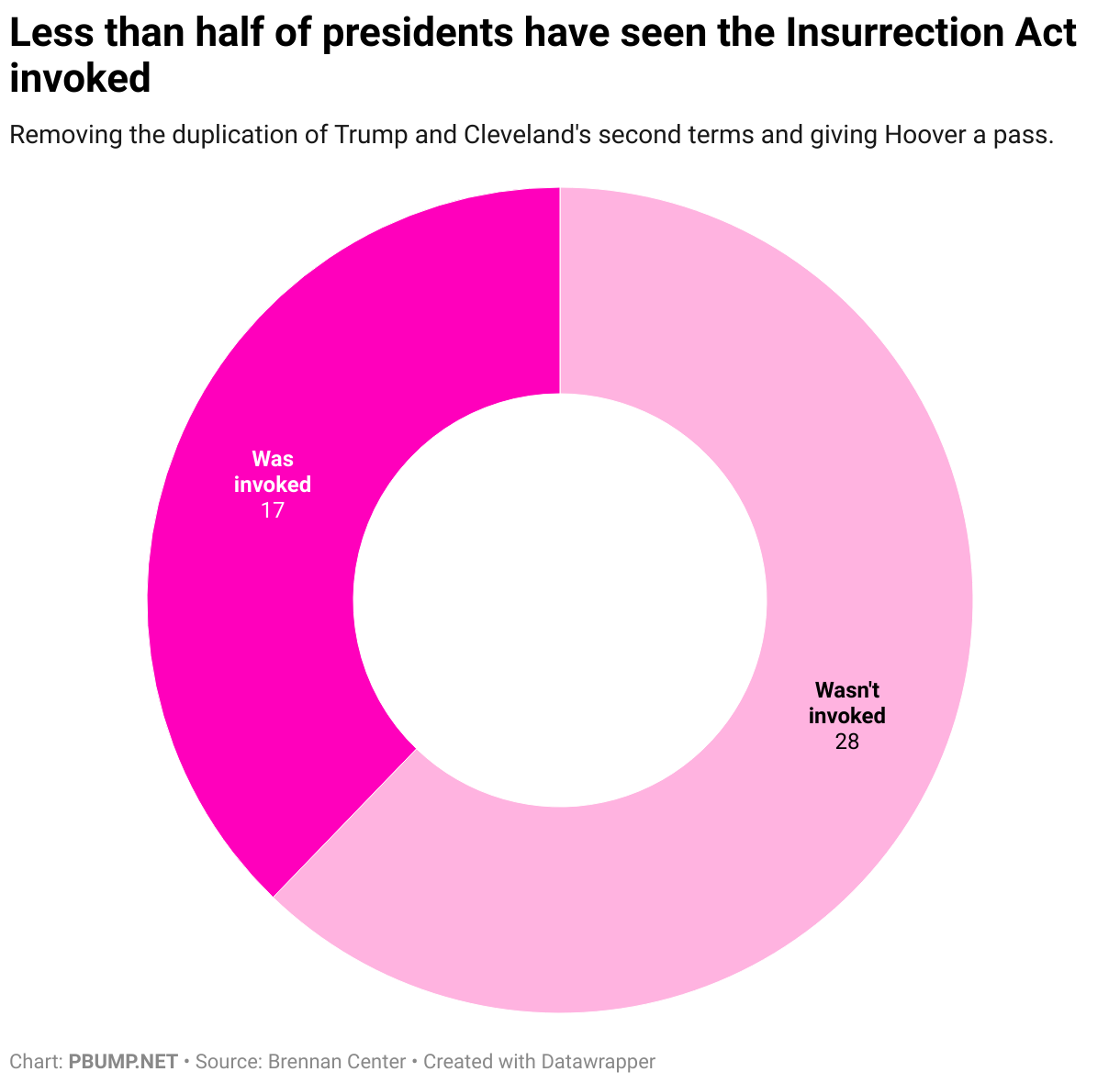
The most important factor here isn’t that Trump’s math is bad. It’s that he wants Americans to think that invocations of the Insurrection Act are par for the historical course, which they aren’t. He wants people to think that it’s relatively trivial to invoke the Act and that he can do so when he wants to for whatever reason he wants to.

But context matters. It’s also true that 50 percent of President Roosevelts declared war on Germany, but that’s because Franklin Roosevelt had reason to do so. There’s a reason those other presidents invoked the Insurrection Act, and it wasn’t because they wanted their political opponents to bend to their will. It was in defense of law and order, not as a defiance of it.

Another way to look at the data on the Insurrection Act is to note that no president has invoked it in more than 30 years. If Trump were to do so, as he’s hinting, he’d be breaking with precedent, not mirroring it.

Photo: Trump at his birthday parade. (White House/Flickr)

Sincerity is not the problem

As is inevitably the case after an election — and is especially the case after an election with an unexpected result — allies of the losing presidential candidate in 2024 looked for people to blame.

One quickly identified culprit was “the groups,” advocacy organizations that had built power and used it to pressure Democratic candidates to push for their positions. Organizations that demanded racial justice and climate groups like the Sunrise Movement have been targets of particular ire. They pushed Democratic legislators to take public positions that were seen as unpopular, ushering in Donald Trump’s second term.

Let’s set aside the central problem with that claim — namely, that inflation was almost certainly a far, far bigger problem for the incumbent party than, say, “wokeness” — and instead consider the supposed problem on its own merits. In particular, the role of climate politics on the left.

It is true that addressing climate change has not proven to be something that inspires many Americans to vote for Democrats, even if they agree that planetary warming is a problem. There just happen to be a lot of other, more pressing problems that voters tend to prioritize.

It is also the case that the world is warming and that is being driven by human activity. It is the case that this is a problem that is already manifest and that it threatens to become more immediate and more damaging as time passes. It is an issue that will necessarily affect people who are alive in the year 2100 more than those who will be alive in 2050, meaning it is an issue that has particular salience to younger Americans.

So, for many young and recently young Americans, climate change became a generationally defining problem. It was something that affected them more than older Americans and it involved a fight against deeply entrenched interests with deep pockets. It is analogous (in admittedly incomplete ways) to the baby boom’s fight against the Vietnam War. That, too, was something that disproportionately affected the young and it, too, involved a fight against established power.

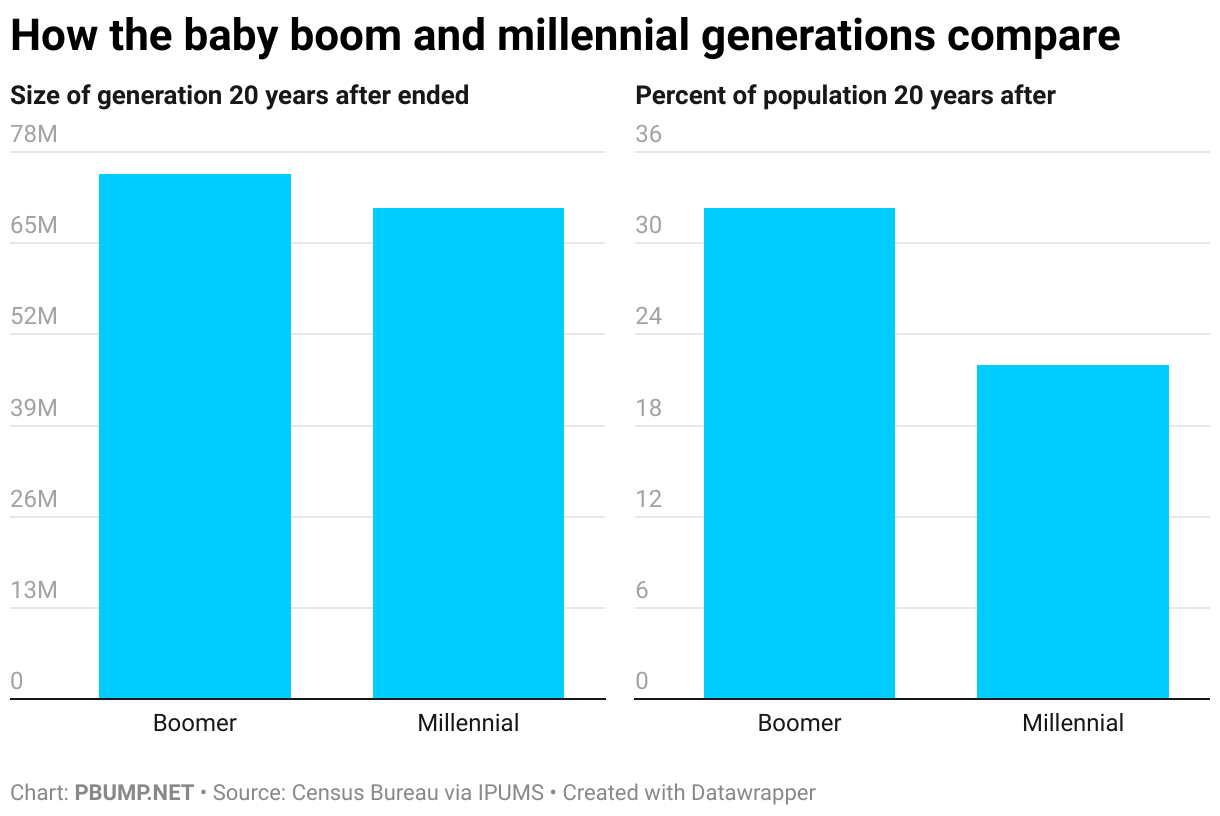
It was also a fight that emerged along with an unusually large population of young people. Millennials were between 10 and 25 years old when “An Inconvenient Truth” elevated global warming to national attention. For every 100 boomers in the U.S. two decades after that generation emerged (that is, in 1984), there were 94 millennials two decades after its emergence (in 2016). It’s just that, in part because of the baby boom, millennials made up far less of the total population.

The generational fight against climate change did not see the same success as did the fight against Vietnam. There are a lot of reasons for that, including that Vietnam War produced immediate, visceral examples of death and immorality that were effective in moving public opinion. The fight against climate change featured plenty of imagery of the effects of warmer oceans and air, but it also ran into a system of denial that wasn’t possible in the 1970s. It wasn’t just a battle against carbon dioxide emissions; it became a battle over reality, with corporations and their allies settling on a strategy of contesting every single inch of rhetorical terrain.

For all of the cynicism that accompanied the anti-war movement a half-century ago, at least the war ended. Young people fighting for what they saw as an existential threat to the planet and themselves, incremental progress in reducing greenhouse gases hardly seemed like much of a victory. They fought the system — and the system won a robust victory.

There was an institution that was supposed to aid their fight: The Democratic Party. Often, though, Democratic politicians adopted moderate positions or advocated for carefully triangulated policy proposals aimed at building consensus. Americans generally and young Americans in particular were already drifting away from party membership in favor of political independence; the Democratic Party didn’t offer young people who cared about climate change much of a reason to sign up.

The Democratic Party is supposed to be the storehouse of political power on the left. But the increased polarization of politics and the increased nationalization of it (the centering of national issues even in state and local races) has trained the party to seek out the least offensive possible position as indicated by public opinion data. So those young people — and people of color and the (mostly) retirement-age women who spun up the Indivisible protests during Trump’s first term — built power elsewhere. Then they deployed it as they saw fit.

This is what stokes the frustration of those left-leaning pundits. Why are you applying pressure there, where it doesn’t matter, instead of here, where it does? Why are you doing something that polls say is unpopular? Why are you being so strident? This is why we lost Montana!

Never mind that there’s often little evidence that these pundits have any special insight into winning elections. We can agree that the Democratic Party needs to incorporate a more diverse array of policies and priorities than does the Republican Party (given the Senate and Electoral College benefits of there being a lot of heavily rural and heavily White states) while still arguing that there’s value in people advocating for what they believe in.

We can also point to recent evidence that poll numbers are far from static. President Trump’s approach to immigration was viewed generally positively until (over objections from some of the aforementioned pundits) the left began elevating the case of Kilmar Abrego Garcia. Trump’s numbers went underwater and have stayed there. The rhetoric drove the polls, instead of the inverse.

With massive anti-Trump protests planned for tomorrow, this is important to remember. Sincerity, staking out a position rooted in one’s personal beliefs, has value. You can win elections by tacking to the middle; lots of people have. But you can also win elections by staking a moral position and convincing people to agree with you. You can earn support by demonstrating what is important to you instead of just being determined to nod along with what you hear.

If the problem for Kamala Harris in 2024 was the emergence of climate and racial justice groups that boxed her in, then the problem wasn’t with those groups. It was with a party that left space for those groups to emerge by failing to capture the energy and urgency of their members.

It is also worth remembering that the moment in which there was the most obvious grass-roots energy around racial justice and against Trump in recent years was in 2020. How’d the Democratic candidate do then?

Photo: 2014 Climate march in NYC.

Whose side will you take on consequences for speech: JD Vance’s or JD Vance’s?

Vice President JD Vance, commenting on random Americans who made light of Charlie Kirk’s assassination:

“Call them out, and hell, call their employer. We don’t believe in political violence, but we do believe in civility.”

Vance, commenting on adult Republicans — including an elected official and staffers — who participated in a group chat that included racist and pro-Hitler commentary:

“The reality is that kids do stupid things. Especially young boys. They tell edgy, offensive jokes. That’s what kids do. … I really don’t want us to grow up in a country where a kid telling a stupid joke — telling a very offensive, stupid joke — is cause to ruin their lives.”

In both cases, Vance was speaking on Kirk’s eponymous podcast. Meaning that he was offering those conflicting messages to the same audience, one that he (probably correctly) assumed would find any joke about Kirk’s death to be worthy of punishment and jokes comparing Black people to monkeys to be dismissible.

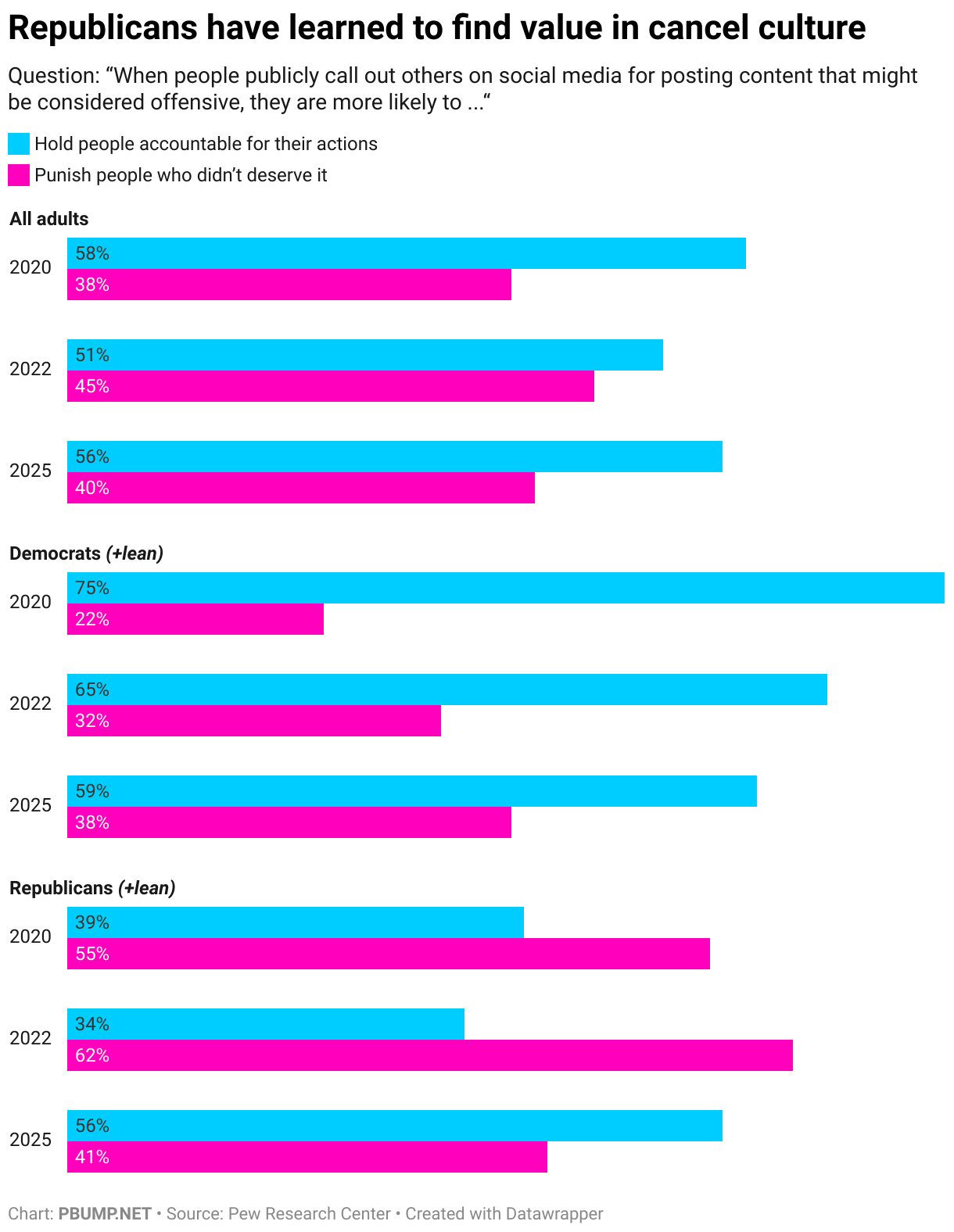
On Thursday, Pew Research Center released data evaluating the extent to which Americans see calling out offensive social-media posts as valuable. In 2022, 6 in 10 Republicans (and Republican-leaning independents) felt that doing so was apt to punish people who didn’t deserve it while about the same percentage of Democrats (and leaders) felt that it introduced accountability.

In the most recent data, that divide is gone. Now, about the same percentage of each party sees accountability as a more likely outcome.

It is probably important both that the above shift overlaps with Trump’s return to the White House and social media companies scaling back their efforts to police abuse and misconduct. Trump and his allies have stoked the idea that America has undergone a sea change, one in which the prevailing ethos has shifted in their direction. Facebook and what was once Twitter have signed onto that idea. The right can’t present themselves as victims of powerful “woke” forces if they see themselves as the ones with cultural power.

But they can police conformity with that power, as they once accused the non-right of doing to them. Monitoring speech is just another tool in the authoritarian toolbox, used as a cudgel against critics or in service of their allies. For my enemies, the law, etc.

In that sense, there is no hypocrisy in Vance’s comments on the Kirk podcast. They are consistent in that they reflect the will of the administration and its approach to power.

Photo: Vance in the Oval Office. (White House/Flickr)

Those young Republicans were young — for Republicans

After Politico reported on the existence of an overtly racist group chat involving a number of leaders of Young Republican groups around the country, some members of their party hoped to wave it all away.

“The reality is that kids do stupid things,” Vice President Vance said on a podcast on Wednesday. “Especially young boys. They tell edgy, offensive jokes. That’s what kids do.” He added that “I really don’t want us to grow up in a country where a kid telling a stupid joke — telling a very offensive, stupid joke — is cause to ruin their lives.”

Vance is being consistent here. In February, he advocated for the re-hiring of an administration staffer who’d been found to have made racist posts on social media. “I don’t think stupid social media activity should ruin a kid’s life,” he insisted at the time.

But, of course, the people engaging in this racism aren’t kids. The guy in February was 25. Mother Jones sussed out the ages of most of the participants in the group chat, finding that all were at least in their mid-20s. Some held elected office; others worked for the party or party organizations.

There is a sense in which they are relatively young, however: they are awfully young for Republicans.

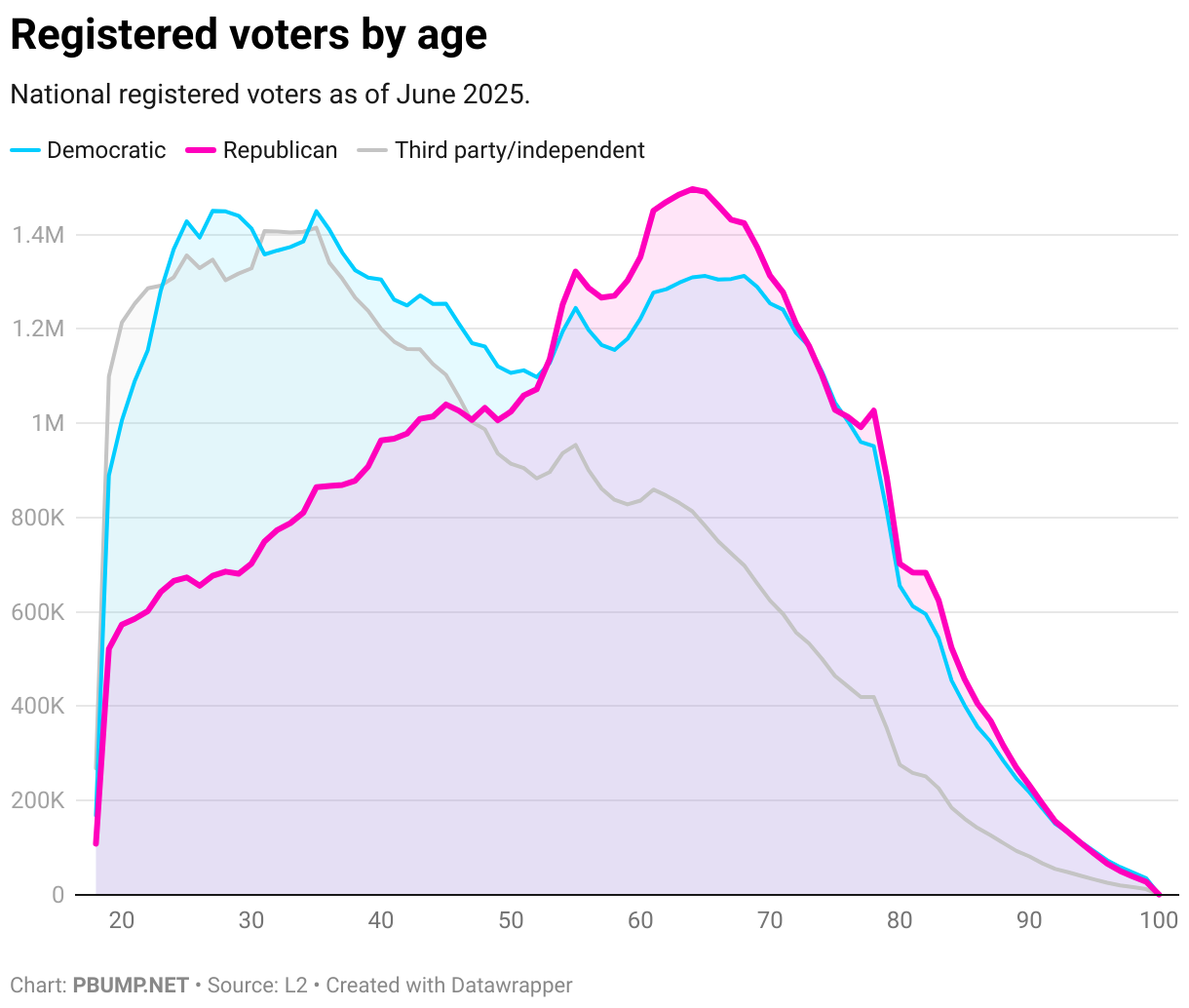
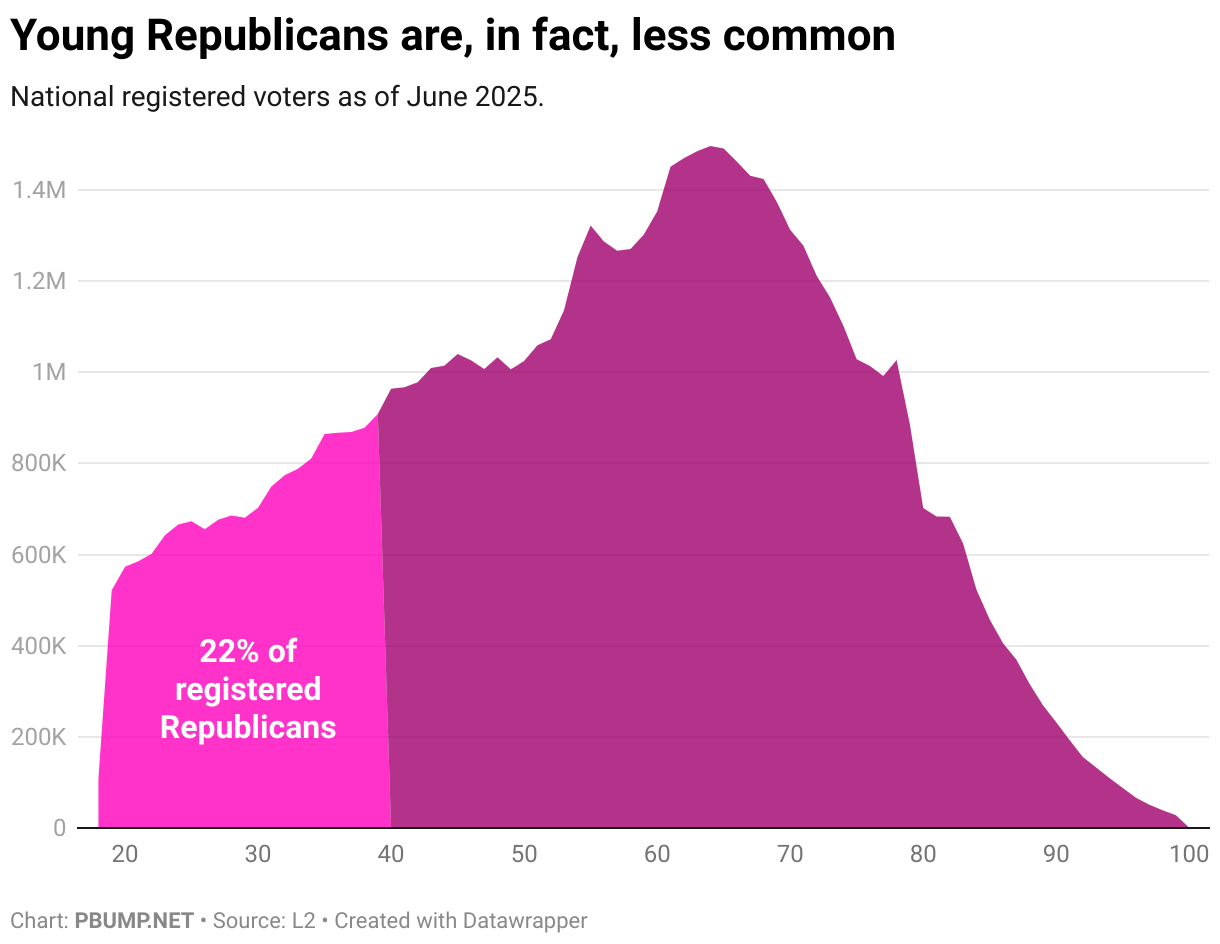
Older Americans, who vote more often, are usually registered with one of the two major parties. Young people, though, tend to register either as Democrats or as independents and members of third parties. Among registered voters under the age of 30 in June, only 1 in 5 were registered as Republicans.

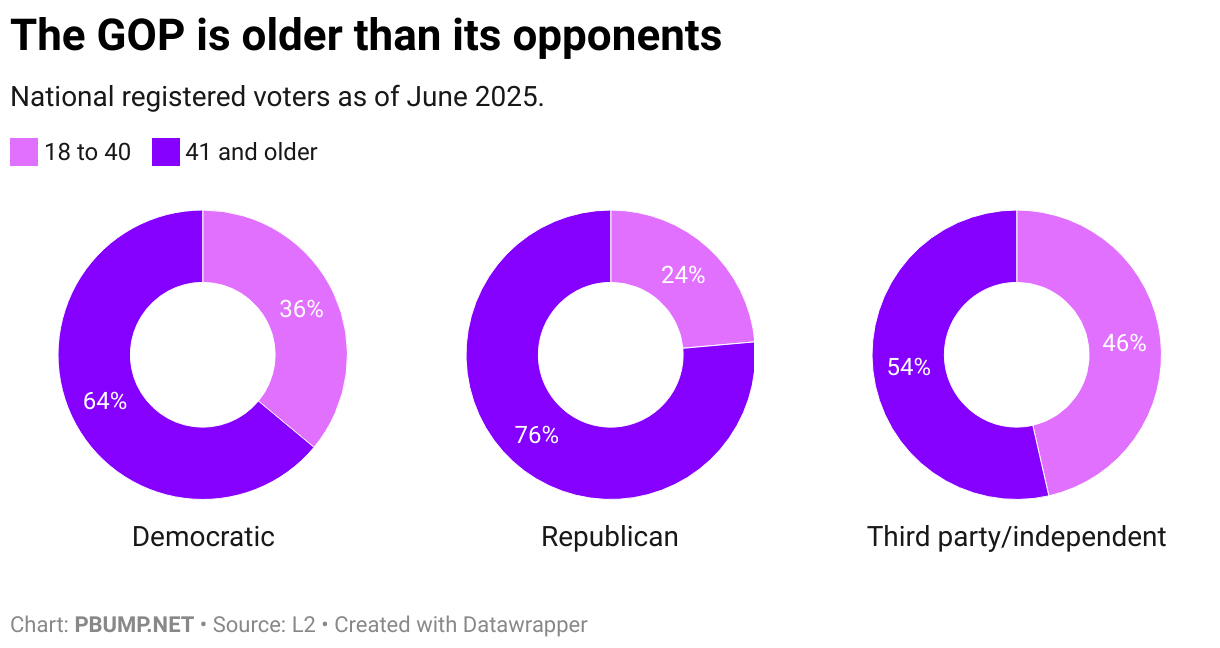
As Politico notes, the Young Republican organizations whose leaders were involved in the group chat target Americans between the ages of 18 and 40. Voter data from June shows that only about 20 percent of Republicans fell into that age range.

Compare that with Democrats, more than a third of whom are 40 and under. Among independents and members of third parties, nearly half are.

Relative to Republicans overall, then, a 30 year-old is sort of a kid? If we grade on a curve.

That’s not the game that Vance is playing, though. He claims that these people who hold leadership positions within his party are too immature to avoid making racist and antisemitic comments to one another — an assertion that you may evaluate for yourself.

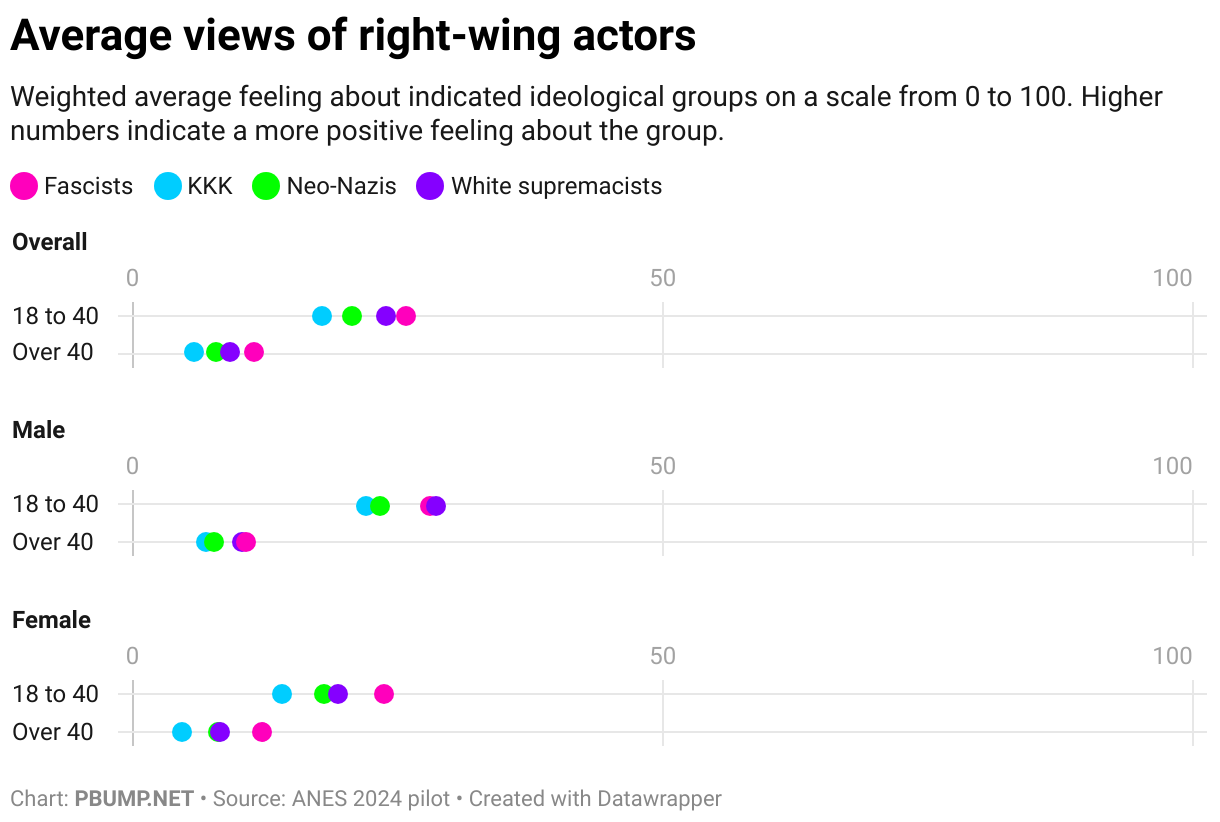
It is true that younger Americans are more receptive to fringe-right ideologies. Pilot research conducted as part of the 2024 American National Election Studies found that adults 40 and under, and particularly young men, had slightly warmer (though still cold) feelings to explicit racists and fascists.

There wasn’t a big difference by either party or ideology, though, except that moderates and independents had warmer feelings than partisans. It’s possible, then, that this is to some extent in part a function of actual naïveté among younger people about these ideologies.

But that’s average Americans, not politically active members of the GOP. And research looking at another facet of the group chat target — antisemitic and pro-Hitler comments — shows that this is a more comment sentiment among young people on the right.

Hersh, E., & Royden, L. (2022). Antisemitic Attitudes Across the Ideological Spectrum. Political Research Quarterly, 76(2), 697-711.

The study, released in 2022, includes a summary of its findings:

“We oversampled young adults because unlike other forms of prejudice that are more common among older people, antisemitism is theorized to be more common among younger people. Contrary to the expectation of horseshoe theory, the data show the epicenter of antisemitic attitudes is young adults on the far right.”

Vance’s effort to wave this away as kids being kids, then, fails on both fronts. Only relative to his unusually old party is a 30 year-old a kid. And only within a particularly toxic subset of young people — one that has some overlap with the party — are the views expressed in that group chat normal young-person behavior.

As at least some other members of his party appear to recognize.

Photo: A middle-aged man visits the president. (White House/Flickr)

Why Arizona seems to have more people of Italian than Native American ancestry

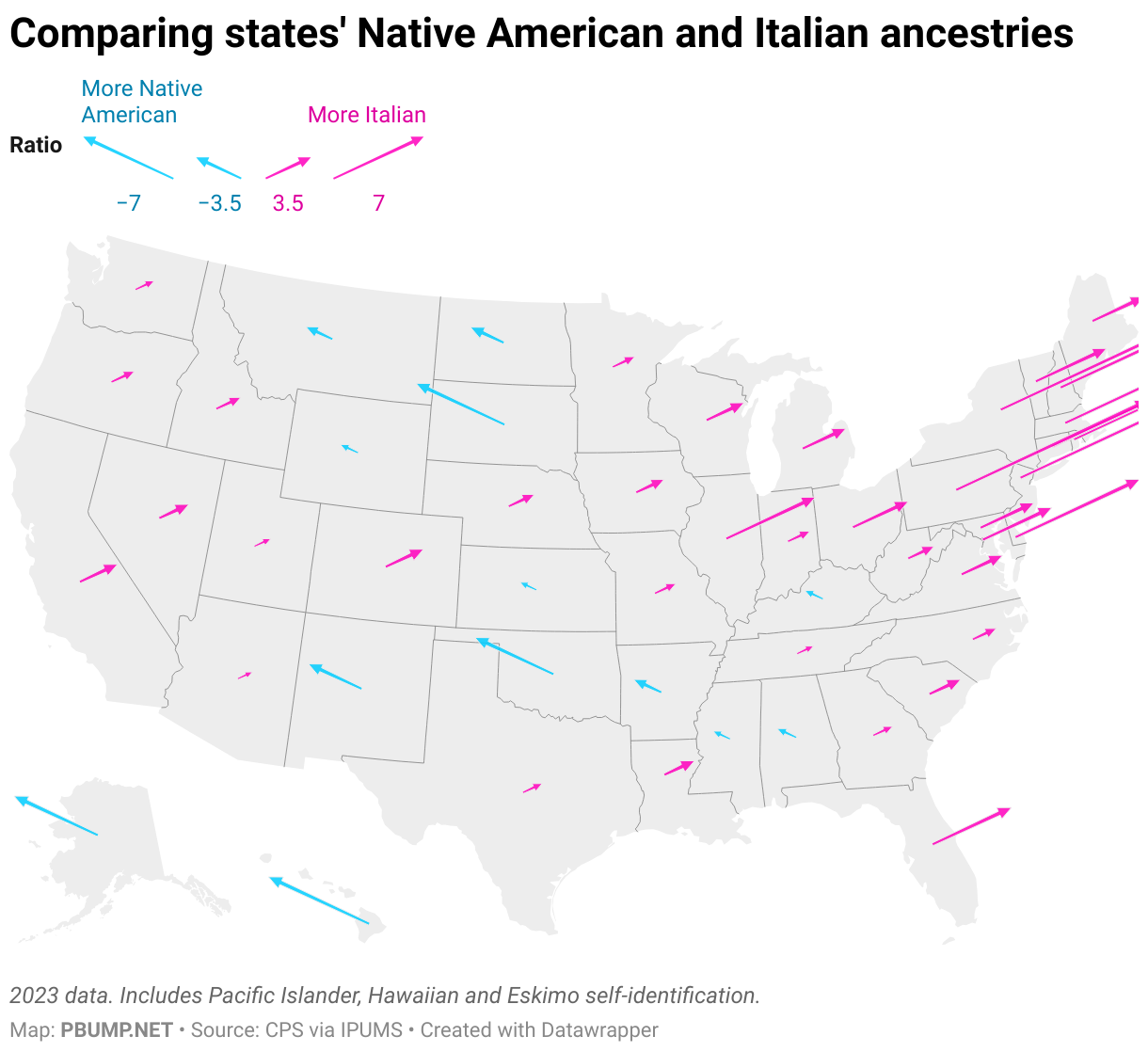
On Monday, I jokingly suggested that the dispute over Columbus/Indigenous Peoples’ Day be resolved on a state-by-state basis, considering the ancestral heritage of each state’s residents. New York, which has far more people of Italian than Native American ancestry, would celebrate Columbus Day. Oklahoma, with far more people whose ancestors were Native Americans, would celebrate Indigenous Peoples’ Day.

Like so many other things I write, this was basically an excuse to do some data analysis. So, using Census Bureau data compiled by IPUMS, I determined what percentage of each states’ residents were Italian or Native American and, therefore, which holiday that state should/will celebrate.

I presented the results in this map.

When I shared this map on social media, a question arose: What was happening in Arizona? Was it really the case that the southwestern state has more people of Italian than Native American ancestry?

And the answer is that, yes, it does — at least according to this CPS data.

That’s only a recent development, though. In 2000, the CPS data indicates that Arizona had about 325,000 people of Native American ancestry but only 235,000 of Italian heritage. Between then and 2023, though, the state grew by 48 percent, with a large number of people from other states (often retirees) moving to the Sun Belt. The number of people of Italian ancestry in Arizona jumped to more than 304,000. During the same period the number of residents of Native American ancestry fell below 300,000. And here we are.

I pulled data from each state for 2000, 2010, 2020 and 2023 to show how the populations have shifted.

You’ll notice that the number of residents of Native American ancestry dropped in a number of states since 2000. In fact, Arizona wasn’t the only one to go from more-Native-American to more-Italian; 13 other states also saw the number of residents of Italian ancestry pass those who have Native American ancestry. (This analysis excludes people who claim both ancestries.) From 2000 to 2023, 41 states saw the number of residents of Italian ancestry increase. Only seven saw an increase in the number of residents claiming Native American ancestry.

It’s likely that this is a function of data collection rather than demography. My former colleague at The Washington Post, Andrew Van Dam, wrote a few years ago about an increase in Native American identification, a function of changes to how the Census Bureau asked about race. That conflicts with the CPS data, which shows a substantial decline in reported Native American ancestry.

It’s a more detailed question than I’ll get into here. Instead, I’d like to return to my original theme: The Holiday That Many People Don’t Even Get Off. So: A quarter of a century ago, most states would have more appropriately celebrated Indigenous Peoples’ Day than Columbus Day. According to this data, that is no longer the case.

Photo: A cactus in Arizona in 1882. (National Archives)