Using the internet is not a RICO predicate

Vice President Vance joined the daily White House press briefing on Thursday in order to talk about a new Justice Department position focused on fraud. But the details of that announcement (think Ronald Reagan’s dishonest “welfare queens” claims aimed at immigrants and updated for the social-media age) got buried by reporters’ questions about the killing of Renee Good in Minneapolis the day prior.

At the top of the briefing, Press Secretary Karoline Leavitt had set the tone.

“The deadly incident that took place in Minnesota yesterday,” she said soon after walking to the lectern, “occurred as a result of a larger, sinister, left-wing movement that has spread across our country where our brave men and women of federal law enforcement are under organized attack.”

Vance similarly accused Good of being involved in an effort broader than herself. In short order, one of the reporters in the room called him on it.

“You just suggested that this woman who was killed was part of a ‘broader, left-wing network,'” the question began. But since it came from Fox News’s Peter Doocy, what followed wasn’t, “What’s your evidence for that.” It was, instead, “Who do you think is behind this ‘broader, left-wing network’?”

Vance tried to offer evidence anyway. Surely there was some undergirding organization, he said. After all, “when somebody throws a brick at an ICE agent or somebody tries to run over an ICE agent, who paid for the brick?”

A red brick costs 64 cents. From whose deep pockets was that fortune drawn?

Vance extended the idea to Good herself.

“How did she get there? How did she learn about this?” he said. “There’s an entire network — and frankly, some of the media are participating in it — that is trying to incite violence against our law enforcement officers.”

We’ve seen this before. When protests against Israel’s military campaign in Gaza emerged in 2024, the right scrambled to insist that there was some well-funded, interlacing organization behind it. (Then, the indescribably expensive thing protesters could somehow access was $20 tents.) The right often acts as though anyone who disagrees with their politics are brainwashed, deranged into action against their true interests by some nebulous conspiracy.

At this point, though, the charges from the administration are consistently narrow. It’s not just that there’s a “broad left-wing network.” It’s that grassroots organizing over the internet itself comprises that network. If you read a story that prompts you to want to protest ICE, if you see that activists are using whistles to alert community members to the presence of immigration officials, if you scramble to a local school to record immigration actions: Bad news. You’re part of this nefarious conspiracy.

In September, after the killing of Charlie Kirk, President Trump and his allies attempted to tie the shooting to an organized left-wing effort. Trump signed an executive order, National Security Presidential Memorandum 7 (NSPM-7), that directed federal agencies to uproot “sophisticated, organized campaigns of targeted intimidation, radicalization, threats, and violence” that ply their trade “through a variety of fora, including anonymous chat forums, in-person meetings, social media, and even educational institutions.”

NPSM-7 is titled “Countering Domestic Terrorism and Organized Political Violence” — precisely the allegations leveled against Good by Homeland Security Secretary Kristi Noem and others.

The ACLU and others have written about how this directive threatens free speech. We see how that works in the Good killing. Beyond the lies being told about Good’s intent, we see how Vance and Leavitt (and countless others online) loop her into a broad conspiracy simply by virtue of being in that place and apparently expressing opposition to ICE’s actions. Since her death, right-wing media has documented Good’s involvement in grassroots “ICE Watch” efforts. But this is effectively a post hoc rationalization for her killing — after Noem and others had already rushed to identify her as a domestic terrorist.

There is a difference between a community and a terrorist organization. There is a difference between gathering information online and being indoctrinated. There is a difference between seeking to get involved and being a conspirator.

We should not assume that the administration and its allies are blurring those differences because they misunderstand them. We should assume, instead, that they are blurring them in order to increase the cost of engaging in the innocuous activities of grass-roots organizing.

Photo: A protest outside the White House this week. (Geoff Livingston/Flickr)

Trumpism depends on the fog of incomplete information

On Thursday morning, multiple major news outlets published analyses of videos from the killing of Renee Good by federal officials in Minneapolis. The New York Times. The Washington Post. CNN. Each neatly dispels the narrative offered by the Trump administration immediately after the shooting, establishing clearly that Good was not trying to run down ICE agents and, in fact, does not appear to have even injured any as she sought to escape.

This was obvious soon after the shooting. The videos analyzed by the news outlets were available Wednesday afternoon, showing precisely what the annotated and professionally edited presentations do. But the standard of evidence used by news outlets is stricter than the one used by a layperson, so it took longer for them to formally reach the same, obvious conclusion. It took longer for them to dismiss the White House’s presentations as false than it did for external observers, in part because they have an obligation not to be wrong that isn’t shared by regular people or, it seems, the president.

A gray zone emerges. As media outlets push to confirm what happened, people with access to much of the same information have already reached conclusions. Bad-faith actors — again including Donald Trump — are able to make flat assertions about what occurred that their loyal and/or incurious supporters accept. Critics of the administration coalesce around their own, more accurate understanding of events, at times chiding the media for being so slow in joining them.

In the days when news was published in daily newspapers or precisely at 6 p.m., this was less of a problem. Not only because there was no expectation of immediacy but because there didn’t exist independent systems by which regular people could view the same information as professional news-gatherers. But now there is, and an awful lot of framing and debate occurs in the space between an event and its being cemented as objective fact.

It’s a bit like election results, an analogy that I draw intentionally. Votes are cast on Election Day and, often, in the weeks prior. In some places, vote-counting continues for hours or days, creating a similar gray area. Initial results might suggest one thing and final votes another; voters and politicians are urged to wait for the latter instead of making assumptions about the former.

Sometimes, though, those voters and politicians know that waiting is disadvantageous. In 2020, Trump knew that, as more votes were counted, it was likely to mean more votes for Joe Biden. There was a plan in place to take advantage of the gray zone — to insist not only that initial information was correct but that subsequent information (that is, more votes) were suspect. Not only did Trump attempt to establish an election result before vote-counting was done, he tried to position the finalized vote totals as fraudulent because they differed from the premature story he’d presented.

We see this following news events, as well. As mainstream media slowly figures out what happened, Trump and his allies (particularly but not exclusively) rally around a story that comports with their politics. As more information comes out, that information isn’t used to adjust their position; instead, it’s used to demonstrate the bias and untrustworthiness of the media. If the final conclusions of the press don’t comport with their story, it’s the press’s fault, not the story’s.

We’ll see how the Good shooting evolves over the next few days. Recent history, though, suggests that Trump and others who are (grotesquely) attempting to blame Good for her own death are much more likely to decide that reality is inaccurate than that they themselves are.

Photo: Trump at a press conference shortly after the 2020 presidential election. (White House/Flickr)

The killing in Minnesota

They will lie about you and then kill you and they will kill you and then lie about you. 

And I don’t mean some ambiguous, imaginary “they” like the one the right invented and blamed for trying to kill President Donald Trump. I mean an actual they, a they that includes federal officials and federal law enforcement and Donald Trump himself. 

The killing of Renee Good in Minneapolis on Wednesday was obviously preventable. Confronted by federal law enforcement officers on a snowy street, video recorded from the scene shows Good attempting to maneuver between a stopped car and an agent standing near her front bumper rather than face arrest. As the car moved forward, brushing the agent to the side, he drew his weapon and shot her. Good was killed. 

But Trump and Homeland Security Secretary Kristi Noem offered very different descriptions of Good’s actions. Noem called her a domestic terrorist and suggested that she’d targeted federal officers with her car. Official statements from DHS echoed these claims. Trump shared distant footage of the incident on the social media platform he owns, describing with words a scenario very different than what anyone watching videos from the shooting would have seen. 

Describing Good as part of a “Radical Left Movement of Violence and Hate” — she was a poet — the president claimed that she had “violently, willfully, and viciously ran over the ICE Officer, who seems to have shot her in self defense.” Based on the clip, he claimed, it was hard to believe the agent survived. Other footage, though, shows him walking to Good’s car and back to other federal vehicles before being driven from the scene. 

What’s striking about the administration’s response isn’t simply that it’s dishonest. A year into Trump’s second term and a year into this era of unshackled immigration officers, we should only be surprised if their initial presentations hold up under scrutiny. Instead, what’s remarkable about the immediate responses is that they include no statements of regret or sympathy. Hours after a federal agent shot and killed a young mother, the government couldn’t even be bothered to extend its condolences. This wouldn’t have made the effort to impugn Good’s life and actions any better, certainly, but it would at least indicate some sense of humanity. It would suggest that even critics of the administration live lives worth preserving and appreciating. 

This administration has no interest in offering that impression. Good, by virtue of being in a position of friction with federal agents, became an Other. And Others are not people for the administration and its allies to mourn. They are people to disparage and mock and accuse. 

The grand theory behind American democracy is that our elected officials hold power with the consent of the governed. This has led past presidents to seek to demonstrate their commitment to even-handedness, to treat those who voted for them and those who voted against them equally, as Americans. There’s an aspect of self-preservation to doing so: the president or his party might need those voters” support in the future. Usually, though, this approach was rooted in the idea that the presidency really was a position centered on the public as a whole. 

This is not how Trump governs. He tends to and cares about only his base, and only as long as his base is enthusiastic about him. He is not an American president but a MAGA president, someone who leads red states with magnanimity and leads blue states like the head of an occupying force. There’s no effort to build consent among his opponents. There is only an effort to redouble his support among his supporters. 

So he and his team and his allies lie. They take the tragic death of a woman who’d just dropped her 6 year-old off at school and turn it into an obviously false narrative about heroic federal agents fending off a deranged left-wing lunatic. And rest assured that they will continue to do so if need be, just as they decided that Kilmar Abrego Garcia’s life needed to be destroyed because they’d embarrassingly screwed up and deported him. 

The Trump administration empowered a federal officer to shoot a woman from close range, reportedly in the head, and then blamed the woman for her own death. They posthumously determined her to be an enemy of the state because they need her to be one in order to keep their supporters from questioning how Trump uses his power. 

They will lie about anything else they feel the need to lie about, too, and for the same reason.

Photo: A vigil in Minneapolis, Jan. 7, 2026. (Chad Davis/Flickr)

Americans are more politically unified by generation than race or gender. But why?

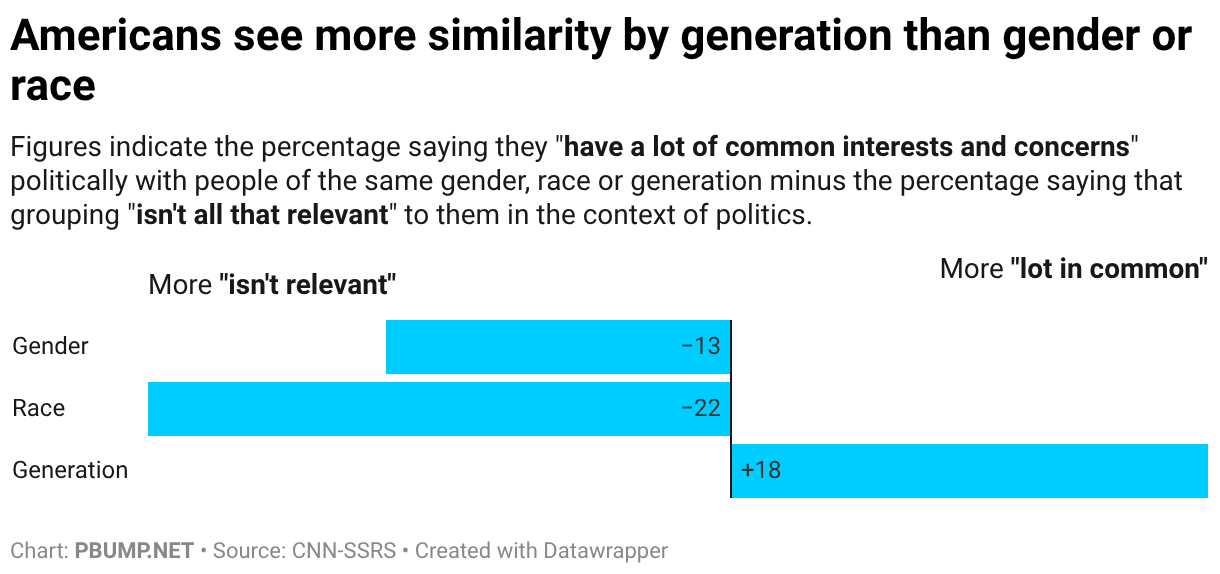
Over the summer, CNN included an unusual question in a national poll of Americans: How politically connected did they feel to others of the same gender, race or generation?

Most Americans replied that neither race nor gender were particularly relevant to their politics. Generation, though? Six in 10 said that they had a lot in common with others in the same age group — about the same percentages that said gender and race weren’t relevant to their politics.

There’s an interesting pattern here. Men are among those most likely to say that gender isn’t relevant to their politics. And White people are among those most likely to say that race isn’t relevant to their politics.

On seeing this, my first thought was a quote from sociologist Robert Terry that I’ve had stuck in my head for years (and that makes numerous appearances in my book): “To be white in America is not to have to think about it.” Men and White people hold disproportionate power in the U.S. and often (though certainly not always) reject the idea that gender and race play a role in their doing so. Their rejection of shared politics with peers might reflect a rejection of the idea that such commonality offers political utility.

How, then, do we explain the results by generation? Older people also hold disproportionate power in the U.S., in part thanks to the growing size of the over-65 population. (I guess I’ll once again point to my book on this subject.)

Well, something interesting happens if you break out the generational splits by party. Democrats (and Democrat-leaning independents) are more likely to reject generational commonality as they get older. Older Republicans (and leaners) are more likely to endorse commonality.

This undercuts my original thesis about the response being downstream from power. After all, an obvious explanation for the inverted trends by party is that young people are more heavily Democratic and old people more heavily Republican, meaning that young Democrats do have more in common with people of their generation than do older Democrats. The same holds for older Republicans, relative to younger ones. Older Republicans, meanwhile, are certainly not lacking for political power.

Maybe, then, what’s being tracked is perceived power. Maybe groups that feel less powerful (regardless of how accurate that is) perhaps see common political concerns with their peers.

If we look at gender and race by party, the picture doesn’t get much clearer.

Democratic (+leaning) men are more likely to say gender isn’t relevant to politics than Republican men and White Democrats are more likely to say that race isn’t relevant than White Republicans. If you squint, you can see how that comports with the revised thesis — the GOP is, at the moment, heavily focused on the false idea that White men have been targets of systematic repression — but it’s not terribly clear.

Which is probably the best place to leave it: Sometimes one set of numbers doesn’t answer all of the questions we might have.

Thanks to Ariel Edwards-Levy for sharing more-detailed breakdowns of the data.

Image: From my 2023 book, a map of where baby boomers lived in 1990 (dashed-line circles) and in 2020 (solid lines).

When were Trump’s three cognitive tests?

The report on President Trump’s health published by the Wall Street Journal on Thursday was not particularly reassuring. The president has shown increasing signs of aging, the Journal’s reporters noted — unsurprising given that he’s the oldest person ever to have been inaugurated to the position. He continues to eat poorly and to adhere primarily to his own medical advice, a dubious approach for someone coming up on his 80th birthday.

But, of course, Trump spun the report on Friday morning as a complete exoneration of any concerns. On the social media platform he owns he wrote that his doctors had asserted that he is in “perfect health” — an assertion made in the article not by his doctors but by Trump himself.

Trump also asserted that his mental acuity has been tested three times, and that he “ACED” the questions the cognitive exam posed. Rather than providing reassurance, though, one might wonder: Why is Trump’s mental fitness being tested so often?

The answer to that question will probably be unsatisfying for both Trump supporters and Trump critics. He isn’t being tested for cognitive impairment particularly frequently; he’s just talking about old tests a lot.

Here is a timeline of the three reported tests.

January 12, 2018

The first exam was conducted during his first term in office, back when his personal physician was still Dr. Ronny Jackson. During a press conference, Jackson informed reporters that Trump had been given an annual physical and, while delineating the elements of the examination, noted that Trump’s cognition had been screened.

“A cognitive screening exam using the Montreal Cognitive Assessment was normal, with a score of 30 over 30.”

This is not atypical, given that Trump was already in his 70s at the time. What was unusual was that Trump seized on this test as being evidence of his cognitive superiority — which, as I’ve written, is a bit like bragging about your superhuman physicality because your covid test was negative.

Sept. 13, 2023

The next cognitive exam was conducted during the Biden administration, after Trump had already declared his intention to seek reelection to the presidency.

Again, this is a normal examination for a person who is 77 years old. But it also allowed Trump to elevate his successful navigation of the screening process to suggest that Joe Biden ought to be public with his own results.

April 11, 2025

Trump’s most recent cognitive test was not, as his post on Friday might suggest, conducted recently. Instead, it was given to him after he’d returned to the White House, during a physical last April.

A report from Trump’s current physician detailed the test in sterile language.

Trump had a follow-up exam in October of last year, during which he received seasonal vaccines and in preparation for international travel. A report from the doctor after that examination does not suggest that it included a cognitive screening.

In the abstract, that makes sense. Such tests are currently recommended annually in the absence of any signs of cognitive impairment.

Whether insisting that a test passed nine months prior constitutes a recent measure of cognitive fitness should be considered a sign of impairment would, I suppose, be up to the doctor to judge.

Photo: Trump grins at Mar-a-Lago in December. (White House/Flickr)