This is what democracy looks like

There is an uncountable number of repositories of power all across the United States. Some are huge and obvious: the federal government, major corporations, police departments, billionaires. But there are millions of small ones, too, including small businesses, community groups, churches — and the people themselves.

In theory and historically, the federal government is the aggregation of all the small individual centers of power. In recent decades, though, it’s been fair to wonder whether the federal government wasn’t instead an aggregation of the huge ones.

No matter. There is a new aggregation of the small centers of power — one manifested every single day in opposition to the federal government that was created to represent them.

We are where we are because Donald Trump saw the power and wealth of the federal government and wanted it for himself. There wasn’t obviously a path for him to get there but he stumbled forward anyway, discovering that repeating the stuff he heard on Fox News about The Elites and The Immigrants got a lot of people riled up. It also took him a while to figure out how — and, moreso, if — he could start siphoning off the country’s power, but he did.

It’s always useful to remember that Trump came to the White House not via the route of politics but via the route of capitalism. It is particularly useful to remember that in this discussion, because the voraciousness is the same. His focus has always been on accumulating as much power and influence as he could, and that’s how he approaches the presidency, too. When he spends the country’s wealth and influence, it’s on what he wants, not what benefits the country.

What’s been weird to learn is that other leaders of institutions act the same way. Some of them hoard and protect their influence like it’s money because they, too, are rich. You don’t get rich by giving your money away and (they seem to believe) you don’t get powerful by exercising your power. But, in fact, that is often how power works: using power can help build power. At the very least, power holds no value unless it is exercised, which alone is a valid reason to exercise it. If you are powerful but never use your power, you are not powerful.

I’m talking here primarily about the huge, obvious loci of power — the centers of power that exist in part to serve as checks on other centers of power. Congress vis-a-vis the presidency. The media relative to the government. Higher education in contrast to misinformation. But they often aren’t serving as checks on what’s unfolding, or are obviously and bizarrely using their power only sparingly, garden hoses aimed at protecting their own homes from the wildfire.

So it’s left to individuals, who have stepped up where institutions have not.

There’s been a lot of ruminating about why this is the case, why individual, average people have been bold but newspapers and senators haven’t been. To some extent, it’s a numbers game. There are 340 million people in the United States. About 260 million of them are over the age of 18, meaning that about 146 million adults just in the U.S. disapprove of the job Donald Trump is doing as president. That’s a big pool from which to find a few thousand who are willing to fight for democracy.

I mean, there are about 350,000 adults in Minneapolis alone. Even just in theory, it wouldn’t be hard to find a dozen who were substantially committed to opposing Trump’s deployment of power that they would make it the center of their daily activity. But in practice, thousands have. Even after two people were killed by federal agents while doing so.

What’s important about this movement is that the only power that most of these protestors have is their own. They are expending all of it — and in doing so helping to build a bigger, aggregated power. The stewards of large accumulations of power are wary and timid. Enough stewards of personal, individual power are bold and engaged that a significant counterweight to the administration has emerged.

It’s telling that so many defenders of the administration can’t accept this for what it is. The constant refrain that opponents of the administration are paid to express their opposition is generally nothing more than a bad-faith effort to delegitimize it. The idea that tens of thousands are being slipped cash to whistle at ICE officers without any evidence of such payments emerging is as dumb an argument as saying that 2020 was affected by rampant fraud — which is a reminder that the stupidity of an argument is no barrier to its adoption. Even the idea that liberal donors giving to liberal groups somehow constitutes “funding” the protests is a deflection from the fact that bespoke responses to ICE have been created on the fly, with thousands of volunteers chipping in.

Not all of the dismissiveness aimed at anti-administration protests is bad faith. In a polarized country, many Americans literally don’t know anyone who disagrees with them; to such people, the idea of sincere opposition might legitimately seem invented, particularly if they are immersed in a media environment that claims precisely that.

Part of it, too, is that the country’s ideological divide manifests in diverging views of how society works. The right focuses on individualism; the left on community. Protests are more common on the left in part because there’s an acceptance of communal action that isn’t prevalent on the right. To them, what’s unfolding in Minneapolis can seem literally inexplicable. (The overlap between this divergence and population density is probably causal; one reason kids who go to college shift left is because going to college is inherently a communal act, even when it isn’t in big cities.)

Individualism and selfishness are intertwined. And hoarding power and money is a selfish act. This is probably overly neat, but it remains true that this tendency toward hoarding is a significant reason that a far-right president has been able to erode American democracy so quickly.

But democracy isn’t solely about elections or about the exercising of aggregated national power. As the old protest chant has it, activism is also what democracy looks like. Citizens piecing together ad hoc institutions to confront oppression is democracy. People stepping up to protect the country when Congress and the Supreme Court won’t is democracy.

Democracy isn’t simply being defended. It’s being reorganized — out of unfortunate necessity, but effectively. So much so that the huge centers of power are finally starting to notice.

Photo: Protesters in Minneapolis. (Fibonacci Blue/Flickr)

Where are ICE and Border Patrol agents coming from?

ProPublica has identified the Border Patrol agents who shot and killed Alex Pretti as Jesus Ochoa and Raymundo Gutierrez, both of South Texas. There have been numerous reports that the federal agents who’ve blanketed Minnesota are not from that state or even that region; agents have been spotted wearing indicia that they are from Texas or other states.

I was curious the extent to which this federal crackdown in Democratic-voting regions of the country was being effected by officers from Republican-voting ones — how much of it was a South-to-North deployment that echoed American history more than might have been intended.

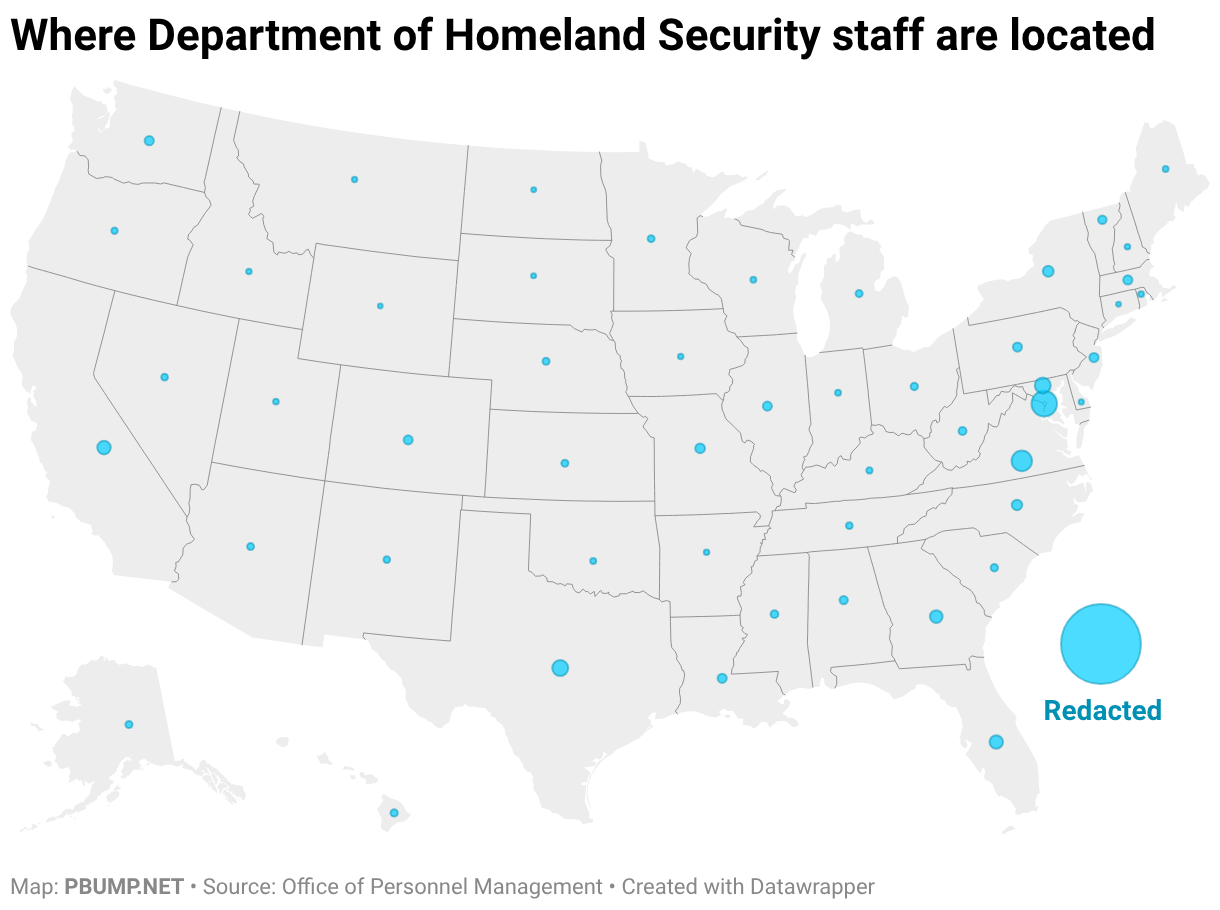
The government aggregates data on its employees, workers who, after all, are paid with public tax dollars. The Office of Personnel Management releases monthly data tables identifying information on age, education, salary range and duty stations for employees of the U.S. government. From the most recent data (covering November) we can see that Department of Interior employees are, as you might expect, spread out across the country.

Some Interior employees don’t have their duty stations recorded. But only a few — 4 percent of the total. Every other employee’s duty station is identified, the most in California.

When you do the same analysis for the Department of Homeland Security, though, the pattern is different.

Fully three-quarters of DHS employees have their duty stations redacted.

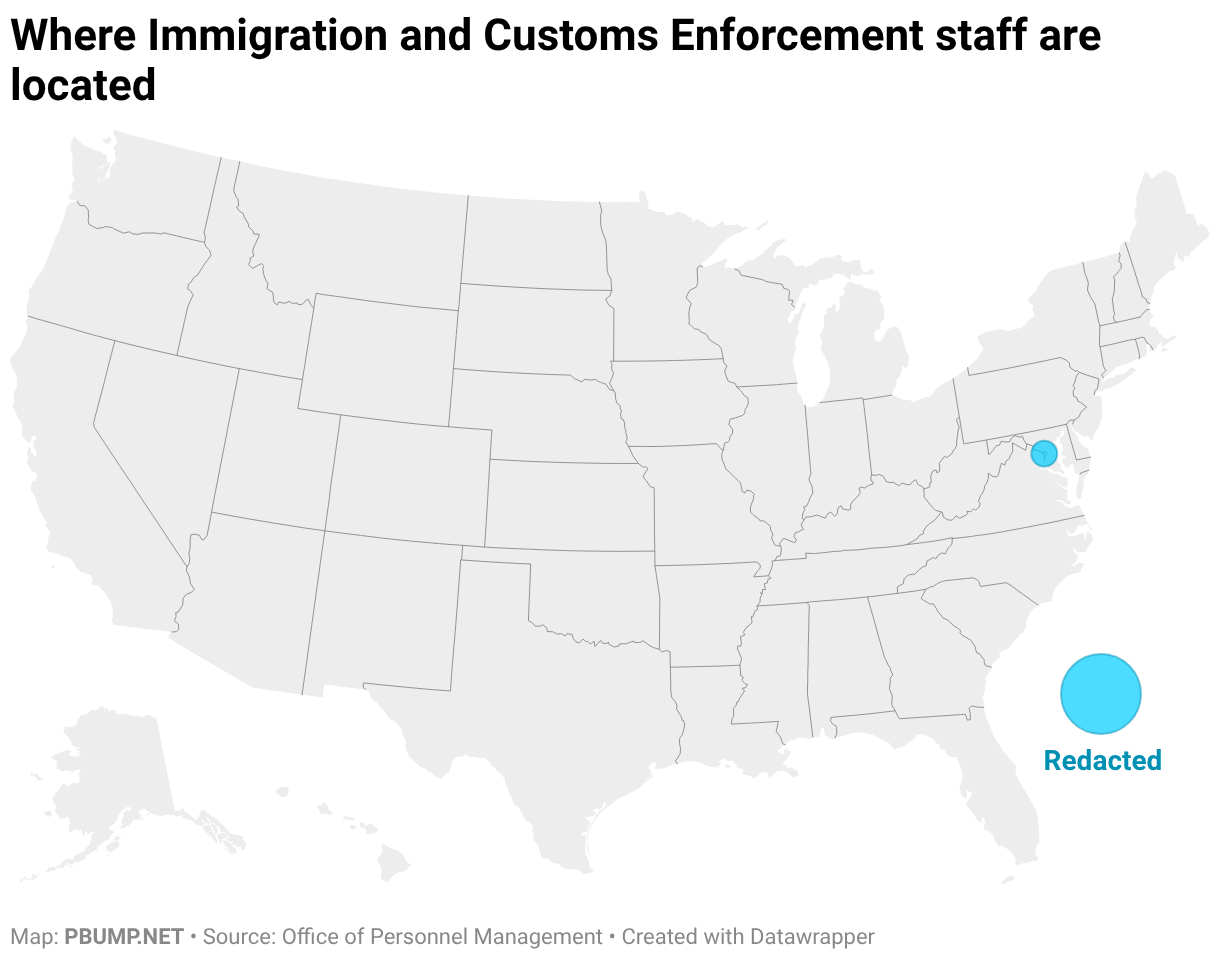
When we look at specific departments, like ICE, we see an even more dramatic shift.

The public is informed that ICE has about 2,000 employees in D.C. Everyone else? Shielded in the OPM data.

Related: ICE’s excuse for wearing masks has never actually manifested

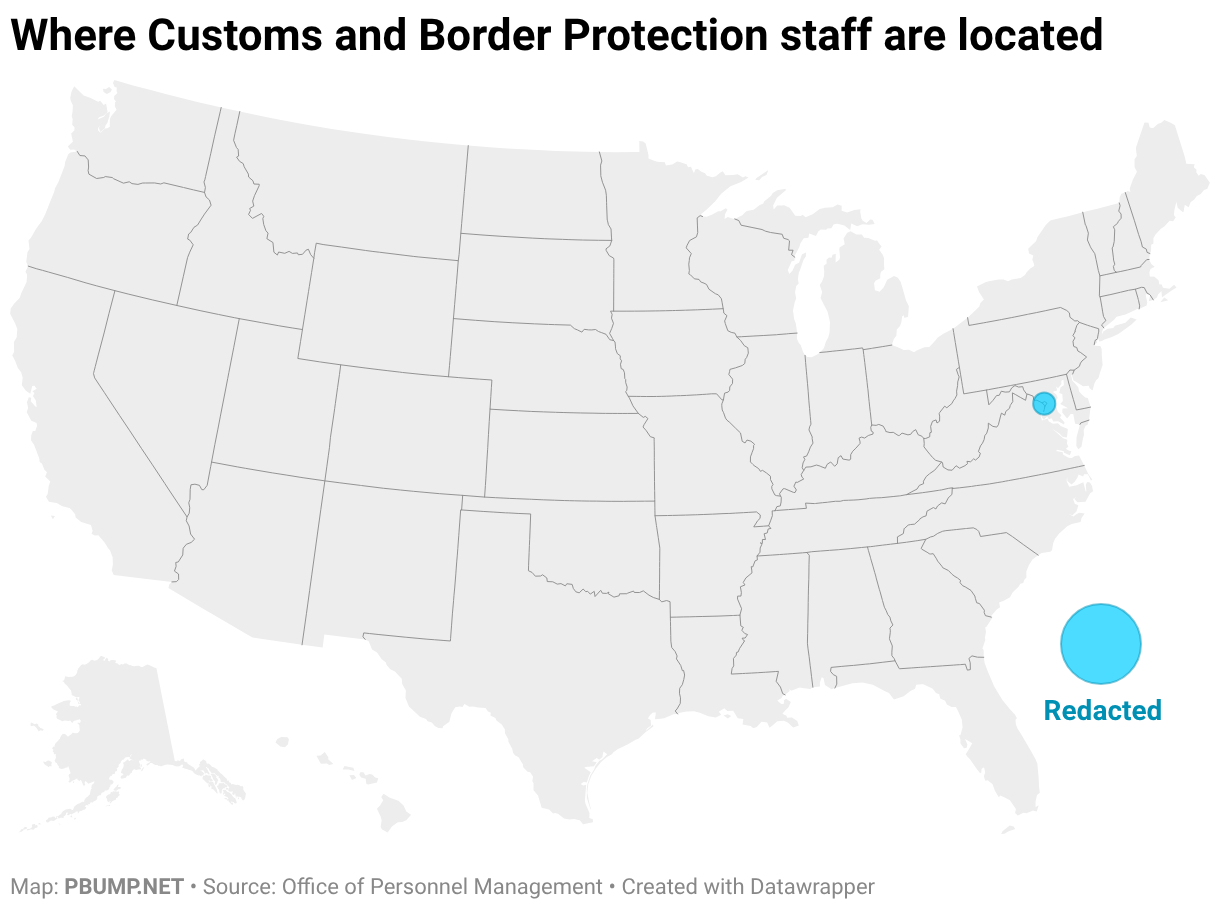
Same with Customs and Border Protection. Of the department’s 67,000 employees, we’re informed about the duty station — D.C. — of only 5 percent.

Together, the redacted duty stations of ICE and CBP staffers constitute more than half of the DHS redactions.

To put an exceptionally fine point on it: My point is not that the duty stations of every individual must necessarily be made public, much less that their home addresses be available. It is striking, though, that we have so little insight into who is patrolling the streets of cities targeted by the administration for overtly political reasons.


Update: As Lauren Harper of the Freedom of the Press Foundation noted on Bluesky, this is a function of both ICE and CBP being extended new protections in 2020, during Trump’s first term in office. A memo released internally after the designation was applied to ICE explained that the designation as a “security/sensitive” agency would “ensure that OPM withholds all relevant personally identifiable information (PII) of all ICE personnel” from public information.

Photo: Items in the Border Patrol Museum in El Paso. (Jonathan McIntosh/Flickr)

It’s worse than an attack on journalism

The first time Donald Trump ever disparaged journalist Don Lemon on social media was during the 2016 campaign. At a rally, Trump, then the Republican nominee for president, had warned his audience that the election of his Democratic opponent Hillary Clinton would mean Supreme Court justices who would scale back gun rights.

“If she gets to pick her judges, nothing you can do folks,” Trump said. “Although the Second Amendment people, maybe there is. I don’t know.”

Lemon, then the host of a show on CNN, asked his guests how this could be interpreted in any way other than as a threat against Clinton. One guest rejected the idea, insisting that the language may have been “imprudent” but that Trump was clearly just telling pro-gun voters to turn out on Election Day. (That guest, incidentally, was Dan Bongino, the right-wing podcaster-turned-Trump FBI Deputy Director-turned right-wing podcaster.)

Trump saw a clip of the exchange and praised Bongino. Lemon, he said, “is a lightweight – dumb as a rock.”

This became a refrain: Lemon, whose coverage of Trump was often critical, was described by the president over and over again as unintelligent and biased. The CNN host — even more than other CNN hosts! — had joined an ignominious (or, depending on your politics, illustrious) group: Enemies of Trump.

On Friday morning, an attorney for Lemon reported that the journalist, now working independently, had been arrested in California. Attorney General Pam Bondi confirmed this news on social media.

“At my direction, early this morning federal agents arrested Don Lemon, Trahern Jeen Crews, Georgia Fort, and Jamael Lydell Lundy,” she wrote, “in connection with the coordinated attack on Cities Church in St. Paul, Minnesota.”

This development was striking in part because the administration had already tried to criminally charge Lemon, without success. Earlier this month, Magistrate Judge Doug Micko declined to sign an arrest warrant targeting Lemon and others. An effort to appeal that decision was also rejected.

It is also striking because of what actually occurred at the church in St. Paul. A pastor at the church is also an official with Immigration and Customs Enforcement, prompting a group of protesters to interrupt a service he was leading. Coverage of the event doesn’t suggest that it was an “attack” in the commonly understood use of the term. But that coverage itself is at the heart of the issue for Lemon: He was there, interviewing participants and the pastor, a presence that would seem clearly to be covered as a constitutionally protected activity. (Georgia Fort, another one of those identified by Bondi, was also there in her capacity as an independent journalist.)

It is tempting to view the targeting of Lemon solely through this lens, as an extension of Trump’s longstanding hostility toward the media — or, more specifically, toward any media outlet or personality that isn’t falling over itself to praise him. Trump has repeatedly used his personal and presidential power to attack reporters and media outlets. The arrest of Lemon is simply another tick on the administration’s anti-First Amendment checklist: religion, speech, assembly and the press.

Yet it is probably wiser to view the Lemon arrest as something broader. It’s not that he’s a journalist. It’s that he’s been identified as an Enemy of Trump, and the president and his base have long been howling for those perceived enemies to be punished.

Again, there’s no public evidence that Lemon was involved in the church protest in any capacity other than as a reporter. But his presence there quickly drew the attention of the pro-Trump right, centering him as a representative not only of the protest but of the broader anti-Trump movement. On social media, Lemon became an avatar for all of the disparate elements of opposition to Trump that have emerged as federal agents have swarmed Minneapolis. Countless demands that he be punished exist within that context, not within any obvious legal one.

Whose arrests did Bondi announce? Two Black journalists and two Black Democrats who’ve sought elected office. In other words, four people who represent an assortment of things that Trump’s base views with some hostility.

To be very clear, it is not better that Trump’s Department of Justice is going after his perceived enemies rather than against journalists for doing journalism. It is far worse, because it reinforces the (already obvious) willingness of the administration to use federal power to impose penalties on critics and opponents. Not necessarily criminal penalties, like jail time, but even simply forcing people into the criminal justice system, spending time and money on attorneys, and so on.

The Trump administration will scoop up a guy in Maryland and send him to El Salvador and then backfill alleged criminal behavior in an effort to get him deported. It will shoot a mother to death in her car and then declare that she was a murderous terrorist.

It’s important that it is filing criminal charges against a reporter who was in the act of reporting. But it’s more important that it is doing so centrally because that reporter was a perceived Enemy. How else to explain the White House celebrating the arrest on social media, seeking accolades and approval from the base?

The Bill of Rights included protections for journalists because the founding fathers understood that people in positions of power would find the press and its accountability systems to be annoying or threatening. What they probably didn’t foresee was a president who wanted to attack a journalist centrally because he wanted to show his supporters how eagerly he was going after their collective perceived opponents.

Photo: Don Lemon smelling cookies my wife made for him and his team back in his CNN days.

ICE’s excuse for wearing masks has never actually manifested

From the earliest months of Donald Trump’s second term in office, federal immigration officers have conducted their raids and arrests while concealing their identities, a notable deviation from the way in which law enforcement has long been conducted in the United States. The public grants police and other law enforcement the right to carry weapons and detain suspects; in return, they are expected to be accountable to the public that employs them.

What the Department of Homeland Security has long argued is that this is dangerous for the officers. Assaults against Immigration and Customs Enforcement and Border Patrol agents surged in 2025, we have been told. Agents must protect their identities in order to keep themselves safe from this uptick in hostility and violence.

A review of DHS and ICE press releases since January 2025, though, indicates that this theoretical scenario has never actually occurred. At no point in time has an officer been seen conducting his work, identified and subsequently attacked. While there have been threats issued against agents and incidents of off-duty harassment, there are no known incidents in which an officer was assaulted while off-duty because he was identified as a federal agent.

There appears to have been only one incident in which an officer was attacked while off-duty. That occurred in July, when an officer was shot during a robbery attempt in New York City. One of the attackers was an immigrant living in the country despite a deportation order.

In September, a sniper fired on an ICE facility in Texas, killing two detainees and injuring another. No officers were struck. A clip found at scene had “ANTI-ICE” written on it; the alleged shooter appears to have had mental health issues.

That this attack occurred at an ICE facility is important. The other assaults documented in DHS and ICE press releases all occurred when agents were either working at an ICE facility or attempting to execute an operation. In other words, they occurred at times when they were obviously identifiable as ICE agents. There was no tracking them down to ID them; the incidents occurred while they were at work. Many of the documented assaults involved immigrants who were hoping to evade detention. Had the agents not been wearing masks, these situations would almost certainly have been no different.

There have been general threats made against federal agents, according to DHS. The agency claims to have uncovered bounties issued by Mexican cartels and others against officers. There have been bomb threats made against facilities in Texas and New York. There have been generalized online threats, too. When I wrote about the documented assaults for The Washington Post last year, a DHS official pointed to the arrest of Ray King, who’d made threats against ICE agents on social media … in part because he was angry that agents were obscuring their identities.

DHS posted a snippet of a voicemail apparently left for the agency, which it described as “DISGUSTING,” including “vile rhetoric” that was part of “violence and dehumanization” their agents faced.

The content of the snippet? The caller suggests that masked agents are “bad guys” and calls for them to be identified and subject to “public shaming.” You may be the judge of the extent to which this constitutes violence.

There have been threats made against and harassment of specific officers. The spouse of an officer in Texas allegedly received a voicemail suggesting that her husband’s fate would mirror that of the Nazis. On Jan. 24, the day Alex Pretti was killed by federal agents, a caller allegedly suggested that an officer should kill himself because “all of your friends are fucking murderers.”

An attorney working for ICE had her personal information posted online. Agents in Portland were identified in flyers posted around the community. A similar incident in California led to a massive raid on a home, footage of which aired on Fox News. An ICE official had a small amount of garbage dumped on their lawn, with a sign reading “ICE IS TRASH.”

Three women were indicted in September for livestreaming while following an agent home and revealing his address. They shouted to neighbors that “ICE lives on your street and you should know” and encouraged anyone watching to “come on down.” Again, though, this was apparently a case in which the agent’s identity was determined because he had been at work when the women started following him.

These are isolated incidents, none of which resulted in violence. Again, most of the assaults against ICE agents have occurred while agents were conducting their duties, including when engaging with protesters. A central reason that assaults against ICE officers have spiked since Trump took office is that there are more officers engaged in more actions and conducting more arrests.

It is fair to note that ICE’s policy of allowing agents to shield their identities might have done exactly what they claim: protected them from off-duty retribution. But it is also fair to note that, even when agents have been identified outside of work, they have not been targeted with violence.

It is also fair to note that ICE has at times conflated “identification,” “harassment” and “violence” to suggest that even criticism and calls for accountability are unacceptable attacks on their employees.

If protection isn’t the reason for masking, you might ask, then what is? Well, perhaps what I theorized back in May (and at the beginning of this article): that masking allows ICE agents to avoid accountability for their actions. We’ve seen far more videos of ICE and Border Patrol agents manhandling protesters and immigrants than we’ve seen the reverse; we’ve seen incidents in which unidentified agents clearly engaged in unacceptable violence against protesters (drive-by pepper spraying, firing non-lethal munitions at peoples’ heads). Who, for example, killed Alex Pretti? We don’t know.

A judge in Minnesota suggested that ICE’s indifference to the law likely has meant that it “has likely violated more court orders in January 2026 than some federal agencies have violated in their entire existence.” If ICE views itself as above the law, which seems more likely: that its agents wear masks so that they are protected against the public — or so that they are protected against legal accountability?

Photo: Federal agents in Minnesota. (Chad Davis/Flickr)

Some things you should know about Fulton County, Georgia

On Wednesday, FBI investigators executed a search warrant targeting the headquarters of the Fulton County, Georgia elections department. The warrant, obtained by ProPublica, sought physical ballots and election records from the state’s 2020 election.

I happen to have just written about how President Trump and his allies are attempting to relitigate the 2020 outcome with an eye toward testing systems in advance of 2026 and 2028, so I won’t regurgitate that here. Instead what I will do is revisit one of the more frustrating periods of my professional life, when, on what seemed like a daily basis, I spent my time debunking conspiracy theories about the results of the election Trump lost.

Many of which were centered in Fulton County and its primary city, Atlanta.

Trump and his allies targeted Georgia with conspiracy theories incessantly, mostly because the margin in the state was narrow enough that tossing out 12,000 Joe Biden ballots could have handed Trump a victory. This isn’t speculation on my part; you may recall that Trump was recorded trying to browbeat Georgia’s secretary of state into flipping the Georgia results.

There was even a brief flurry of action in December 2020 when Trump ousted Attorney General Bill Barr (in part because Barr admitted there was no evidence of fraud) and entertained replacing him with Jeff Clark, who dutifully cobbled together an official letter from the government telling Georgia that its results were suspect. Cooler heads prevailed, at least until the first week of January.

This time around, there are no cooler heads running the Department of Justice or the FBI. So it is up to me, it seems, to remind everyone of how we can be so confident that there was no significant fraud in Georgia in the election five years ago.

Again, a lot of what you might hear about Fulton County has not only been debunked but was debunked even before Trump left office the first time around. The thing about a water main break? About poll workers pulling secret ballots out from under a table? Neither of those things was an example of fraud — or even particularly interesting. They were simply Unusual Things That Happened™, and so were tasked by Trump’s allies with the important work of Raising Suspicions™. That’s all Trump ever really wanted to do, get enough people to think, hmmm that’s odd, that they wouldn’t mind if Georgia’s election totals were thrown out.

More than five years ago, state officials refuted Trump’s claims about fraud in the state.

It’s important to recognize that these lies were not victimless. Two women, Ruby Freeman and her daughter Shaye Moss, became the faces of alleged fraud in Fulton County (in no small part because they were Black women), including in a series of false claims from Trump and his attorney Rudy Giuliani. But the state cleared them of any wrongdoing and Giuliani withdrew his allegations and was ordered to pay more than $140 million in damages.

Fulton County, like every county in Georgia, used Dominion voting machines in the 2020 election. This meant that an automatic machine recount was completed fairly quickly. There was also an additional recount conducted by hand; neither changed the results significantly. And what those results show is that Fulton County did shift to the Democratic candidate between 2016 and 2020 — but so did 84 other of Georgia’s 159 counties.

In fact, Fulton County swung left less than most of the counties that surrounded it. It was a focus primarily because there were a lot of votes cast for Joe Biden there, not because there was an unusual number of votes cast for him.

On average, Georgia counties saw 5.6 percent more votes cast in 2020 than in 2016. In Fulton, the increase was only 2.2 percent, ranking it 102nd out of 159 in terms of turnout growth.

In other words, if Fulton County was a hotbed of fraud, it was amateur hour compared to all the other counties around it.

That Georgia used Dominion machines, though, meant that it (and Fulton County) got smeared with the conspiratorial idea that machines had been rigged to give the election to Biden. An analysis I completed in December 2020, though, showed that most swing-state counties that used Dominion machines still voted for Donald Trump.

In fact, more counties that didn’t use Dominion machines flipped from Trump to Biden than did counties where the machines were in use.

Over time, more allegations about Fulton County emerged. Tucker Carlson, then still at Fox News, elevated a claim that ballots in the county had been counted more than once, inflating Biden’s totals. Carlson told a tale of a warehouse alarm being tripped and a mysteriously open door — a story that ended up being about an employee accidentally being locked in the building after using the restroom. There’s no evidence votes were counted more than once, as evidenced by the fact that those votes were counted two more times in the recounts and the totals didn’t change to a significant degree.

Then there was Dinesh D’Souza’s movie “2000 Mules.” D’Souza claimed that rampant illegal voting had occurred when people hired to collect ballots stuffed them into drop boxes. From the moment the movie was released, it was obvious that D’Souza had no evidence of drop boxes being stuffed, much less this happening as part of a grand conspiracy, much less that there was a discernible number of votes cast, much less that those votes were illegal. In time, D’Souza too was forced to admit that his movie didn’t show what he claimed it did.

None of this is to say that Fulton County’s handling of 2020 was flawless. The slow counting that occurred kept the door open for Trump and his allies to suggest that something untoward was occurring. The man in charge of elections in the county was ousted in February 2021.

But administrative clumsiness is not fraud. It is not close to fraud. And nothing remotely close to fraud has been identified in five-plus years of feverish searching by the president and his allies.

So what do we make of the FBI search that unfolded on Wednesday? Well, we should look at it in the context of Trump’s past efforts to use claims of fraud to secure power despite election results. And we should recognize it as, if nothing else, an effort to degrade trust in elections systems. Remember when he was impeached for trying to get Ukraine to launch an investigation of Joe Biden before the 2020 contest? He and his team knew that the investigation itself would raise suspicions, even if nothing was ever proven (or even surfaced). Here, too, the investigation is itself part of the effort to shape perceptions.

Here’s what we can expect to happen next. It will probably be the case that the seized information will yield some new allegation, just as Trump and his allies gaining access to other federal information led them to make fresh, dubious claims about old, settled issues.

And we can assume that when no smoking gun of 2020 election fraud emerges, as it almost certainly won’t, Trump supporters won’t view that as a repudiation of their shared belief in wrongdoing. It will, instead, simply be treated as proof that the fraud was so significant that records were destroyed before Trump and FBI Director Kash Patel could get to them.

Leading them to advocate strongly for changes making it harder for “fraud” to occur — changes that will invariably make it harder for Democrats to win or to have their victories certified.

Did I forget any debunked Fulton County conspiracy theories? Email me.

Photo: Trump talks with Pence in the Oval Office before heading to Senate campaign rallies in Georgia, Jan. 4, 2021. (White House/Flickr)