Where are ICE and Border Patrol agents coming from?

ProPublica has identified the Border Patrol agents who shot and killed Alex Pretti as Jesus Ochoa and Raymundo Gutierrez, both of South Texas. There have been numerous reports that the federal agents who’ve blanketed Minnesota are not from that state or even that region; agents have been spotted wearing indicia that they are from Texas or other states.
I was curious the extent to which this federal crackdown in Democratic-voting regions of the country was being effected by officers from Republican-voting ones — how much of it was a South-to-North deployment that echoed American history more than might have been intended.
The government aggregates data on its employees, workers who, after all, are paid with public tax dollars. The Office of Personnel Management releases monthly data tables identifying information on age, education, salary range and duty stations for employees of the U.S. government. From the most recent data (covering November) we can see that Department of Interior employees are, as you might expect, spread out across the country.

Some Interior employees don’t have their duty stations recorded. But only a few — 4 percent of the total. Every other employee’s duty station is identified, the most in California.
When you do the same analysis for the Department of Homeland Security, though, the pattern is different.
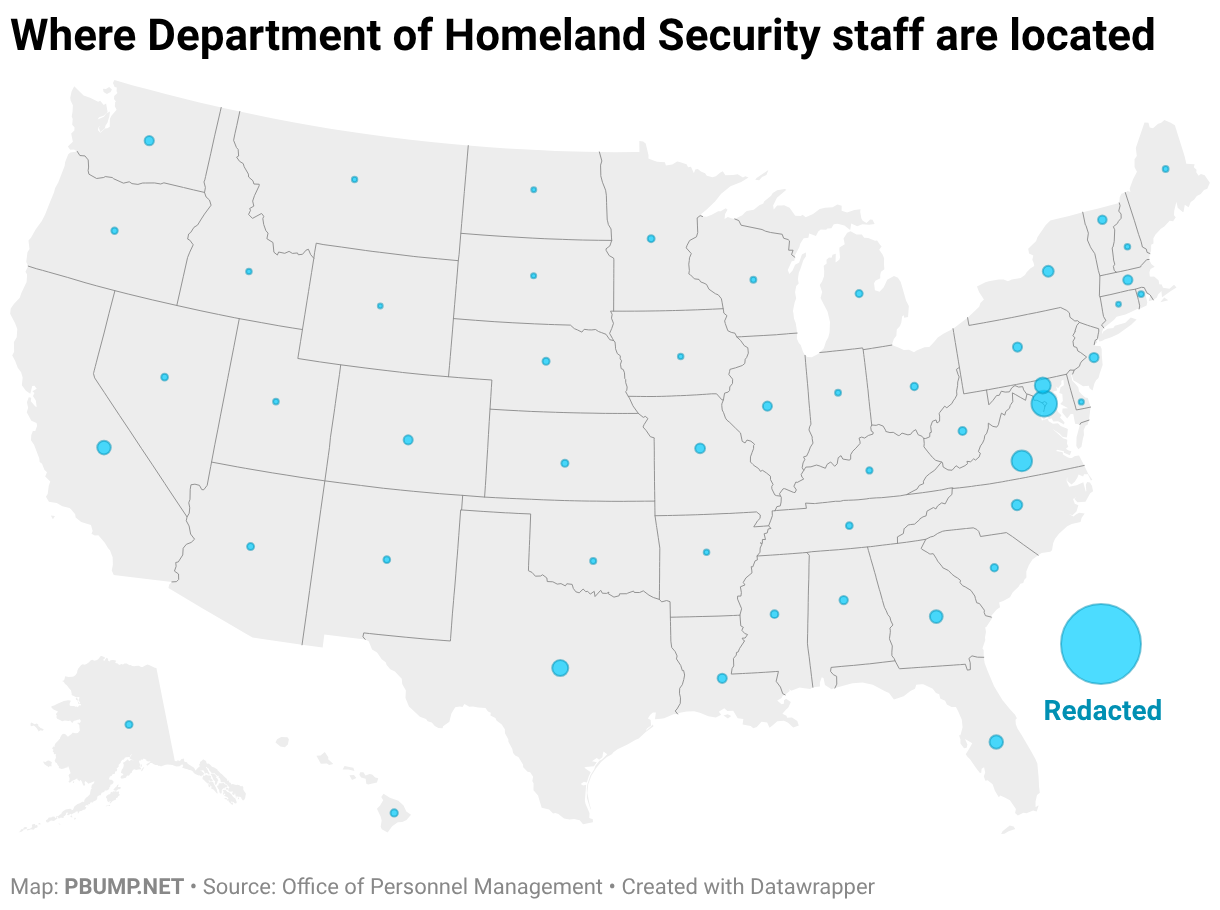
Fully three-quarters of DHS employees have their duty stations redacted.
When we look at specific departments, like ICE, we see an even more dramatic shift.

The public is informed that ICE has about 2,000 employees in D.C. Everyone else? Shielded in the OPM data.
Related: ICE’s excuse for wearing masks has never actually manifested
Same with Customs and Border Protection. Of the department’s 67,000 employees, we’re informed about the duty station — D.C. — of only 5 percent.
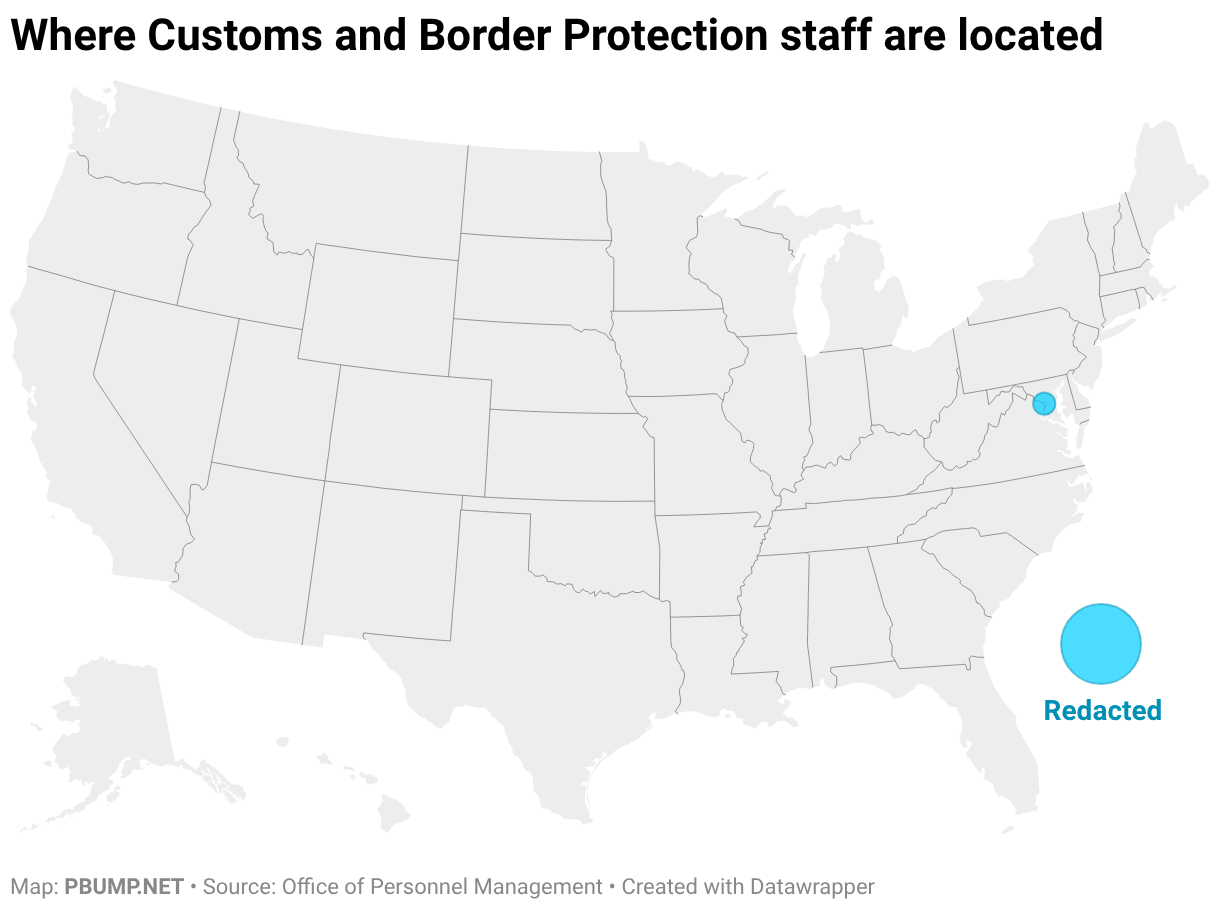
Together, the redacted duty stations of ICE and CBP staffers constitute more than half of the DHS redactions.
To put an exceptionally fine point on it: My point is not that the duty stations of every individual must necessarily be made public, much less that their home addresses be available. It is striking, though, that we have so little insight into who is patrolling the streets of cities targeted by the administration for overtly political reasons.
Update: As Lauren Harper of the Freedom of the Press Foundation noted on Bluesky, this is a function of both ICE and CBP being extended new protections in 2020, during Trump’s first term in office. A memo released internally after the designation was applied to ICE explained that the designation as a “security/sensitive” agency would “ensure that OPM withholds all relevant personally identifiable information (PII) of all ICE personnel” from public information.
Photo: Items in the Border Patrol Museum in El Paso. (Jonathan McIntosh/Flickr)