Half of Republicans aren’t sure how violent the No Kings protests were

I’ve been traveling this week, so the amount of attention I’ve been able to pay to the world around me is diminished, no doubt to my benefit.

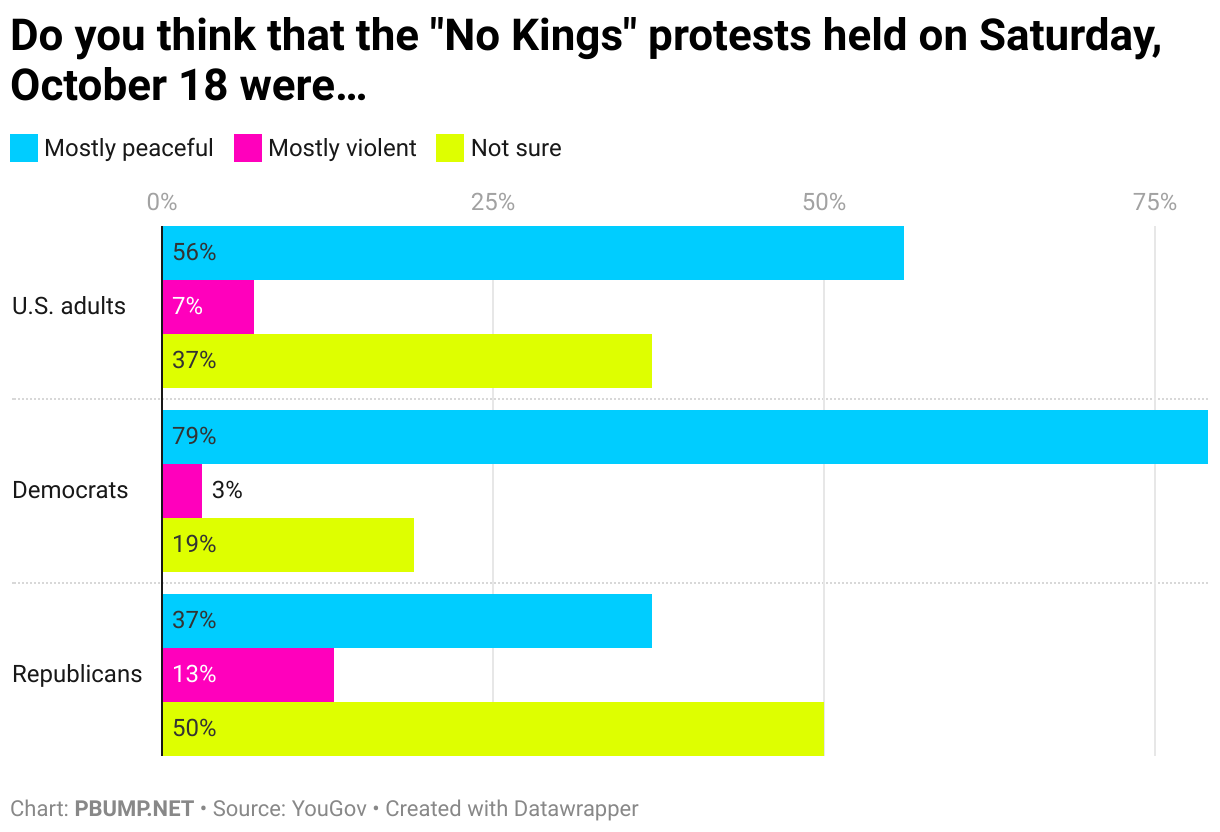
That said, the poll result below did come to my attention, and I thought it was worth elevating. In short, YouGov asked Americans whether last weekend’s almost-entirely-peaceful protests were mostly peaceful or mostly violent. And most Americans correctly said that they were mostly peaceful, because they were.

But the results among Republicans do stand out. Twice as many said they were mostly peaceful as said they were mostly violent — but, again, there’s no evidence of significant violence at all, much less nationally. Still, 1 in 8 Republicans think the protests were mostly violent, a claim that you might be forgiven for allowing to color their complaints about the rampant violence during the Black Lives Matter protests in the summer of 2020. Those, too, were mostly peaceful, but incidents of violence have been amplified for years — including in recent Fox News coverage — in an effort to cast all of those events as dangerous and illegitimate. Now that sentiment has bled over into last week’s events, which are perhaps described by Republicans as violent simply because (like the 2020 protests) they understood to be hostile.

Of course, we must also note that 50 percent of Republicans say they aren’t sure how violent the protests were. This may be a function of limited coverage among media outlets most consumed by Republicans. Or it may be a function of the pattern — present among both parties — of feigning ignorance instead of conceding an inconvenient point. If you are a Republican who opposes the protests and knows they weren’t violent, you might simply say “man, who’s to say” when prompted to evaluate what unfolded.

The real tell here will be how the protests are viewed in the future. It took time for the 2020 protests to become summarized as uniformly violence-soaked and wantonly destructive, just as it took time for other false narratives about American politics to take root. When your perceptions of the world are uniformly filtered through a partisan lens, what you see necessarily diverges from reality.

Photo: A No Kings march in New Jersey. (Jeffrey Hayes/Flickr)

Trump wants you to think invoking the Insurrection Act is more common than it is

It’s clear that Donald Trump spent a big chunk of the period between his presidencies thinking about what he would do differently if he returned to the White House. One thing he settled on was that he wouldn’t be constrained by staffers and experts who were cautioning him about precedent and the law. Another was that he would use the power of the presidency as a cudgel against his opponents, real and perceived.

This was obvious well in advance of his actual election. During his first term — and particularly after the BLM protests that emerged in mid-2020 — he’d made repeated comments about deploying the military against protesters and immigrants. His interest in invoking the Insurrection Act to deploy the military on the streets of American cities became part of Kamala Harris’ argument against his election. When that didn’t work, questions about such deployments became part of the confirmation hearings for Trump’s Cabinet.

Those concerns were well-founded. Trump hasn’t invoked the Insurrection Act, but he has federalized state National Guards to use as law enforcement. And over the weekend, he repeatedly suggested that the Insurrection Act was the next step.

“I haven’t used it but, don’t forget, I can use the Insurrection Act,” he said in an interview with his friend Maria Bartiromo. “Fifty percent of the presidents, almost, have used that. And that’s unquestioned power.”

Flying back to D.C. from (another) weekend at Mar-a-Lago, he repeated the claim when talking to reporters.

“I’m allowed as you know as president, like, 50 percent of the presidents have used the Insurrection Act,” he said. “Everybody agrees you’re allowed to use that and there is no more court cases, there is no more anything.”

He’s making two claims here, both of them false.

The second claim is that the Insurrection Act allows him to have “unquestioned power” and avoid “court cases.” It does not. The Brennan Center explained what it actually does a few years ago, articulating that it, in essence, allows the president to use the military to “execute the Laws of the Union, suppress Insurrections and repel Invasions.” In other words, to stamp out rebellions or to supplement law enforcement.

But I’d like to focus on Trump’s first claim, that about half of presidents have invoked the Insurrection Act. That’s not true.

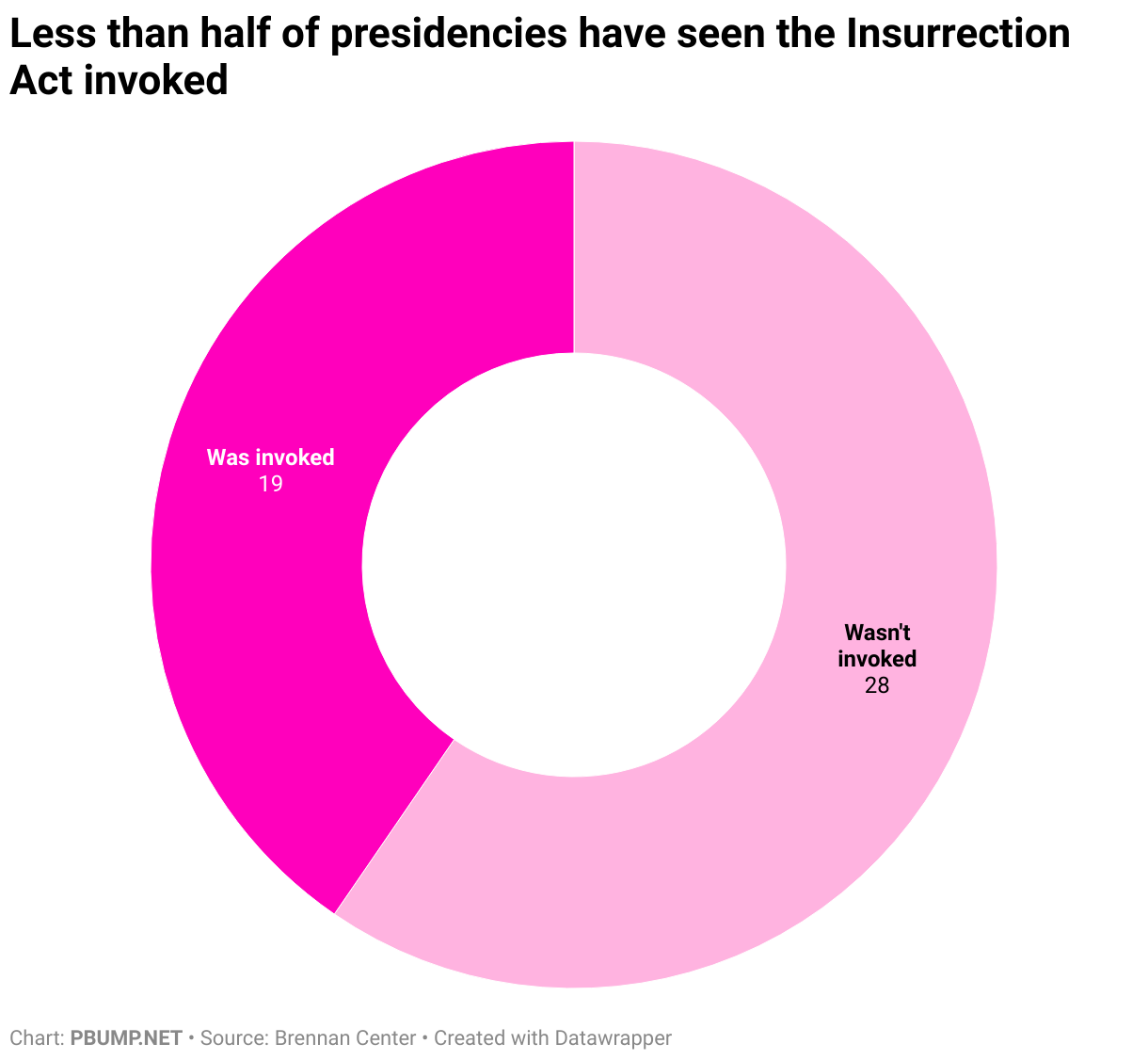
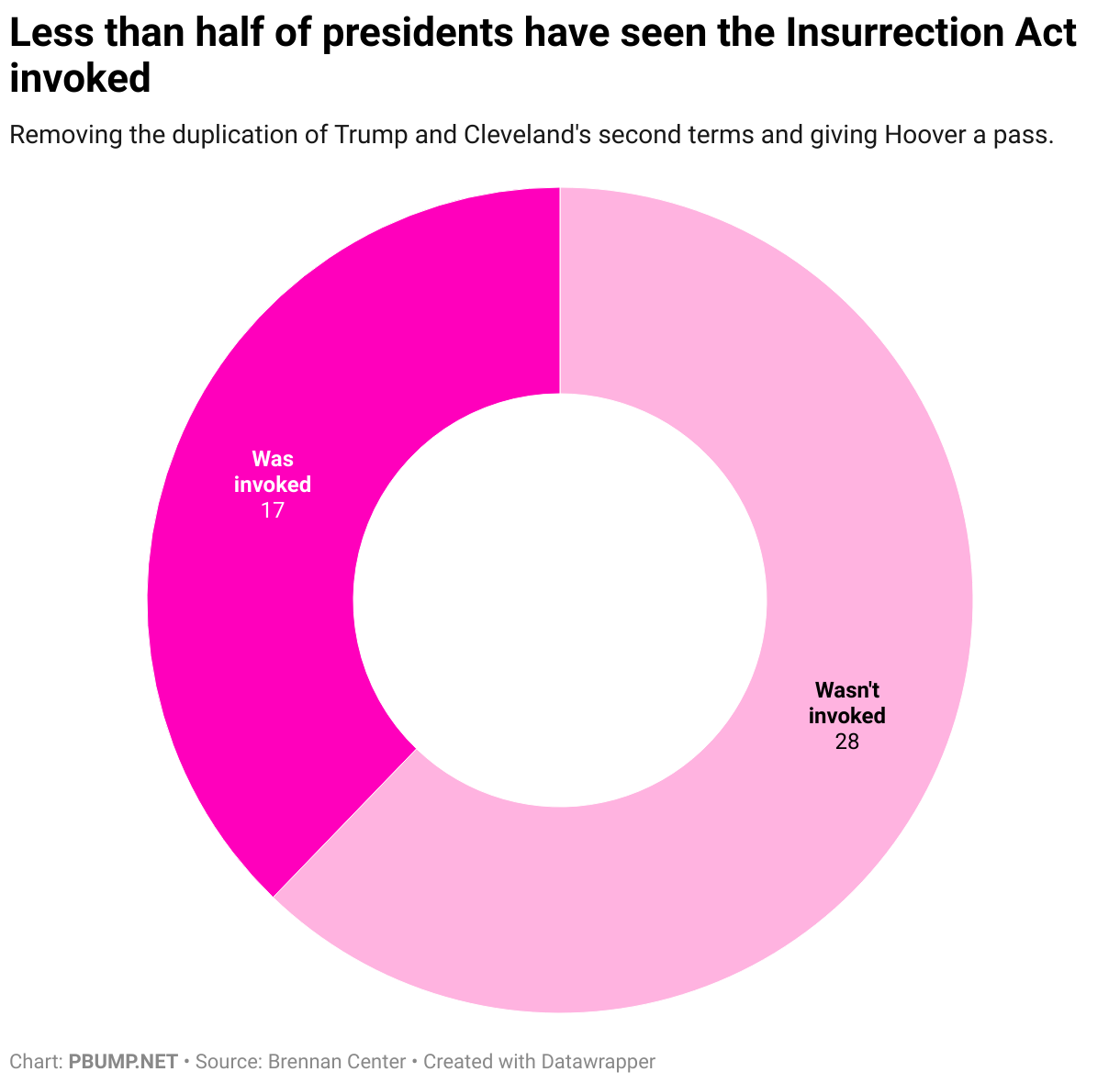
The Brennan Center has a list of times at which the Act has been invoked in U.S. history. Over the course of 47 presidencies, it has been invoked in 19 — meaning about 2 in 5 presidencies, not 5 in 10.

The reasons for those invocations vary. Early in the country’s history, they were to put down actual rebellions — including at the outset of the Civil War. At a lot of other times, the Act has been invoked to allow a federal response to racist incidents: anti-Chinese riots, efforts by Southern states to retain segregation. In that latter case, the federal government stepped in to enforce laws that state authorities were hoping to ignore.

The most recent invocations — during the presidencies of Ronald Reagan and George H.W. Bush — were to provide additional support to states combatting unrest. Not rebellions but riots, like the ones that followed the acquittal of the police officers who beat Rodney King in Los Angeles.

Notice that an invocation of the Act during the Hoover administration was actually not undertaken by Hoover. If we remove that one from the calculus and look at the numbers by president (as Trump did) the percentage drops further: just over a third of presidents have invoked the Insurrection Act.

The most important factor here isn’t that Trump’s math is bad. It’s that he wants Americans to think that invocations of the Insurrection Act are par for the historical course, which they aren’t. He wants people to think that it’s relatively trivial to invoke the Act and that he can do so when he wants to for whatever reason he wants to.

But context matters. It’s also true that 50 percent of President Roosevelts declared war on Germany, but that’s because Franklin Roosevelt had reason to do so. There’s a reason those other presidents invoked the Insurrection Act, and it wasn’t because they wanted their political opponents to bend to their will. It was in defense of law and order, not as a defiance of it.

Another way to look at the data on the Insurrection Act is to note that no president has invoked it in more than 30 years. If Trump were to do so, as he’s hinting, he’d be breaking with precedent, not mirroring it.

Photo: Trump at his birthday parade. (White House/Flickr)

Sincerity is not the problem

As is inevitably the case after an election — and is especially the case after an election with an unexpected result — allies of the losing presidential candidate in 2024 looked for people to blame.

One quickly identified culprit was “the groups,” advocacy organizations that had built power and used it to pressure Democratic candidates to push for their positions. Organizations that demanded racial justice and climate groups like the Sunrise Movement have been targets of particular ire. They pushed Democratic legislators to take public positions that were seen as unpopular, ushering in Donald Trump’s second term.

Let’s set aside the central problem with that claim — namely, that inflation was almost certainly a far, far bigger problem for the incumbent party than, say, “wokeness” — and instead consider the supposed problem on its own merits. In particular, the role of climate politics on the left.

It is true that addressing climate change has not proven to be something that inspires many Americans to vote for Democrats, even if they agree that planetary warming is a problem. There just happen to be a lot of other, more pressing problems that voters tend to prioritize.

It is also the case that the world is warming and that is being driven by human activity. It is the case that this is a problem that is already manifest and that it threatens to become more immediate and more damaging as time passes. It is an issue that will necessarily affect people who are alive in the year 2100 more than those who will be alive in 2050, meaning it is an issue that has particular salience to younger Americans.

So, for many young and recently young Americans, climate change became a generationally defining problem. It was something that affected them more than older Americans and it involved a fight against deeply entrenched interests with deep pockets. It is analogous (in admittedly incomplete ways) to the baby boom’s fight against the Vietnam War. That, too, was something that disproportionately affected the young and it, too, involved a fight against established power.

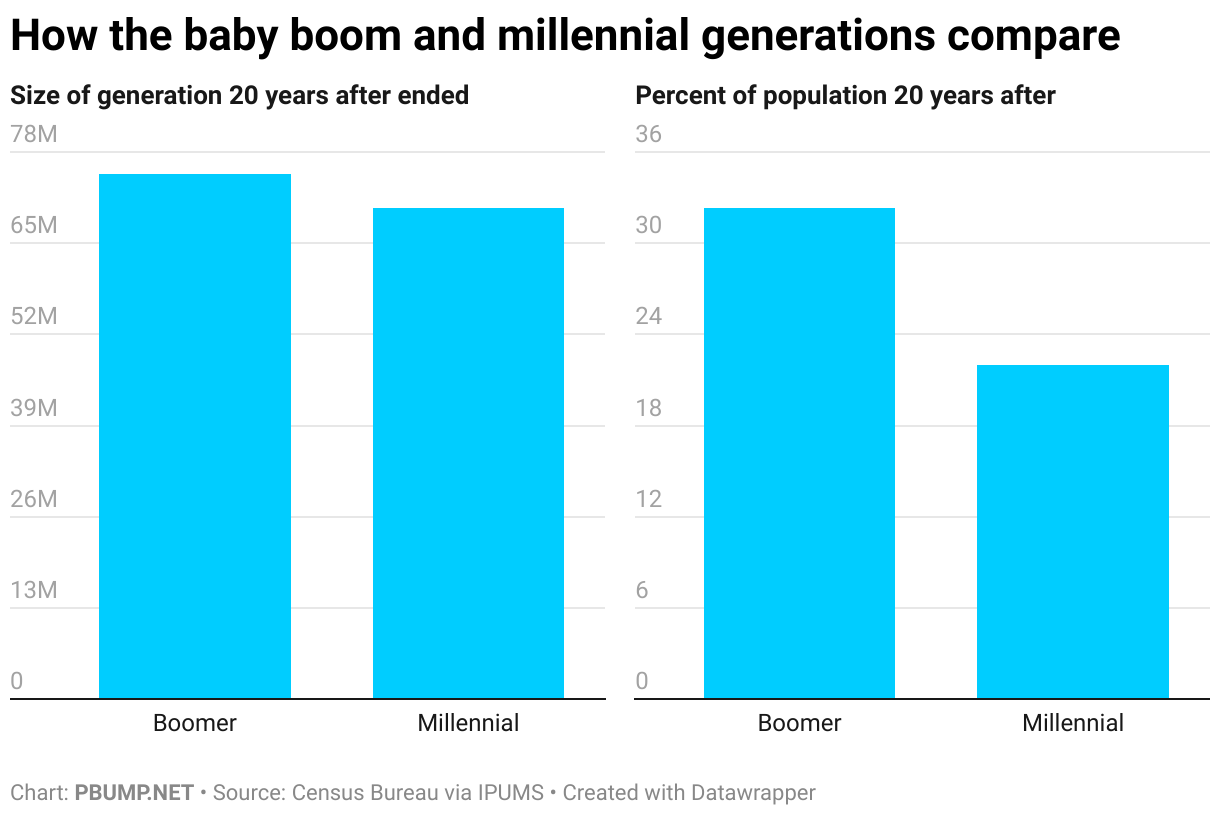
It was also a fight that emerged along with an unusually large population of young people. Millennials were between 10 and 25 years old when “An Inconvenient Truth” elevated global warming to national attention. For every 100 boomers in the U.S. two decades after that generation emerged (that is, in 1984), there were 94 millennials two decades after its emergence (in 2016). It’s just that, in part because of the baby boom, millennials made up far less of the total population.

The generational fight against climate change did not see the same success as did the fight against Vietnam. There are a lot of reasons for that, including that Vietnam War produced immediate, visceral examples of death and immorality that were effective in moving public opinion. The fight against climate change featured plenty of imagery of the effects of warmer oceans and air, but it also ran into a system of denial that wasn’t possible in the 1970s. It wasn’t just a battle against carbon dioxide emissions; it became a battle over reality, with corporations and their allies settling on a strategy of contesting every single inch of rhetorical terrain.

For all of the cynicism that accompanied the anti-war movement a half-century ago, at least the war ended. Young people fighting for what they saw as an existential threat to the planet and themselves, incremental progress in reducing greenhouse gases hardly seemed like much of a victory. They fought the system — and the system won a robust victory.

There was an institution that was supposed to aid their fight: The Democratic Party. Often, though, Democratic politicians adopted moderate positions or advocated for carefully triangulated policy proposals aimed at building consensus. Americans generally and young Americans in particular were already drifting away from party membership in favor of political independence; the Democratic Party didn’t offer young people who cared about climate change much of a reason to sign up.

The Democratic Party is supposed to be the storehouse of political power on the left. But the increased polarization of politics and the increased nationalization of it (the centering of national issues even in state and local races) has trained the party to seek out the least offensive possible position as indicated by public opinion data. So those young people — and people of color and the (mostly) retirement-age women who spun up the Indivisible protests during Trump’s first term — built power elsewhere. Then they deployed it as they saw fit.

This is what stokes the frustration of those left-leaning pundits. Why are you applying pressure there, where it doesn’t matter, instead of here, where it does? Why are you doing something that polls say is unpopular? Why are you being so strident? This is why we lost Montana!

Never mind that there’s often little evidence that these pundits have any special insight into winning elections. We can agree that the Democratic Party needs to incorporate a more diverse array of policies and priorities than does the Republican Party (given the Senate and Electoral College benefits of there being a lot of heavily rural and heavily White states) while still arguing that there’s value in people advocating for what they believe in.

We can also point to recent evidence that poll numbers are far from static. President Trump’s approach to immigration was viewed generally positively until (over objections from some of the aforementioned pundits) the left began elevating the case of Kilmar Abrego Garcia. Trump’s numbers went underwater and have stayed there. The rhetoric drove the polls, instead of the inverse.

With massive anti-Trump protests planned for tomorrow, this is important to remember. Sincerity, staking out a position rooted in one’s personal beliefs, has value. You can win elections by tacking to the middle; lots of people have. But you can also win elections by staking a moral position and convincing people to agree with you. You can earn support by demonstrating what is important to you instead of just being determined to nod along with what you hear.

If the problem for Kamala Harris in 2024 was the emergence of climate and racial justice groups that boxed her in, then the problem wasn’t with those groups. It was with a party that left space for those groups to emerge by failing to capture the energy and urgency of their members.

It is also worth remembering that the moment in which there was the most obvious grass-roots energy around racial justice and against Trump in recent years was in 2020. How’d the Democratic candidate do then?

Photo: 2014 Climate march in NYC.

Whose side will you take on consequences for speech: JD Vance’s or JD Vance’s?

Vice President JD Vance, commenting on random Americans who made light of Charlie Kirk’s assassination:

“Call them out, and hell, call their employer. We don’t believe in political violence, but we do believe in civility.”

Vance, commenting on adult Republicans — including an elected official and staffers — who participated in a group chat that included racist and pro-Hitler commentary:

“The reality is that kids do stupid things. Especially young boys. They tell edgy, offensive jokes. That’s what kids do. … I really don’t want us to grow up in a country where a kid telling a stupid joke — telling a very offensive, stupid joke — is cause to ruin their lives.”

In both cases, Vance was speaking on Kirk’s eponymous podcast. Meaning that he was offering those conflicting messages to the same audience, one that he (probably correctly) assumed would find any joke about Kirk’s death to be worthy of punishment and jokes comparing Black people to monkeys to be dismissible.

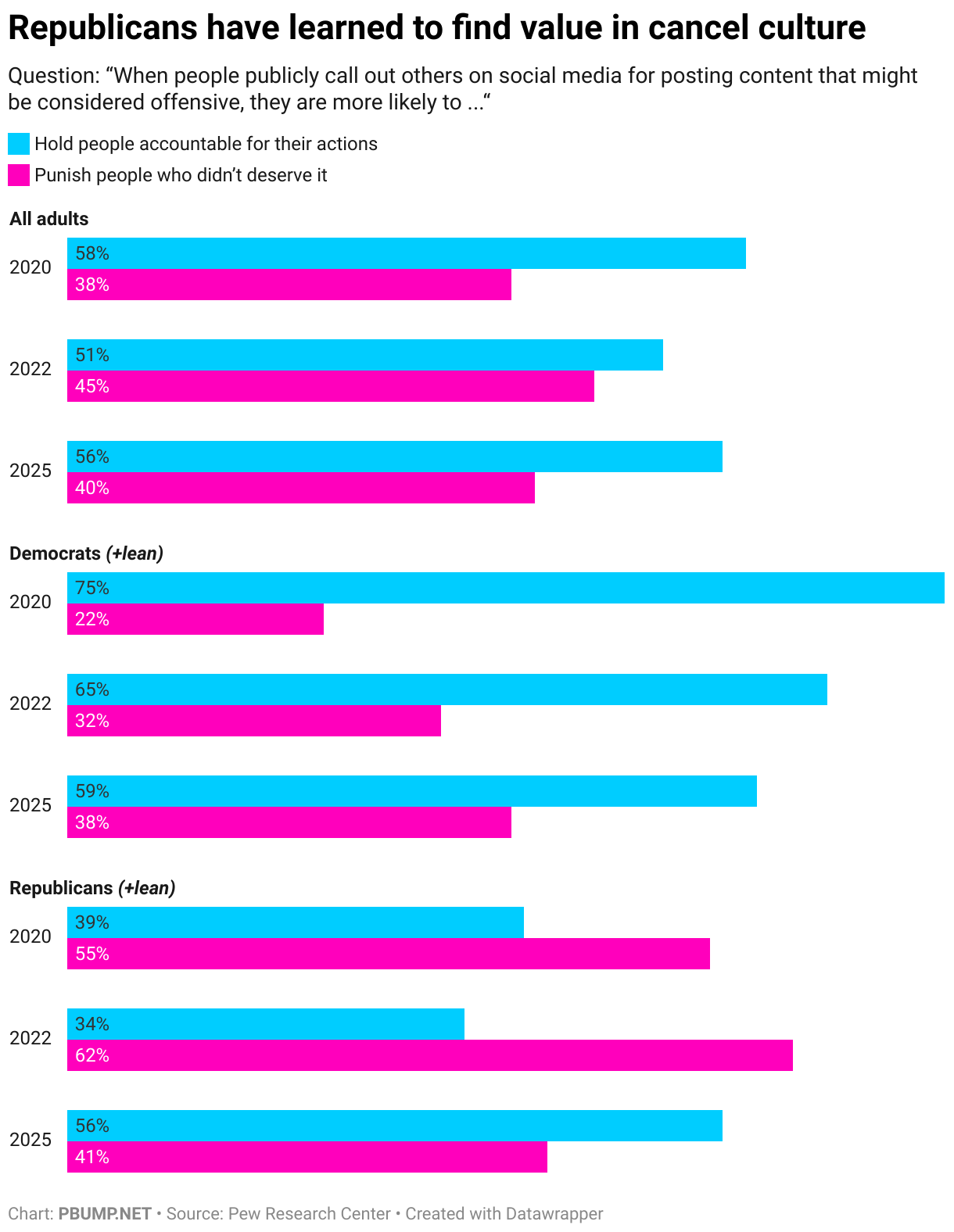
On Thursday, Pew Research Center released data evaluating the extent to which Americans see calling out offensive social-media posts as valuable. In 2022, 6 in 10 Republicans (and Republican-leaning independents) felt that doing so was apt to punish people who didn’t deserve it while about the same percentage of Democrats (and leaders) felt that it introduced accountability.

In the most recent data, that divide is gone. Now, about the same percentage of each party sees accountability as a more likely outcome.

It is probably important both that the above shift overlaps with Trump’s return to the White House and social media companies scaling back their efforts to police abuse and misconduct. Trump and his allies have stoked the idea that America has undergone a sea change, one in which the prevailing ethos has shifted in their direction. Facebook and what was once Twitter have signed onto that idea. The right can’t present themselves as victims of powerful “woke” forces if they see themselves as the ones with cultural power.

But they can police conformity with that power, as they once accused the non-right of doing to them. Monitoring speech is just another tool in the authoritarian toolbox, used as a cudgel against critics or in service of their allies. For my enemies, the law, etc.

In that sense, there is no hypocrisy in Vance’s comments on the Kirk podcast. They are consistent in that they reflect the will of the administration and its approach to power.

Photo: Vance in the Oval Office. (White House/Flickr)

Those young Republicans were young — for Republicans

After Politico reported on the existence of an overtly racist group chat involving a number of leaders of Young Republican groups around the country, some members of their party hoped to wave it all away.

“The reality is that kids do stupid things,” Vice President Vance said on a podcast on Wednesday. “Especially young boys. They tell edgy, offensive jokes. That’s what kids do.” He added that “I really don’t want us to grow up in a country where a kid telling a stupid joke — telling a very offensive, stupid joke — is cause to ruin their lives.”

Vance is being consistent here. In February, he advocated for the re-hiring of an administration staffer who’d been found to have made racist posts on social media. “I don’t think stupid social media activity should ruin a kid’s life,” he insisted at the time.

But, of course, the people engaging in this racism aren’t kids. The guy in February was 25. Mother Jones sussed out the ages of most of the participants in the group chat, finding that all were at least in their mid-20s. Some held elected office; others worked for the party or party organizations.

There is a sense in which they are relatively young, however: they are awfully young for Republicans.

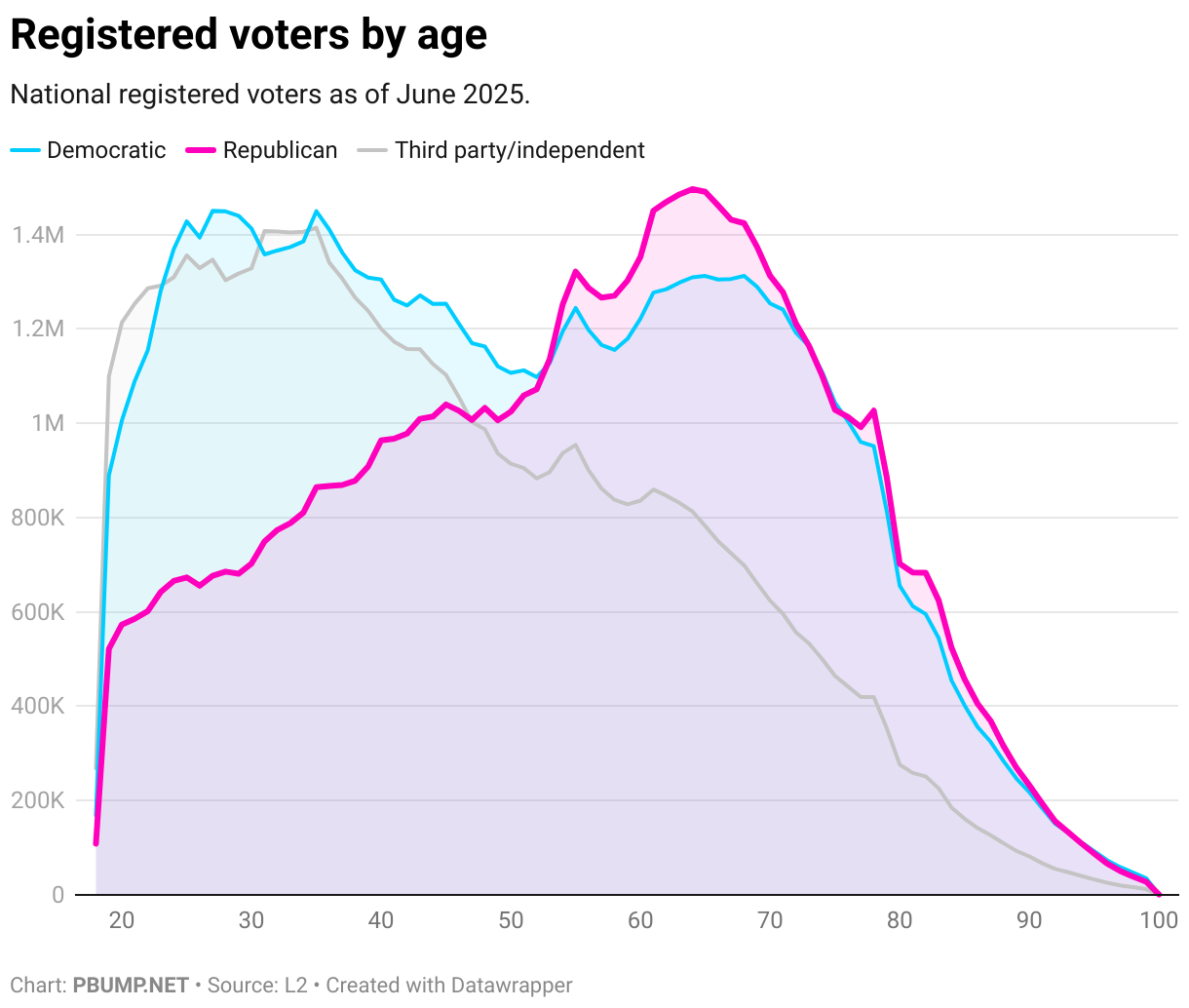
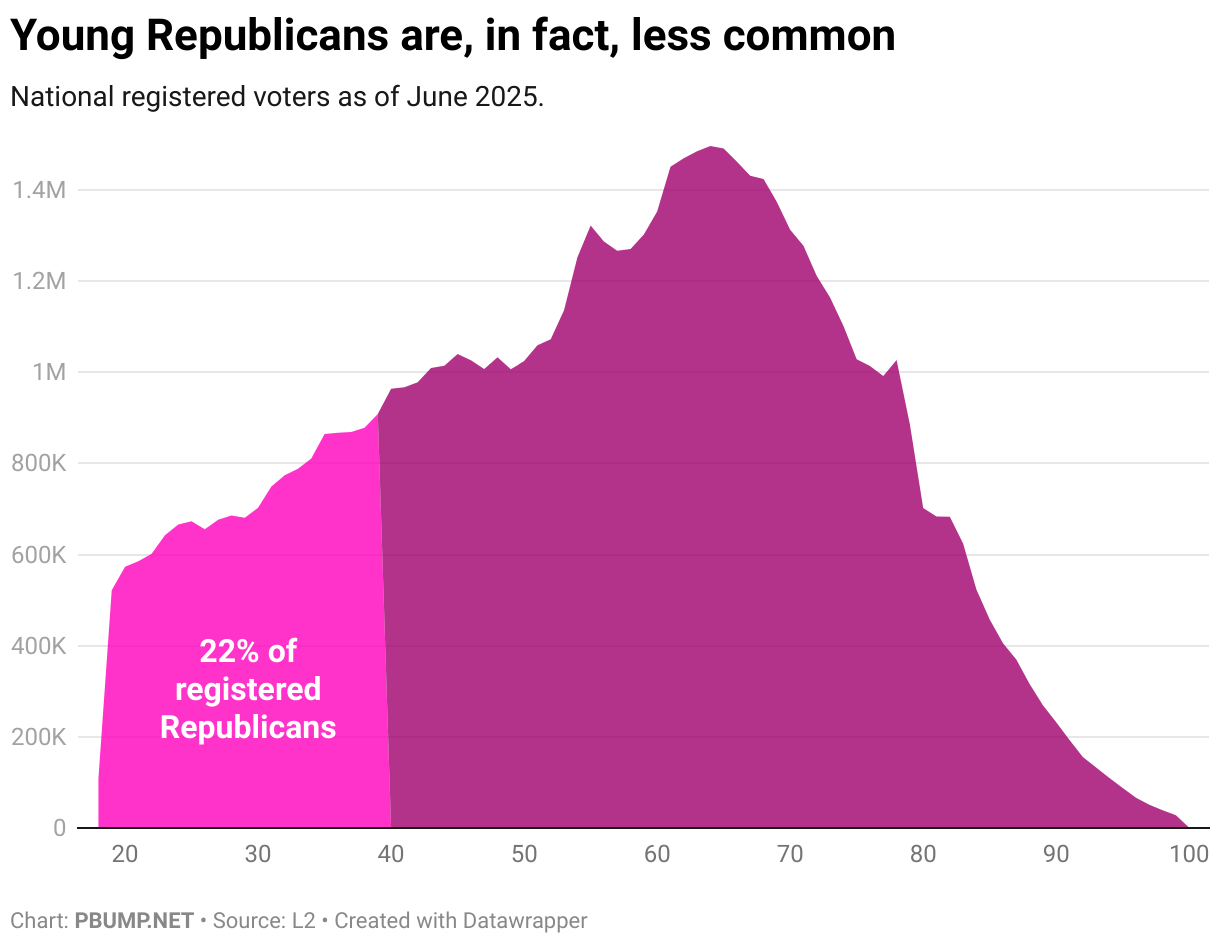
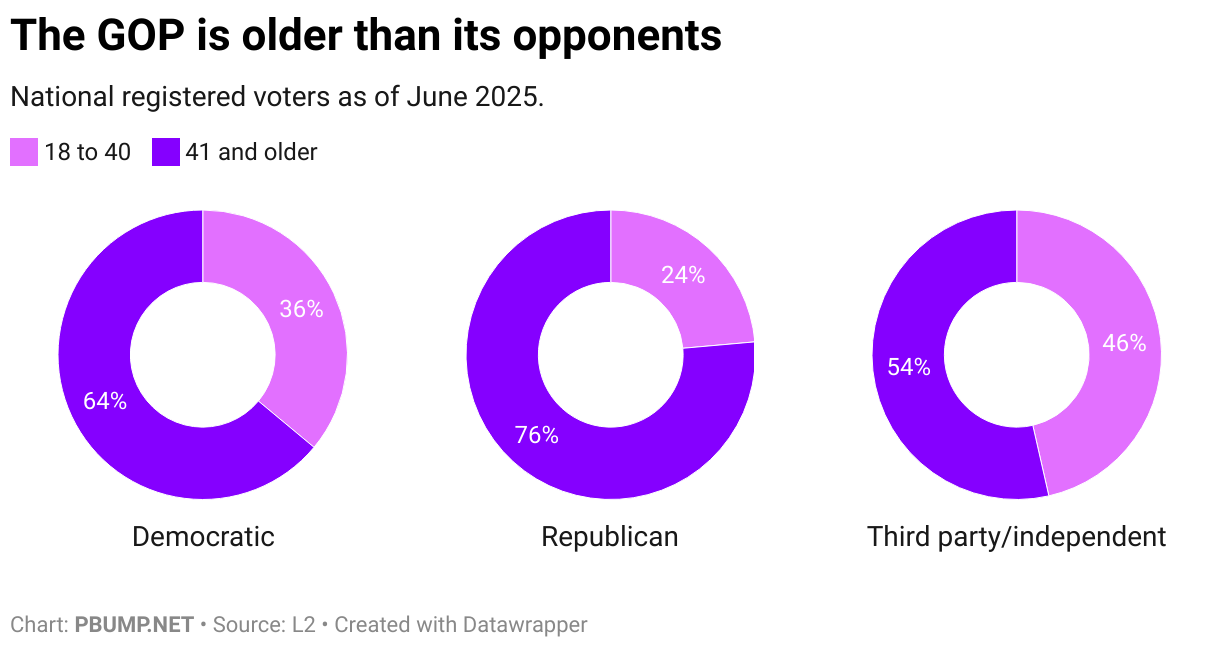
Older Americans, who vote more often, are usually registered with one of the two major parties. Young people, though, tend to register either as Democrats or as independents and members of third parties. Among registered voters under the age of 30 in June, only 1 in 5 were registered as Republicans.

As Politico notes, the Young Republican organizations whose leaders were involved in the group chat target Americans between the ages of 18 and 40. Voter data from June shows that only about 20 percent of Republicans fell into that age range.

Compare that with Democrats, more than a third of whom are 40 and under. Among independents and members of third parties, nearly half are.

Relative to Republicans overall, then, a 30 year-old is sort of a kid? If we grade on a curve.

That’s not the game that Vance is playing, though. He claims that these people who hold leadership positions within his party are too immature to avoid making racist and antisemitic comments to one another — an assertion that you may evaluate for yourself.

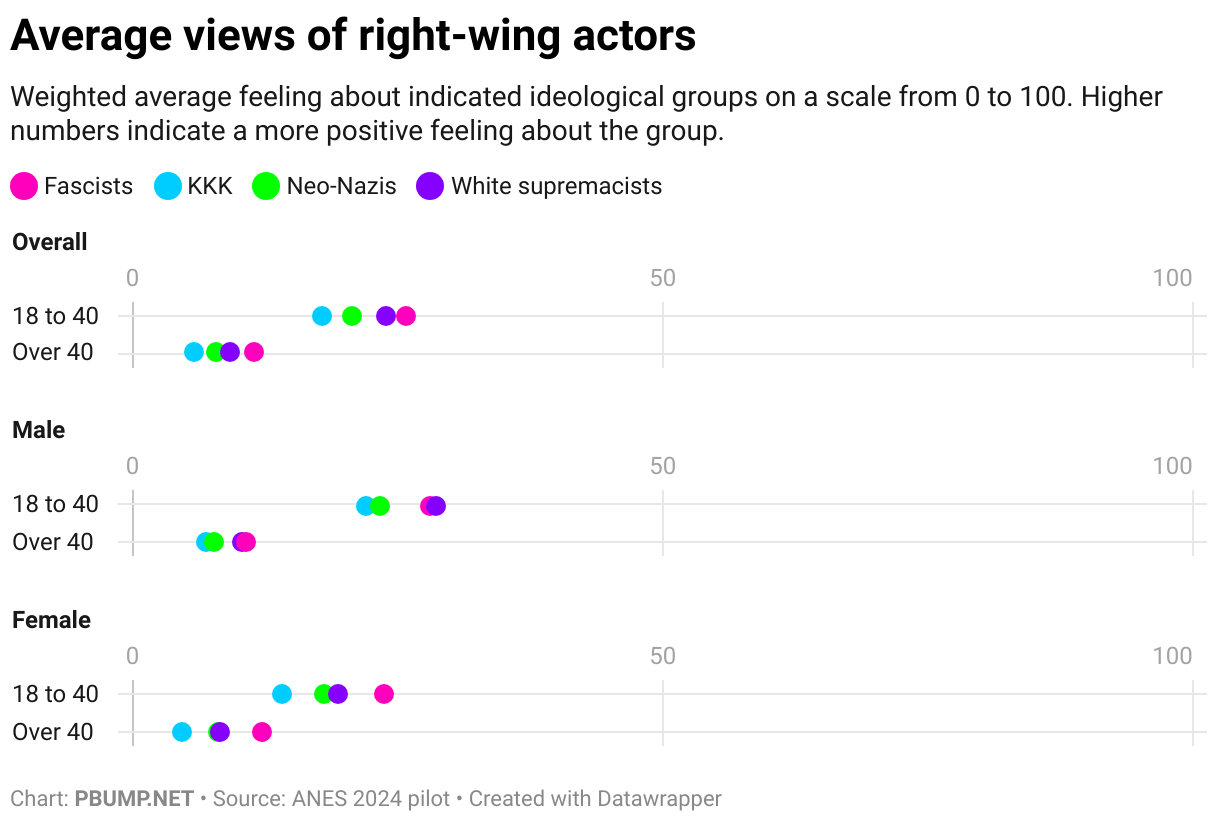
It is true that younger Americans are more receptive to fringe-right ideologies. Pilot research conducted as part of the 2024 American National Election Studies found that adults 40 and under, and particularly young men, had slightly warmer (though still cold) feelings to explicit racists and fascists.

There wasn’t a big difference by either party or ideology, though, except that moderates and independents had warmer feelings than partisans. It’s possible, then, that this is to some extent in part a function of actual naïveté among younger people about these ideologies.

But that’s average Americans, not politically active members of the GOP. And research looking at another facet of the group chat target — antisemitic and pro-Hitler comments — shows that this is a more comment sentiment among young people on the right.

Hersh, E., & Royden, L. (2022). Antisemitic Attitudes Across the Ideological Spectrum. Political Research Quarterly76(2), 697-711.

The study, released in 2022, includes a summary of its findings:

“We oversampled young adults because unlike other forms of prejudice that are more common among older people, antisemitism is theorized to be more common among younger people. Contrary to the expectation of horseshoe theory, the data show the epicenter of antisemitic attitudes is young adults on the far right.”

Vance’s effort to wave this away as kids being kids, then, fails on both fronts. Only relative to his unusually old party is a 30 year-old a kid. And only within a particularly toxic subset of young people — one that has some overlap with the party — are the views expressed in that group chat normal young-person behavior.

As at least some other members of his party appear to recognize.

Photo: A middle-aged man visits the president. (White House/Flickr)

Why Arizona seems to have more people of Italian than Native American ancestry

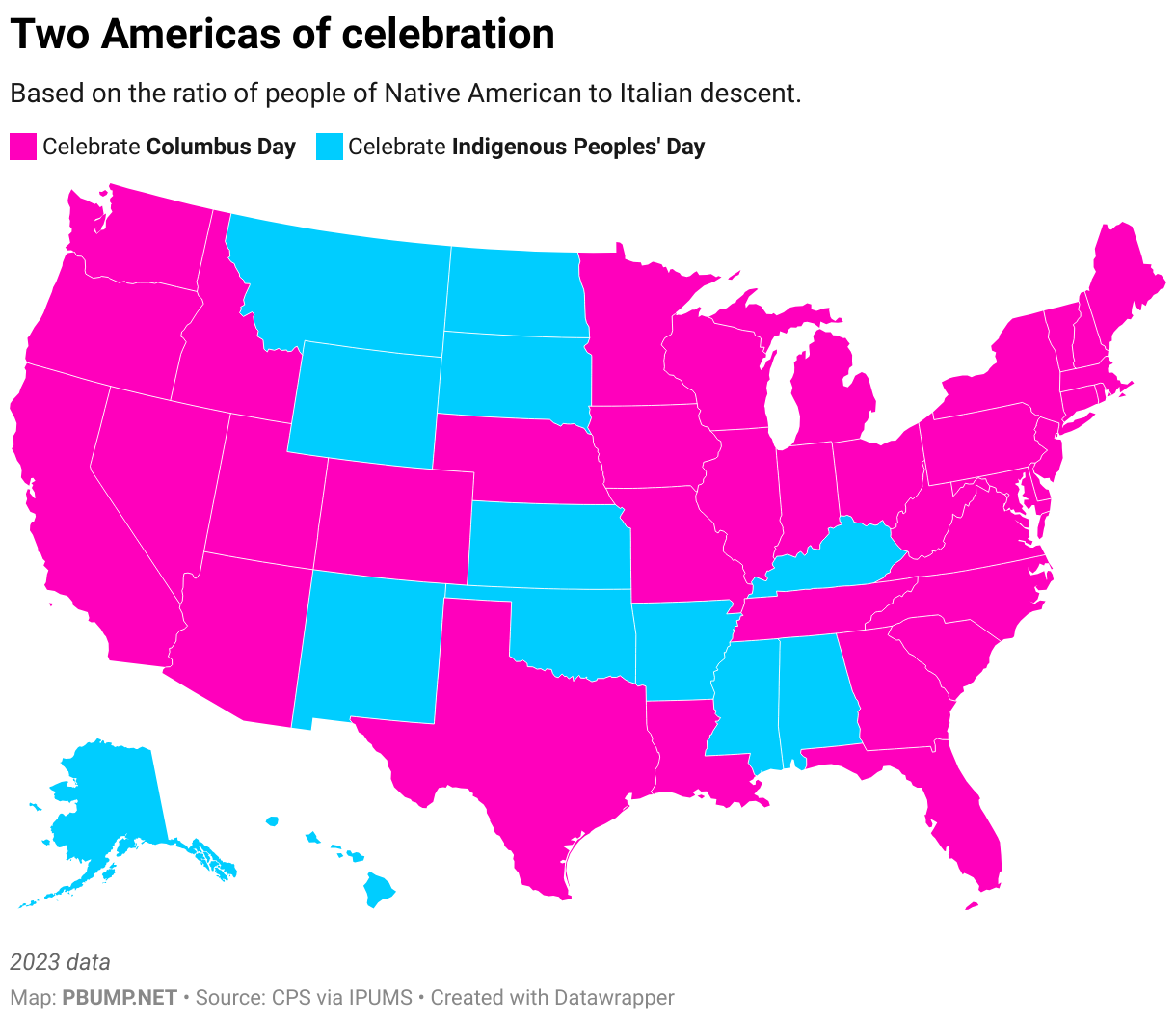
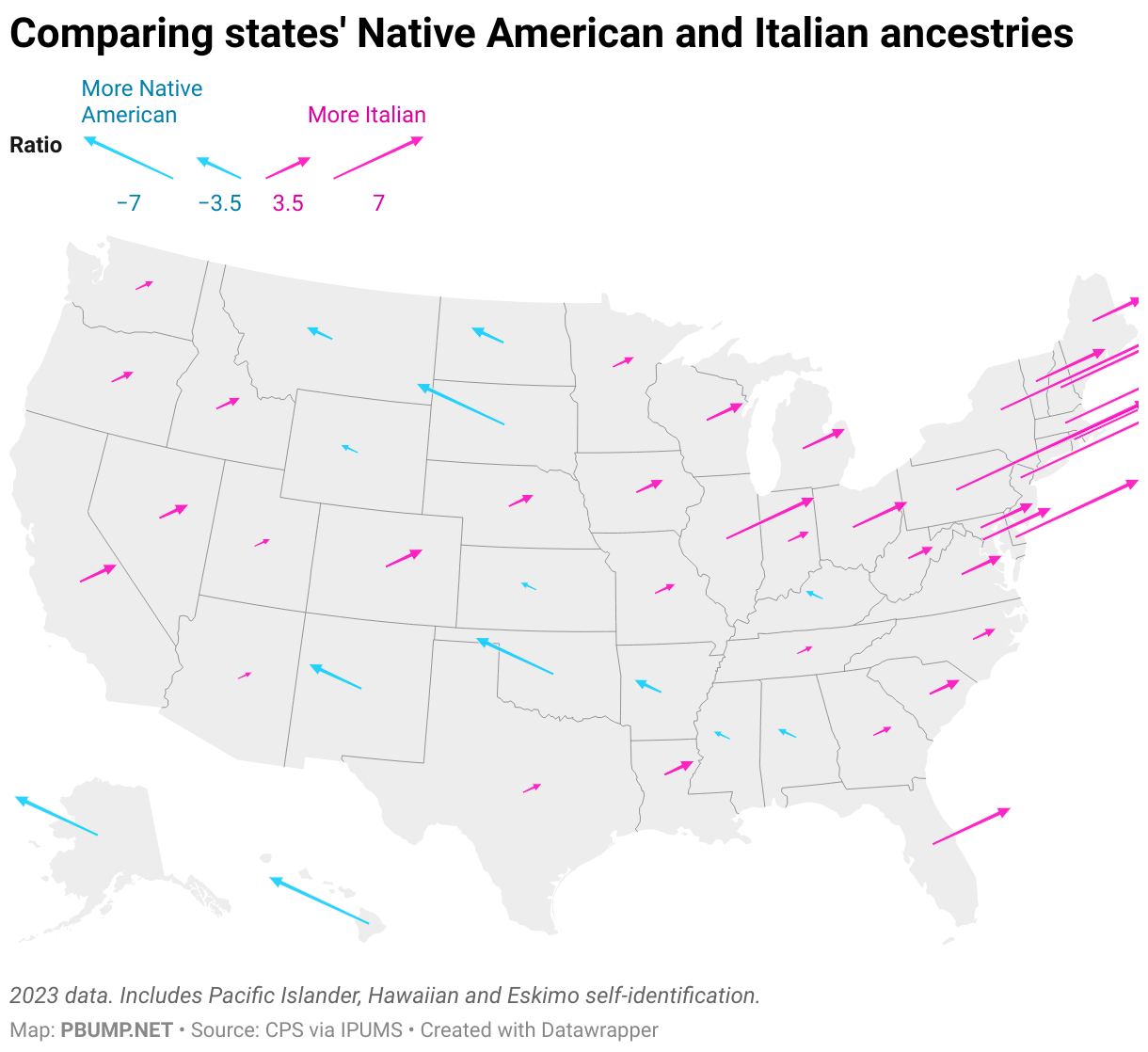
On Monday, I jokingly suggested that the dispute over Columbus/Indigenous Peoples’ Day be resolved on a state-by-state basis, considering the ancestral heritage of each state’s residents. New York, which has far more people of Italian than Native American ancestry, would celebrate Columbus Day. Oklahoma, with far more people whose ancestors were Native Americans, would celebrate Indigenous Peoples’ Day.

Like so many other things I write, this was basically an excuse to do some data analysis. So, using Census Bureau data compiled by IPUMS, I determined what percentage of each states’ residents were Italian or Native American and, therefore, which holiday that state should/will celebrate.

I presented the results in this map.

When I shared this map on social media, a question arose: What was happening in Arizona? Was it really the case that the southwestern state has more people of Italian than Native American ancestry?

And the answer is that, yes, it does — at least according to this CPS data.

That’s only a recent development, though. In 2000, the CPS data indicates that Arizona had about 325,000 people of Native American ancestry but only 235,000 of Italian heritage. Between then and 2023, though, the state grew by 48 percent, with a large number of people from other states (often retirees) moving to the Sun Belt. The number of people of Italian ancestry in Arizona jumped to more than 304,000. During the same period the number of residents of Native American ancestry fell below 300,000. And here we are.

I pulled data from each state for 2000, 2010, 2020 and 2023 to show how the populations have shifted.

You’ll notice that the number of residents of Native American ancestry dropped in a number of states since 2000. In fact, Arizona wasn’t the only one to go from more-Native-American to more-Italian; 13 other states also saw the number of residents of Italian ancestry pass those who have Native American ancestry. (This analysis excludes people who claim both ancestries.) From 2000 to 2023, 41 states saw the number of residents of Italian ancestry increase. Only seven saw an increase in the number of residents claiming Native American ancestry.

It’s likely that this is a function of data collection rather than demography. My former colleague at The Washington Post, Andrew Van Dam, wrote a few years ago about an increase in Native American identification, a function of changes to how the Census Bureau asked about race. That conflicts with the CPS data, which shows a substantial decline in reported Native American ancestry.

It’s a more detailed question than I’ll get into here. Instead, I’d like to return to my original theme: The Holiday That Many People Don’t Even Get Off. So: A quarter of a century ago, most states would have more appropriately celebrated Indigenous Peoples’ Day than Columbus Day. According to this data, that is no longer the case.

Photo: A cactus in Arizona in 1882. (National Archives)
The votes-per-acre paradox

One of Donald Trump’s favorite places in the country is Sweetwater County, Wyoming. Not because there’s anything in the county that’s particularly compelling beyond its natural beauty. No, Trump likes Sweetwater County (even if he couldn’t name it) because it is 1) very large and 2) voted for him by more than a 50-point margin each time he ran for president.

In other words, Sweetwater County is one of the largest splotches of red on the maps of election results that Trump likes to wave around in the Oval Office. Only about 41,000 people live there, but it punches above its weight in making the U.S. look much more red than it actually is.

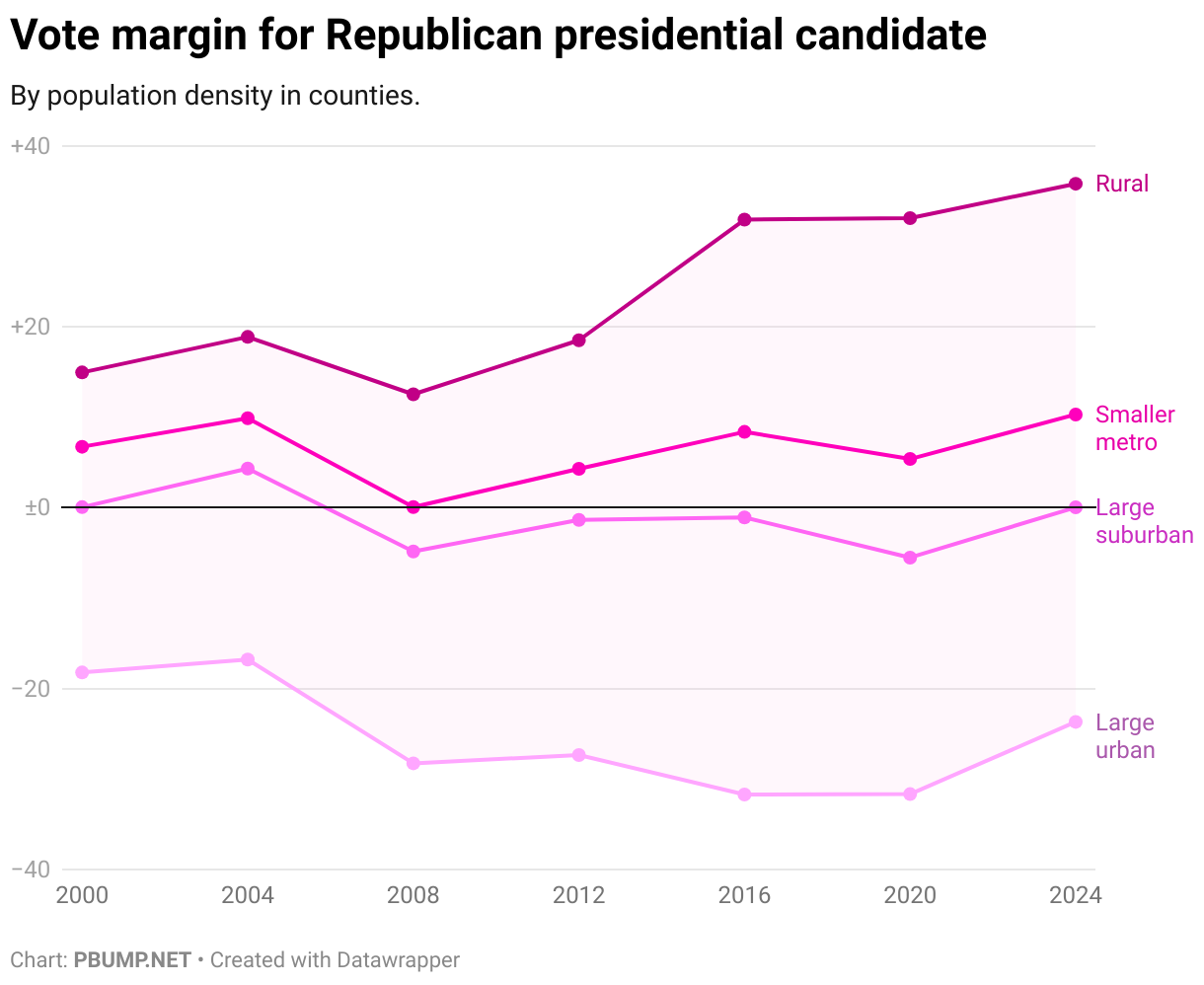
There is an established (and, for some time, strengthening) link between population density and voting. More urban areas vote more heavily Democratic; more rural, more heavily Republican.

The gap between the most urban and the most rural counties narrowed slightly in 2024 but, relative to 2012, it’s still yawning.

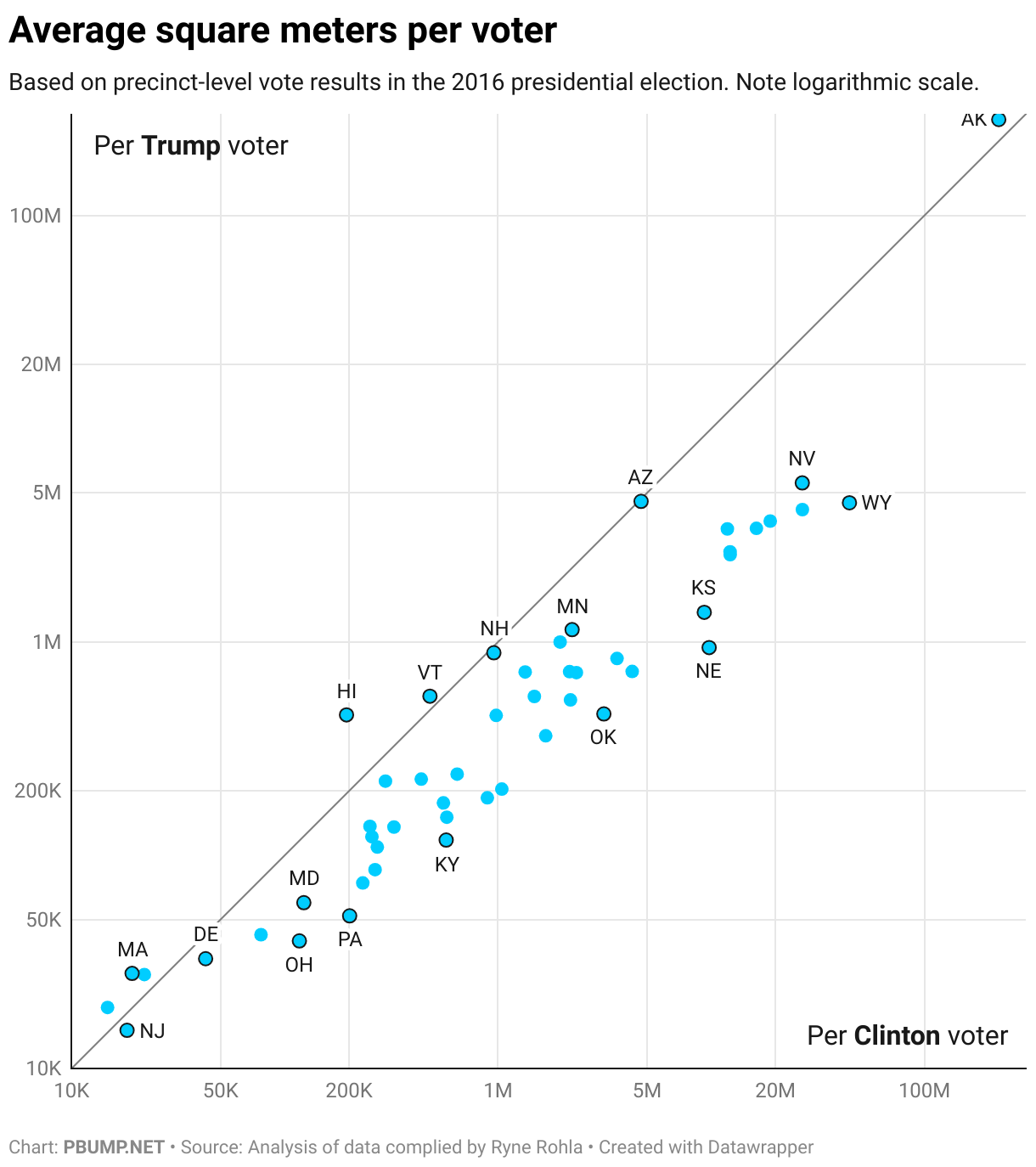
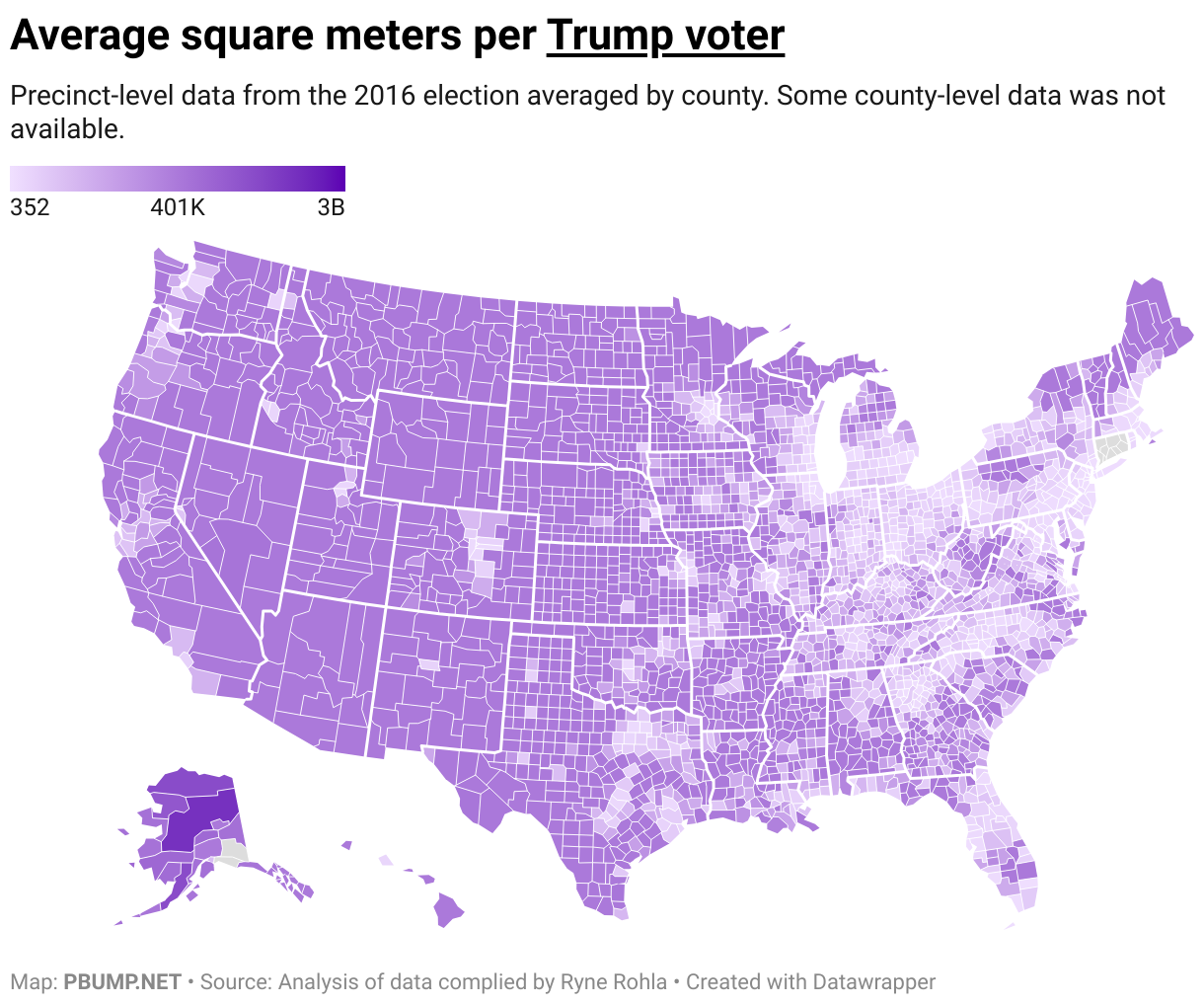
One might assume, as I did, that this means that comparing vote counts to the land area in which voting takes place would mean that the average number of square miles (or, as the charts below indicate, square meters) is lower for Democratic voters in denser parts of the country than it is for Republicans.

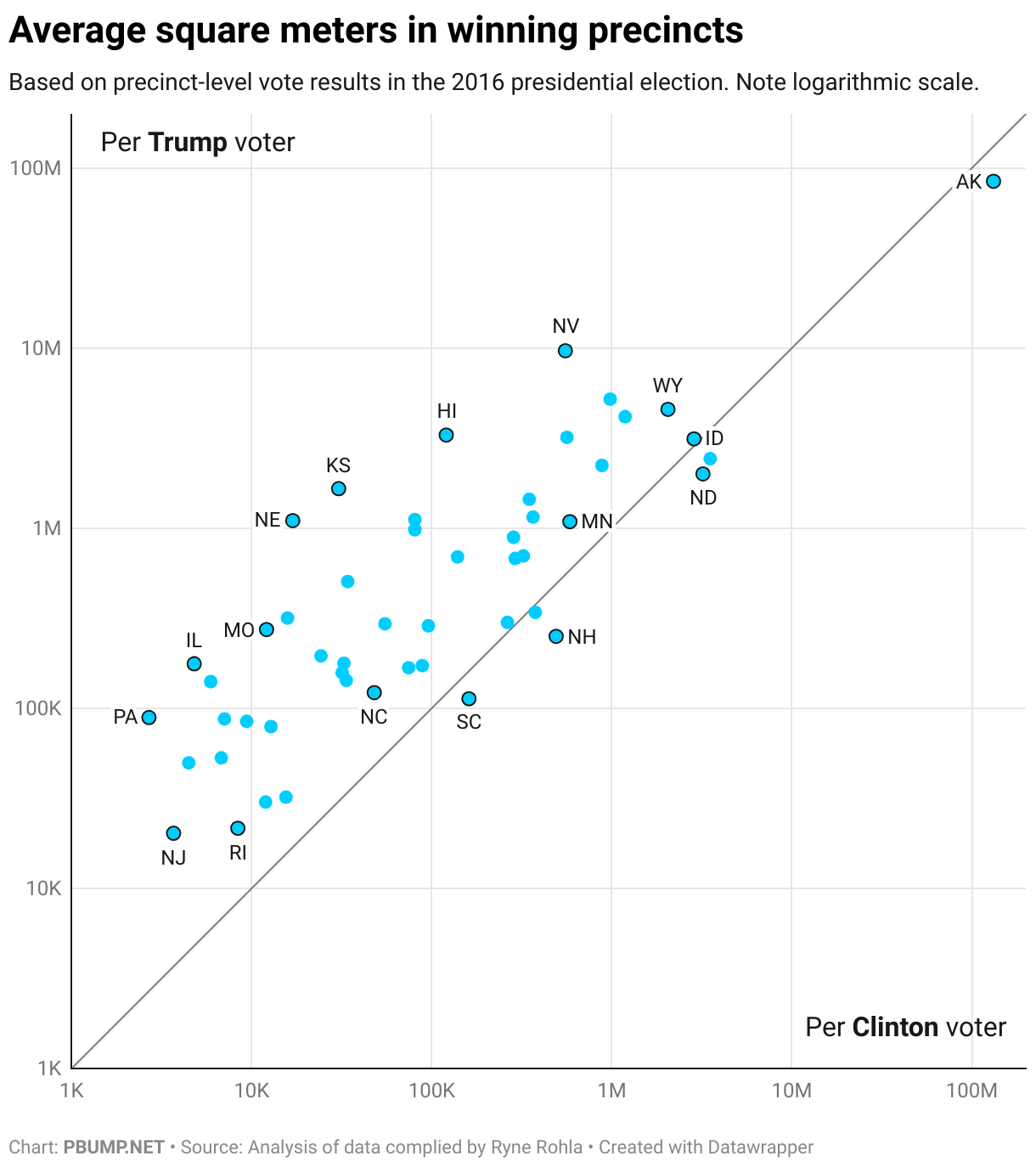
Using precinct-level data from 2016, though, we see that, averaged across states, it isn’t. On the chart below, dots below the line indicate an average square-meters-per-voter that’s higher for Hillary Clinton voters than it is for Trump voters in that state. And, as you can see, that’s the case for nearly every state.

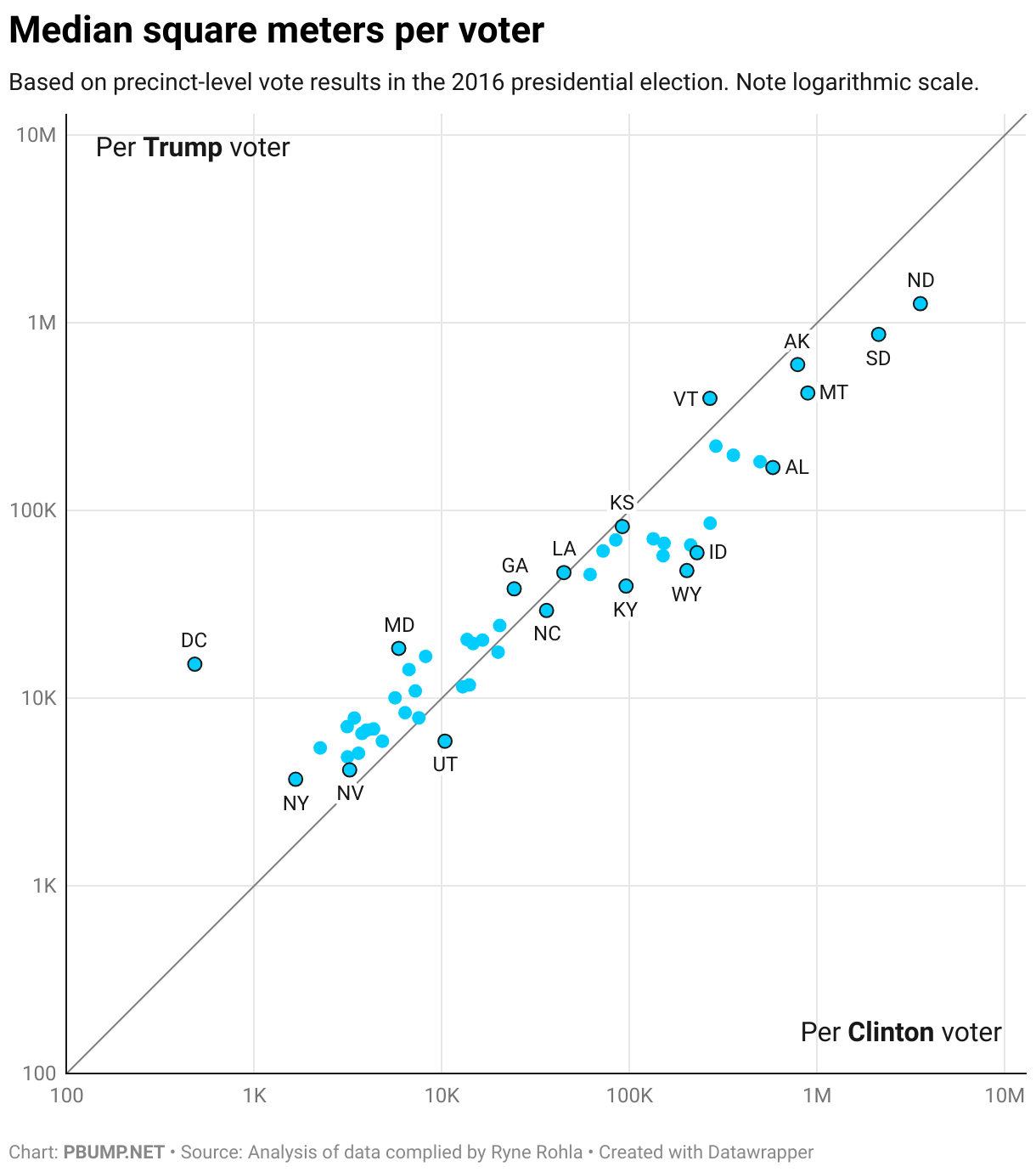
If we use median square meters rather than average, the picture is slightly different. States with lower median square-meters-per-voter tended to see more square meters per Trump voters than Clinton. States with higher square-meters-per tended to see more square meters per Clinton voters.

You’ll notice that most of the lower square-meters-per-voter values are in states that voted for Clinton. And that, it turns out, is most of the story.

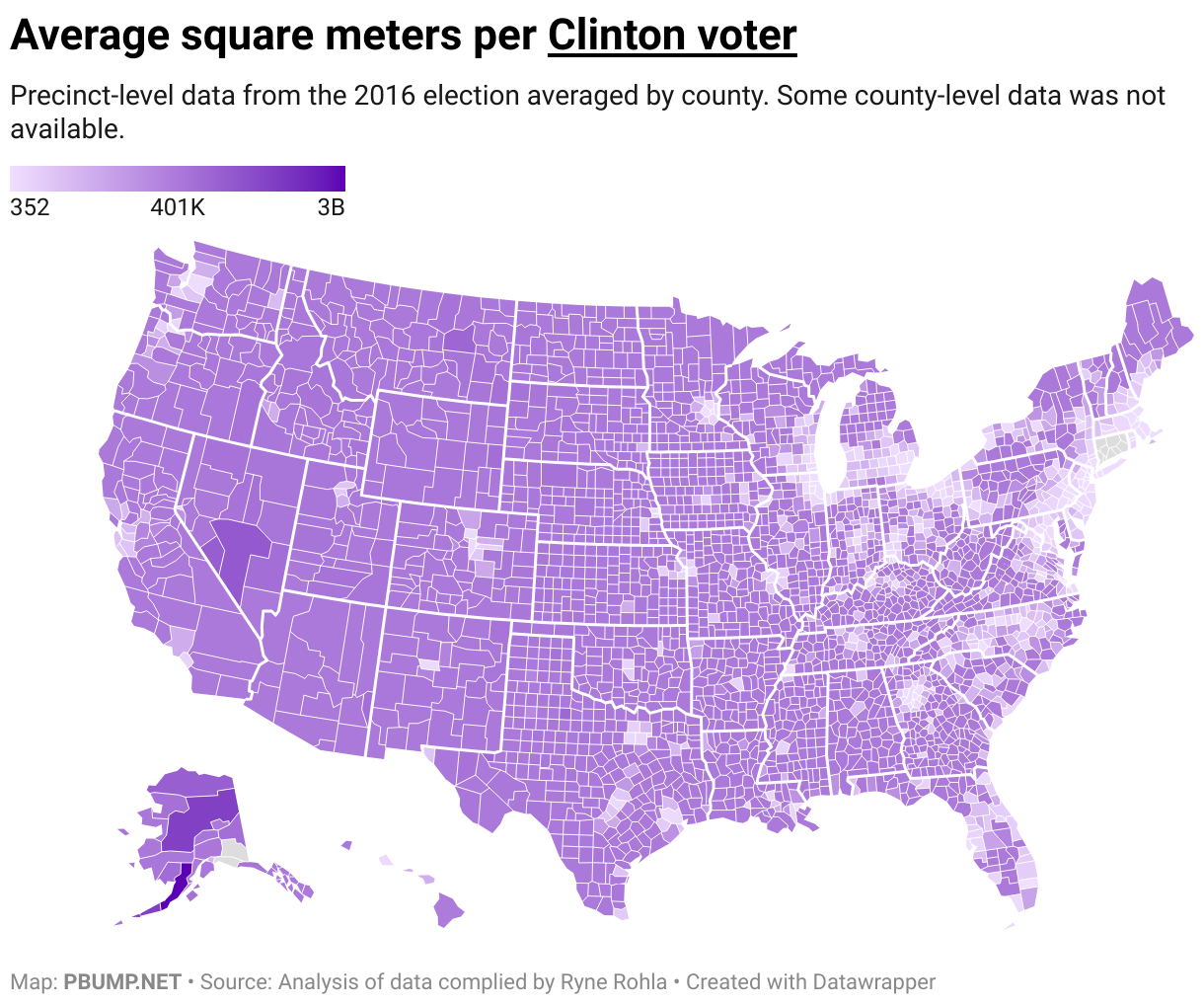
If we look at the average square meters per Clinton voter in individual counties, we see how urban areas stand out. They have lower square-meters-per-voter because there are more voters in a smaller space. In rural Nevada, there’s a much higher value — more space and fewer Clinton voters.

If we do the same analysis for Trump voters, we see a key difference: much more vote density in the areas around the cities that stand out above.

In other words: more Trump voters in the suburbs, increasing the denominator in our calculation.

Since Trump won more rural areas and Clinton won more urban ones, the ratio of area to votes spikes for the Democrat in places where she got blown out. In Sweetwater County, for example, there were 8.4 square kilometers per Clinton voter compared to 2.2 for each Trump voter.

If we look only at the averages in precincts each candidate won, the chart looks more like what I would have expected at the outset. In nearly every state, Clinton voters cast ballots from more densely-packed areas than did Trump voters.

As I was mulling this over in the first place, I thought it would be interesting to see whether the understood correlation between population density and voting could be measured using these data. I reached an unsatisfying answer: Sort of.

Photo: Trump at a campaign event in 2020. (White House archive/Flickr)

A 79 year-old freshman senator would be … unusual

Maine Gov. Janet Mills (D) has announced her intention to run for Senate against the state’s well-known — ahem — incumbent, Susan Collins. When the next Senate term begins in January 2027, Collins will be 74 years old, well past the typical retirement age in the United States. But Mills will be 79 — well, well past the typical age at which one assumes a new, stressful job.

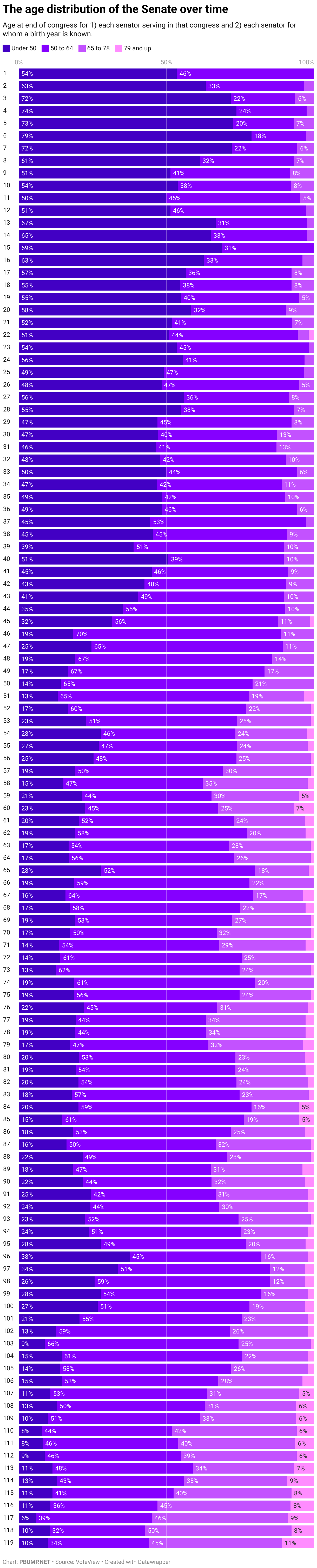
It used to be relatively rare for anyone as old as Mills would be to serve in the Senate at all, much less as a freshman. Until the 114th Congress (2015–2016), no more than seven senators served in a single congress who would have turned 79 by the end of the congress’s second year. Since the 114th Congress, though, there have been at least eight in each congress. The current, 119th Congress, has 11 senators who will be 79 or older by the end of next year.

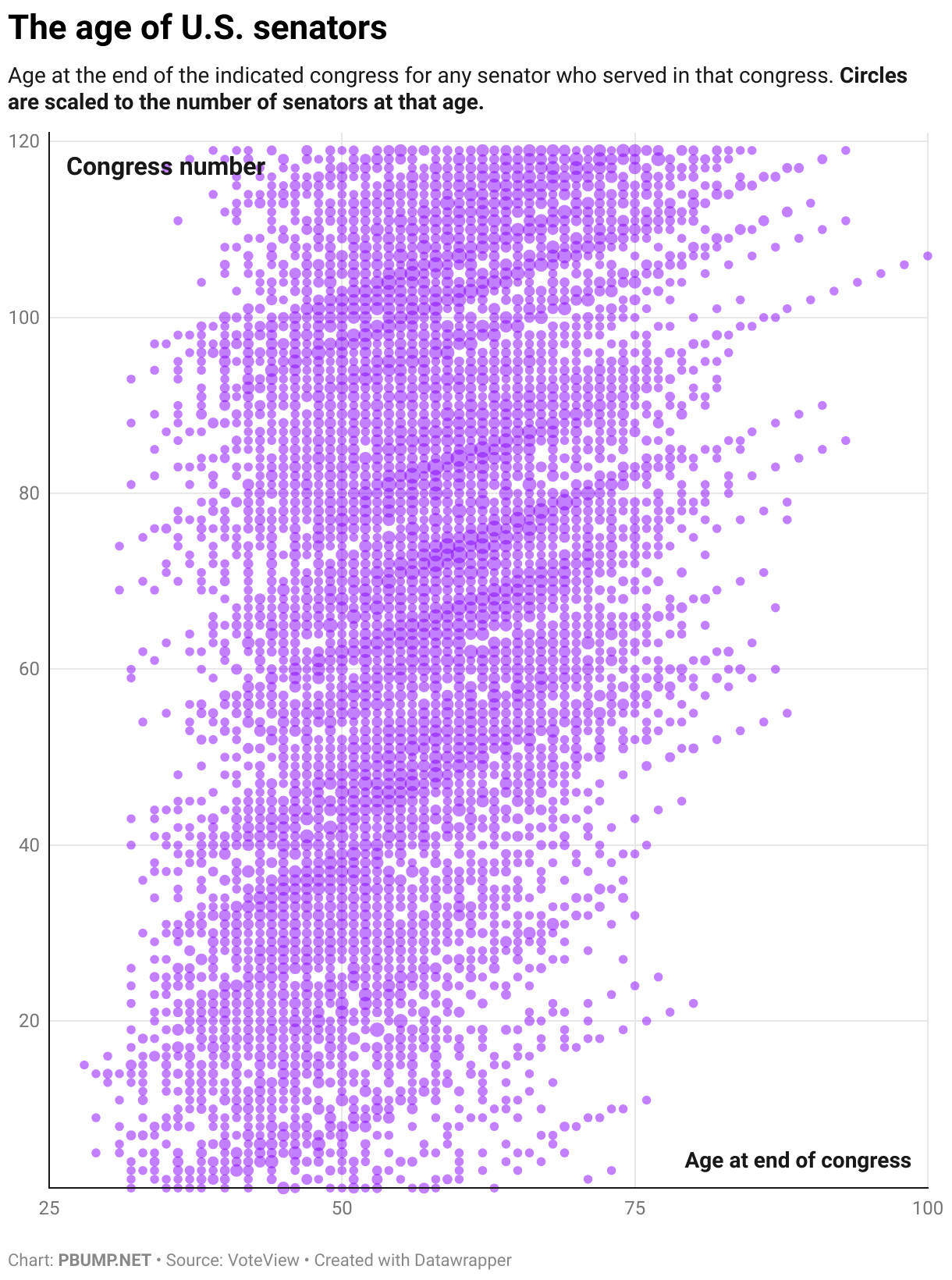
You can see on the chart below how the age of sitting senators has slid upward — as, of course, has the age of the American public.

There are some senators who stand out on the chart above. The series of dots that extends all the way to the 100 mark, for example, indicates Strom Thurmond, who served as a senator for nearly 1 in 5 years that the U.S. has been in existence.

Often, freshmen senators who were in their 70s and 80s were appointed to fill vacancies. The oldest new senator (according to my analysis of VoteView data), was Andrew Jackson Houston, appointed at age 86 to fill a vacancy. He started in April 1941. He died in June 1941.

By my count, there are seven freshman senators in U.S. history who would have been 79 or older by the end of the congress in which they first served. All but one, Isaac Stephenson, was appointed. Stephenson was elected, assuming office in 1907 at the age of 77 — more than a year younger than Mills would be.

Until the 1860s, almost or more than half of senators were under the age of 50. That hasn’t been the case since the congress that ended in 1868. Over the past five congresses, an average of just under 10 percent of senators have been under the age of 50. In the current congress, more than 10 percent will be 79 or older by the end of next year.

When Rep. Jerry Nadler (D-N.Y.) announced his intent to retire back in September, I suggested that the Democratic Party was slowly beginning to recognize its generational problem. It will be in part up to primary voters in Maine — given a choice between Mills and a 40-something challenger — to determine the extent to which the party’s base agrees that there’s a problem at all.

Given that Maine’s residents are the oldest of any state, they may not.

Photo: Ronald Reagan and Strom Thurmond in 1987. (National Archives)
Resolving the ‘Columbus Day’ fight

For years, the country has grappled with a difficult question: should we set aside a holiday to honor the man who accidentally discovered North America and its native inhabitants before willfully killing huge numbers of them? Some people say no.

This isn’t the actual issue, of course. Columbus Day has become a proxy for recognizing the contribution of Italian immigrants to the U.S., as seen in the documentary film “The Sopranos.” It’s less about Columbus than it is about recognizing a part of American culture — one that itself took a while to establish a foothold.

Still, though, Columbus’s was the precipitating event for a lot of native deaths. In 2021, President Joe Biden signed an executive order that accommodated that history, stating that Columbus Day (a congressionally authorized federal holiday) would also serve as Indigenous Peoples’ Day. And since Biden did that, this month Trump gleefully undid it, acting as though Columbus Day had been eradicated (which it hadn’t) and he was the salvation of Italian heritage.

Given that history of tension, I am proud to offer a solution. The holiday will now be celebrated as a function of state populations, with states having a larger portion of residents of Native American ancestry celebrating Indigenous Peoples’ Day and states with more residents of Italian ancestry celebrating Spain’s most notorious contractor.

The Census Bureau collects data on ancestry. In the U.S., there are a bit under three times as many people who report Italian heritage as report Native American. The Native Americans are at a slight disadvantage, having been slaughtered so enthusiastically that it affected the climate, but that’s where we are.

As noted, though, this varies by state. Some, particularly in the Northeast, have far more people of Italian ancestry. A few have more of Native American ancestry.

That map doesn’t include people whose ancestors were Pacific Island natives or identified as being of Hawaiian ancestry. If we add them:

The county-level data are limited, but within that limited set, the county with the biggest ratio of Native American to Italian ancestry is Coconino County, Ariz. The one with the biggest Italian to Native American is Morris County, N.J. — where several scenes from the documentary “The Sopranos” were shot.

Once the nation adopts my proposal for the holiday, here’s what will be celebrated where, at least until people move around.

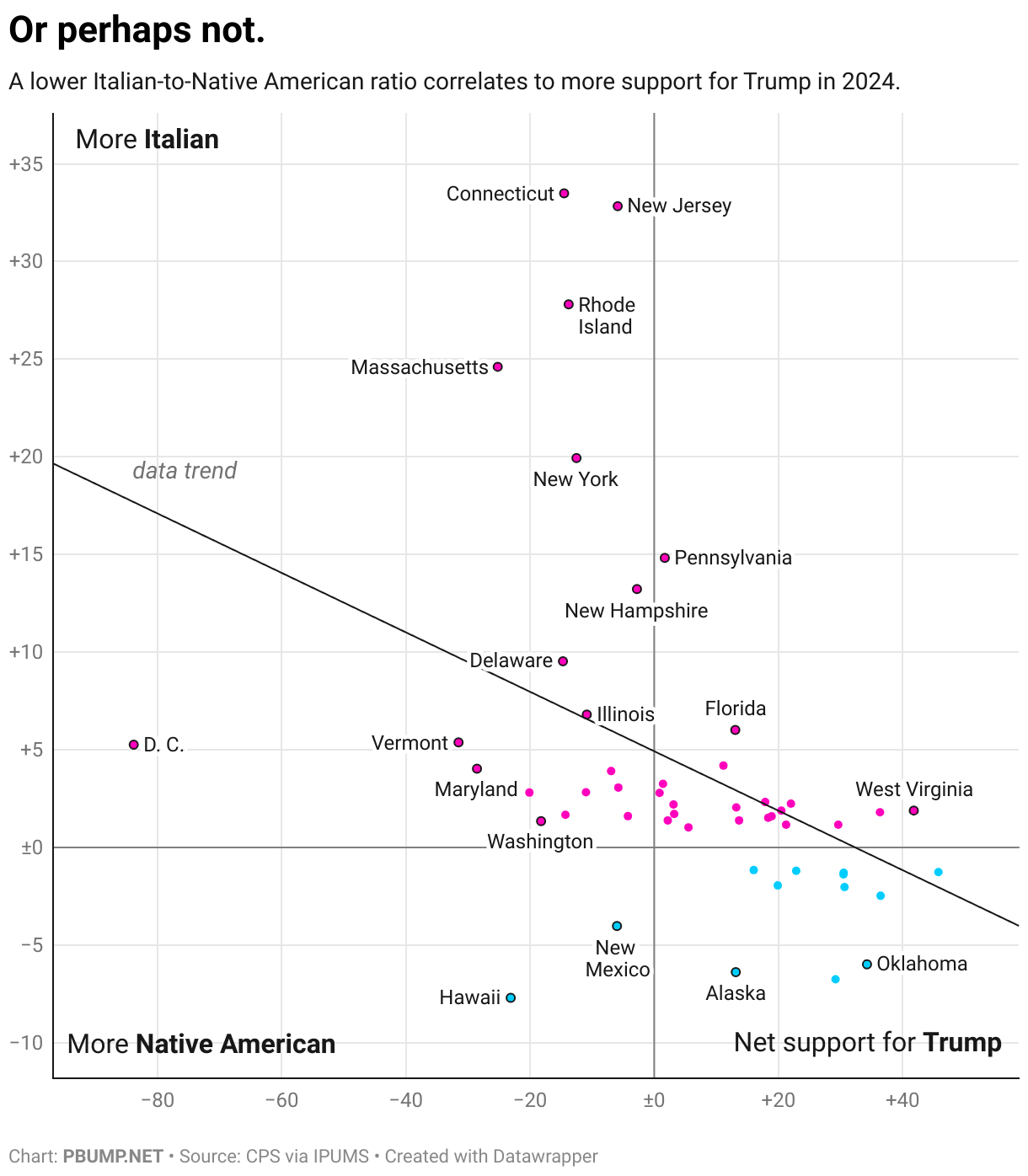
There is one problem with this plan, I’ll admit. There is a (relatively loose) correlation between the prevalence of residents of Native American ancestry and support for Trump in the 2024 election. Meaning that states that would celebrate Indigenous Peoples’ Day would be more likely to also support Trump’s presidency.

This, too, has at least some roots in the unhappy history of Native Americans. Oklahoma has a lot more people of Native American than Italian history not entirely because the Native Americans were hoping it would work out that way.

But, look. A solution is a solution. I look forward to a bipartisan Capitol Hill coalition embracing and implementing this idea, one that will leave everyone satisfied.

Photo: Barbara Bush in a Columbus Day parade, 1989. (National Archives)
The president’s pretend enemy

There is no crisis of unrest in Portland, Oregon.

One way I know this to be true is that President Trump — who is insistent that Portland faces just such a crisis — doesn’t offer any evidence of it. At some point last month, he may have seen old footage from 2020 on Fox News and decided to declare that the city needed the intervention of federal or federalized troops. (We don’t know that he was watching Fox but he did offer the governor the bemused observation that what she was telling him about Portland didn’t match what he saw on TV.)

On Sept. 27, he declared that the city was “War ravaged,” demanding military presence. A few days later, he claimed that “conditions continue to deteriorate into lawless mayhem,” with “ANTIFA and the Radical Left Anarchists … viciously attacking our Federal Law Enforcement Officers.” He insisted that “[w]e will never allow MOBS to take over our streets, burn our Cities, or destroy America.” That same day, Oct. 1, he insisted that “Portland is a NEVER-ENDING DISASTER. Many people have been badly hurt, and even killed.”

But he hasn’t presented any videos or photos showing this mayhem and murder. No social media clips of rioters running through the streets. No citizens cowering in terror. His social media guru Dan Scavino did post a video showing protesters outside an ICE facility in the city clashing with police and ICE officers. Other than that? You just have to take Trump’s word for it. As when he claimed during a recent White House event that the city “[doesn’t] even have stores anymore. They don’t even put glass up. They put plywood on their windows.”

No wonder a federal judge (appointed by Trump in his first term) described the president’s push to deploy National Guard troops to the city as being “simply untethered to the facts.”

“You look at what’s happened with Portland over the years; it’s a burning hellhole,” he said this week, disparaging that judge (who had “lost her way,” he said). “There’s a huge problem in Portland. I’ll tell you what the problem is: Crime.”

So let’s look at crime data. The Portland Police Bureau reports that reported incidents of vandalism in the city were down in August — the most recent month for which data is available — relative to the recent average for that month. Assaults were up slightly and homicides down, while reported incidents of arson were up. But bear in mind that there aren’t that many incidents of arson in the city; there were 41 in August 2024 and 46 in August 2025.

This approach of claiming that soldiers are needed to quell unrest while not showing any evidence for that need does not seem to be convincing many Americans. Polling conducted by Ipsos for Reuters found that most Americans, including most Republicans, think that Trump should only deploy troops to counter external threats. A plurality thought that Trump should not be allowed to send troops over the objection of state governors.

One group that Trump has convinced, though, is Republican legislators. The president recently signed a memorandum centered on “countering domestic terrorism and organized political violence.” He invoked “riots in … Portland” among evidence of what he described as “sophisticated, organized campaigns of targeted intimidation, radicalization, threats, and violence designed to silence opposing speech, limit political activity, change or direct policy outcomes, and prevent the functioning of a democratic society.”

The memo claimed that “domestic terrorists” were waging an assault on the country “under the umbrella of self-described ‘anti-fascism.’ “

“Common threads animating this violent conduct include anti-Americanism, anti-capitalism, and anti-Christianity; support for the overthrow of the United States Government; extremism on migration, race, and gender; and hostility towards those who hold traditional American views on family, religion, and morality.”

Again, this is predicated, in part, on the fiction about Portland that Donald Trump has created. Leaders in his party have nonetheless embraced it.

On Friday morning, a number of senior elected Republicans claimed that the upcoming “No Kings” protest in D.C. was an arm of this anti-American hostility. It was a “hate-America rally” involving “antifa people,” House Speaker Mike Johnson (R-La.) said on Fox News. House Majority Whip Tom Emmer (R-Minn.) said this “hate-America rally” was being held by the “terrorist wing of their party.” On Newsmax, Sen. Roger Marshall (R-Kan.) described it as a “Soros paid-for protest for his professional protesters,” indicating that the National Guard would be needed.

“Hopefully it’ll be peaceful,” he added. “I doubt it.”

There is a throughline here, and it isn’t that the president is taking necessary steps to keep Americans safe. It is that Trump frames dissent — at Portland’s ICE facility, in the streets of Washington, even simply in the abstract — as a threat that demands a governmental and/or military response. He and his allies have gone from describing Portland’s anti-ICE protests (which now regularly feature people wearing inflatable animal costumes) as a danger demanding armed response to preemptively framing an anti-Trump protest as the work of people the president has defined as domestic terrorists.

For his allies and many of his supporters, it seems, his word on the subject is more than enough.

Photo: Trump at Fort Liberty in June. (White House/Flickr)

A quick reminder that crime is down in U.S. cities

One of the particularly frustrating things about President Trump’s push to send federal officials and red-state National Guard soldiers to cities to “fight crime” is that those cities (and cities generally) are already seeing declines in crime.

It is not the case that there is no crime in those cities, of course, any more than it is the case that national elections see no illegal votes cast. But it is important to recognize that — in the same way Trump’s rhetoric about voter fraud is aimed at changing voting laws — the emphasis on crime here is obviously about rationalizing and justifying the deployment, rather than the other way around. Could military deployments end crime in cities entirely? Probably, but I would imagine you don’t really want to live in a federally mandated police state.

Courtesy of Jeff Asher’s Real-Time Crime Index, which aggregates department data to offer a timely look at crime trends, here is how levels of violent crime in U.S. cities targeted by Trump have changed from July 2019 to July 2025 (the most recent month for which aggregate data are available). These figures are the total number of violent crimes over the preceding 12 months, in order to smooth out seasonal changes.

Notice that in Chicago and D.C., violent crime has been sliding for some time. In Portland, there was a plateau last year but violent crime is again trending down. (This is not how Trump describes the city.)

On a population-adjusted basis, you can generally see the pandemic-era increase in crime and how it has faded. Violent crime in Memphis is much more common than in Chicago, even as it trends down. Crime in D.C. is and has been relatively low.

You probably noticed that each chart shows January 2025, when Trump was re-inaugurated as president. In each city, population-adjusted violent crime numbers are down since that point. In each city, population-adjusted crime is down year-over-year.

There is always more that can be done to combat crime. The question that we should ask is when the government aims to go too far.

Photo: MacGruff the crime dog, seen in 1985. (National Archives)
Even 2 in 5 Republicans understand Trump is impeding free speech

It’s not often the case that you will be working on a quick article about something only to have the president of the United States directly validate your thesis. But it happens occasionally, particularly since Jan. 20. And it happened today.

At a White House event this afternoon, President Trump declared that his administration had “[taken] freedom of speech away” — the sort of thing that past presidents didn’t say, in part because they had far less reason to do so.

Trump: "We took the freedom of speech away because that's been through the courts and the courts said you have freedom of speech, but what has happened is when they burn a flag it agitates and irritates crowds."

Aaron Rupar (@atrupar.com) 2025-10-08T19:42:11.679Z

The event was focused on the purported threat posed by antifa, a loose-knit, microscopic collective of left-wing agitators that the administration has framed as an existential threat to the nation. During the discussion, the attorney general and the head of the Department of Homeland Security both presented antifa as a robust, insidious organization that demanded federal intervention, which is true only in that there is more grassroots interest in battling fascism than there was nine months ago.

Then Trump declared that one of his tools in combatting The Antifa Menace™ was instituting criminal punishments on people who burned American flags, something that he’s threatened on social media in the past but which continues to run afoul of First Amendment protections on speech. (See Texas v. Johnson.) Trump didn’t and can’t “take it away.”

As I said, I was already writing on the subject because of remarkable new data published by Pew Research Center this afternoon. Pew’s researchers asked Americans whether they viewed Trump’s use of presidential power positively or negatively, finding that most Americans considered his actions improper — and most disagreed that the changes he’s instituted have been positive.

The issue on which Americans were most critical? That Trump has improperly used his office to punish those who say things he doesn’t like. Which isn’t Congress making a law abridging speech (as the First Amendment prohibits) but is a reflection of Trump’s efforts to stamp out criticism and wrongthink.

So two-thirds of Americans think Trump is improperly using his power to punish those who make statements he opposes. Even more remarkably, that figure includes more than 40 percent of Republicans and independents who usually vote Republican. So even within his own party, a party that’s been fervently supportive of Trump, about 2 in 5 think that the president has improperly constrained speech.

I was originally going to end this post by noting that there was good reason for them to feel this way, articulating examples of Trump and his administration imposing costs on the free exercise of speech. But then the president just up and said it: we took the freedom of speech away.

Quod erat demonstrandum, I guess.

Photo: Trump in the Gold Office. (White House/Flickr)

Thawing out ‘Arctic Frost’ and the new Biden-was-worse argument

A recent American presidency, you may be alarmed to hear, engaged in an action that was “arguably worse than Watergate” — an event still positioned in some circles as the gold-standard of presidential malfeasance. What might surprise you about this claim is that the presidential administration during which this horrendous act occurred was Joe Biden’s, not Donald Trump’s. What might further surprise you is that Biden had nothing to do with it.

So let us now talk about Arctic Frost, the FBI investigation into Donald Trump’s efforts to overturn the results of the 2020 presidential election that was turned over to special counsel Jack Smith once he was appointed in November 2022. It is Arctic Frost that Sen. Chuck Grassley (R-Iowa) described as Watergate-esque, making it the latest in Grassley’s fumbling effort to cast the Biden administration as the most nefarious since Richard Nixon’s.

What’s the new development?

As part of that effort, Grassley asked the FBI to sift through a set of restricted-access files to see what might turn up. FBI Director Kash Patel — also eager to portray the pre-him FBI as hopelessly biased against Trump and the right — turned over a September 2023 document indicating that the Bureau had received “limited toll records” linked to nine U.S. senators.

The document doesn’t say much more than that, except that a special agent conducted “preliminary toll analysis” on the data that had been received.

On X, Patel crowed about having “discovered and exposed the weaponization of law enforcement” as he shared a clip from Sen. Josh Hawley (R-Mo.) complaining about the revelation. On Tuesday, Hawley demanded that Attorney General Pam Bondi explain who “ordered the tapping of phones” of senators including himself.

So what’s a ‘toll record’ and how is it obtained?

Well, it isn’t phone-tapping. Such records don’t include information about the content of calls, especially in real-time.

Instead, toll records include data about calls, allowing for potential analysis of the “source or destination of a call; the times of calls; and the dates, frequency, sequence, patterns, and duration of calls to/from one or many telephones” (as a fairly old Justice Department handbook explains). It’s not clear what information about calls to or from the senators’ phones were obtained by the FBI, given the qualifier “limited” in the published document’s description.

Importantly, the authorization for obtaining the records followed the approval of a subpoena by a grand jury, according to CBS News. In other words, this wasn’t the FBI simply digging into phone records. It was the government presenting a case to grand jurors that the records would be useful in their investigation and the jurors agreeing.

Why would investigators want those records?

“The only thing we all had in common was we were all Republicans,” Sen. Bill Hagerty (R-Tenn.) fumed after the story broke. But that commonality is important.

Remember, Arctic Frost was an investigation into the effort to overturn the 2020 election, an effort that culminated in the attack at the Capitol on Jan. 6, 2021. And phone calls made to senators that day played an important role in the investigation.

Here, for example, is the federal indictment accusing Trump of (among other things) conspiracy to defraud the U.S.:

Notice that it contains multiple mentions of calls to senators on Jan. 6 that were allegedly part of Trump’s effort to block the finalization of Electoral College votes.

In Smith’s overview of his investigation, presented to the Justice Department in the waning days of the Biden administration, he offers a pithier summary:

Same deal, though: Trump and his team were calling senators to pressure them to reject valid slates of electors. And since Trump was at the White House and his team was (mostly) at the nearby Willard Hotel, this cajoling occurred over the phone.

If you want to know who called which senators to apply pressure, there’s a straightforward way to do so: obtaining records of calls to those senators’ phones.

Is there any reason to think that the senators broke the law?

In fairness, we don’t know what data was sought and obtained. But there’s no reason to think, based on this document, that the senators were themselves targets of the investigation.

That said, there is reason to think that at least some of these senators were engaged with Trump’s effort to retain power. In the days prior to the finalization of the electoral votes, multiple senators publicly announced their intentions to vote against certification of the results. Hawley went out on his own, releasing a statement indicating that he would oppose the slate of electors offered by Pennsylvania (for contrived reasons). Sen. Ted Cruz (R-Tex.) cobbled together a group of senators (and senators-elect) who announced their intention to oppose the final electoral tally, including Hagerty, Tommy Tuberville (R-Ala.), Cynthia Lummis (R-Wyo.) and Marsha Blackburn (R-Tenn.).

Sen. Lindsey Graham (R-S.C.) appeared on Fox News Tuesday night to complain about being on the Arctic Frost list and to assert that he “made phone calls to a lot of people to find out what I should do as a senator regarding certifying the election and whether or not we should have hearings.” That’s true. But this downplays what happened pretty dramatically.

Remember, there was no reason to believe that there should be hearings into voter fraud by Jan. 6, 2021 — or even by Dec. 14, 2020, the day electors met to vote. Hell, there wasn’t reason to think there was anything suspect about the results by mid-November. But Trump was stoking the idea that the outcome was dubious (for obvious, self-serving reasons), building demand within his base for Republican politicians to agree. Graham did — to the extent that a grand jury in Georgia recommended that he be indicted in that state as part of the conspiracy to throw out its election results. Prosecutors declined to do so.

Why are Republicans making such a big deal out of it?

A few reasons.

One becomes clear when you consider the timing of the new information: just before Bondi was on Capitol Hill to face questions about her handling of the Justice Department. New claims rippling through the right-wing media universe centered on alleged abuse by the Biden administration gave Republicans and Trump allies a way to dismiss the obvious and explicit intervention by Trump in federal prosecutions at the moment. It was a useful way to say “Biden was worse,” which is in fact what a lot of the Republicans questioning Bondi ended up saying.

More fundamentally, though, Republicans simply don’t think Jan. 6 and the effort to overturn the 2020 election is worth investigating. Many of them see the probe into Trump’s post-election efforts not as an attempt to enforce accountability in the wake of a subversion of American democracy but, instead, as Democrats and Democrat-sympathetic investigators attempting to block their rightful power. This is much easier to believe if you are soaked in the right-wing media conversation, where the riot at the Capitol is seen as harmless or ancillary or both. To this day, most Republicans believe there was something hinky about the results of that election, a belief that’s largely a function of the concerted, unrelenting push by Trump and his supporters to insist, despite the evidence, that there was.

In addition to excusing Trump’s behavior, this idea also plays into the sense of victimization that Trump has stoked in his base. They and he aren’t doing anything bad; it’s the bad guys who are out to get them!

But, wait: Did Biden have anything to do with this?

No. Except that Biden was president in the wake of Trump’s first presidency and his effort to overturn the results of the 2020 election, and that Biden nominated (and 20 Republican senators voted to confirm) an attorney general, Merrick Garland, who believed in adherence the rule of law and independence from the White House. Jack Smith’s appointment, you will recall, was meant to separate the probe from the Biden administration, given that Trump had just announced his bid to be the Republican nominee challenging Biden’s reelection effort.

That’s really the original sin here: Someone tried to hold Trump to account. And Donald Trump doesn’t like to be held to account, so his allies gin up elaborate explanations for why doing so was invalid. Was somehow, bafflingly, “arguably worse than Watergate.”

Photo: FBI headquarters in September 1974. (National Archives)

The red-state invasion that worsened Chicago gun violence

President Trump’s eager deployment of federal and federalized troops is ostensibly rooted in fighting crime. Maybe he actually believes that; he did apparently see some footage from 2020 on the TV and argue that it actually represents the current environment in Portland. But it’s almost certainly mostly a pretext. He’s wanted to have troops marching through the streets of D.C. for years and was reportedly just looking for a reason to send them out. There’s also not much evidence that the deployment in D.C. is having much effect on crime.

What’s happening in Chicago isn’t being driven by soldiers. It’s immigration officers — mostly Immigration and Customs Enforcement, augmented by other deployed federal officials — who are turning over apartment buildings and tackling residents. But the administration’s messaging has long dishonestly conflated “immigration” and “crime,” and its current rhetoric about Chicago often mirrors what the president is saying about threats everywhere else.

During an interview on CNN Tuesday morning, Rep. Jonathan Jackson (D-Ill.) was asked about the argument that Chicago has an urgent need to address violent crime. He offered a useful counterpoint.

If the president’s concern about gun violence were sincere, Jackson argued, Trump “would be more interested in saying, ‘How do we effectively deal with gun violence? How do we deal with gun manufacturers?’ The city of Chicago does not have one gun shop, does not have one gun range.”

“How are these guns flooding our streets?” he continued.

It’s a very good question.

It is not the case that there are no gun dealers in Chicago. The Bureau of Alcohol, Tobacco, Firearms and Explosives (ATF) maintains a list of licensed firearm dealers in the U.S. Cross-referencing that list with Chicago-area ZIP codes shows only six licensed dealers in the city — a city of 2.7 million people.

Mapping dealers by ZIP code, you can see how few dealers there are in Chicago. Zoom in on the city below.

You might also notice that there are a lot of ZIP codes with a number of gun dealers not that far from Chicago. In fact, there are 14 licensed dealers in the 46350 ZIP code, an hour east in La Porte, Ind., home to about 22,000 people.

The ATF also tracks where firearms recovered from crime scenes were originally purchased. Just over half of the firearms recovered in Illinois in 2023 were purchased in Illinois. Another 16 percent came over the border from Indiana.

If that balance sounds about right — most from in-state, some from a neighbor — consider the numbers for Indiana itself. More than 80 percent of firearms recovered in Indiana in 2023 came from Indiana, while less than 2 percent came from Illinois.

This is Jackson’s point. It is much easier to buy a gun in Indiana than in Illinois, so a large percentage of guns used in Illinois come from Indiana. In fact, the number of firearms seized in Illinois that originated in that state is remarkably low compared to other states.

You may notice that many of the states with the most seized firearms that originated in-state are red states and that most of those with the fewest are blue. Those two things do correlate: the more a state voted for Trump in 2024, the higher the percentage of seized guns that originated in that state.

In the vast majority of states, most of the seized firearms that originated out-of-state came from red states — states where gun laws are often looser.

None of this excuses gun violence or is meant to suggest that such violence is entirely a function of lax gun laws in red states. But it is the case that a lot of the gun violence that occurs in Illinois and in Chicago uses weapons purchased outside of the city.

It is easier — and more palatable to Trump’s base — to send squads of enforcers into the heavily blue city to crack skulls. Combatting gun violence, though, might also benefit from efforts to reduce access to guns, reconciling Illinois’ efforts to limit gun ownership with its neighbor’s interest in putting firearms in shopping bags.

Photo: Biplanes over Chicago in 1931. (National Archives)

You can’t get anti-institutionalists to trust an institution

I will stipulate at the outset that I do not know how to reverse the long trend toward distrust in traditional American news sources. There’s probably a solution out there, likely something involving increased engagement in communications formats where people spend more time and less money. I’m pretty confident, though, that the answer is not taking established media institutions and attempting to realign them to meet the tastes of Americans who are actively hostile to media institutions.

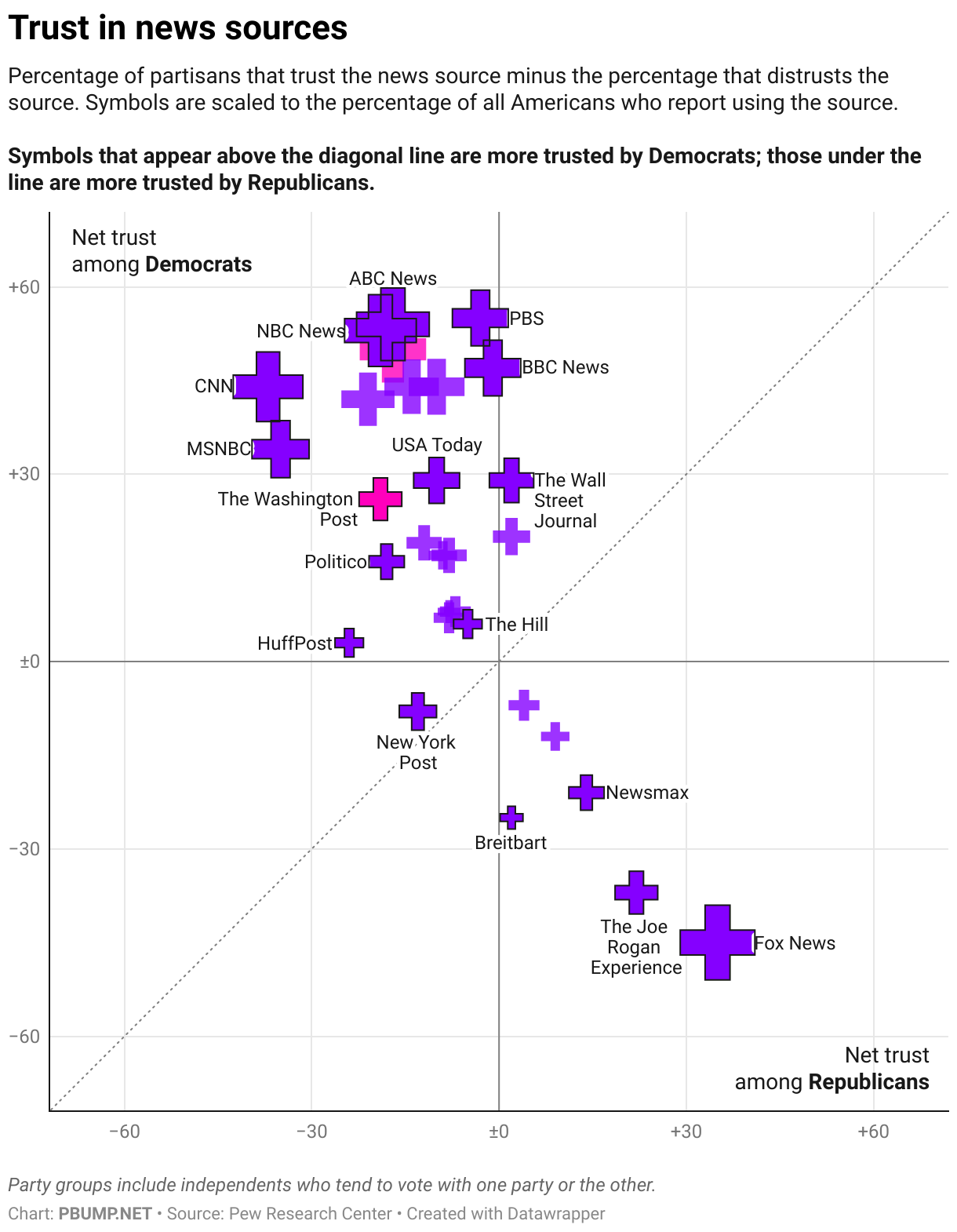
When we talk about distrust in the media, we are usually (though not always) talking centrally about distrust among Republicans. In Pew Research Center’s June analysis of trust in news sources, Democrats expressed more trust than distrust in 23 of the 30 sources identified. Republicans expressed more trust than distrust in only eight. Among Democrats, there were 10 sources of news that were trusted by 30 percentage-point more respondents than distrusted them. Among Republicans, only one source hit that mark: Fox News.

You’ll notice that I’ve highlighted CBS News and The Washington Post on that chart. These are both news sources that fall into the traditional/institutional media bucket and both sources that have attempted or are attempting to remedy the decline in trust by appealing more explicitly to “all Americans” — meaning, obviously, more Republicans.

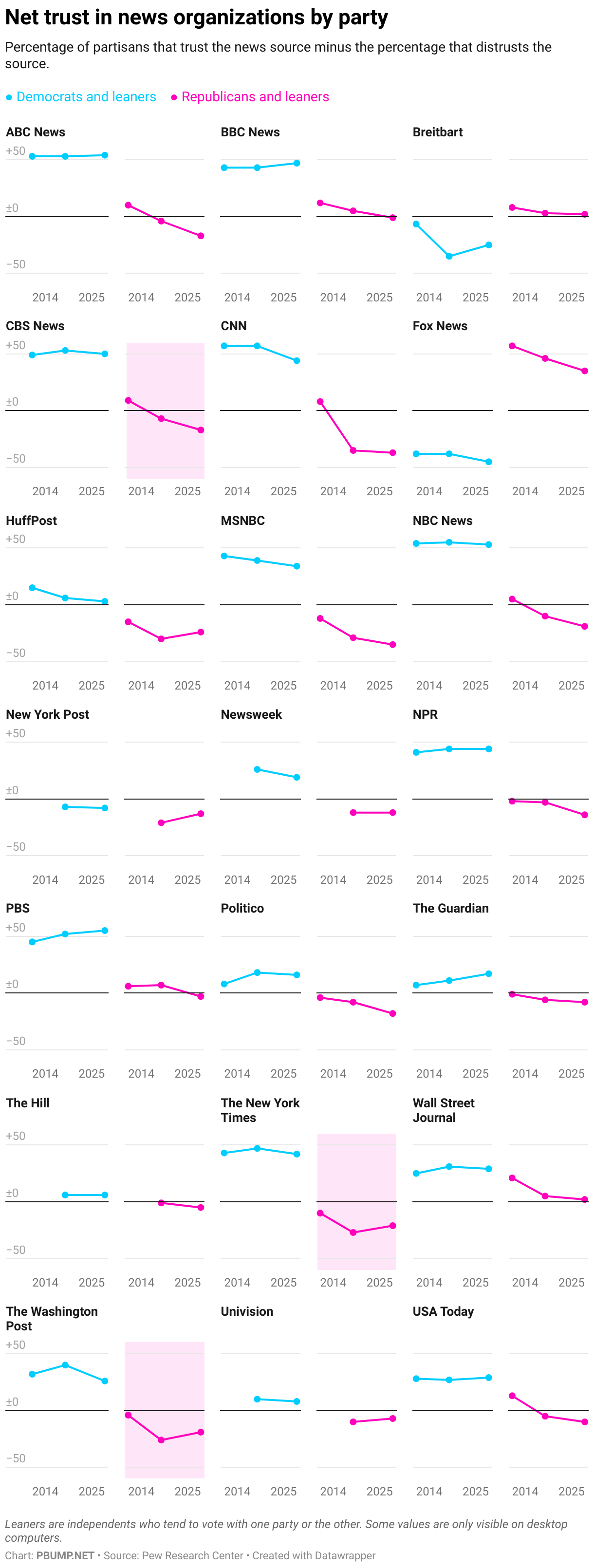
CBS’s shift is driven by its new owner, David Ellison — the son of megabillionaire and Donald Trump ally Larry Ellison. The Post’s, to which I can attest firsthand, is driven by the shifting approach of its owner, megabillionaire Jeff Bezos. In each case, net trust among Republicans dipped from net-positive or neutral in 2014 to negative by 2025 (as measured at both points by Pew).

The Post has seen an uptick in net trust among Republicans since 2019, a change that one might be inclined to attribute to Bezos’s accommodation of Trump and his base. But Pew notes that Republican trust in news sources surged upward since last year, a change “which has coincided with President Donald Trump’s return to the White House.” More importantly, Republican trust in the New York Times has also shifted upward since 2019, to about the same extent that trust in The Post increased. In other words, there’s no reason to think that The Post’s improvement is a function of Bezos’s public moves to appease Trump, like spiking the paper’s endorsement of Kamala Harris. And, in fact, Republicans are still more likely to distrust the paper than to trust it, by a wide margin.

Ellison has argued that the changes he’s advocating at CBS News, including the installation of Bari Weiss as editor-in-chief of the network’s news side, is an effort to “appeal to the 70 percent of Americans who define themselves as center-left or center-right,” as the Times reports. This is familiar framing for those who want to frame distrust in the media as being a function of its unfair coverage, arguing that the media is out of touch with mainstream America. For what it’s worth, analysis from the General Social Survey shows that only about a third of Americans are both mostly moderate and mostly independent. The remaining two-thirds are more partisan, more ideological, or both.

“We want to be in the truth business, we want to be in the fact business,” Ellison said earlier this year. But, of course, CBS and The Post have long been in the fact business and the truth business. The problem is that the fact and truth businesses are both suffering economic headwinds driven by the bullshit and rhetoric businesses. The current administration is hostile to facts that conflict with the president’s claims and is both leveraging and driving his base’s distrust in any outlet that’s actually in the business of generating facts.

What we can assume Ellison is really saying, of course, is that he wants to be in the business of generating the sorts of facts that won’t stir the ire of the president and his supporters. Maybe this will be good for the outlet’s bottom line — though that seems unlikely. Trump’s politics are rooted in the idea that his and his base’s worldview is rejected and mocked by traditional institutions including outlets like CBS and The Post. Each will be on a very short leash as it tries to appeal to those Americans, with coverage scrutinized endlessly for any perception of hostility to the president. It is an impossible standard to meet if one wants to be in the “fact business.”

Cynics will note that the Ellisons and Bezos are in other, non-fact businesses, too — ones that depend on the largesse of the federal government and therefore, in this moment, the approval of the president. Perhaps, then, the effort to publicly rescope the work of these institutions built to hold power to account is aimed less at some theoretical 70 percent of Americans than at one American in particular.

Photo: Harry Reasoner, CBS-TV, interviews Secretary of Defense Robert S. McNamara in 1964. (National Archives)
The corrosive rigidity of fascism

Is America something fixed or something fluid? Is it a country founded on a perfect set of ideas or a country that has struggled to become perfect? Is it a system that works or one that sputters, one that’s being damaged or one that’s being fixed?

This debate undergirds an enormous part of the political conversation. It manifests in disputes about the Constitution, in the fight over immigration, in attacks on government spending and research. At the risk over being overly concise — particularly since this is mostly meant to be a rumination on Paul Thomas Anderson’s film “One Battle After Another” — it seems likely that some part of this is rooted in the idea that America achieved and now risks losing a position as the most dominant nation on Earth. The America that was, won. Can the America that is?

The position of the administration is that America is deviating from its path, led astray by deviants. Rhetoric from the vice president and Trump allies centers on the idea that the United States is a nation built centrally by 18th century writers and 19th century frontiersmen (the “White” descriptor not always left as subtext). That trajectory of greatness led the country to where it is, a path forward as unswerving and inevitable to their eyes as the Democratic Party’s historic embrace of Southern racism.

To protect the nation, they argue, we must protect that path. We must more tightly control how Americans think and who enters the country. We must return rigor and rigidity to the American system.

To a significant extent, this narrative is often used as post hoc rationalization for the centralization of power. But the rigidity is always there. The inflexible understanding of what constitutes America sits at the root of the effort. Make America great again, as it was.

The opposing theory is that the union isn’t perfect. That it doesn’t follow clean lines and never has. And, in fact, that this is what makes America great. America is a social experiment that shifts ingredients and approaches and achieved success through experimentation and flexibility. It is not and has never been a perfect machine, as any even cursory assessment of history will attest. But it can be made more perfect, by continuing to explore and test and adjust.

”One Battle After Another” is a terrific film, and an astonishingly timely one. I won’t get into the plot since if you’ve seen it there’s no need and if you haven’t I wouldn’t want to spoil it. But I will say that this tension between rigid and flexible is at its core: from the explicit tension between the fascist regime and opposing revolutionaries, to the search for racial purity in our national melting pot, to the question of what constitutes a family. The overarching national battle between rigid and flexible isn’t resolved in the movie, but the others are — with the forces of rigidity losing. Even, at one point, they lose to more rigid versions of themselves.

As a work of fiction, we shouldn’t see the outcome as particularly reassuring. (It’s telling, though, that some on the real-world right view the story as threatening.) What we might take from the movie instead is its reminder that fluidity is natural, if not unavoidable; uncertainty seeping out of and into order. Love strengthens a family more than DNA does. Inclusion strengthens America more than exclusion does.

American ideals and American success require defense. Improvement means eternal adjustment and improvisation. Creating a more perfect union means fighting one battle after another, indefinitely.

Photo via Warner Bros. Pictures.

A rabbit hole about speed boats

The United States military killed more people on your behalf today, targeting a boat somewhere in the Caribbean Sea.

President Donald Trump and Defense Secretary Pete Hegseth shared footage of the destruction on social media, thereby fulfilling one of the apparent objectives of the strike. Hegseth used various Clancyesque vocabulary (though not “opsec”) while Trump celebrated the positive benefits for you, a U.S. resident.

The boat, he claimed, was “loaded with enough drugs to kill 25 TO 50 THOUSAND PEOPLE” but was stopped off the coast of Venezuela before it was able to “[enter] American Territory.”

As journalist Matt Novak pointed out, though, Venezuela isn’t terribly close to the U.S. So — even granting the administration’s claim that the boat was smuggling drugs, which one might be justified in not immediately granting — how imminent was the threat to the U.S.?

To answer this question, we need to know two things. First, how far was the boat from the U.S.? Second, how fast was it going? The second question is actually the trickier one, so let’s tackle it first.

The only information we have at our disposal is contained in the shared video. It shows a small vessel with what appears to be two outboard motors on the back. (See the pink box below.)

The appearance is consistent with what are called “go-fast” boats, boats stripped down to do little more than carry a lot of drugs a long way very quickly. In 2016, the FBI published a report on these sorts of vessels, explaining how the government tracked and captured their occupants. The story does not involve the extrajudicial invocation of capital punishment.

What the report doesn’t include is an estimate of speed. So, for that, we turn to analysis from Jake Tunaley of the London Research and Development Corporation.

“The hulls are usually made of fibreglass with a sharp, vertically rounded bow and a transom stern,” Tunaley writes of such boats. “They are typically 30 to 50 feet long with a narrow beam and powerful engines delivering up to 1000 hp. This gives speeds of greater than 80 kts in calm waters, 50 kts in choppy waters and 25 kts in 1.5 to 2 m Caribbean seas.”

The “kts” there refers to knots, nautical miles per hour. That’s what we’ll use for our calculations.

Next, we need to figure out the distance the boat had to travel. That means figuring out (roughly) how far it is from the “Coast of Venezuela” to “American Territory.”

The territorial boundary of the U.S. is generally 12 miles from our coastline. If a go-fast boat left from the point closest to the boundary in Florida, weaving between Cuba and the Dominican Republic, as shown below, that’s about 1,000 nautical miles.

Assuming calm seas, a constant 80-knot speed and no aerial or surface interdictions, a smuggler could cover that distance in about 12-and-a-half hours. Perhaps not as long as one might think.

But Florida is not the closest American Territory to Venezuela. Puerto Rico is. And it’s less than 400 nautical miles away.

That means that the boat could have covered the distance in about four-and-a-half hours. (You can see the math here.) The vessel could also have chosen a shorter route by heading to the U.S. facility at Guantanamo Bay, but that was probably not a desired destination.

These are very rough estimates, mind you, but the idea that a boat from Venezuela was headed to U.S. territory in short order is not that far-fetched. So we can instead spend our time wondering why, if the vessel was spotted near the Venezuelan coast, there wasn’t a way to impede its progress (and determine its intent and cargo) other than shooting ordnance at it to generate a social-media post.

The Americans who see ‘toxic masculinity’ as a problem — and those who don’t

Every year, the site 19th News conducts a national poll with SurveyMonkey that focuses heavily on issues of gender in American politics and society. This may not sound interesting, much less remarkable, but it is. Polling isn’t cheap, meaning that media outlets tend to focus on issues in the news and electoral questions. Detailed analyses of more fundamental aspects of the U.S. is invaluable.

I’m going to focus on a set of questions evaluating how Americans view gender roles, as the headline promises, but I do want to share one striking finding: Most Americans know someone who is non-binary. That includes half of Republicans and Republican-leaning independents! (Those independents are what the “+lean” parenthetical below means.) Black Americans are the racial group least likely to know someone who identifies that way.

As you might expect, given broader trends in LGBTQ identity, younger Americans are more likely than older Americans to know someone non-binary. But even 4 in 10 Americans aged 80 and over say they do.

So when Donald Trump was running all those ads in 2024 attacking Kamala Harris as being for “they/them,” half of his voters could visualize someone they knew who he was talking about.

As I mentioned, the poll also presented respondents with a series of statements, asking whether they agreed or disagreed with the sentiment. On net — that is, subtracting those who disagreed from those who agreed — Americans didn’t agree with the idea that society would benefit from young people having families before pursuing career accomplishments or other goals.

But they did agree on net that families are better off when a parent stays home with kids and (to a much narrower degree) that there would be a benefit to returning to traditional gender roles. That’s because men were 23 points more likely to agree than to disagree, while women were 17 points more likely to disagree than to agree.

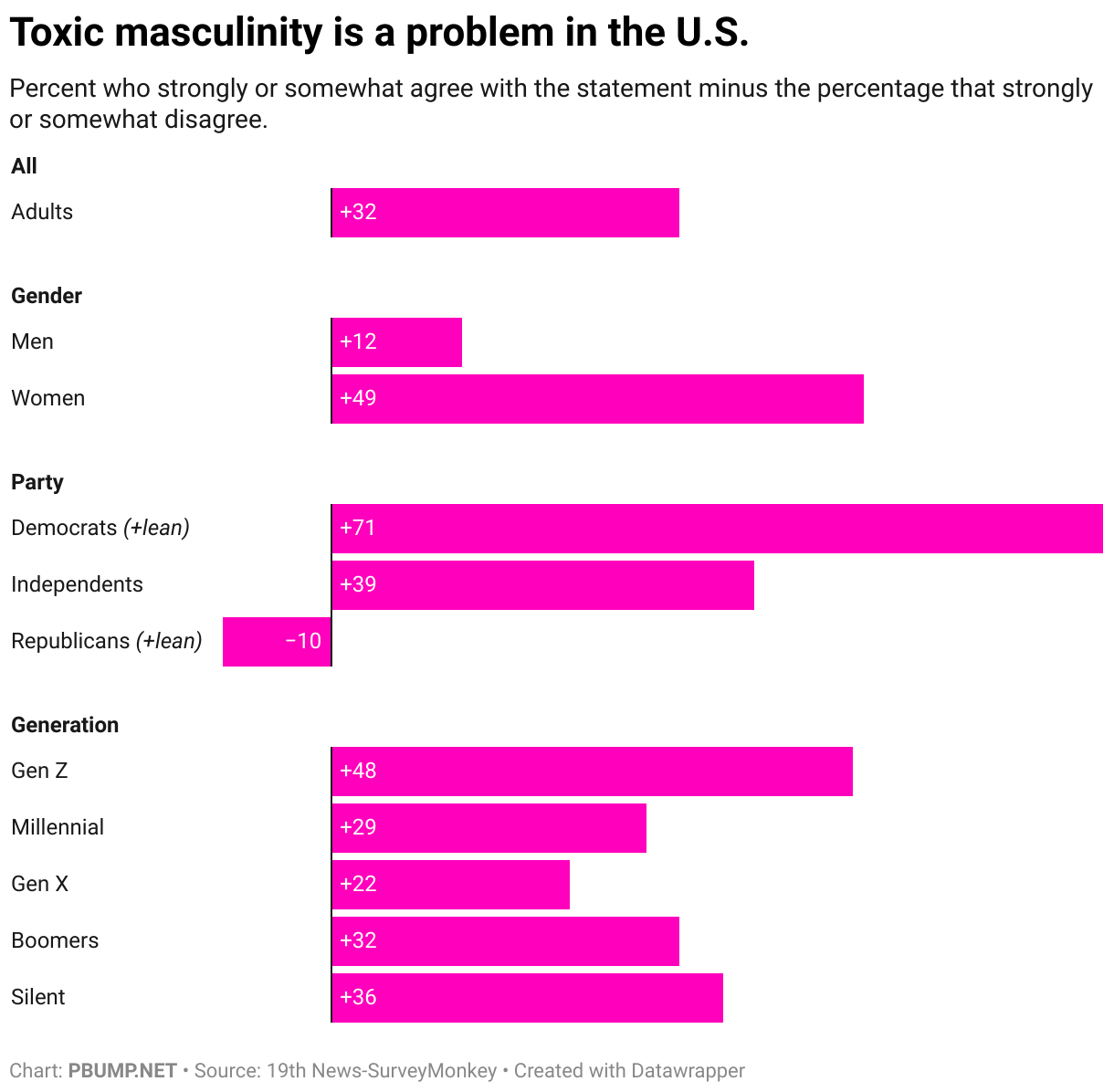
I want to drill down on the idea that toxic masculinity is a problem for society, something that was viewed with net agreement to the same extent that having a parent stay home was. (By the way, most of those who said one parent should stay home said it should be whichever parent wants to stay home.)

Here, again, there was a wide gender gap, with women being far more likely to agree it’s a problem than were men. There was also a partisan gap: Democrats and independents overwhelmingly see toxic masculinity as a problem while Republicans are more likely to disagree than agree that it is.

Generationally, it’s the youngest and oldest Americans who agree on net that toxic masculinity as a problem. More on that in a moment.

Broken out by race and gender, White men are the least likely to agree on net that toxic masculinity is a problem, save for men from other racial groups than those identified by the pollsters. In each racial group, women were more likely to agree on net than were the men.

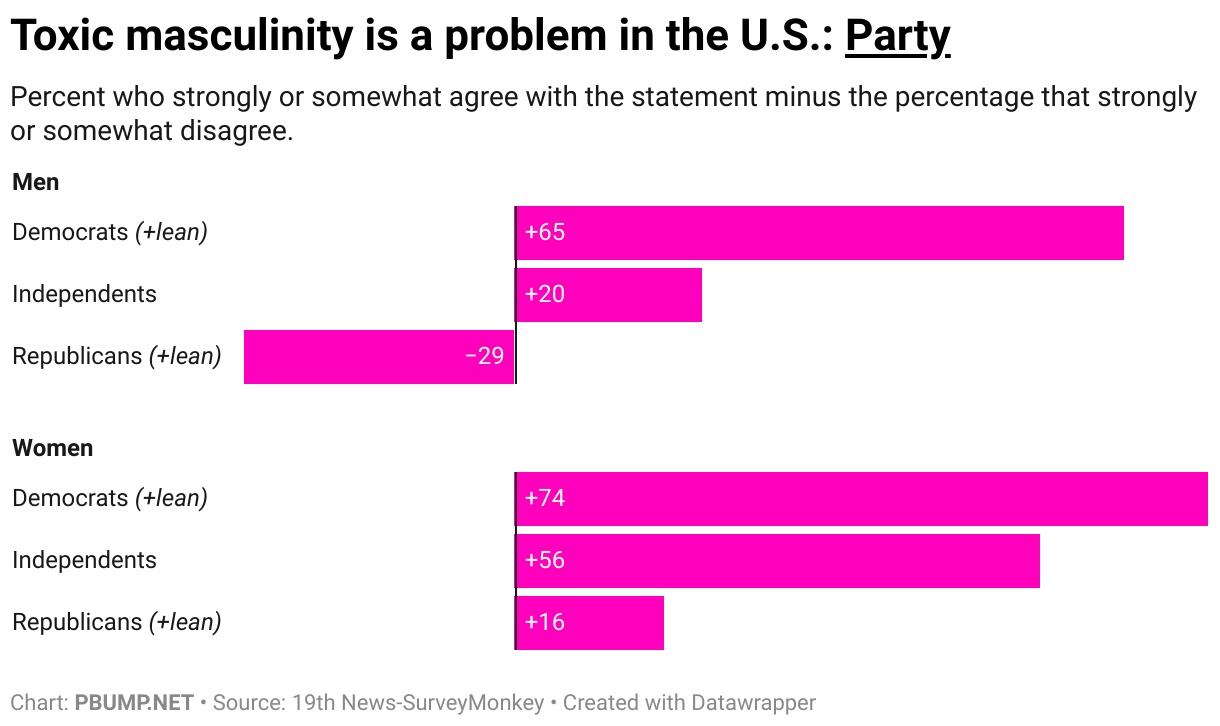
The same holds by party. Notice, though, that Republican women are more likely to agree that toxic masculinity is a problem than to disagree with that idea.

Overlapping these responses, White, married evangelical men are among those most likely to say that they disagree that toxic masculinity is a problem. Make of that what you will.

When we look at the results by generation, we see a decline in agreement among millennial and Gen X respondents among both men and women, though women remain much more likely to agree with the idea than men regardless of age group.

Diving even deeper into the crosstabs — meaning, I must note, that we’re increasing margins of error — we see some interesting splits by age and race. Black men, for example, are generally likely to agree that toxic masculinity is a problem at consistent levels. White and Hispanic men, though, are not.

This chart also supports the “Gen X is the most reactionary generation” narrative — particularly among White men.

You will notice that I have not spent time here actually adjudicating claims about toxic masculinity or even its definition. Neither did the poll. For the most part, it’s beside the point.

I will note, though, that the group most likely to say they disagreed somewhat or strongly with the assertion that toxic masculinity is a problem in the U.S. was Republican men. The group second most likely to say so? 2024 Trump voters.

Photo: Artifacts from the Women’s Equality National Monument. (National Archives)

Sorry about your luck, 24 million Trump voters

It has been the case since Donald Trump’s first tenure as president that he wants to slice the size of the federal workforce. During his period in the political wilderness (also known as the Biden administration), his allies, led by his first-term Office of Management and Budget director Russ Vought, put together a hefty document that included recommendations for sweeping layoffs. When Trump returned to office in January, bringing Vought with him, he and his team (then including Elon Musk) began indiscriminately laying off federal employees.

All of which is to say that the administration’s recent declarations that the shutdown allows them to slash the federal workforce are not Trump and Vought suddenly seizing upon a new idea. Instead, the shutdown offers a pretext for doing what they wanted to do anyway, to shift some of the blame for something that hasn’t proven too popular.

The same holds for other elements of the administration response to the shutdown. It’s a disruption in government that is also letting a team that has demonstrated its indifference to rules about spending and management lean into the punitive responses it has always sought.

Consider an announcement from Vought that he made on Musk’s social media platform on Wednesday.

Vought identified 16 states as targets of billions of dollars of cuts. The states below, to be precise.

Perhaps that map reminds you of something. Well, allow me to put a fine point on it.

These states also include a number of the country’s most populous. In fact, nearly 4 in 10 Americans live in states that Vought has announced will be the targets of cuts.

These are also states that contribute disproportionately to the nation’s gross domestic product.

The targeted states received $191 billion more in government services than they paid in taxes in 2023. Non-targeted states received much more in government spending, receiving $1.1 trillion more than they paid.

These sorts of things are generally abstractions to the president. So let’s put it in terms he might appreciate a bit more. While most of his voters live in non-targeted states (as do most of those who voted for Kamala Harris last year), nearly a third of 2024 Trump voters — some 24 million — live in states targeted for cuts.

The cuts Vought has presented are modest (in the scale of the federal government) and he frames them in a way that Trump voters are unlikely to oppose. But if Vought means spending from the bipartisan infrastructure bill, he’s talking about impeding money that often went to building and improvement projects, not whatever Republicans think of when they think of “Green New Deal” spending.

In other words, it’s very likely that Trump’s base will feel the negative effects of the administration’s partisan attacks. And not for the first time.

Photo: Russ Vought at the White House, March 2019. (White House/Flickr)

Digging deep on the presidential electorate

After every federal election, Pew Research Center conducts an incredibly useful bit of polling: asking Americans what they did on Election Day and validating that those who reported voting were actually registered voters. It takes a few months for the analysis to be completed, but the result is one of the most useful and detailed assessments of the electorate — and the non-voter pool — that is publicly available. Think exit polls, but more reliable.

I’ve used this analysis (the 2024 iteration of which was published in June) in the past to evaluate how Donald Trump’s base has evolved since the 2016 election. But after seeing a social-media post this week (which I’ll share in a moment), I realized that there’s a lot more information that can be presented to help explore how the 2024 election unfolded.

I came up with a little game. Below is a blank scatterplot, a chart that contrasts the margin of support in the presidential race (from more Democratic at left to more Republican at right) with the percentage of voters a particular demographic group constituted last year.

I know that’ complicated, so let me just explain what to do. Figure out what percentage of the electorate were White men last year and what margin they preferred the Democratic (Kamala Harris) or Republican (Trump) candidate in the election. If you think that they were 100 percent of voters and split evenly between Harris and Trump, you’d be wrong. But you’d click/tap right at the top center of the chart — at the place where 100% of the electorate meets zero on the left-right spectrum. If you think they were 50 percent of voters and backed Trump by 50 points, you’d tap/click at the intersection of the second horizontal line down and the third vertical line from the left.

That’s confusing, too. So just try it.

Where did White men fall among all voters in 2024?

Once you do, it tells you how close you were. Was the actual value where you thought it would be?

Now try to guess where the values for Black voters (all of them, not just men) landed last year.

Where did Black voters fall among all voters in 2024?

Contrast that with the values for White evangelical Protestant voters.

Where did Evangelical voters fall among all voters in 2024?

Why that comparison? Because it was a post from my former colleague Perry Bacon that inspired this experiment.

The number of white evangelicals backing Harris in 2024 is around the same as Black voters backing Trump. (15 percent of the group).

Perry Bacon (@perrybaconjr.bsky.social) 2025-09-28T13:55:00.671Z

You’ll notice that his point is about shares of voters for Harris and Trump, not voters overall. We can test that, too. (Note the change in the question below.)

Where did Black voters fall among Democratic voters in 2024?

We can run the same experiment for years past, given that Pew’s been doing this since 2016.

Where did Black voters fall among all voters in 2016?

The Pew data encapsulates an enormous range of demographic groups, particularly in more recent years. (There are some caveats I mostly elide here; feel free to go read the methodology in detail.)

Where did Hispanic voters fall among all voters in 2024?

At the bottom of this article is a version of the scatterplot that lets you compare demographics and years directly. One thing you might want to play around with is how voting shifted by age. For example, try your hand at how young voters voted in 2024…

Where did voters under 30 fall among all voters in 2024?

…versus 2016.

Where did voters under 30 fall among all voters in 2020?

And then compare that with older voters.

Where did 65 and older fall among all voters in 2024?

One demographic group I found interesting to consider, given the amount of attention that has been paid to it over the past few years, is Jewish Americans. Where do you estimate their support lands on our chart?

Where did Jewish voters fall among all voters in 2024?

Anyway, here’s the whole thing. Lots of categories and cross-tabulations to explore. There are some gaps in the data for 2020 and (more often) 2016, so if a dot doesn’t show up on the chart for some combination, that’s likely why.

SELECTION

COMPARISON

Find something particularly surprising? Let me know on social media or by email!

Photo: Balloon drop at the 1972 Republican convention. (National Archives)

How Trumpworld inflates the perceived danger of the left

It is stipulated at the outset that there have been gruesome acts of political violence in recent months that appear to have been motivated by hostility to right-wing politics or the administration. This is not really contestable and rarely seriously contested. There is, in fact, violence on the political left.

It is also the case, though, that right-wing political violence has been much more common in recent years. This is not a useful bit of information to the Trump administration, which actively seeks to ignore or bury it. The administration, like Trump himself, is committed to presenting political violence as centrally if not entirely a function of the left — obviously in part because doing so provides a rationalization for the administration to crack down on the president’s political opponents. Trump’s been champing at the bit to deploy the military against protesters, a desire so obvious that questions about his doing so were part of Pete Hegseth’s confirmation hearings to serve as Defense Secretary.

Over the weekend, Trump announced on social media that he would be directing the (since-confirmed) Hegseth to “provide all necessary Troops to protect War ravaged Portland, and any of our ICE Facilities under siege from attack by Antifa, and other domestic terrorists.” He further “authoriz[ed] Full Force, if necessary” — apparently giving the military a green light to shoot at the purported “terrorists”.

Why Portland? Well, that’s an interesting story that reflects one of the central ways that Trump and his allies convince the right that there’s an imminent threat — a tactic so convincing that it apparently convinced Trump, too.

Bad reporting

In mid-June 2020, I noticed something weird about Fox News’s coverage of the racial-justice protests that had emerged in response to the killing of George Floyd: they were often accompanied by footage of violence or vandalism that had actually occurred more than a week prior. Tucker Carlson (then still a Fox host), Sean Hannity and Laura Ingraham were incorporating footage into their shows that had been recorded in late May. The reason for doing so wasn’t subtle; they (and Trump, who was president) hoped to suggest that a firm hand was needed to keep the lunatic left under control.

It didn’t work. But what I couldn’t have anticipated then was that Fox would still be using that footage five years later.

For a moment, Trump seemed to waver on his threat to send troops to Portland. In an interview with NBC’s Yamiche Alcindor, he described a conversation he’d had with Oregon’s governor.

“I said, ‘Well wait a minute, am I watching things on television that are different from what’s happening? My people tell me different,’ ” Trump said of the conversation. “They are literally attacking and there are fires all over the place…it looks like terrible.”

Well, yes, Man Who Has Access to the Breadth of Federal Intelligence Gathering. What you saw on TV was in fact not what was happening at the moment in Portland.

So what had Trump seen? Given his tendency to stay tuned to Fox News we can make some educated guesses.

Trump made his pledge to send troops to Portland on Saturday morning. On Friday, Fox News had several segments in which purported violence in the city was shown.

One featured Tricia McLaughlin, a Homeland Security official who often appears on cable shows. As she was discussing an executive order Trump signed, the channel showed b-roll of events in Portland.

Sept. 26, 2025. (Internet Archive)

You will notice, though, that the footage was not timestamped for any date in September. Instead, they showed an encounter apparently involving tear gas that occurred back in June … and footage from protests in July 2020.

In the next hour, they ran the same playbook. Former House Speaker Newt Gingrich was on, talking about how dangerous the left was next to footage of Portland violence from July 2020.

Sept. 26, 2025. (Internet Archive)

If this is what Trump was seeing, one can see how he might have been confused about the timeline (particularly if he wasn’t wearing his glasses). You can also see how the average Fox News viewer might be under the impression that Portland is a violent hellscape.

Particularly given the extent to which Fox News otherwise frames its coverage. The McLaughlin interview, for example, included a graphic purporting to show arrests of “antifa-aligned left-wing violent extremists” across the country — a series of events across the country that would seem to bolster Trump’s anti-antifa (is there a more concise way to say that?) executive order.

Fox News still, Sept. 26, 2025. (Internet Archive)

But the graphic is not only conflating arrests of protesters with “violent extremists,” it’s looping those purported extremists in with the category “antifa” — presenting people who oppose the administration’s actions with the sort of extremism that Trump is targeting. It’s an exaggeration almost as egregious and obvious as the use of vandalism footage from 2020.

Bad data

On Sunday, deputy White House press secretary Abigail Jackson took a different tack in suggesting that the left was uniquely dangerous. She shared a story from Axios with the useful headline, “Study: Left-wing terrorism outpaces far-right attacks for first time in 30 years.”

Jackson summarized the headline as “left-wing terrorism climbs to 30-year high,” a claim at odds with the graphic that accompanied the link in her social-media post. The number of attacks in 2022 was higher than the number this year, for example, though the 2025 numbers are only through July 4.

Perhaps you noticed something else striking about that chart! Here, take a closer look in case you didn’t.

Yellow is left-wing attacks. Gray is right-wing attacks. Knowing that, is your assessment of the problem the same as Jackson’s?

If we get rid of the stacked columns, the difference is even more obvious. The blue/left-wing line does finally emerge from the shadow of the right-wing mountain range … at least through July 4.

If we look at the three-year average of these events, we get a better picture of what’s been happening in the U.S. Yes, left-wing attacks (as measured by the Center for Strategic and International Studies) have been rising since the mid-2010s. But, in about the same period, right-wing terrorism began to skyrocket.
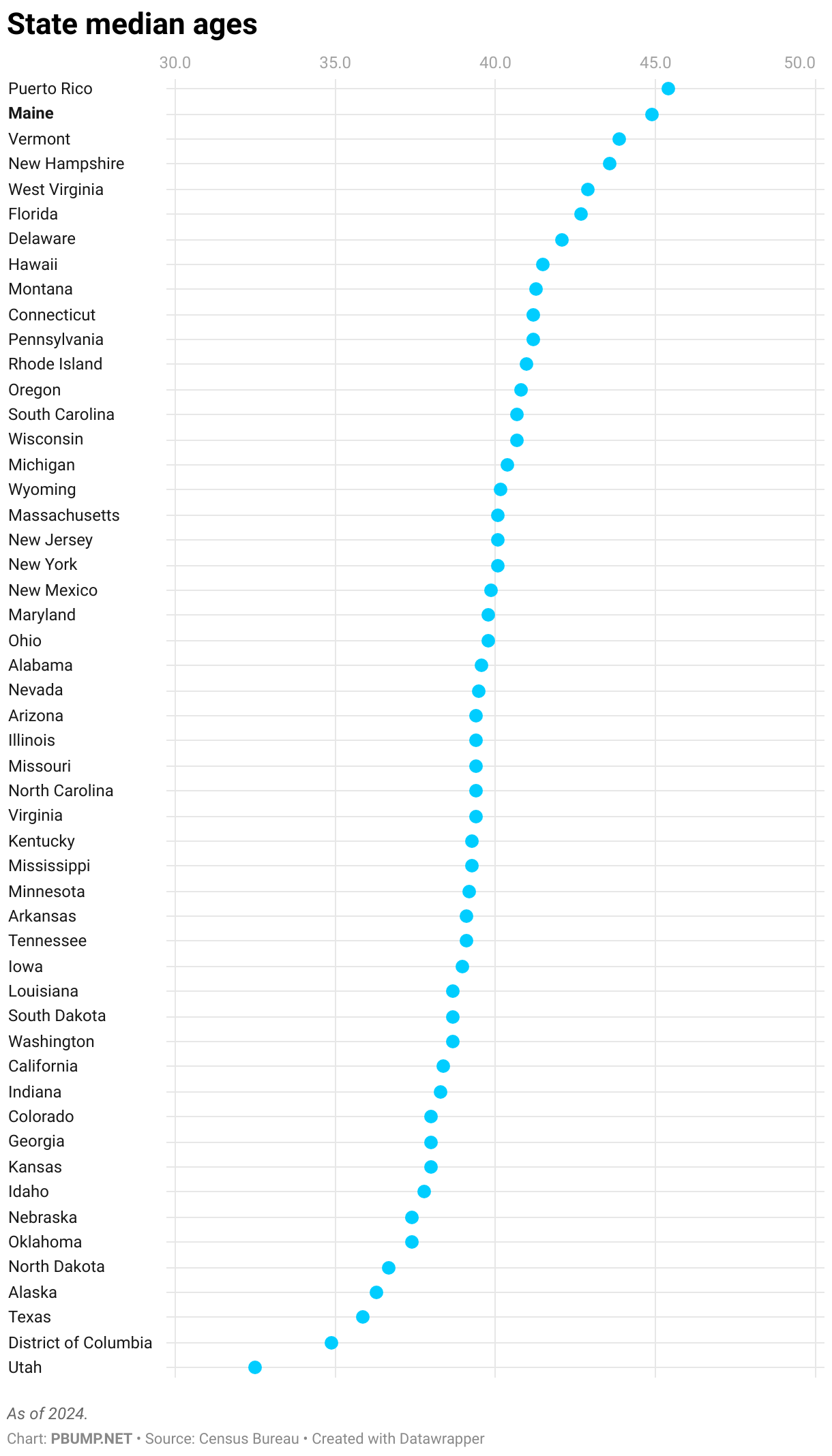
The researchers’ finding about the emerging gap between left- and right-wing attacks depends on the idea that there has been only one right-wing attack this year, the assassination of Minnesota Democrat Melissa Hortman. There has been a “striking” decline in right-wing terrorism, they write, allowing left-wing attacks to have become more common.

Explanations for the drop are “speculative,” they note, but they do offer a possibility: “many traditional grievances that violent right-wing extremists have espoused in the past—opposition to abortion, hostility to immigration, and suspicions of government agencies, among others—are now embraced by President Trump and his administration.” Put another way, the White House has gobbled up the right-wing fringe, meaning there’s less reason for fringe actors to use terrorism to effect their desired outcomes.

This is not the story the administration and its allies want to tell, though. So they center not on the fact that there have been four times as many right-wing as left-wing attacks in the past decade but on the determination that there have been five times as many left-wing attacks this year — since five is five times one.

And if you aren’t convinced that the left is more dangerous, just wait until you see what people were doing in Portland five years ago.

Photo: Trump watches himself on Fox News at the White House, June 27, 2025. (White House/Flickr)
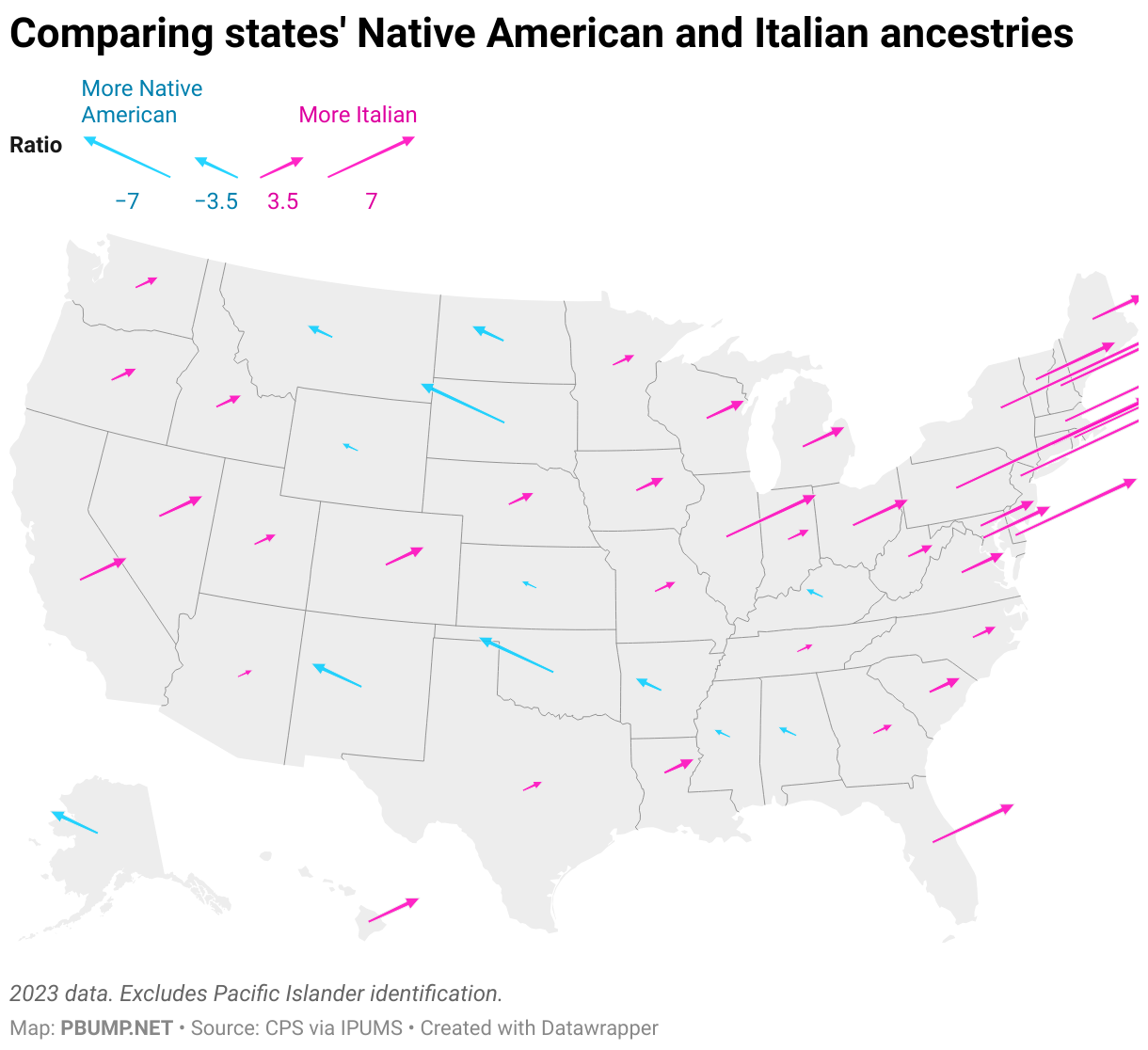
Update: After this was published, it became clear that Trump hadn’t given up on his idea of invading Portland, so I tweaked the language I’d originally used.

The hat generator returns

Back in, oh, 2015 or 2016, I made a tool that let Washington Post readers create their own versions of Donald Trump’s signature baseball hats. After a while and after a change in The Post’s content-management system, it stopped working. I sort of forgot about it.

I have since remembered it. And, tonight, I got an email from someone asking if it was still around. So I figured I’d fix it. Here it is.

When you generate the image, you can just right-click / press-and-hold to save it and do whatever you want with it. I wash my hands of the whole thing.

Photo: Trump in Daytona. (White House/Flickr)

Taking Tylenol

“DON’T GIVE TYLENOL TO YOUR YOUNG CHILD FOR VIRTUALLY ANY REASON”

I don’t remember why we brought our two-year-old son all the way into Brooklyn to see the doctor. We were living way out near Connecticut at the time and traveling to downtown Brooklyn had to have taken at least an hour, if we were lucky. But his first pediatrician was there, the doctor who, when we showed up a few days after our son’s premature birth in an utter, tear-streaked shambles, had told us exactly what we needed to hear: You guys need to relax. He was always calm and never riled and, given that our son was running a high fever and that this was still new to us, calm and unriled was no doubt worth an hour in the car.

When we got there, another doctor was on duty. His bedside manner was not as reassuring, but he was a doctor and our son was seen and given ibuprofen to reduce his fever and that was about what we could hope for. So we scooped up our son and headed for the elevator, to the parking garage under the building so we could head home.

As we walked into the garage, my son started to seize. His little body twitched and his eyes rolled back and the panic that had spurred us to drive to Brooklyn suddenly soared into outer space. Our son had lost control, was doing something I did not know could happen and something that I did not know what could happen next.

Writing this now, six years later, I feel that panic. I tear up. That day, it was far worse, sheer terror — for us and no doubt for the people who were in the elevator we commandeered in our rush back up to the doctor. I remember their stunned faces watching me holding my tiny, convulsing son. They probably thought what I thought, that he was on the brink of death. But they, at least, weren’t his father.

We got back to the doctor’s office and pushed through the waiting room, interrupting the doctor as he was talking with other parents. (Parents who probably also still remember this moment vividly! I can’t imagine how I would have reacted if, after the pediatrician in that first visit told us to relax, some other father had burst in with a baby having a seizure.) The doctor noticed my son’s lips turning blue, put him on oxygen and summoned an ambulance.

That, thank God, was as bad as it got. My son stirred and regained control of himself. We got to the hospital where they simply kept an eye on him for a bit and, in a few hours, we went home.

What we learned (and wished we’d learned sooner) was that small children can sometimes have what are called febrile seizures, seizures that stem from fevers. In essence, the fever that results from a body’s fight against illness can, in small kids, short-circuit the connection between the brain and everything else. If the temperature rises too quickly, it can trigger a seizure. You do have to watch for the sorts of dangers that accompany any seizure, but, over the long run, the risk from such events is low. So are the chances it happens; my son hasn’t had another seizure since, nor has his brother. (Febrile seizures are believed to have a genetic component.)

Of course, the absence of further events may also be because we aggressively treat fevers as they emerge. Switching between ibuprofen and acetaminophen (the active ingredient in Tylenol) every few hours helps control fevers and reduce the possibility of spikes.

Or so it has been explained to me by doctors, to whom I defer on such issues. I will opt for the opinion of people who went to medical school and have spent decades helping children get well on questions about the wellness of my children.

That day, April 20, 2019, was the most terrifying day of my life. Perhaps using Tylenol to combat the fever wouldn’t have prevented the seizure; maybe using it in the future didn’t prevent other ones. But since we began treating high fevers by alternating Advil and Tylenol, I have not since held my child’s limp body in my arms as I wonder if he is going to die. I choose to follow the guidance offered by that experience over the insistences of a guy posting his opinions on social media.

Photo: The view from the doctor’s office on the day it happened. The quote, of course, is from the president.

All the president’s bogeymen

Immigration and Customs Enforcement regularly publishes data on the people being held at its detention facilities. Considered over time, those numbers are revealing. It is now the case, for example, that there are more ICE detainees being held in ICE custody who have not been charged with a crime than there are convicted criminals or people with pending charges — almost certainly the first time in the organization that’s been the case.

That’s because, until Jan. 20, 2025, ICE mostly did what President Donald Trump insists it is now doing: targeting criminal immigrants within the country’s borders. A far larger proportion of ICE detainees who’d been stopped by Customs and Border Protection — meaning primarily people stopped directly at the border as they sought entry into the U.S. — were people with no criminal convictions or charges.

Since Trump took office, though, that’s changed. First, the number of people being stopped at the border has dropped as fewer immigrants are seeking entry into the U.S. But, more importantly, ICE is spending a lot more money and energy scooping up non-criminal immigrants. A year ago, only about 3 percent of the people in ICE detention who didn’t have pending criminal charges or a conviction had been arrested by ICE. Now, more than half have.

The year-over-year change since last September is stark. The percentage of immigrants with criminal convictions who’ve been arrested by ICE is up about 80 percent. The percentage of immigrants with no convictions or pending charges who’ve been targeted by ICE is up nearly 2,000 percent.

Again, this is not generally what the president and his allies promised during the 2024 campaign. While the president did at times say that a second Trump administration would identify and deport every immigrant living in the country illegally — a group that is itself determined by vague and disputed boundaries — far more often he promised America that he would target the really bad guys, the criminals who he insisted were running rampant in the U.S., wantonly committing horrible acts of violence. But it turns out that people who are seeking permanent residency by following the rules are a lot easier to arrest and it turns out that the administration is more interested in the number of arrests than the target of them, so here we are. Trump told his base that immigrants were criminals and tasked his subordinates with arresting as many of them as possible, even if they turned out not to be criminals at all.

You likely noticed, though, that the image at the beginning of this article featured not an immigrant or an ICE officer but former FBI director James Comey, pictured in happier times and with a different president. Perhaps you see the throughline, but I’ll put a fine point on it anyway.

Comey, too, is the center of a narrative about his supposedly criminality that has been stoked and tended for years within the pro-Trump media bubble. He is not as sympathetic a victim as an immigrant parent seized outside his kid’s school, certainly, but the pattern is the same. Comey was presented as a nefarious force within the U.S. and a lawbreaker and, Trump’s base having accepted that, he is now being targeted for prosecution by the federal government.

I’ll take a moment here to note that, just as many of the non-criminal immigrant detentions are waved away as justified because those immigrants didn’t arrive on valid visas, Trump allies will and do insist that Comey’s prosecution is warranted given his actions. According to the federal indictment, Comey made false claims during congressional testimony. But legal observers from Lawfare to Fox News contributor Andrew McCarthy view the charges as weak if not entirely contrived.

The way in which the indictment was obtained does little to counteract that perception. With the statute of limitations on Comey charges winding down, Trump publicly demanded that his attorney general move forward on targeting his opponents. A new acting U.S. attorney — someone who’d served as his personal counsel — was put in place and the indictment pushed forward. The official she replaced had declined to seek charges, almost certainly because of the weakness of the case.

What’s striking about the Comey indictment is that, even on its own terms, it is contrived. Trumpworld loathes Comey because it holds him responsible for the investigation into Russian interference in the 2016 presidential election, one of the central irritations of Trump’s political career. But this indictment doesn’t allege that Comey invented the Russia probe or anything even close to that. It is, at best, a multi-bumper bank shot, one that satisfies the right’s desire to see Comey in the crosshairs rather than its desire to prove Trump’s view of the Russia probe correct. (Trump and his allies have tried this before, with other targets. It didn’t work out.)

Instead, we have a pattern in which someone or some group of people is offered up by Trump as an enemy of the American people. This is credulously accepted by his base, in part because the pro-Trump media universe scrambles to dig up sketchy support for his claims in its eternal race for the right’s most valuable currency, attention. Trump’s presentations about the world rely on widespread incuriosity and accepting bad-faith actors at face value, but because those values have been so effectively inculcated on the right there’s little value for right-wing politicians or media personalities to contradict his claims.

The president said these were bad guys and so a third of Americans accept and celebrate that they are bad guys. The president says these people should be in jail so his administration works to put them in jail, to cheers from the base that he’s deceiving and the political allies who aren’t interested in disagreeing. And when it turns out that the presentation was wrong or that things weren’t quite as clear-cut as had been suggested, blame always falls somewhere outside of the Oval Office.

Trump’s us-vs.-them worldview will never run out of thems because what makes someone a them isn’t anything they’ve done — it’s simply that Trump has decided they are not an us.

Photo: FBI Director Robert Mueller acknowledges applause during President Barack Obama’s remarks in the Rose Garden of the White House, June 21, 2013. (White House Photo by Pete Souza/Flickr)

The doomerism spiral

Democracy depends on optimism.

This isn’t simply a pithy slogan; it’s an encapsulation of what it means to agree that power should be allocated by consensus. If you cast a vote for a candidate who loses, you need to be optimistic both that you will not be punished for your vote and that a candidate of your choosing can win in the future. While elections are generally zero-sum contests between two sides, democracy isn’t. It and the government it undergirds are fluid things, shifted subtly by changes in how power is allocated.

Or, at least, that’s usually been the case. The second presidency of Donald Trump is not approaching his accession as a temporary granting of power by the people. Instead, it’s treating Trump as the central executor of all federal decision-making, a treatment that is prompting very little pushback from Congress or the Supreme Court, the entities specifically designed to keep his power in check.

Americans don’t like what Trump is doing. His approval rating is underwater, with more than a 10-point gap between those who approve of his presidency and those who disapprove.

For those who disapprove, though, there’s no immediate consolation, no possibility that he will suddenly face condemnation from the Republican-controlled House and Senate. Even the idea that Democrats will retake control of the House in next year’s midterms isn’t a salve for the most concerned critics of the president. Democrats won the House in 2018, but it didn’t change the trajectory of Trump’s first presidency much. Not to mention that the president and his allies appear to be doing everything in their power to cement his control over the government, from creating new House maps that disadvantage Democrats to threatening to assume federal control over local elections.

In February, YouGov asked Americans to evaluate how important certain things were to American democracy and whether those things were actually present in our system. At that point — early in Trump’s effort to remake the country during his second term — about 9 in 10 respondents said that having open and fair elections was very or somewhat important to democracy. Only about three-quarters, though, said they strongly or somewhat agree that our national elections are open and fair.

Less than half of Americans strongly agree that national elections are fair. Among American adults under the age of 30, only about a third did. That’s a striking amount of pessimism about the system.

A few years ago, I spoke with Princeton University political scientist Corrine McConnaughy. She reinforced that the central aim of a democratically elected government is to “solve problems in ways that people feel represented enough, they feel their voice heard enough.” Participants in the system need to “understand that losing today is not losing tomorrow” — an optimism that depends on the idea that there’s a possibility of future victory.

It seems likely that one reason younger Americans are relatively pessimistic about national elections is that many of them have internalized pessimism about American systems. The candidate who was most effectively mobilizing young voters in the past decade was Sen. Bernie Sanders (I-Vt.), someone whose argument — as Marquette University political scientist Julia Azari once put it to me — is that “the system does not work for you.”

“And,” Azari added, “younger people were saying, ‘Yeah, that’s right. It doesn’t.’ “

There are lots of manifestations of this frustration among younger voters, including the backlash Joe Biden saw during his own presidency. Some of that centered on America’s role in Israel’s invasion of Gaza; much of it was a function of younger Americans being less engaged in party politics. A lot of it centered on rising prices, still the most obvious driver of Donald Trump’s reelection overall.

Younger Americans also have a pessimism about the country that extends beyond politics. Yes, past presentations of the economic status of millennial Americans in particular overstated how disadvantaged they have been relative to older generations. (With all due modesty, this is a point I made in my 2023 book.) But recent measures of economic confidence have seen sharp declines among young people. A poll conducted by NORC for the Wall Street Journal determined that 7 in 10 Americans think the American dream no longer holds true or never did.

That sentiment is encapsulated for many young people in the difficulty of purchasing a home — a milestone that is hampered by student loan debt, high interest rates and a graying U.S. population that bought homes decades ago in which they still live. Data from the American Community Survey conducted by the Census Bureau shows that millennials are less likely to own a home at this stage in their lives than were members of the baby boom generation or Gen X.

Why wouldn’t Americans who grew up experiencing the Great Recession and/or covid — and who saw politics dominated by older Americans and little responsiveness within the democratic system even before this second Trump administration — be pessimistic about the nation’s future? Why wouldn’t some fragile subset of that group collapse into cynicism and irony and toxic online communities where they can feel some sense of power?

I would argue that this is the reason that it’s important for Trump’s political opponents to demonstrate that they are challenging him if they hope to gain power. The president is not simply a political opponent, he is the manifestation of the system and someone who is actively trying to reshape the system so that it excludes those with whom he disagrees. Compromise is valuable in a democracy, but in the moment any talk of compromising with Trump shows a willingness from Democratic leaders to maintain the system that’s triggering so much pessimism. Two of the people that have energized the left the most in the past few years are Rep. Alexandria Ocasio-Cortez (D-N.Y.) and Zohran Mamdani — politicians who are not part of the traditional Democratic Party and who present their politics through an optimistic lens. They are young; they argue that change is possible, if not inevitable.

Over the short term, presenting a credible, optimistic vision of the future will help disarm doomers who foresee nothing but collapse. Over the long term, reinforcing optimism — where- and however possible — is essential for maintaining democracy itself.

How that’s done, of course, is the challenge.

Photo: B-17s flying over Germany in World War II. (National Archives)