The Americans who see ‘toxic masculinity’ as a problem — and those who don’t

Every year, the site 19th News conducts a national poll with SurveyMonkey that focuses heavily on issues of gender in American politics and society. This may not sound interesting, much less remarkable, but it is. Polling isn’t cheap, meaning that media outlets tend to focus on issues in the news and electoral questions. Detailed analyses of more fundamental aspects of the U.S. is invaluable.
I’m going to focus on a set of questions evaluating how Americans view gender roles, as the headline promises, but I do want to share one striking finding: Most Americans know someone who is non-binary. That includes half of Republicans and Republican-leaning independents! (Those independents are what the “+lean” parenthetical below means.) Black Americans are the racial group least likely to know someone who identifies that way.

As you might expect, given broader trends in LGBTQ identity, younger Americans are more likely than older Americans to know someone non-binary. But even 4 in 10 Americans aged 80 and over say they do.

So when Donald Trump was running all those ads in 2024 attacking Kamala Harris as being for “they/them,” half of his voters could visualize someone they knew who he was talking about.
As I mentioned, the poll also presented respondents with a series of statements, asking whether they agreed or disagreed with the sentiment. On net — that is, subtracting those who disagreed from those who agreed — Americans didn’t agree with the idea that society would benefit from young people having families before pursuing career accomplishments or other goals.
But they did agree on net that families are better off when a parent stays home with kids and (to a much narrower degree) that there would be a benefit to returning to traditional gender roles. That’s because men were 23 points more likely to agree than to disagree, while women were 17 points more likely to disagree than to agree.

I want to drill down on the idea that toxic masculinity is a problem for society, something that was viewed with net agreement to the same extent that having a parent stay home was. (By the way, most of those who said one parent should stay home said it should be whichever parent wants to stay home.)
Here, again, there was a wide gender gap, with women being far more likely to agree it’s a problem than were men. There was also a partisan gap: Democrats and independents overwhelmingly see toxic masculinity as a problem while Republicans are more likely to disagree than agree that it is.
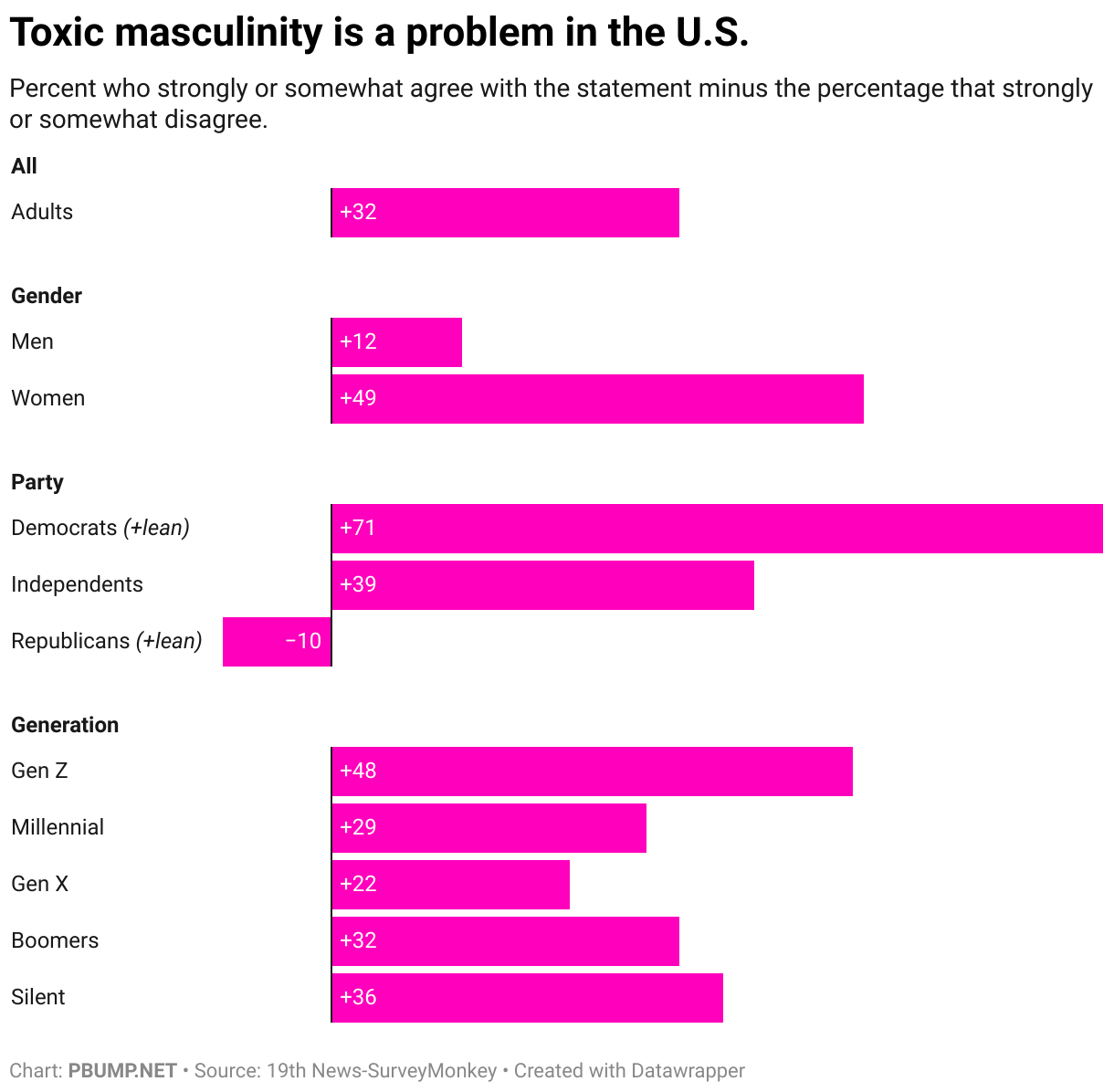
Generationally, it’s the youngest and oldest Americans who agree on net that toxic masculinity as a problem. More on that in a moment.
Broken out by race and gender, White men are the least likely to agree on net that toxic masculinity is a problem, save for men from other racial groups than those identified by the pollsters. In each racial group, women were more likely to agree on net than were the men.

The same holds by party. Notice, though, that Republican women are more likely to agree that toxic masculinity is a problem than to disagree with that idea.
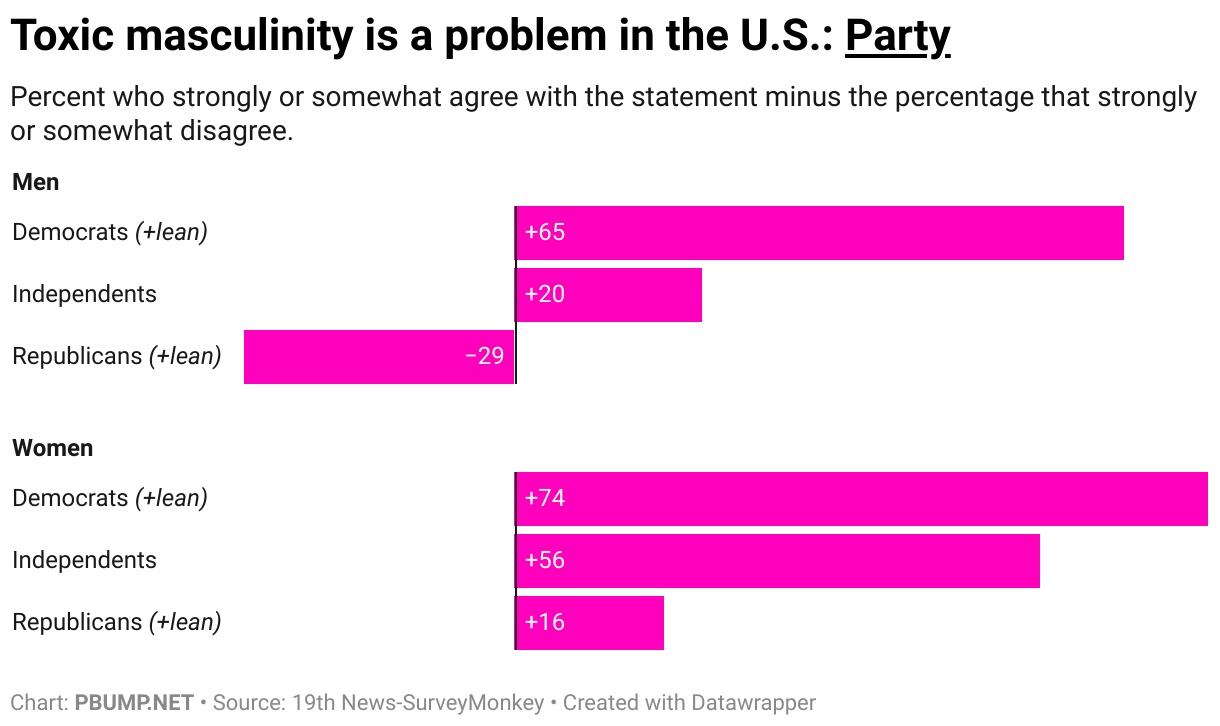
Overlapping these responses, White, married evangelical men are among those most likely to say that they disagree that toxic masculinity is a problem. Make of that what you will.
When we look at the results by generation, we see a decline in agreement among millennial and Gen X respondents among both men and women, though women remain much more likely to agree with the idea than men regardless of age group.

Diving even deeper into the crosstabs — meaning, I must note, that we’re increasing margins of error — we see some interesting splits by age and race. Black men, for example, are generally likely to agree that toxic masculinity is a problem at consistent levels. White and Hispanic men, though, are not.

This chart also supports the “Gen X is the most reactionary generation” narrative — particularly among White men.
You will notice that I have not spent time here actually adjudicating claims about toxic masculinity or even its definition. Neither did the poll. For the most part, it’s beside the point.
I will note, though, that the group most likely to say they disagreed somewhat or strongly with the assertion that toxic masculinity is a problem in the U.S. was Republican men. The group second most likely to say so? 2024 Trump voters.
Photo: Artifacts from the Women’s Equality National Monument. (National Archives)