Television (audience) is not real life

The debate over the shelving of Jimmy Kimmel’s show isn’t really a debate, as such.
Kimmel has been a target of Donald Trump’s for years, with the president predicting in July that the ABC host’s show would be next to be shut down after CBS cancelled Stephen Colbert. Last week, Kimmel made a joke about Republican eagerness to pin the Charlie Kirk assassination on the left, a joke that suggested obliquely that the shooter was a Trump supporter. The head of the FCC suggested that ABC should face sanction for the comments. A conglomerate that owns a number of local ABC stations — and is seeking a merger that requires FCC approval — announced that it would not air Kimmel’s show. ABC itself quickly followed suit.
In other words, Trump got his desired outcome. And Trump desired that outcome because he pays far more attention to television personalities and ratings than nearly anyone else in America.
Analysis from the Hollywood Reporter published last year found that ABC had a median primetime viewership age a bit lower than CBS in 2024 — 65.6 years versus 67.8. The youngest audience that tuned into ABC’s primetime lineup was for “NBA Primetime,” which enjoyed a youthful median age of 57.1 years.
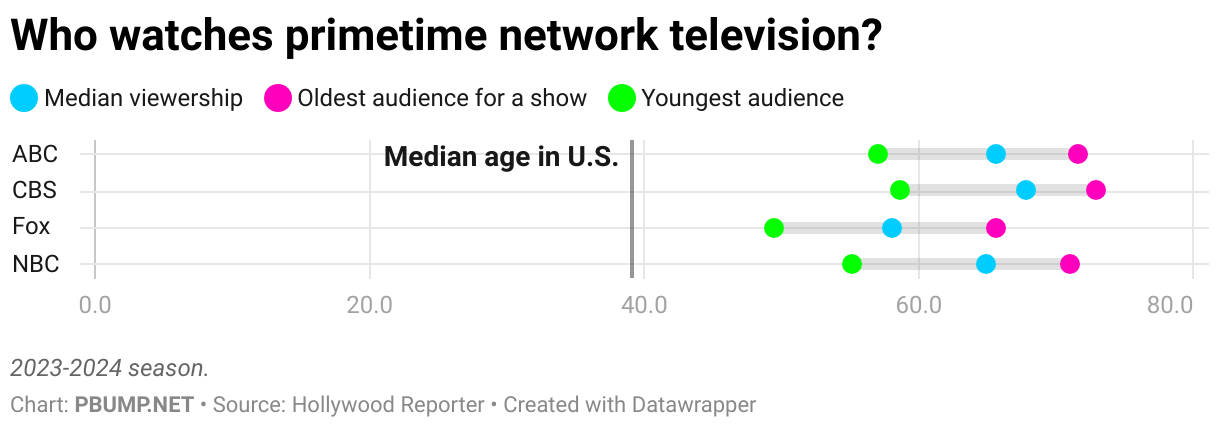
If you’re curious, as I was, three-quarters of the U.S. population were younger than 57.1 years old in 2024.
After poking around a bit, I couldn’t find current estimates of the median age of Kimmel’s viewership. But that’s OK, since I mostly wanted to talk about the news.
Last month, Pew Research Center published its most recent analysis of the audiences of different news organizations. It included estimates of the median ages of people who cite specific sources as regular sources of news.

You’ll notice that two of the news sources with the youngest audiences are Spanish-language and targeting a Hispanic audience. That is almost certainly not unrelated to the fact that Hispanics are generally younger than Americans overall — and substantially younger than White Americans.

You may also have noticed on the original chart that the two oldest audiences were for right-wing outlets: Breitbart and Newsmax. This, too, is related to the racial demographics above.
But let’s consider those numbers in the context I offered for “NBA Primetime.” Univision has the youngest median audience, landing right at the median age of Americans overall. Every other news source skews older, with a larger percentage of the population younger than its median age than older. (According to Pew’s calculations, that is.)

It’s also true that most of these news sources have audiences that skew older than the voter pool in the U.S. That pool of people is older than the population overall, since you have to be 18 in order to vote. Using Census Bureau estimates of the voting-age population, we see that most of the news sources still skew older than the universe we’re looking at.
The point here is simple: These audiences are not particularly representative of the population. And that’s even before we consider actual viewership, which is a small subset of any particular age group. Kimmel averaged 1.7 million viewers last year, one-half of one percent of the U.S. population.
Targeting Kimmel shouldn’t really be viewed about sending him a message to constrain his dangerous, popular commentary. It is instead about sending a message to the rest of us.
Photo: Something that is unidentifiable to anyone under the age of 40. (National Archives)